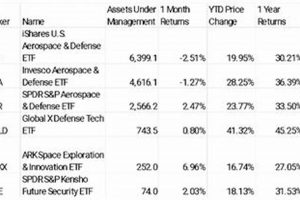
This exchange-traded fund (ETF) focuses on providing investment results that, before fees and expenses, correspond generally to the total return performance of the S&P Aerospace & Defense Select Industry Index. It offers investors targeted exposure to companies involved in the aerospace and defense sectors of the U.S. market. Such firms typically include those engaged in the research, development, manufacture, and support of military aircraft, space equipment, and defense systems.
The appeal of this type of investment vehicle stems from the potential for consistent growth driven by government spending, technological advancements, and geopolitical factors. Historically, allocations to the aerospace and defense industries have been considered relatively stable due to long-term government contracts and the essential nature of national security. Benefits may include diversification within a specific sector and relatively easy access to a basket of companies that might be difficult to invest in individually.
The subsequent analysis will delve into the specific holdings, performance metrics, risk factors, and expense ratios associated with this investment product. Furthermore, a comparative evaluation against similar investment options in the market will be provided. Finally, consideration will be given to the potential impact of macroeconomic trends and regulatory changes on its future performance.
Tips for Evaluating an Aerospace and Defense Sector ETF
Before allocating capital, a thorough understanding of the specific nuances of aerospace and defense sector investment vehicles is crucial. These tips aim to provide a structured framework for informed decision-making.
Tip 1: Examine the Underlying Index: Scrutinize the methodology of the S&P Aerospace & Defense Select Industry Index, against which the fund’s performance is benchmarked. Understanding the index’s constituent selection criteria and weighting scheme is fundamental.
Tip 2: Analyze Expense Ratios: Compare the expense ratio of this fund with similar ETFs. Lower expense ratios generally translate to higher net returns over the long term. Consider the impact of fees on overall performance.
Tip 3: Assess Portfolio Holdings: Review the ETF’s top holdings and their respective allocations. Diversification within the aerospace and defense sectors is vital. A concentration in a few specific companies can increase risk.
Tip 4: Evaluate Performance Metrics: Analyze historical performance, including returns, volatility (as measured by standard deviation), and Sharpe ratio. Compare these metrics against relevant benchmarks and peer funds.
Tip 5: Understand Geopolitical Risks: Recognize that geopolitical events and government policies significantly impact the aerospace and defense industries. Stay informed about political and economic developments that could affect the sector.
Tip 6: Consider Dividend Yield: Evaluate the dividend yield of the ETF. While not the primary focus, a consistent dividend stream can contribute to total return and provide a cushion during market downturns.
Tip 7: Monitor Fund Flows: Observe the fund’s asset flows. Significant inflows or outflows can indicate investor sentiment and potentially impact the fund’s performance.
Adherence to these guidelines can facilitate a more comprehensive assessment of investment suitability. A disciplined approach to due diligence is paramount in navigating the complexities of sector-specific investments.
The subsequent section will address potential risks associated with investments in this area, and suggest strategies for mitigating those risks.
1. Sector Specificity

Sector specificity, in the context of the SPDR Aerospace & Defense ETF, defines the investment scope. The ETF focuses exclusively on companies within the aerospace and defense industries. This concentration provides targeted exposure but also introduces unique considerations due to the sector’s distinct characteristics.
- Government Contracts & Regulation
A primary facet is the heavy reliance on government contracts. Companies in this sector frequently derive a significant portion of their revenue from government agencies, making them subject to political decisions, budget allocations, and regulatory oversight. For the SPDR Aerospace & Defense ETF, this implies that its performance is closely tied to defense spending policies and international relations. Any shift in governmental priorities or a reduction in defense budgets could directly impact the profitability and stock prices of the constituent companies.
- Technological Advancement & R&D
The aerospace and defense industries are characterized by constant technological innovation. Substantial investments in research and development (R&D) are necessary to maintain a competitive edge. Companies in this ETF are often at the forefront of advanced engineering, materials science, and cybersecurity. Investors should recognize that success hinges on continued innovation and adaptation to emerging technologies. Failures in R&D or the inability to keep pace with technological changes can negatively impact the financial performance of individual companies and, consequently, the ETF as a whole.
- Geopolitical Risk
Geopolitical events and international tensions play a crucial role. Increased global instability or conflicts can lead to higher demand for defense products and services, benefiting companies within the ETF. Conversely, periods of peace and disarmament can result in reduced demand. This sensitivity to geopolitical forces introduces a level of uncertainty and volatility that investors must consider. Examples include heightened tensions in specific regions leading to increased defense spending or arms sales, boosting the revenue of companies held in the ETF.
- Barriers to Entry
The aerospace and defense sector has substantial barriers to entry. The technical expertise, high capital requirements, and stringent regulatory approvals make it difficult for new companies to compete. This limits the number of players in the market and can lead to greater stability and predictability in the long term. However, it also concentrates power in the hands of a few established companies, potentially increasing the risk of anti-competitive behavior or a lack of innovation driven by complacency. The SPDR Aerospace & Defense ETF benefits from this barrier to entry as it primarily invests in well-established firms with proven track records.
The sector specificity of the SPDR Aerospace & Defense ETF demands a nuanced understanding of the industry’s drivers and risks. While it provides focused exposure to a potentially lucrative market, investors must be aware of the unique factors that influence its performance, including government spending, technological innovation, geopolitical events, and barriers to entry. Diligence in analyzing these factors is critical for assessing the suitability of this investment.
2. Index Tracking
Index tracking is a fundamental characteristic of exchange-traded funds (ETFs), including the SPDR Aerospace & Defense ETF. It defines the methodology by which the fund seeks to replicate the performance of a specific benchmark index. For this fund, the target is the S&P Aerospace & Defense Select Industry Index. Understanding the nuances of this tracking mechanism is crucial for evaluating the ETF’s investment approach and potential performance.
- Replication Strategy
The fund employs a replication strategy to mirror the index’s composition. This typically involves holding the same securities as the index, in similar proportions. The SPDR Aerospace & Defense ETF aims to minimize tracking error, which is the difference between the fund’s returns and the index’s returns. For example, if the S&P Aerospace & Defense Select Industry Index rises by 1%, the fund strives to achieve a similar increase, accounting for expenses and minor discrepancies.
- Index Composition and Weighting
The S&P Aerospace & Defense Select Industry Index determines the holdings of the ETF. The indexs methodology dictates which companies are included and their respective weightings. These criteria typically involve factors such as market capitalization, liquidity, and sector representation. For instance, companies with larger market capitalizations within the aerospace and defense industries may have a higher weighting in the index, thus a larger allocation in the ETF’s portfolio. It is important to recognize that sector-specific weightings within the benchmark index also play a role.
- Tracking Error
Tracking error is an unavoidable aspect of index tracking. Several factors contribute to this discrepancy, including fund expenses, transaction costs, and differences in timing between the fund’s trading and the index’s price movements. While the SPDR Aerospace & Defense ETF strives to minimize tracking error, it is essential for investors to monitor this metric to assess the fund’s effectiveness in replicating the index’s performance. A higher tracking error may indicate inefficiencies in the fund’s management or challenges in replicating the index.
- Portfolio Turnover
Portfolio turnover refers to the rate at which the fund buys and sells securities. Index tracking ETFs generally have lower turnover rates compared to actively managed funds, as they primarily aim to maintain the index’s composition. However, periodic rebalancing of the index can lead to portfolio adjustments. For the SPDR Aerospace & Defense ETF, turnover may occur when the S&P Aerospace & Defense Select Industry Index rebalances, requiring the fund to buy or sell securities to align with the updated index weights. Excessive turnover can increase transaction costs and negatively impact returns.
These facets of index tracking collectively shape the investment characteristics of the SPDR Aerospace & Defense ETF. By closely replicating the S&P Aerospace & Defense Select Industry Index, the fund aims to provide investors with exposure to the aerospace and defense sectors. However, it is crucial to understand the underlying mechanics of index tracking and the potential for tracking error to make informed investment decisions. The interplay between replication strategy, index composition, tracking error, and portfolio turnover ultimately determines the fund’s ability to deliver returns that closely match those of its benchmark index.
3. Expense Ratio
The expense ratio is a critical factor for investors to consider when evaluating the SPDR Aerospace & Defense ETF. It represents the annual cost of operating the fund, expressed as a percentage of the fund’s average net asset value. This ratio directly impacts the returns that investors receive, making it essential to understand its components and implications.
- Definition and Calculation
The expense ratio encompasses all management fees, administrative fees, and other operational costs incurred by the fund. It is calculated by dividing the total annual expenses by the fund’s average net asset value. A lower expense ratio indicates that the fund is more cost-efficient to operate. For instance, an expense ratio of 0.35% means that for every $1,000 invested, $3.50 is used to cover the fund’s operating expenses each year. This amount reduces the overall return that the investor receives.
- Impact on Returns
The expense ratio directly reduces the total return of the SPDR Aerospace & Defense ETF. While the fund aims to replicate the performance of its underlying index, the actual returns experienced by investors will always be lower due to the deduction of expenses. Over the long term, even small differences in expense ratios can significantly impact investment outcomes. For example, if the ETF generates a gross return of 10% and has an expense ratio of 0.35%, the net return to the investor is 9.65%. The impact is magnified over many years due to compounding.
- Comparison with Peers
It is essential to compare the expense ratio of the SPDR Aerospace & Defense ETF with those of similar ETFs in the aerospace and defense sector. A higher expense ratio compared to peer funds may indicate that the fund is less cost-competitive. Conversely, a lower expense ratio can be a significant advantage, attracting investors seeking cost-effective exposure. Analyzing the expense ratios of competing ETFs provides a benchmark for assessing the value proposition of the SPDR Aerospace & Defense ETF.
- Fixed vs. Variable Costs
The expense ratio typically comprises both fixed and variable costs. Fixed costs are those that remain relatively constant regardless of the fund’s size, such as administrative fees. Variable costs, on the other hand, may fluctuate with the fund’s assets under management or trading activity. Understanding the breakdown of these costs can provide insights into the fund’s operational efficiency and its ability to manage expenses as it grows. For example, economies of scale can potentially lead to lower expense ratios as the fund’s assets increase.
In summary, the expense ratio is a crucial metric for evaluating the SPDR Aerospace & Defense ETF. A lower expense ratio enhances the fund’s attractiveness by maximizing net returns to investors. While the expense ratio is not the only factor to consider, its direct impact on returns underscores its importance in the investment decision-making process. Comparison with peer funds and an understanding of its components provide valuable context for assessing the overall value of the ETF.
4. Portfolio Composition

The composition of the holdings within the SPDR Aerospace & Defense ETF is a primary determinant of its performance and risk profile. Understanding the specific companies included and their respective weightings offers crucial insights into the ETF’s investment characteristics.
- Top Holdings and Sector Allocation
The ETF’s portfolio typically exhibits concentration among a few leading firms within the aerospace and defense sectors. These may include companies such as Boeing, Lockheed Martin, and RTX Corporation (formerly Raytheon Technologies). The allocation to these top holdings significantly influences the overall performance of the ETF. For instance, a significant decline in the stock price of one of these major constituents can disproportionately impact the ETF’s returns. Examining the percentage allocation to each sector within aerospace and defense, such as aircraft manufacturers, defense contractors, and space technology companies, further refines the understanding of its exposure.
- Diversification within the Sector
While the ETF focuses on the aerospace and defense industries, the level of diversification within these sectors is important. A portfolio heavily concentrated in a narrow subset of companies or sub-sectors exposes the ETF to idiosyncratic risks. For example, an ETF primarily invested in companies focused on military aircraft production may be more vulnerable to changes in government defense spending priorities compared to one with broader exposure across various sub-sectors, including space exploration, cybersecurity, and commercial aviation.
- Impact of Index Rebalancing
The SPDR Aerospace & Defense ETF tracks the S&P Aerospace & Defense Select Industry Index, which undergoes periodic rebalancing. This process involves adjusting the weightings of existing holdings and potentially adding or removing companies from the index. These rebalancing events can impact the ETF’s portfolio composition, influencing its performance and risk characteristics. For example, if a company’s market capitalization increases significantly, its weighting in the index will also increase, potentially leading to a larger allocation within the ETF’s portfolio. Conversely, companies that underperform may see their weightings reduced.
- Overlap with Other ETFs
Assessing the degree of overlap between the SPDR Aerospace & Defense ETF and other ETFs in an investor’s portfolio is essential for managing overall risk and diversification. If an investor already holds ETFs with exposure to similar companies or sectors, adding this ETF may not provide significant diversification benefits. Analyzing the common holdings and their respective weightings can help investors avoid unintended concentration risks and optimize their asset allocation. Portfolio overlap analysis tools can facilitate this assessment.
In conclusion, the portfolio composition of the SPDR Aerospace & Defense ETF provides valuable insights into its investment strategy, risk profile, and potential performance drivers. By examining the top holdings, sector diversification, index rebalancing effects, and potential portfolio overlap, investors can make more informed decisions about whether this ETF aligns with their investment objectives and risk tolerance. A detailed understanding of these components is crucial for effectively incorporating this ETF into a broader investment portfolio.
5. Dividend Yield

Dividend yield, in relation to the SPDR Aerospace & Defense ETF, represents the annual dividend income an investor can expect to receive relative to the ETF’s share price. It is a key metric for assessing the income-generating potential of the fund and its attractiveness to income-seeking investors.
- Calculation and Interpretation
The dividend yield is calculated by dividing the annual dividend per share by the current share price, expressed as a percentage. For the SPDR Aerospace & Defense ETF, this figure reflects the aggregate dividends paid out by the companies within the fund’s portfolio. A higher dividend yield may indicate that the ETF is undervalued or that the underlying companies are generating significant profits and returning them to shareholders. Conversely, a lower yield could suggest that the companies are reinvesting their earnings for growth or that the ETF’s share price is relatively high. Consider an example: if the ETF pays out $2.00 per share annually and the share price is $100, the dividend yield is 2%. This means that for every $100 invested, an investor receives $2 in dividends annually.
- Influence of Sector Characteristics
The aerospace and defense sector traditionally does not command high dividend yields compared to more mature sectors, such as utilities or consumer staples. Companies in this industry often prioritize capital expenditure for research and development, acquisitions, and other growth initiatives rather than distributing a large portion of their earnings as dividends. Therefore, the dividend yield of the SPDR Aerospace & Defense ETF is typically moderate, reflecting the capital-intensive nature of the underlying businesses. The yield may be more attractive during periods when defense spending is high and profitability is strong.
- Comparison with Competing ETFs and Benchmarks
When evaluating the SPDR Aerospace & Defense ETF, comparing its dividend yield with those of similar ETFs and broader market benchmarks provides valuable context. If the ETF’s dividend yield is significantly higher than its peers, it may suggest a unique characteristic, such as a different investment strategy or a portfolio of higher-yielding companies within the sector. Conversely, a lower yield may indicate a greater emphasis on capital appreciation or a more conservative investment approach. Comparing the yield to benchmarks like the S&P 500 helps investors gauge whether the ETF offers a competitive income stream relative to the overall market.
- Impact of Dividend Policies of Underlying Companies
The dividend yield of the SPDR Aerospace & Defense ETF is directly influenced by the dividend policies of the companies within its portfolio. If these companies increase their dividend payouts, the ETF’s dividend yield will likely increase as well. Conversely, if companies reduce or suspend their dividends, the ETF’s yield will decrease. Monitoring the dividend policies of key holdings, such as Boeing, Lockheed Martin, and RTX Corporation, provides insight into the potential future dividend income from the ETF. Factors such as company profitability, cash flow, and strategic priorities will shape their dividend decisions.
In conclusion, dividend yield is a relevant, but not necessarily primary, consideration when evaluating the SPDR Aerospace & Defense ETF. While the aerospace and defense sector may not offer the highest yields, understanding the calculation, influences, and comparative context of the dividend yield provides valuable information for investors seeking income-generating investments. Ultimately, assessing the dividend yield in conjunction with other factors, such as growth potential and risk, will contribute to a well-informed investment decision.
6. Risk Factors
Investment in the SPDR Aerospace & Defense ETF necessitates careful consideration of inherent risk factors. These risks directly influence the ETF’s performance and potential returns. A primary risk stems from the concentration of the ETF’s holdings within a specific sector. Economic downturns or shifts in government policy that disproportionately affect aerospace and defense companies can lead to significant declines in the ETF’s value. Dependence on government contracts is another key risk. Aerospace and defense firms often rely on government spending for a substantial portion of their revenue. Changes in defense budgets, political priorities, or international relations can directly impact the profitability and stock prices of these companies, thus affecting the ETF’s performance. For example, a major arms treaty could lead to reduced defense spending, negatively impacting the ETF.
Geopolitical risks present further challenges. Global instability, armed conflicts, or shifts in international alliances can create both opportunities and risks for aerospace and defense companies. Increased demand for defense products may boost revenue for some firms, while escalating tensions can disrupt supply chains and increase operational costs. The competitive landscape also poses a risk. The aerospace and defense sector is characterized by intense competition and technological innovation. Companies that fail to innovate or adapt to changing market conditions may lose market share, impacting their profitability and stock prices. Furthermore, regulatory risks, including export controls and compliance requirements, can constrain the operations and profitability of aerospace and defense firms. Violation of these regulations can result in significant penalties and reputational damage.
In summary, evaluating the risk factors associated with the SPDR Aerospace & Defense ETF is essential for making informed investment decisions. Concentration risk, dependence on government contracts, geopolitical instability, competitive pressures, and regulatory compliance each contribute to the overall risk profile of the ETF. Investors must carefully weigh these factors against their investment objectives and risk tolerance to determine whether this ETF is a suitable addition to their portfolio. Understanding these risks is not merely academic; it is a practical necessity for navigating the complexities of sector-specific investments and protecting capital.
7. Historical Performance

The historical performance of the SPDR Aerospace & Defense ETF (XAR) provides essential insights into its behavior under varying market conditions and its sensitivity to specific industry trends. Examining past returns, volatility, and drawdowns allows for a more informed assessment of its potential future behavior. The ETF’s historical performance is directly tied to the performance of the underlying companies within the aerospace and defense sectors. Factors such as geopolitical events, government spending policies, and technological advancements have historically exerted significant influence on the ETF’s returns. For example, increased defense spending during periods of international conflict has typically led to positive performance for XAR, while budget cuts or arms control agreements have often resulted in negative performance. Understanding these cause-and-effect relationships is crucial for interpreting the historical data.
A key component of evaluating XAR is comparing its historical performance against relevant benchmarks, such as the S&P 500 or other aerospace and defense indices. This comparison provides a measure of the ETF’s relative strength and its ability to outperform or underperform the broader market. For instance, during periods of economic expansion, XAR may outperform the S&P 500 due to increased demand for commercial aviation and aerospace products. Conversely, during economic downturns, XAR may underperform due to reduced defense spending and a decline in commercial air travel. Analyzing historical performance also involves assessing the ETF’s volatility, typically measured by standard deviation. A higher standard deviation indicates greater price fluctuations and a higher level of risk. Investors must consider their risk tolerance when evaluating the ETF’s historical volatility and its potential for significant price swings.
In conclusion, the historical performance of the SPDR Aerospace & Defense ETF serves as a valuable tool for investors seeking to understand its potential risks and rewards. While past performance is not indicative of future results, it offers critical insights into the ETF’s sensitivity to market conditions, its relative strength compared to benchmarks, and its historical volatility. A thorough analysis of historical data, combined with an understanding of the underlying factors that drive the aerospace and defense sectors, is essential for making informed investment decisions. This analysis, however, must acknowledge that unforeseen events and shifts in the economic or political landscape can always disrupt established patterns, presenting a challenge to relying solely on past performance as a predictor of future outcomes.
Frequently Asked Questions Regarding the SPDR Aerospace & Defense ETF
This section addresses common inquiries concerning the SPDR Aerospace & Defense ETF (XAR), offering clarity on its investment objectives, strategies, and potential risks.
Question 1: What is the investment objective of the SPDR Aerospace & Defense ETF?
The ETF seeks to provide investment results that, before fees and expenses, correspond generally to the total return performance of the S&P Aerospace & Defense Select Industry Index. It offers targeted exposure to companies primarily involved in the aerospace and defense sectors.
Question 2: What types of companies are included in the SPDR Aerospace & Defense ETF?
The ETF invests in companies engaged in the research, development, manufacturing, and support of military aircraft, space equipment, and defense systems. These firms typically derive a significant portion of their revenue from government contracts and are subject to regulatory oversight.
Question 3: What are the primary risk factors associated with investing in the SPDR Aerospace & Defense ETF?
Key risk factors include concentration risk due to its sector-specific focus, dependence on government contracts, geopolitical risks, intense competition within the industry, and regulatory compliance challenges. Economic downturns and shifts in government policy can significantly impact the ETF’s performance.
Question 4: How does the SPDR Aerospace & Defense ETF track its benchmark index?
The ETF employs a replication strategy, holding the same securities as the S&P Aerospace & Defense Select Industry Index in similar proportions. While it aims to minimize tracking error, factors such as fund expenses and transaction costs can lead to slight deviations from the index’s returns.
Question 5: What is the expense ratio of the SPDR Aerospace & Defense ETF, and how does it impact returns?
The expense ratio represents the annual cost of operating the fund, expressed as a percentage of its average net asset value. This ratio directly reduces the total return of the ETF, as it covers management fees, administrative fees, and other operational costs. A lower expense ratio generally translates to higher net returns for investors.
Question 6: How has the SPDR Aerospace & Defense ETF performed historically compared to the S&P 500?
The ETF’s historical performance has varied depending on market conditions, geopolitical events, and government spending policies. During periods of increased defense spending or economic expansion, it may outperform the S&P 500. Conversely, during economic downturns or budget cuts, it may underperform. Historical performance is not indicative of future results.
In summary, the SPDR Aerospace & Defense ETF offers targeted exposure to a specific sector but carries inherent risks tied to government policies, geopolitical factors, and industry competition. A thorough understanding of these aspects is crucial for informed investment decisions.
The subsequent discussion will present a comparative analysis against similar ETFs.
Concluding Remarks on the SPDR Aerospace & Defense ETF
This exploration has provided a detailed overview of the SPDR Aerospace & Defense ETF, encompassing its investment objective, portfolio composition, risk factors, expense ratio, and historical performance. This fund offers targeted exposure to the aerospace and defense sectors, making it susceptible to sector-specific risks and heavily reliant on government policies. A thorough understanding of these dynamics is crucial for investors considering this ETF as part of their portfolio.
Careful consideration of individual investment goals, risk tolerance, and a comprehensive analysis of the aerospace and defense industries are paramount before allocating capital. Continued monitoring of macroeconomic trends, geopolitical events, and regulatory changes will be essential for managing this investment effectively. The information presented herein is for informational purposes only, and does not constitute investment advice.