An education in aerospace engineering provides a robust foundation for a diverse range of professional pursuits. Graduates acquire specialized knowledge in areas such as aerodynamics, propulsion, materials science, and structural analysis. This skillset enables them to design, develop, and test aircraft, spacecraft, satellites, and related systems. The curriculum often includes advanced mathematics, physics, and computer science, cultivating strong analytical and problem-solving abilities.
The significance of this academic background extends beyond the aerospace sector. The rigorous training fosters adaptability and critical thinking, highly valued in numerous industries. Historically, advancements in aerospace have spurred innovations in other fields, from medical imaging to consumer electronics, demonstrating the broad impact of aerospace engineering principles. The specialized knowledge acquired is also crucial for national security, scientific exploration, and technological advancement.
The following sections will explore potential career paths, necessary skills, salary expectations, and educational pathways within the field. Furthermore, it will address the ongoing evolution of the industry and the future opportunities available to those with expertise in this domain.
Graduating with a degree focused on aerospace engineering opens numerous doors. Successfully navigating the job market requires strategic preparation and a clear understanding of industry expectations.
Tip 1: Cultivate a Strong Technical Foundation: Master core subjects like aerodynamics, propulsion, and structural analysis. Employers seek candidates with demonstrable expertise in these areas, often assessed through coursework and project experience.
Tip 2: Gain Practical Experience Through Internships: Secure internships with aerospace companies, research institutions, or government agencies. This provides invaluable hands-on experience and exposure to real-world engineering challenges.
Tip 3: Develop Proficiency in Relevant Software: Learn and become proficient in industry-standard software such as CAD (Computer-Aided Design), CAM (Computer-Aided Manufacturing), and simulation tools. Proficiency demonstrates immediate value to potential employers.
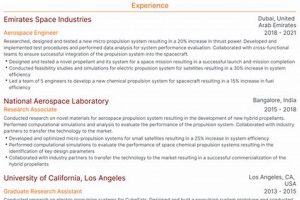
Tip 4: Highlight Project Experience: Showcase design projects, research involvement, and team collaborations on resumes and during interviews. Quantify achievements whenever possible, demonstrating the impact of contributions.
Tip 5: Network Actively: Attend industry conferences, career fairs, and networking events. Connect with professionals in the field and build relationships that can lead to job opportunities.
Tip 6: Consider Advanced Degrees: Explore pursuing a master’s degree or doctorate to specialize in a particular area of interest. Advanced degrees can lead to research positions or specialized engineering roles.
Tip 7: Tailor Resumes and Cover Letters: Customize application materials for each specific job. Highlight relevant skills and experiences that align with the job requirements and the company’s mission.
These strategies, when diligently applied, can significantly enhance the likelihood of securing a fulfilling and impactful career. They also require constant adaptation and learning.
Moving forward, the article will offer a more detailed exploration of the typical roles that graduates fill and the skills needed to excel in those positions.
1. Design Engineering

Design engineering represents a cornerstone of career possibilities for individuals completing a degree in aerospace engineering. The ability to conceptualize, model, and refine aerospace systems is a direct outcome of the core curriculum. This skillset is essential for creating efficient and safe aircraft, spacecraft, and related technologies. Cause and effect are readily apparent: rigorous training in areas such as aerodynamics, structural mechanics, and materials science directly translates to the ability to design functional and innovative components.
The importance of design engineering stems from its role in translating theoretical knowledge into tangible solutions. Aerospace engineers apply computational tools and engineering principles to develop optimized designs. Consider, for example, the design of a new aircraft wing. Aerospace engineers must analyze airflow patterns, structural integrity, and weight distribution to create a wing that meets specific performance requirements. Design engineers are important in companies, NASA, and many other private companies.
Understanding the connection between this academic background and design engineerings practical application is crucial. It allows prospective students and current engineers to focus their studies and career development on areas that enhance their design capabilities. This understanding is a key element, so individuals can apply what they learned, design functional and innovative components that lead the company to sucess. It is very beneficial for the individual as a team.
2. Research and Development

Research and development (R&D) represents a pivotal avenue for aerospace engineering graduates, offering opportunities to push the boundaries of current technology. This field centers on the investigation of new materials, propulsion systems, aerodynamic designs, and control methodologies. R&D roles demand a strong theoretical foundation coupled with a desire to explore novel solutions to complex engineering challenges.
- Materials Science Innovation
Aerospace R&D frequently involves the creation and testing of advanced materials. This includes developing lighter, stronger, and more heat-resistant materials for aircraft and spacecraft. For example, researchers may investigate new composite materials or alloys that can withstand extreme conditions during atmospheric re-entry. This contributes directly to improved vehicle performance and safety.
- Propulsion System Advancement
Improving propulsion systems is a constant focus of aerospace R&D. This can involve exploring novel engine designs, alternative fuels, or electric propulsion systems. For instance, research into scramjet engines aims to enable hypersonic flight, while studies of ion propulsion are intended to enhance the efficiency of long-duration space missions. These advancements are critical for future space exploration and high-speed transportation.
- Aerodynamic Efficiency
Aerodynamic research aims to optimize the shape and design of aircraft and spacecraft to reduce drag and increase lift. This may involve wind tunnel testing, computational fluid dynamics simulations, and flight testing of new designs. For example, researchers may study the use of winglets or blended wing bodies to improve fuel efficiency and reduce emissions. Such developments directly impact the environmental footprint of air travel.
- Autonomous Systems Development
Aerospace R&D also encompasses the development of autonomous systems for aircraft and spacecraft. This includes designing algorithms for autonomous navigation, collision avoidance, and mission planning. For example, researchers are working on autonomous drones for surveillance and delivery applications, as well as autonomous spacecraft for exploring distant planets. This work contributes to increased safety, efficiency, and accessibility of aerospace technologies.
These research and development facets highlight how an aerospace engineering background provides the tools to innovate and solve critical problems. These endeavors are essential for maintaining technological leadership and addressing future challenges in aerospace and related industries. The work propels technological progress and answers problems.
3. Testing and Analysis
Testing and analysis are integral components of the activities undertaken by individuals with an aerospace engineering degree. These processes validate designs, identify potential weaknesses, and ensure the safety and reliability of aerospace systems. A strong foundation in engineering principles enables graduates to conduct and interpret a variety of tests, ranging from component-level assessments to full-scale flight simulations. The cause-and-effect relationship is clear: design decisions directly impact performance, and rigorous testing reveals whether the intended effects are achieved. Without comprehensive testing and analysis, the risk of catastrophic failure increases exponentially, potentially jeopardizing human lives and valuable assets.
The importance of testing and analysis is demonstrated through numerous real-world examples. The development of new aircraft wings involves extensive wind tunnel testing to validate aerodynamic performance and structural integrity. Similarly, spacecraft components undergo vibration, thermal, and vacuum testing to simulate the harsh conditions of space. Finite element analysis, a computational technique, is used to predict stress concentrations and optimize designs before physical prototypes are even constructed. These processes are necessary to verify that products meet required performance standards and regulatory specifications, and that they will perform during their intended use.
In summary, competence in testing and analysis is a hallmark of a proficient aerospace engineer. The ability to design, execute, and interpret test data is indispensable for ensuring the safety, reliability, and performance of aerospace vehicles and systems. This skill not only addresses the technical and practical requirements of the job but serves a vital role in the success of the entire industry. It also ensures that all safety regulations are followed during and after testing and analysis.
4. Project management

Project management offers a substantial pathway for individuals possessing an aerospace engineering degree. The skills honed through aerospace engineering curricula, such as systems thinking, problem-solving, and technical proficiency, are directly transferable to the management of complex engineering projects. Effective project management ensures that aerospace ventures are completed on time, within budget, and to the required specifications.
- Integration of Engineering Disciplines
Aerospace projects often require the coordinated efforts of multiple engineering disciplines, including aerodynamics, propulsion, structures, and avionics. Project managers with an aerospace engineering background can effectively integrate these diverse areas, ensuring seamless collaboration and optimized project outcomes. For example, a project manager overseeing the development of a new satellite must coordinate the design and integration of solar panels, communication systems, and propulsion units, requiring a broad understanding of aerospace engineering principles.
- Risk Management and Mitigation
Aerospace projects involve inherent risks, ranging from technical challenges to budget overruns and schedule delays. Project managers must identify, assess, and mitigate these risks proactively. An aerospace engineering background provides a framework for understanding the technical risks associated with complex systems and developing effective mitigation strategies. For instance, a project manager overseeing the development of a new rocket engine must anticipate potential issues with combustion instability and implement measures to prevent or address these problems.
- Budget and Resource Allocation
Efficient resource allocation and budget management are critical for the success of aerospace projects. Project managers with an aerospace engineering background can make informed decisions about resource allocation, considering the technical requirements and cost implications of different options. For example, a project manager may need to decide whether to invest in advanced materials for a new aircraft component or opt for a more conventional, cost-effective solution. The background in aerospace allows for an informed choice.
- Regulatory Compliance and Certification
Aerospace projects are subject to stringent regulatory requirements and certification processes. Project managers must ensure that projects comply with all applicable regulations and meet the necessary certification standards. An aerospace engineering background provides a thorough understanding of these regulations and standards, enabling project managers to navigate the certification process effectively. For instance, a project manager overseeing the development of a new aircraft must ensure that it meets all FAA safety requirements and obtains the necessary certifications before entering service.
In conclusion, the principles and practices of project management are directly relevant to “what can you do with an aerospace engineering degree.” Possessing an aerospace engineering degree enhances a project manager’s ability to oversee technically intricate projects. The knowledge of regulatory guidelines, budget management, and integrated engineering creates an advantage in aerospace positions. The importance of this integration is seen across sectors from commercial aviation to defense.
5. Consulting roles

An aerospace engineering degree provides a foundation for consulting roles within the aerospace sector and beyond. The technical expertise acquired through this education enables graduates to offer specialized knowledge and guidance to organizations facing complex engineering challenges. The cause is clear: the rigorous analytical and problem-solving skills honed during studies translate directly into the ability to assess, diagnose, and recommend solutions for diverse technical issues. The importance of consulting stems from its role in optimizing efficiency, improving safety, and driving innovation within aerospace and related industries.
Consulting roles encompass various areas, including design optimization, risk assessment, regulatory compliance, and technology integration. For example, a consultant with an aerospace engineering background may advise an airline on strategies to improve fuel efficiency through aerodynamic modifications or recommend design changes to enhance the structural integrity of an aircraft. Likewise, consultants might assist aerospace manufacturers in navigating complex regulatory requirements or evaluating the feasibility of adopting new technologies. One particular instance involves guiding companies through FAA compliance standards or advising defense contractors on developing cutting-edge drone technology.
In summary, an aerospace engineering degree serves as a valuable asset for those pursuing consulting careers. The technical proficiency combined with an understanding of business principles allows consultants to provide practical and effective solutions to a wide range of challenges. Though the field is competitive and demands excellent communication skills, the expertise developed in obtaining an aerospace engineering degree is essential for consulting and its successful application within the aerospace sector.
Frequently Asked Questions
This section addresses common inquiries regarding career opportunities accessible with an aerospace engineering degree. The following answers aim to provide clarity on potential career trajectories, skill requirements, and industry expectations.
Question 1: Are career options limited to designing aircraft and spacecraft with an aerospace engineering degree?
The career landscape is broader than solely designing aircraft and spacecraft. Opportunities exist in research and development, testing and analysis, project management, and consulting. Furthermore, the analytical and problem-solving skills developed through an aerospace engineering curriculum are applicable in diverse fields such as automotive engineering, renewable energy, and financial modeling.
Question 2: What specific skills are most valued by employers seeking candidates with an aerospace engineering background?
Employers prioritize proficiency in areas like aerodynamics, propulsion, structural analysis, and control systems. Practical experience with industry-standard software such as CAD, CAM, and FEA is highly desirable. Strong communication, teamwork, and problem-solving skills are also essential.
Question 3: Is it necessary to pursue a graduate degree to advance in the aerospace engineering field?
A graduate degree can enhance career prospects, particularly for research-oriented or specialized engineering roles. While not always mandatory, a master’s or doctoral degree can provide a competitive advantage and open doors to advanced positions and higher earning potential.
Question 4: What is the typical salary range for entry-level positions in aerospace engineering?
Entry-level salaries vary based on location, company size, and specific job responsibilities. However, the typical range is competitive compared to other engineering disciplines. Experienced engineers and those with advanced degrees generally command higher salaries.
Question 5: What are the primary industries that employ aerospace engineers?
The aerospace industry, including aircraft and spacecraft manufacturers, is a major employer. Other significant industries include government agencies such as NASA and the Department of Defense, research institutions, and consulting firms. Furthermore, opportunities are present in related fields like automotive engineering and renewable energy.
Question 6: How is the aerospace engineering field evolving, and what are the future opportunities?
The field is undergoing rapid transformation driven by advancements in areas like autonomous systems, electric propulsion, and space tourism. Future opportunities exist in the development of sustainable aviation technologies, the exploration of space, and the integration of artificial intelligence into aerospace systems.
These FAQs offer a brief overview of the many considerations associated with “what can you do with an aerospace engineering degree.” The field requires consistent adaptation, education, and awareness.
The next section will outline actions to consider to maximize opportunities for graduates.
Conclusion
The preceding discussion provides a comprehensive overview of what can you do with an aerospace engineering degree. Opportunities extend beyond traditional roles in aircraft and spacecraft design to encompass research, development, testing, project management, and consulting. Success within these diverse career paths requires a robust technical foundation, practical experience, and continuous professional development.
Prospective and current aerospace engineers should proactively cultivate the necessary skills and seek experiences that align with their career aspirations. As the field continues to evolve, adaptability and a commitment to lifelong learning will be crucial for sustained success. The aerospace engineering field offers considerable impact, so those seeking it should be prepared for challenges to improve our futures.


![Is Caltech Aerospace Engineering Ranking Worth It? [2024] | Innovating the Future of Flight with Reliable Aviation Solutions](https://mixaerospace.com/wp-content/uploads/2026/05/th-337-300x200.jpg "Is Caltech Aerospace Engineering Ranking Worth It? [2024] Innovating the Future of Flight with Reliable Aviation Solutions")