



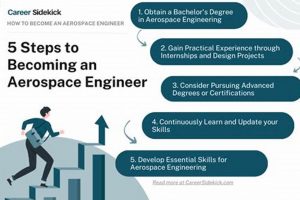
The fundamental requirement for a career in aerospace engineering is a bachelor’s degree in aerospace engineering or a closely related field. This educational foundation provides the necessary knowledge of mathematics, physics, and engineering principles crucial for designing, developing, and testing aircraft and spacecraft.
Obtaining the relevant academic credentials unlocks opportunities for professional advancement and specialization within the aerospace sector. This educational background provides access to entry-level positions and serves as a platform for pursuing advanced studies, such as a master’s or doctoral degree, to focus on specific areas of expertise within the field.
The subsequent sections will elaborate on the specific coursework included in such degree programs, alternative educational pathways into the field, and the advantages of pursuing advanced degrees for career progression and research opportunities.
Guidance for Aspiring Aerospace Engineers
Selecting the correct educational path is paramount for a successful career in aerospace engineering. The following points provide essential guidance for navigating this process.
Tip 1: Prioritize Accreditation. Ensure that the chosen degree program is accredited by ABET (Accreditation Board for Engineering and Technology). Accreditation signifies that the program meets established quality standards and is recognized by employers.
Tip 2: Focus on Foundational Coursework. Strong performance in mathematics, physics, and computer science courses is essential. These subjects form the bedrock of aerospace engineering principles.
Tip 3: Seek Relevant Internships. Practical experience gained through internships in aerospace companies or research institutions provides invaluable real-world exposure and networking opportunities.
Tip 4: Consider a Minor or Specialization. Complementing the core aerospace engineering curriculum with a minor in a related field, such as computer science or materials science, can enhance specialized skills and broaden career options.
Tip 5: Explore Research Opportunities. Participating in undergraduate research projects can deepen understanding of specific aerospace topics and demonstrate a commitment to innovation.
Tip 6: Network with Professionals. Attend industry conferences and workshops to connect with experienced aerospace engineers and learn about current trends and career paths.
Adhering to these guidelines can significantly improve the prospects of securing a fulfilling and impactful career within the aerospace engineering field.
The subsequent section will provide insights into alternative pathways and advanced educational opportunities.
1. ABET Accreditation

ABET accreditation is a critical component of a qualified aerospace engineering degree. Employers within the aerospace industry, governmental agencies, and research institutions often prioritize, or even require, graduation from an ABET-accredited program. This preference stems from the assurance that the curriculum meets specific quality standards established by the engineering profession. These standards encompass a rigorous curriculum, qualified faculty, adequate facilities, and a commitment to continuous improvement.
For example, a company seeking to hire a structural engineer for aircraft design will be more confident in the abilities of a graduate from an ABET-accredited program because the curriculum will have demonstrably covered key principles of structural analysis, materials science, and aerospace design. Similarly, governmental agencies such as NASA rely on ABET accreditation to ensure that the engineers they employ possess the fundamental knowledge and skills required for critical projects, such as spacecraft development and mission planning.
In summary, while not every aerospace engineering position explicitly mandates an ABET-accredited degree, its possession significantly enhances career prospects and demonstrates a foundational level of competence recognized throughout the industry. Selection of an ABET-accredited program is, therefore, a practical and strategic decision for those seeking a successful career in aerospace engineering.
2. Core Curriculum Strength

A robust core curriculum within an aerospace engineering degree program directly impacts an individual’s ability to succeed in the field. The depth and breadth of knowledge acquired through foundational coursework are essential for problem-solving, innovation, and adapting to the ever-evolving landscape of aerospace technology.
- Mathematics and Computational Skills
Proficiency in calculus, differential equations, linear algebra, and numerical methods provides the mathematical toolkit necessary for modeling and simulating complex aerospace systems. For instance, analyzing the trajectory of a spacecraft requires solving differential equations, while designing an efficient airfoil necessitates computational fluid dynamics (CFD) simulations. A weaker foundation in these areas can hinder an engineer’s ability to accurately predict system behavior and optimize designs.
- Fundamentals of Physics
A thorough understanding of classical mechanics, thermodynamics, electromagnetism, and quantum mechanics is critical for grasping the underlying principles governing aerospace phenomena. Understanding fluid dynamics principles, rooted in physics, is crucial for developing efficient aerodynamic designs. A deficiency in physics knowledge can lead to flawed assumptions and inaccurate analyses.
- Aerospace-Specific Disciplines
Courses in aerodynamics, propulsion, structures, flight mechanics, and control systems provide the specialized knowledge required for aerospace engineering practice. Designing an aircraft wing requires a deep understanding of aerodynamics, while developing a rocket engine demands knowledge of propulsion principles. Inadequate exposure to these disciplines restricts an engineer’s ability to contribute effectively to specific aerospace projects.
- Engineering Design and Systems Thinking
Training in engineering design processes, systems engineering principles, and CAD software enables engineers to translate theoretical knowledge into practical solutions. Designing a complete aircraft or spacecraft system necessitates integrating knowledge from various disciplines and considering trade-offs between different design parameters. A lack of design experience can limit an engineer’s ability to create innovative and feasible solutions.
The strength of the core curriculum in an aerospace engineering program fundamentally shapes the graduates preparedness for the demands of the profession. A rigorous curriculum, covering the aforementioned facets, is essential for engineers to effectively analyze, design, and innovate within the aerospace field, ultimately answering the underlying inquiry: an aerospace engineering degree requires a strong core curriculum strength.
3. Practical Experience (Internships)

Practical experience, typically gained through internships, constitutes a vital component of an aerospace engineering education. While a degree provides the theoretical foundation, internships bridge the gap between academic learning and real-world application, significantly enhancing an individual’s preparedness for a career in the field. Securing relevant internships should be a strategic objective for any student pursuing an aerospace engineering degree.
- Application of Theoretical Knowledge
Internships offer the opportunity to apply theoretical knowledge acquired in the classroom to practical engineering problems. For example, a student studying aerodynamics might work on wind tunnel testing or computational fluid dynamics simulations at an aerospace company. This experience solidifies understanding and reveals the nuances of real-world engineering challenges that are not always apparent in textbook examples. This practical application reinforces the value of the underlying degree program.
- Development of Practical Skills
Beyond theoretical application, internships foster the development of practical skills essential for success in aerospace engineering. These skills include proficiency with industry-standard software, familiarity with manufacturing processes, data analysis, and technical report writing. Such skills are difficult to acquire solely through classroom learning. Successfully completing projects and meeting deadlines within a professional environment contributes to confidence and competence.
- Exposure to Industry Culture and Practices
Internships provide invaluable exposure to the culture and practices of the aerospace industry. This includes understanding the dynamics of project teams, navigating organizational structures, and adhering to industry standards and regulations. Observing experienced engineers at work and participating in team meetings provides insights into the professional responsibilities and expectations of an aerospace engineer, refining the focus of academic pursuits.
- Networking and Career Opportunities
Internships offer the opportunity to build professional relationships with engineers and managers within the aerospace industry. These connections can prove invaluable for securing future employment opportunities. Many companies use internship programs as a pipeline for recruiting full-time employees, increasing the likelihood of securing a job after graduation. This highlights the strategic importance of internships in complementing the educational qualifications obtained through an aerospace engineering degree.
The insights gleaned from these internships serve to complement formal education, solidifying the value of the degree and allowing for a more focused application of learned principles. In essence, practical experience attained through internships is not merely supplemental; it is integral to translating theoretical knowledge into practical competence, enriching the academic foundation of the degree and preparing graduates for impactful contributions to the aerospace field.
4. Specialized Knowledge (Minors)

While a bachelor’s degree in aerospace engineering provides a broad foundation, acquiring specialized knowledge through a minor can significantly enhance an individual’s skill set and career prospects. The selection of a suitable minor should align with individual interests and career aspirations, complementing the core aerospace engineering curriculum.
- Computer Science Minor
Aerospace engineering increasingly relies on computational methods for design, analysis, and simulation. A minor in computer science provides expertise in programming, data structures, and algorithms, enabling engineers to develop custom software tools, analyze large datasets, and implement advanced control systems. For example, an aerospace engineer with a computer science minor may develop algorithms for autonomous flight control or create software to analyze data from wind tunnel tests. This enhanced computational proficiency directly contributes to the engineer’s ability to tackle complex aerospace problems, making the degree more versatile.
- Electrical Engineering Minor
Aerospace vehicles incorporate sophisticated electrical and electronic systems for navigation, communication, and control. An electrical engineering minor equips aerospace engineers with knowledge of circuit design, signal processing, and control theory. This expertise is particularly valuable for designing avionics systems, developing sensors, and integrating electrical components into aircraft and spacecraft. Understanding these elements strengthens the overall aerospace engineering competency.
- Materials Science and Engineering Minor
The performance and reliability of aerospace vehicles depend heavily on the properties of the materials used in their construction. A minor in materials science and engineering provides in-depth knowledge of material properties, processing techniques, and failure analysis. This expertise is essential for selecting appropriate materials for aircraft structures, developing high-temperature alloys for jet engines, and designing composite materials for lightweight spacecraft. Knowledge of materials further enhances the value and focus of the aerospace engineering degree.
- Mathematics Minor
A deeper understanding of advanced mathematical concepts can be invaluable for tackling complex aerospace engineering problems. A mathematics minor provides expertise in areas such as differential equations, linear algebra, and numerical analysis. This enhanced mathematical proficiency enables engineers to develop more sophisticated models, optimize designs, and analyze complex systems with greater accuracy. This expertise is useful in all aspects of the aerospace field.
In summary, pursuing a minor in a related field allows aerospace engineers to develop specialized expertise that complements their core knowledge, increasing their versatility and competitiveness in the job market. This targeted knowledge builds upon the foundational elements of “the degree” enabling engineers to contribute more effectively to specific projects and address increasingly complex engineering challenges within the aerospace field. A strategically chosen minor is a strong complement to the required aerospace engineering degree.
5. Advanced Degrees (Master's/PhD)

While a bachelor’s degree serves as the foundational qualification for entering the aerospace engineering profession, pursuing advanced degrees, such as a Master of Science (MS) or Doctor of Philosophy (PhD), can significantly alter career trajectories and professional capabilities. The selection of an advanced degree should align with specific career aspirations and specialized areas of interest within the aerospace field.
- Specialized Knowledge and Skills
Advanced degree programs allow for in-depth exploration of specific aerospace engineering disciplines, such as aerodynamics, propulsion, or structural mechanics. For instance, an MS degree might focus on computational fluid dynamics for improved aircraft design, while a PhD could involve research on advanced composite materials for spacecraft applications. This specialization equips engineers with highly sought-after expertise, enabling them to tackle complex technical challenges and contribute to cutting-edge research.
- Research and Development Opportunities
A PhD in aerospace engineering is often a prerequisite for pursuing careers in research and development within academia, government laboratories, or private industry. PhD programs emphasize independent research, culminating in a dissertation that advances the knowledge base of the field. This research experience equips graduates with the skills to design and conduct experiments, analyze data, and publish scholarly articles, making them well-suited for roles involving innovation and discovery. Example: researching new propulsion technologies, such as hypersonic engines.
- Leadership and Management Roles
While not always a direct requirement, an advanced degree can enhance an individual’s qualifications for leadership and management positions within aerospace organizations. The rigorous coursework and research experience associated with advanced degrees cultivate critical thinking, problem-solving, and communication skills, which are valuable assets for leading teams and managing complex projects. For example, an aerospace engineer with an MS in systems engineering may be better positioned to manage a large-scale aircraft development program.
- Increased Earning Potential
Generally, individuals with advanced degrees in aerospace engineering command higher salaries than those with only a bachelor’s degree. The increased earning potential reflects the specialized knowledge, skills, and experience gained through advanced studies. For example, a senior engineer with a PhD in aerospace engineering may earn significantly more than a colleague with a bachelor’s degree and similar years of experience. The salary differential varies depending on the specific role, industry sector, and geographic location.
In summary, while a bachelor’s degree fulfills the basic requirement of “what degree is needed”, advanced degrees represent a strategic investment for those seeking to specialize, lead research efforts, advance into management roles, and maximize their earning potential within the aerospace engineering profession. The selection of an advanced degree program should be carefully considered based on individual career goals and areas of specialization.
Frequently Asked Questions
The following section addresses common inquiries regarding the educational requirements for a career in aerospace engineering. These answers provide clarity on the necessary qualifications and pathways into this field.
Question 1: Is a bachelor’s degree the only path to becoming an aerospace engineer?
While a bachelor’s degree in aerospace engineering is the most direct route, individuals with degrees in related fields, such as mechanical engineering or physics, may also enter the profession. Such individuals typically require additional coursework or experience to demonstrate competency in aerospace-specific areas.
Question 2: How important is ABET accreditation?
ABET accreditation is highly significant. Many employers, particularly those in the government and defense sectors, prioritize graduates from ABET-accredited programs. Accreditation signifies that the curriculum meets established industry standards and prepares graduates for professional practice.
Question 3: Are internships essential for aspiring aerospace engineers?
Internships are strongly recommended. Practical experience gained through internships enhances theoretical knowledge, develops practical skills, and provides valuable industry connections. Internships significantly improve job prospects after graduation.
Question 4: What are the benefits of pursuing a master’s or doctoral degree in aerospace engineering?
Advanced degrees offer opportunities for specialization, research, and career advancement. A master’s degree can lead to specialized roles, while a doctoral degree is often required for research positions in academia or industry. Advanced degrees typically result in higher earning potential.
Question 5: Can one specialize within aerospace engineering during undergraduate studies?
Some undergraduate programs offer specializations or concentrations within aerospace engineering, such as aerodynamics, propulsion, or structures. While these specializations can be beneficial, a broad foundation in core aerospace engineering principles remains essential.
Question 6: Is it possible to switch into aerospace engineering from another engineering discipline?
Switching into aerospace engineering from another engineering discipline, such as mechanical or electrical engineering, is possible, but may require additional coursework or a graduate degree to acquire the necessary aerospace-specific knowledge and skills. Bridging programs can facilitate this transition.
This FAQ section provides a concise overview of key educational considerations for aspiring aerospace engineers. A clear understanding of these points can aid in making informed decisions about educational pathways.
The subsequent section will provide concluding thoughts on the pursuit of an aerospace engineering career.
Conclusion
The preceding sections have provided a comprehensive overview of the educational requirements for a career in aerospace engineering. The consistent throughline underscores the fundamental necessity of a bachelor’s degree, ideally from an ABET-accredited program. While alternative pathways exist through related disciplines, specialized knowledge and practical experience remain paramount. The decision to pursue advanced degrees, such as a master’s or doctorate, hinges on individual career aspirations and the pursuit of specialized expertise or research-oriented roles. Understanding “what degree do I need to be an aerospace engineer” provides a foundation for a successful path into the field.
Ultimately, the pursuit of an aerospace engineering career requires a strategic approach to education, encompassing both theoretical knowledge and practical application. Prospective engineers are encouraged to carefully consider their educational options, seek out relevant experiences, and continuously develop their skills to meet the evolving demands of this dynamic and technologically advanced field. The future of aerospace innovation rests on the shoulders of well-prepared and highly skilled engineers.


![Best: Top 20 Aerospace Engineering Colleges Guide [2024] | Innovating the Future of Flight with Reliable Aviation Solutions](https://mixaerospace.com/wp-content/uploads/2026/04/th-337-300x200.jpg "Best: Top 20 Aerospace Engineering Colleges Guide [2024] Innovating the Future of Flight with Reliable Aviation Solutions")