![Aerospace Engineering: Focused Specialization Guide [2024]](data:image/svg+xml;base64,PHN2ZyB4bWxucz0iaHR0cDovL3d3dy53My5vcmcvMjAwMC9zdmciIHdpZHRoPSI0NzQiIGhlaWdodD0iNTYiIHZpZXdCb3g9IjAgMCA0NzQgNTYiPjxyZWN0IHdpZHRoPSIxMDAlIiBoZWlnaHQ9IjEwMCUiIHN0eWxlPSJmaWxsOiNjZmQ0ZGI7ZmlsbC1vcGFjaXR5OiAwLjE7Ii8+PC9zdmc+ "Aerospace Engineering: Focused Specialization Guide [2024] Innovating the Future of Flight with Reliable Aviation Solutions")
Focused study within the field concerned with the design, development, and testing of aircraft and spacecraft allows for deep expertise in a specific area. Examples include propulsion systems, aerodynamics, structural mechanics, control systems, and space systems engineering. This targeted education prepares engineers for advanced roles requiring specialized knowledge.
Concentrated expertise is crucial for advancements in aviation and space exploration. It fosters innovation by enabling engineers to tackle complex challenges with greater precision and understanding. Historically, such focused study has driven significant breakthroughs, from the development of jet engines to the design of interplanetary probes.
The subsequent sections will explore the various focused areas of study within this broad domain. This includes the career paths available to those with such concentrated skills, and the evolving technological landscape influencing these specialized areas.
Guidance for Focused Study in Flight and Spacecraft Technologies
The following recommendations are designed to assist individuals in effectively navigating the path of focused study within the field of aerospace engineering, optimizing their academic and professional development.
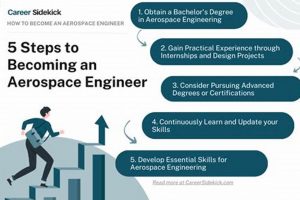
Tip 1: Early Identification of Interest: Begin exploring specific areas of interest within aerospace early in the academic career. This may involve participation in relevant student organizations, research projects, or specialized coursework. For example, students fascinated by propulsion systems might seek internships at companies developing advanced engine technologies.
Tip 2: Strategic Course Selection: Carefully choose elective courses that align with the chosen area of focus. Supplement core aerospace engineering curricula with courses in related disciplines such as mathematics, physics, computer science, and materials science. A future structures engineer, for example, may benefit from advanced courses in finite element analysis and composite materials.
Tip 3: Research Opportunities: Actively pursue research opportunities under the guidance of faculty members specializing in the desired area. Participating in research provides valuable hands-on experience, strengthens analytical skills, and can lead to publications in peer-reviewed journals. This may include working on projects related to computational fluid dynamics, advanced materials characterization, or control system design.
Tip 4: Internships and Co-ops: Seek internships or cooperative education experiences with aerospace companies or government agencies that align with the chosen specialty. These experiences provide practical application of theoretical knowledge and build professional networks. For instance, an individual interested in space systems engineering could pursue an internship at NASA or a private space exploration company.
Tip 5: Develop Specialized Skills: Acquire proficiency in relevant software tools and technologies used within the selected specialty. This may include CAD/CAM software, simulation packages, programming languages, and data analysis tools. Individuals concentrating on aerodynamics may benefit from mastering computational fluid dynamics software such as ANSYS Fluent or OpenFOAM.
Tip 6: Attend Industry Conferences: Participate in industry conferences and workshops to stay abreast of the latest advancements and network with professionals in the field. These events provide opportunities to learn from experts, present research findings, and explore potential career paths. Conferences such as the AIAA SciTech Forum offer valuable insights into emerging technologies and research trends.
Tip 7: Seek Mentorship: Establish a mentoring relationship with an experienced engineer or faculty member who can provide guidance and support throughout the academic and professional journey. A mentor can offer valuable insights, provide feedback on career decisions, and help navigate the complexities of the industry.
These recommendations facilitate the development of targeted expertise, which increases marketability and prepares individuals to contribute meaningfully to the advancement of aerospace technology.
The following sections will delve into the specific challenges and opportunities facing aerospace engineers with focused expertise in the 21st century.
1. Aerodynamics Expertise
Aerodynamics, the study of air in motion and its interaction with solid objects, forms a cornerstone of aerospace engineering. Focused study in this area is essential for designing aircraft and spacecraft that operate efficiently and safely within diverse atmospheric conditions. Specialization allows engineers to develop a deep understanding of complex flow phenomena and their impact on vehicle performance.
- Computational Fluid Dynamics (CFD)
CFD involves the use of numerical methods and algorithms to solve and analyze problems that involve fluid flows. Specialists employ CFD software to simulate airflow around aircraft wings, predict drag, and optimize aerodynamic performance. This expertise enables the design of more efficient airfoils and reduces the need for costly wind tunnel testing. For example, CFD is used extensively in the design of new aircraft wings to minimize fuel consumption and increase range.
- Wind Tunnel Testing
Wind tunnels provide a controlled environment for simulating flight conditions and measuring aerodynamic forces and moments on scale models or full-size aircraft components. Aerodynamics specialists utilize wind tunnels to validate CFD simulations, identify potential aerodynamic issues, and gather experimental data for design optimization. This technique is critical for verifying the performance of new aircraft designs and ensuring their safety.
- Aircraft Performance Analysis
This facet involves evaluating the aerodynamic characteristics of aircraft to determine their performance capabilities, including lift, drag, stall speed, and maneuverability. Specialists apply aerodynamic principles and analytical techniques to predict aircraft performance under various flight conditions and optimize designs for specific mission requirements. Such analysis is vital for ensuring aircraft meet performance specifications and safety standards.
- High-Speed Aerodynamics
High-speed aerodynamics focuses on the study of airflow at transonic and supersonic speeds, where compressibility effects become significant. Specialists in this area address challenges such as shock wave formation, sonic boom mitigation, and thermal effects on aircraft structures. Expertise in high-speed aerodynamics is essential for the design of supersonic aircraft and hypersonic vehicles. For example, specialized study in this area is paramount for the development of future hypersonic transport systems.
These elements of aerodynamics expertise highlight the necessity of focused education in aerospace engineering. Mastering these areas enables engineers to design safer, more efficient, and higher-performing aircraft and spacecraft, thereby contributing to the advancement of flight technology and space exploration.
2. Propulsion Systems

The design, analysis, and optimization of propulsion systems constitute a critical area of study within aerospace engineering. Focused expertise in this domain is essential for developing advanced engines and propulsion methods that enable both atmospheric and space flight. The efficiency, power, and reliability of these systems directly dictate the performance capabilities of aircraft and spacecraft. Therefore, deep understanding and specialized knowledge are paramount.
Advanced propulsion technologies, such as ramjets, scramjets, and electric propulsion, depend on engineers with highly specialized knowledge. For example, the development of the next-generation of supersonic transport aircraft relies on innovative engine designs that minimize noise and maximize fuel efficiency. Similarly, deep space exploration missions require advanced propulsion systems with high specific impulse, such as ion thrusters or nuclear thermal rockets. The success of these projects hinges on specialized expertise in areas like combustion, fluid dynamics, heat transfer, and materials science. These advanced areas need a lot of expertises from different backgrounds.
In summary, concentrated study in propulsion systems is a critical component of aerospace engineering. It directly impacts the advancement of air and space travel by enabling the creation of more efficient, powerful, and reliable engines. Challenges remain in areas like emissions reduction, noise abatement, and the development of high-performance propulsion systems for extreme environments. Continued focus in this specialized area is vital for addressing these challenges and for realizing the full potential of aerospace technology.
3. Structural Design

Structural design within aerospace engineering necessitates focused expertise due to the stringent demands placed on aircraft and spacecraft. Cause and effect are inextricably linked: inadequacies in structural design lead to catastrophic failure, while robust designs ensure mission success. As a component of specialized aerospace study, it mandates understanding materials science, stress analysis, and fatigue resistance. The importance of effective structural design is exemplified by the Comet airliner disasters of the 1950s, where metal fatigue caused structural failure, leading to significant design revisions in subsequent aircraft. Understanding the practical significance of this aspect is crucial for ensuring flight safety and operational reliability.
Practical applications of specialized knowledge in structural design extend across numerous facets of aerospace engineering. Finite element analysis (FEA) is routinely employed to model and simulate stress distributions within airframes under various load conditions. This allows engineers to identify potential weak points and optimize structural components. Moreover, advanced materials such as composites are increasingly used in aerospace structures to reduce weight and improve strength-to-weight ratios. The Boeing 787 Dreamliner, with its extensive use of carbon fiber reinforced polymer (CFRP), illustrates the successful application of these advanced materials and design principles. Such applications demonstrate the tangible benefits of focused structural expertise.
In conclusion, focused expertise in structural design is paramount within aerospace engineering. It addresses critical challenges related to safety, performance, and longevity. Despite advancements in materials and analytical tools, challenges remain in predicting structural behavior under extreme conditions, particularly in the context of hypersonic flight and space exploration. Continued specialization in this area is essential for pushing the boundaries of aerospace technology and ensuring the safety and reliability of future aircraft and spacecraft.
4. Control Engineering
Control engineering, as a facet of aerospace engineering, addresses the design and implementation of systems that govern the behavior of aircraft and spacecraft. Its importance arises from the need to maintain stability, achieve desired trajectories, and ensure precise operation in dynamic environments. Consequently, the effects of improper control system design can range from degraded performance to catastrophic failure. Real-life examples, such as the development of fly-by-wire systems in modern aircraft, demonstrate the practical significance: these systems replace mechanical linkages with electronic controls, enhancing maneuverability and safety. Therefore, focused expertise in control theory, sensor technology, and actuator design is vital.
Practical applications of control engineering within aerospace are diverse. Autopilots for commercial airliners automate flight operations, reducing pilot workload and improving fuel efficiency. Guidance, navigation, and control (GNC) systems are essential for spacecraft to maintain orientation, execute orbital maneuvers, and perform precision landing. Moreover, control systems are integrated into unmanned aerial vehicles (UAVs) to enable autonomous flight and mission execution. The development of robust control algorithms is particularly crucial in mitigating the effects of atmospheric disturbances and system uncertainties. For instance, adaptive control techniques are used to compensate for changes in aircraft aerodynamics due to icing or damage.
In conclusion, control engineering is an indispensable component of specialized aerospace study. Its significance lies in ensuring the stability, performance, and safety of aircraft and spacecraft. While advancements in control theory and technology have yielded substantial improvements in flight capabilities, challenges persist in developing control systems for complex, highly dynamic environments. Further specialization in this area is critical for advancing autonomous flight, improving aircraft efficiency, and enabling future space exploration missions.
5. Spacecraft Systems

Spacecraft systems represent a critical area of specialization within aerospace engineering, focusing on the design, development, and operation of vehicles intended for spaceflight. The complexity of these systems necessitates focused study due to the unique environmental challenges of space, including vacuum, extreme temperatures, radiation exposure, and microgravity. Consequent failure in any subsystem can compromise mission objectives or, in extreme cases, result in catastrophic loss. A real-world example is the Hubble Space Telescope, where initial flaws in its optical system required a complex repair mission, highlighting the importance of rigorous design and testing of spacecraft components.
The design of spacecraft systems encompasses multiple disciplines, including propulsion, power generation and distribution, thermal management, communications, attitude control, and life support (for crewed missions). Each of these areas demands specialized knowledge and skills. For instance, the development of reliable and efficient power systems, such as solar arrays and radioisotope thermoelectric generators (RTGs), is critical for long-duration missions. Similarly, advanced thermal management systems are essential to maintain operational temperatures for sensitive electronic equipment. The International Space Station (ISS) serves as a prime example, integrating complex systems for power, thermal control, communication, and life support, demonstrating the tangible results of focused expertise in these disciplines.
In conclusion, spacecraft systems are an integral aspect of specialization in aerospace engineering. Addressing the unique challenges of spaceflight requires a comprehensive understanding of interrelated subsystems and their operational constraints. Despite advancements in technology and engineering practices, challenges remain in designing robust and reliable spacecraft for increasingly complex missions, such as deep-space exploration and asteroid mining. Continued specialization in spacecraft systems is, therefore, essential for pushing the boundaries of space exploration and utilization.
6. Materials Science

Materials science is fundamentally intertwined with specialization within aerospace engineering. The performance, safety, and longevity of aircraft and spacecraft are directly governed by the properties and behavior of the materials from which they are constructed. Consequently, expertise in this area is not merely beneficial but critical for advancements in the field.
- Alloy Development for High-Temperature Applications
Gas turbine engines, essential for propulsion, operate at extremely high temperatures. The development of nickel-based superalloys, for example, allows turbine blades to withstand these harsh conditions without deformation or failure. Engineers specializing in materials science focus on improving alloy composition, processing techniques, and coating technologies to enhance the temperature capabilities of engine components. This translates directly to increased engine efficiency and thrust-to-weight ratios.
- Composite Materials for Lightweight Structures
Reducing the weight of aircraft and spacecraft is paramount for improving fuel efficiency and payload capacity. Composite materials, such as carbon fiber reinforced polymers (CFRP), offer exceptional strength-to-weight ratios compared to traditional metals. Materials scientists develop new composite materials, optimize their manufacturing processes, and analyze their structural performance under various loading conditions. The widespread adoption of CFRP in aircraft like the Boeing 787 demonstrates the impact of materials science on modern aerospace design.
- Materials for Extreme Environments in Space
Spacecraft operating in orbit or on planetary surfaces are subjected to extreme temperatures, radiation, and micrometeoroid impacts. Materials science addresses these challenges by developing specialized materials with resistance to radiation damage, high thermal stability, and impact protection. For example, multilayer insulation (MLI) blankets are used to regulate the temperature of spacecraft, while radiation-hardened electronics are essential for reliable operation in space. The selection and application of these materials are crucial for the success of space missions.
- Nanomaterials for Enhanced Performance
The integration of nanomaterials into aerospace structures and components presents opportunities for significant performance enhancements. Carbon nanotubes, for example, can be incorporated into composite materials to increase their strength and electrical conductivity. Nanoparticle additives can also improve the wear resistance and corrosion protection of coatings. Materials scientists are actively researching and developing nanomaterial-based solutions for a wide range of aerospace applications, from improving aircraft structural integrity to enhancing the performance of sensors and actuators.
The interplay between materials science and aerospace engineering underscores the necessity for specialized knowledge in both domains. As aerospace technology continues to advance, the demand for innovative materials solutions will only increase. Expertise in materials science is, therefore, essential for driving progress in areas such as fuel efficiency, structural integrity, and the exploration of extreme environments.
7. Avionics Integration

Avionics integration, the complex process of integrating electronic systems within aircraft and spacecraft, represents a critical specialization within aerospace engineering. The effective combination of these systemsincluding navigation, communication, flight control, and electronic warfaredirectly impacts operational performance and safety. A malfunction in integrated avionics can cause system-wide failures, underscoring the need for focused expertise. The development of the Boeing 777’s integrated avionics system, which replaced numerous standalone units with a centralized architecture, exemplifies the value of skilled avionics integration specialists. Their work facilitated improved system management, diagnostics, and overall reliability.
Practical applications of avionics integration specialization are evident in numerous aerospace projects. In modern commercial aircraft, integrated flight management systems (FMS) combine navigation, performance management, and flight planning functionalities, resulting in optimized flight profiles and reduced fuel consumption. Military aircraft rely on integrated sensor suites and data fusion algorithms to enhance situational awareness and targeting capabilities. Spacecraft require highly integrated avionics for attitude control, telemetry, and command processing, enabling precise orbital maneuvers and data acquisition. The successful integration of these systems requires proficiency in hardware and software engineering, communication protocols, and system-level testing. For example, specialists are now responsible for creating highly secure systems protecting aircraft from cyberattacks.
In conclusion, avionics integration forms an indispensable aspect of specialization within aerospace engineering. Its significance lies in optimizing the functionality, reliability, and safety of aircraft and spacecraft electronic systems. Despite advancements in technology, challenges persist in managing the increasing complexity of avionics architectures and ensuring seamless interoperability between diverse components. Continued focus and expertise in this area are therefore essential for advancing aerospace capabilities and maintaining operational integrity.
Frequently Asked Questions
The following questions address common inquiries regarding the benefits, requirements, and implications of focused study within the field of aerospace engineering. These answers aim to provide clarity and guidance for prospective specialists.
Question 1: What specific advantages does focused expertise offer over a general aerospace engineering education?
Concentrated study facilitates the development of deep knowledge and specialized skills in a particular area, enabling engineers to tackle complex problems and contribute to cutting-edge research and development. General aerospace engineering education provides a broad foundation, but concentrated study ensures a higher level of proficiency.
Question 2: What are the primary areas of focused study within aerospace engineering?
Key areas include aerodynamics, propulsion systems, structural design, control engineering, spacecraft systems, materials science, and avionics integration. The choice of specialization often depends on individual interests, career goals, and industry trends.
Question 3: How does one effectively choose a suitable area for concentrated expertise?
Strategic course selection, research opportunities, internships, and mentorship are essential for identifying and developing expertise in a specific area. Early exploration of interests and alignment with career aspirations are also important considerations.
Question 4: What academic qualifications or experiences are beneficial for pursuing a specialization?
Advanced coursework, research publications, internships at relevant companies or government agencies, and participation in industry conferences demonstrate commitment and expertise in a specialized area.
Question 5: How does focused study impact career prospects within the aerospace industry?
Specialized expertise enhances marketability and prepares individuals for advanced roles requiring in-depth knowledge and skills. It increases the likelihood of securing positions in research, development, and engineering within specific domains.
Question 6: What are the ongoing challenges and opportunities for specialized aerospace engineers?
Challenges include adapting to rapidly evolving technologies, addressing complex environmental concerns, and innovating in areas such as autonomous flight and space exploration. Opportunities exist for contributing to groundbreaking advancements and shaping the future of aerospace technology.
Focused study enables individuals to make significant contributions to aerospace engineering.
The following sections will discuss the real-world applications and future trends shaping the field.
Conclusion
This exploration has underscored the critical importance of specialization in aerospace engineering for driving innovation and ensuring continued progress in the field. From aerodynamics and propulsion to structural design and avionics integration, focused expertise enables engineers to tackle complex challenges and develop advanced technologies for both atmospheric and space applications. The breadth and depth of knowledge required across these specialized domains necessitates dedicated study and experience.
As aerospace technology evolves, the demand for specialized engineers will only intensify. Continued investment in focused education and research is essential to address emerging challenges and unlock new possibilities in flight and space exploration. The future of aerospace hinges on the expertise and dedication of individuals who pursue in-depth knowledge and contribute to the advancement of this vital field.