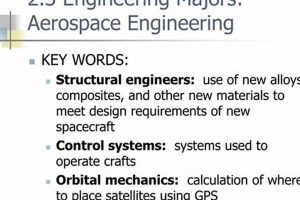
Aerospace engineering relies heavily on a spectrum of mathematical disciplines to design, analyze, and test aircraft, spacecraft, and related systems. Foundational calculus, differential equations, linear algebra, and complex analysis constitute essential tools. For example, differential equations describe the motion of a rocket, while linear algebra is crucial for structural analysis of an aircraft wing.
Proficiency in mathematical techniques provides the framework for simulating flight dynamics, optimizing aerodynamic performance, and ensuring structural integrity. A strong mathematical foundation enables engineers to accurately predict performance characteristics, minimize risks, and ultimately enhance the safety and efficiency of aerospace vehicles. Historically, advancements in aerospace have directly correlated with breakthroughs in mathematical modeling and computational power.
Consequently, the core mathematical concepts utilized encompass areas such as fluid dynamics modeling, control systems design, orbital mechanics calculations, and materials science analysis. These specific applications necessitate a deep understanding of mathematical principles and their practical implementation within the aerospace field.
Mathematical Proficiency for Aerospace Engineering
The following provides specific guidance for aspiring aerospace engineers regarding crucial mathematical areas.
Tip 1: Master Calculus Fundamentals: A thorough understanding of differential and integral calculus is essential. Applications include calculating lift and drag forces on airfoils and determining fuel consumption rates during flight.
Tip 2: Develop Expertise in Differential Equations: Proficiency in solving ordinary and partial differential equations is critical for modeling dynamic systems. Examples include simulating the trajectory of a spacecraft and analyzing the stability of flight control systems.
Tip 3: Strengthen Linear Algebra Skills: Linear algebra provides the foundation for structural analysis, control system design, and optimization algorithms. Applying linear algebra enables determination of stress distribution within an aircraft structure and the control inputs required for stable flight.
Tip 4: Acquire Proficiency in Numerical Methods: Many aerospace engineering problems lack analytical solutions, thus requiring numerical methods for approximation. Understanding techniques such as finite element analysis and computational fluid dynamics enables simulation of complex phenomena like airflow around a wing or heat transfer in a rocket engine.
Tip 5: Embrace Statistical Analysis: Statistical methods are vital for analyzing experimental data, assessing system reliability, and quantifying uncertainties. These tools are used to analyze wind tunnel test results to validate aerodynamic models and to determine the probability of failure for critical components.
Tip 6: Explore Complex Analysis: Complex analysis is invaluable in areas like aerodynamics and signal processing. It finds application in analyzing airflow around complex geometries and designing filters for navigation systems.
Tip 7: Familiarize Yourself with Optimization Techniques: Aerospace design often involves optimizing performance parameters while satisfying constraints. Applying optimization algorithms allows engineers to minimize drag, maximize payload capacity, and minimize fuel consumption.
These skills provide a robust toolkit for approaching the complex challenges inherent in aerospace engineering. A strong grasp of these mathematical principles is crucial for success in this demanding field.
Subsequent discussion will focus on specific mathematical applications within different aerospace engineering disciplines.
1. Calculus fundamentals

Calculus serves as a cornerstone for much of the analytical work performed by aerospace engineers. It provides the mathematical language and tools necessary to model and understand continuous change, a phenomenon inherent in many aerospace applications. The ability to accurately describe and predict these changes is essential for effective design and analysis.
- Modeling Trajectories
Calculus enables the precise modeling of object trajectories, essential for spacecraft navigation and control. By utilizing derivatives, engineers can determine instantaneous velocity and acceleration, enabling accurate prediction of future positions. Integrals are used to calculate the total distance traveled or the total fuel consumed over a specified time interval. These calculations are crucial for mission planning and ensuring mission success.
- Aerodynamic Force Calculation
Aerodynamic forces, such as lift and drag, are fundamentally defined using calculus. These forces are often expressed as integrals over the surface of an aircraft, requiring calculus to compute their magnitude and distribution. Understanding the interplay between air velocity, pressure, and surface geometry, which is achieved through calculus, is paramount to designing efficient and controllable aircraft.
- Optimization Problems
Aerospace engineering frequently involves optimization problems aimed at maximizing performance or minimizing costs. Calculus-based techniques, such as finding maxima and minima of functions, are essential for solving these problems. Examples include optimizing airfoil shapes for maximum lift-to-drag ratio, or minimizing the structural weight of a spacecraft while maintaining structural integrity. These optimization processes directly impact the efficiency and effectiveness of aerospace vehicles.
- Control Systems Design
Calculus forms the basis for designing stable and responsive control systems for aircraft and spacecraft. Differential equations, derived from calculus, describe the dynamic behavior of these systems. Control engineers use these equations to design feedback control loops that maintain desired flight characteristics. An understanding of calculus is therefore critical for ensuring that aerospace vehicles operate safely and predictably across a range of conditions.
The applications described demonstrate the pervasive influence of calculus in aerospace engineering. Its principles are integrated into various aspects of design and analysis, from trajectory planning to structural optimization. Proficiency in calculus is therefore a fundamental requirement for anyone seeking to contribute meaningfully to the field. The understanding and application of calculus greatly affect the safety and success of aerospace ventures.
2. Differential Equations

Differential equations serve as a crucial analytical tool for aerospace engineers, enabling the mathematical modeling of dynamic systems. These equations, which describe the relationships between a function and its derivatives, are indispensable for understanding and predicting the behavior of various aerospace phenomena.
- Modeling Aircraft Dynamics
Differential equations are used to model the motion of aircraft, accounting for forces such as lift, drag, thrust, and gravity. These equations, often complex and nonlinear, describe the aircraft’s position, velocity, and orientation over time. Solutions to these equations enable engineers to simulate flight characteristics, evaluate stability, and design control systems.
- Analyzing Rocket Trajectories
Predicting the trajectory of a rocket or spacecraft necessitates solving differential equations that incorporate gravitational forces, atmospheric drag (if applicable), and the rocket’s thrust profile. These equations, which can be highly sensitive to initial conditions, are critical for mission planning and ensuring accurate navigation. Sophisticated numerical methods are often employed to obtain solutions for complex trajectory scenarios.
- Designing Control Systems
Control systems for aircraft and spacecraft rely heavily on differential equation models. These models describe the system’s response to control inputs, allowing engineers to design feedback loops that maintain desired performance characteristics. Stability analysis, based on the properties of differential equations, is crucial for preventing oscillations or instability in the control system.
- Simulating Fluid Dynamics
Computational Fluid Dynamics (CFD), a vital tool for aerospace design, involves solving partial differential equations that govern fluid flow. These equations, known as the Navier-Stokes equations, describe the conservation of mass, momentum, and energy in a fluid. Solving these equations numerically enables engineers to analyze aerodynamic performance, optimize airfoil shapes, and predict heat transfer in engines and other components.
The ability to formulate, solve, and interpret differential equations is a core competency for aerospace engineers. This mathematical framework underpins the analysis, design, and control of a wide range of aerospace systems, ensuring their safety, efficiency, and performance. Without proficiency in differential equations, comprehensive understanding and management of complex aerospace systems is unattainable.
3. Linear Algebra Applications

Linear algebra serves as a fundamental mathematical tool in aerospace engineering, providing a framework for analyzing and solving problems involving systems of linear equations and transformations. Its applications are pervasive, impacting the design, analysis, and control of aerospace vehicles and systems.
- Structural Analysis
Finite Element Analysis (FEA), a cornerstone of structural design, relies heavily on linear algebra. FEA discretizes a structure into smaller elements, formulating a system of linear equations to determine stress and strain distributions under various loads. Solution of these large-scale systems, often involving millions of unknowns, requires efficient linear algebra algorithms. Accurate structural analysis is essential for ensuring the integrity and safety of aerospace components.
- Control System Design
Linear algebra provides the mathematical foundation for modeling and controlling dynamic systems. State-space representation, a common method in control theory, utilizes matrices to describe the system’s behavior. Linear algebra techniques are used to analyze system stability, design feedback controllers, and optimize system performance. Precise control is critical for stable flight and accurate navigation.
- Flight Simulation
Flight simulators employ linear algebra to model aircraft dynamics and generate realistic flight experiences. Transformations, rotations, and translations of objects in three-dimensional space are represented using matrices. Linear algebra operations are used to update the aircraft’s position and orientation in response to pilot inputs and environmental conditions. Realistic flight simulation is invaluable for pilot training and aircraft design validation.
- Orbital Mechanics
Determining and predicting the orbits of satellites and spacecraft requires solving systems of linear equations. Linear algebra is used to represent orbital elements, perform coordinate transformations, and calculate orbital trajectories. Accurate orbital calculations are essential for satellite communication, navigation, and space exploration missions.
These applications illustrate the critical role of linear algebra in aerospace engineering. From structural integrity to flight control and orbital mechanics, linear algebra provides the analytical tools necessary for addressing complex engineering challenges. Proficiency in linear algebra is therefore indispensable for aerospace engineers seeking to design, analyze, and operate advanced aerospace systems.
4. Numerical methods expertise

Aerospace engineering frequently encounters problems that lack analytical solutions. This necessitates the application of numerical methods, which provide approximate solutions through iterative computations. These methods are indispensable for simulating complex physical phenomena, optimizing designs, and predicting system performance. The selection and implementation of appropriate numerical techniques are critical for the accuracy and reliability of engineering analyses. Without numerical methods expertise, many aerospace engineering problems would remain intractable, hindering innovation and progress.
Computational Fluid Dynamics (CFD) exemplifies the significance of numerical methods. Analyzing airflow around an aircraft wing involves solving the Navier-Stokes equations, a system of partial differential equations that generally lacks analytical solutions. CFD employs numerical techniques, such as finite volume methods, to discretize the flow domain and iteratively compute approximate solutions. Similarly, Finite Element Analysis (FEA) relies on numerical methods to analyze the structural behavior of aerospace components under various loads. Both CFD and FEA require a deep understanding of numerical methods, including convergence criteria, stability analysis, and error estimation, to ensure the accuracy and reliability of the results. Examples of real-world applications extend to simulating combustion processes in rocket engines, modeling heat transfer in spacecraft thermal protection systems, and predicting the dynamic response of aircraft to turbulence.
The challenges associated with numerical methods include computational cost, convergence issues, and the potential for numerical instability. Effective application requires careful consideration of these factors, along with validation against experimental data or analytical solutions where available. Developing robust numerical methods and validating their accuracy remains a critical area of research in aerospace engineering, directly impacting the ability to design and analyze increasingly complex aerospace systems. The integration of numerical methods with other mathematical tools constitutes an essential aspect of the mathematical expertise demanded in this field.
5. Statistical analysis rigor

Statistical analysis rigor is a critical component of the mathematical toolkit employed by aerospace engineers. It addresses inherent uncertainties and variabilities present in experimental data, simulations, and manufacturing processes. A rigorous statistical approach allows engineers to quantify these uncertainties, make informed decisions, and ultimately enhance the reliability and safety of aerospace systems. The application of statistical methods is not merely an adjunct to deterministic calculations; it is an integral part of the engineering process.
For instance, consider the testing of aircraft components. Destructive testing provides data on failure modes and stress limits, but the sample size is typically limited due to cost and time constraints. Statistical analysis enables engineers to extrapolate from these limited data points to estimate the reliability of the entire population of components. Furthermore, in flight testing, numerous parameters are measured, each subject to measurement error. Statistical techniques are used to filter noise from the data, identify trends, and validate aerodynamic models. As another practical application, consider quality control in manufacturing processes. Statistical process control techniques are employed to monitor production parameters, detect deviations from specified tolerances, and prevent defective components from entering the aerospace supply chain. The implementation of these statistical methods contributes significantly to minimizing risks associated with manufacturing and operation.
In conclusion, statistical analysis rigor strengthens the robustness of aerospace engineering practices. By addressing uncertainty, quantifying risks, and ensuring data integrity, statistical methods enable engineers to make more informed decisions and build safer, more reliable aerospace systems. The challenges associated with applying statistical methods in aerospace engineering include data scarcity, the complexity of physical models, and the need for specialized expertise. However, the benefits of a rigorous statistical approach far outweigh the challenges, making it an indispensable aspect of the mathematical skillset required for aerospace engineers.
6. Optimization techniques

Optimization techniques represent a critical intersection within the mathematical disciplines used by aerospace engineers. The inherent goal of aerospace engineeringto design and operate efficient, safe, and high-performing systemsnecessitates the application of mathematical optimization methods.
- Aerodynamic Shape Optimization
The design of airfoils and aircraft wings frequently involves optimizing their shape to minimize drag and maximize lift. This process employs mathematical optimization algorithms, such as gradient-based methods or genetic algorithms, to iteratively refine the geometry. The optimization objective function is often derived from Computational Fluid Dynamics (CFD) simulations, which themselves rely on solving partial differential equations numerically. The resulting optimized shapes lead to improved fuel efficiency and performance characteristics.
- Trajectory Optimization
Mission planning for spacecraft requires optimizing trajectories to minimize fuel consumption, transit time, or other mission-specific objectives. This is achieved through mathematical optimization techniques such as optimal control theory and nonlinear programming. The problem involves solving differential equations that govern the spacecraft’s motion while satisfying various constraints, such as orbital parameters and launch window availability. Efficient trajectory optimization is paramount for successful and cost-effective space missions.
- Structural Weight Minimization
Minimizing the structural weight of aircraft and spacecraft is crucial for maximizing payload capacity and fuel efficiency. Structural optimization involves finding the optimal distribution of material within a structure to meet strength and stiffness requirements while minimizing weight. This process often employs finite element analysis (FEA) to assess structural performance and mathematical optimization algorithms to iteratively refine the design. Reduced structural weight translates directly to improved vehicle performance.
- Control System Optimization
Control systems for aircraft and spacecraft must be designed to achieve stable and responsive performance. Optimization techniques are used to tune control system parameters to meet specific performance objectives, such as minimizing settling time, overshoot, and control effort. This process often involves formulating a cost function that quantifies the desired performance characteristics and using optimization algorithms to find the optimal controller parameters. Well-optimized control systems enhance the safety and reliability of aerospace vehicles.
These diverse applications demonstrate the significance of optimization techniques within the mathematical framework employed by aerospace engineers. The ability to formulate and solve optimization problems is essential for designing and operating advanced aerospace systems that meet stringent performance and cost requirements. The integration of optimization methods with other mathematical tools ensures the continuous improvement and innovation in this field.
Frequently Asked Questions
The following addresses common inquiries regarding the specific mathematical skills utilized by aerospace engineers, emphasizing the practical application and importance of each area.
Question 1: Does aerospace engineering rely solely on theoretical mathematics, or are there practical applications?
Aerospace engineering employs mathematics extensively in practical applications. Theoretical concepts are applied to solve real-world problems, ranging from designing efficient airfoils to calculating stable satellite orbits. The field emphasizes translating mathematical models into tangible engineering solutions.
Question 2: Is a deep understanding of calculus essential for all aerospace engineers?
A robust understanding of calculus is essential. Calculus provides the foundation for modeling continuous change, which is fundamental to understanding fluid dynamics, trajectory optimization, and control systems design. Without a strong calculus foundation, comprehending these core aerospace engineering principles is not possible.
Question 3: How is linear algebra applied in the design of aerospace structures?
Linear algebra is crucial for analyzing the structural integrity of aerospace components. Finite Element Analysis (FEA), a technique for simulating stress and strain distributions, relies heavily on solving large systems of linear equations. Therefore, linear algebra expertise enables the creation of safe and efficient aerospace structures.
Question 4: Are numerical methods only necessary for advanced research, or are they used in routine engineering tasks?
Numerical methods are essential for both advanced research and routine engineering tasks. Many aerospace engineering problems lack analytical solutions, requiring numerical techniques to approximate solutions. Computational Fluid Dynamics (CFD) and Finite Element Analysis (FEA) are examples of frequently used numerical methods.
Question 5: Why is statistical analysis important in aerospace engineering, given the precision required?
Statistical analysis addresses inherent uncertainties and variabilities in experimental data, simulations, and manufacturing processes. It enables the quantification of these uncertainties and informs decision-making processes, ultimately enhancing the reliability and safety of aerospace systems.
Question 6: Can aerospace designs be optimized without the use of sophisticated mathematical techniques?
Effective optimization in aerospace engineering relies heavily on sophisticated mathematical techniques. These techniques enable engineers to refine designs iteratively to maximize performance, minimize weight, or achieve other specific objectives. Without optimization, achieving optimal designs for complex aerospace systems is improbable.
A comprehensive understanding of these mathematical areas is a crucial aspect of aerospace engineering competence, ensuring accurate design, analysis, and operation of advanced aerospace systems.
The next section will explore specific examples of mathematical modeling in aerospace applications.
Mathematical Foundations in Aerospace Engineering
This exploration has demonstrated the pervasive and essential nature of mathematical proficiency within aerospace engineering. The discussed mathematical disciplines, including calculus, differential equations, linear algebra, numerical methods, statistical analysis, and optimization techniques, are not merely theoretical concepts but rather practical tools applied to a wide range of engineering challenges. From designing efficient airfoils to ensuring the structural integrity of spacecraft, mathematical principles underpin every aspect of the field.
The ongoing advancement of aerospace technology depends on a continued emphasis on mathematical rigor and innovation. Future progress will require engineers to not only master existing mathematical techniques but also to develop new methods for addressing emerging challenges in areas such as hypersonic flight, space exploration, and sustainable aviation. The importance of “what type of math do aerospace engineers use” will only continue to grow as the complexity of aerospace systems increases.