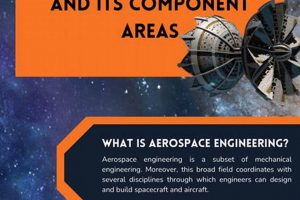
An individual in this profession applies scientific and mathematical principles to design, develop, test, and maintain aircraft, spacecraft, satellites, and missiles. This multifaceted role requires a strong foundation in mechanics, materials science, thermodynamics, and fluid dynamics. For instance, such a professional might be involved in the structural analysis of an airplane wing, the design of a satellite propulsion system, or the aerodynamic modeling of a new rocket nozzle.
Possessing a strong engineering foundation offers a competitive advantage in this advanced field. It cultivates a deep understanding of mechanical systems, enabling a more holistic approach to aerospace challenges. Historically, this interdisciplinary skill set has been instrumental in numerous aerospace advancements, driving innovation in aircraft performance, spacecraft reliability, and space exploration capabilities. The ability to integrate mechanical engineering knowledge within the aerospace context fosters creative problem-solving and efficient design strategies.
Therefore, individuals with this educational background are well-positioned to contribute significantly to the advancement of the aerospace industry. The following sections will delve further into the specific skills, responsibilities, and career pathways associated with this integrated professional profile.
Guidance for Aspiring Professionals
The following are recommendations for those pursuing a career involving integrated aerospace and mechanical engineering expertise. These suggestions emphasize the development of a robust skill set and a strategic approach to career advancement.
Tip 1: Develop a Strong Mathematical Foundation: A thorough understanding of calculus, differential equations, and linear algebra is critical. These mathematical tools are essential for analyzing complex engineering problems in both aerospace and mechanical systems. For example, finite element analysis, used extensively in structural design, relies heavily on linear algebra.
Tip 2: Master Fundamental Engineering Principles: Gain a solid grasp of thermodynamics, fluid mechanics, heat transfer, and materials science. These principles underpin the design and analysis of aerospace components, from jet engines to spacecraft thermal control systems. Familiarity with these concepts allows for effective problem-solving and design optimization.
Tip 3: Cultivate Proficiency in CAD and Simulation Software: Experience with industry-standard software such as SolidWorks, ANSYS, and MATLAB is highly valuable. These tools enable the creation of detailed designs, the simulation of system performance, and the analysis of complex data. Proficiency in these platforms enhances productivity and design accuracy.
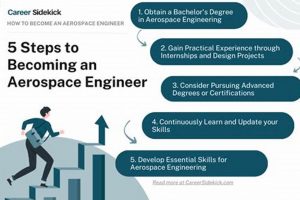
Tip 4: Seek Internships and Research Opportunities: Practical experience is essential for applying theoretical knowledge to real-world problems. Internships at aerospace companies, research labs, or government agencies provide invaluable hands-on experience and networking opportunities. These experiences allow individuals to contribute to real-world projects and develop professional skills.
Tip 5: Specialize in a Specific Area: While a broad understanding is beneficial, specializing in a specific area, such as propulsion, structures, or control systems, can enhance career prospects. Focused expertise allows for deeper understanding and contribution to specific projects within the aerospace domain.
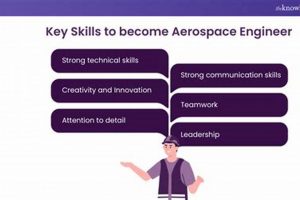
Tip 6: Develop Strong Communication Skills: The ability to communicate technical information effectively is crucial. This includes written reports, presentations, and collaborative discussions with colleagues. Clear and concise communication ensures efficient teamwork and project success.
Tip 7: Obtain Relevant Certifications: Consider pursuing relevant certifications, such as those offered by professional engineering organizations. These certifications can demonstrate competence and enhance credibility within the industry.
Adherence to these recommendations will contribute to the development of a well-rounded and highly competitive professional profile. The integration of theoretical knowledge, practical experience, and specialized skills is crucial for success in this demanding and rewarding field.
The subsequent sections will address common challenges and explore strategies for navigating the career landscape in this field.
1. Aerodynamics Expertise
Aerodynamics expertise is a cornerstone skill for individuals in the aerospace field. It underpins the ability to design efficient and stable aircraft and spacecraft, directly influencing performance characteristics and operational capabilities. A thorough grasp of aerodynamics is paramount for any professional aiming to contribute meaningfully to the advancement of flight technologies.
- Lift and Drag Optimization
An understanding of lift generation and drag reduction is crucial. Engineers manipulate wing shapes, control surfaces, and overall vehicle design to maximize lift while minimizing drag. This knowledge directly impacts fuel efficiency, flight range, and payload capacity. For example, winglets on modern aircraft are a direct result of aerodynamic optimization, reducing induced drag and improving fuel economy.
- Computational Fluid Dynamics (CFD) Application
CFD is a powerful tool for simulating airflow around complex shapes. Proficiency in CFD software allows engineers to predict aerodynamic performance, identify potential design flaws, and optimize designs before physical prototyping. This simulation-based approach reduces development time and cost, while improving the performance and safety characteristics.
- Stability and Control Analysis
Aerodynamic forces significantly influence vehicle stability and control. Engineers analyze these forces to ensure stable flight characteristics and responsive control surfaces. This analysis informs the design of control systems that allow pilots to maneuver the aircraft safely and effectively. For instance, the design of a fighter jet incorporates careful aerodynamic shaping and control surface placement to achieve high maneuverability at various speeds and altitudes.
- Supersonic and Hypersonic Flow Considerations
At high speeds, compressibility effects become significant. Understanding shock waves, expansion fans, and other phenomena associated with supersonic and hypersonic flow is essential for designing high-speed aircraft and spacecraft. This expertise is critical for developing next-generation transportation systems and defense technologies. For instance, the design of a hypersonic aircraft requires specialized knowledge of high-temperature aerodynamics and the effects of extreme heat on structural materials.
The facets of aerodynamics expertise are interwoven into the design lifecycle. From initial concept to flight testing, aerodynamic principles inform decisions and guide optimization efforts. A professional with mechanical expertise leverages these facets to create efficient, stable, and controllable aerospace vehicles, contributing directly to advancements in flight technologies and space exploration.
2. Structural Integrity
Structural integrity is a paramount concern in aerospace engineering. Professionals in this field must ensure the safety and reliability of aircraft and spacecraft by designing structures capable of withstanding extreme stresses and environmental conditions. The mechanical engineering background provides a solid foundation for addressing these challenges effectively.
- Stress Analysis and Finite Element Methods
Stress analysis is the cornerstone of ensuring structural integrity. Professionals employ analytical and numerical methods, particularly finite element analysis (FEA), to predict stress distributions within a structure under various loading conditions. For instance, FEA is used to model the stress concentrations around fastener holes in an aircraft wing, ensuring that these areas are adequately reinforced. Understanding these stress patterns allows engineers to design structures that can withstand operational loads without failure.
- Material Selection and Testing
The choice of materials is crucial for structural integrity. Aerospace engineers must select materials with appropriate strength, stiffness, and fatigue resistance for specific applications. Thorough material testing is conducted to verify that the selected materials meet design requirements. For example, composite materials, such as carbon fiber reinforced polymers, are widely used in modern aircraft due to their high strength-to-weight ratio. Testing ensures that these materials perform as expected under simulated flight conditions.
- Fatigue and Fracture Mechanics
Fatigue and fracture mechanics are essential for predicting the lifespan of aerospace structures. Cyclic loading can lead to fatigue crack growth, eventually resulting in catastrophic failure. Engineers use fracture mechanics principles to assess the tolerance of structures to cracks and to develop inspection schedules that detect cracks before they reach critical size. The Comet airliner disasters of the 1950s highlighted the importance of understanding fatigue behavior in aircraft structures, leading to significant advancements in this field.
- Structural Health Monitoring
Structural health monitoring (SHM) involves the integration of sensors and data analysis techniques to continuously monitor the condition of aerospace structures. SHM systems can detect damage, such as cracks or corrosion, in real-time, allowing for proactive maintenance and preventing potential failures. For instance, SHM systems can be used to monitor the condition of composite aircraft wings, providing early warning of any structural degradation. This technology enhances safety and reduces maintenance costs.
These facets of structural integrity are interconnected and critical for aerospace vehicles. The ability to perform stress analysis, select appropriate materials, understand fatigue behavior, and implement structural health monitoring techniques are essential for ensuring the safety and reliability of aerospace structures. This expertise is central to the role of an aerospace engineer with mechanical engineering knowledge, contributing to safe and innovative designs.
3. Propulsion Systems

The design, development, and maintenance of propulsion systems represent a critical function within aerospace engineering. Individuals possessing expertise in mechanical engineering principles find a natural application for their skills in this domain. The functionality of aircraft, spacecraft, and missiles hinges directly on the efficiency and reliability of their propulsion systems. These systems, converting stored energy into thrust, necessitate a deep understanding of thermodynamics, fluid mechanics, combustion, and materials science all core competencies cultivated through mechanical engineering education. Consider the development of a new jet engine: a professional will apply knowledge of compressor and turbine design, fuel injection systems, and heat transfer to optimize performance while adhering to stringent safety and emissions standards. The successful execution of such a project underscores the intrinsic link between propulsion systems and the specific skills honed by these engineers.
Further illustrative examples include the design of rocket engines for space exploration. The extreme operating conditions encountered in space require innovative solutions for propellant storage, combustion control, and nozzle design. Engineers leverage their understanding of advanced materials and heat transfer to create engines capable of withstanding immense thermal stresses and pressures. Furthermore, the rise of electric propulsion systems for satellites and spacecraft presents new challenges and opportunities for professionals. Expertise in mechanical design and thermal management is vital for developing efficient and reliable electric propulsion systems that can operate for extended periods in the harsh environment of space. All these fields shows how a mechanical engineering degree adds to the value of an aerospace engineer
In summary, the relationship between propulsion systems and those with mechanical engineering expertise within the aerospace sector is symbiotic. The design and optimization of these systems demand a robust understanding of fundamental mechanical principles. While challenges persist in areas such as efficiency, emissions reduction, and operational longevity, professionals with this integrated skillset are well-equipped to address these challenges and drive advancements in aerospace technology. The ongoing evolution of propulsion technologies ensures continued demand for skilled engineers capable of innovating and adapting to emerging requirements in the field.
4. Materials Science

Materials science is fundamental to aerospace engineering, dictating the performance, safety, and longevity of aircraft and spacecraft. An individual with specialized training leverages knowledge of material properties, processing techniques, and failure mechanisms to select and implement the optimal materials for each application.
- Alloy Development and Application
Alloys, engineered combinations of metals, offer tailored properties for specific aerospace needs. Aluminum alloys, titanium alloys, and nickel-based superalloys are frequently used due to their high strength-to-weight ratios, corrosion resistance, and ability to withstand high temperatures. An aerospace engineer might select a specific aluminum alloy for an aircraft fuselage to minimize weight while maintaining structural integrity or a nickel-based superalloy for turbine blades in a jet engine to endure extreme temperatures and stresses.
- Composite Material Design and Manufacturing
Composite materials, such as carbon fiber reinforced polymers (CFRPs), provide exceptional strength and stiffness at low densities. The design of composite structures involves careful consideration of fiber orientation, resin selection, and manufacturing processes. Aerospace engineers utilize composite materials to reduce the weight of aircraft wings and fuselages, leading to improved fuel efficiency. They also play a crucial role in satellite construction, where lightweight structures are essential for maximizing payload capacity.
- Material Characterization and Testing
Comprehensive material characterization and testing are essential to validate the performance of aerospace materials. Techniques such as tensile testing, fatigue testing, and non-destructive inspection are employed to determine material properties and identify potential flaws. Engineers analyze test data to ensure that materials meet design requirements and to predict their long-term behavior under operational conditions. For instance, fatigue testing of aircraft components is critical to prevent catastrophic failures due to cyclic loading.
- Corrosion Protection and Control
Corrosion poses a significant threat to aerospace structures, particularly in harsh environments. Aerospace engineers implement various corrosion protection strategies, including coatings, surface treatments, and cathodic protection, to prevent material degradation. Regular inspections and maintenance programs are essential to detect and address corrosion before it compromises structural integrity. The selection of corrosion-resistant materials and the implementation of effective corrosion control measures are crucial for ensuring the long-term safety and reliability of aircraft and spacecraft.
The selection, characterization, and protection of materials are indispensable for aerospace applications. Those with proper educational foundation employ this information to create structures that are robust, efficient, and safe. The integration of this knowledge is fundamental to advancing aerospace technology.
5. Control Engineering
Control engineering plays a pivotal role in aerospace systems, ensuring precise and stable operation of complex vehicles and equipment. For individuals, understanding control systems is essential for designing and optimizing the performance of aircraft, spacecraft, and related technologies. The application of control engineering principles allows for the automation of tasks, the enhancement of system responsiveness, and the mitigation of disturbances, all crucial for safe and efficient aerospace operations.
- Flight Control Systems
Flight control systems are central to the operation of aircraft, governing stability, maneuverability, and overall flight performance. Professionals design these systems using feedback control principles to maintain desired flight paths and attitudes. For example, autopilot systems rely on sensors to measure aircraft position and orientation, and then actuate control surfaces to correct deviations from the intended trajectory. The mechanical background provides the essential understanding of actuator dynamics, sensor characteristics, and control algorithms necessary for designing effective flight control systems.
- Guidance and Navigation Systems
Guidance and navigation systems are critical for autonomous vehicles, spacecraft, and missiles. These systems use a combination of sensors, such as GPS, inertial measurement units (IMUs), and star trackers, to determine the vehicle’s position and orientation in space. Control algorithms then guide the vehicle along a pre-defined trajectory or towards a target. The design of robust guidance and navigation systems requires a thorough understanding of Kalman filtering, optimal control, and sensor fusion techniques. An aerospace engineer is uniquely qualified to integrate these elements into a reliable and accurate navigation solution.
- Engine Control Systems
Engine control systems regulate the performance of aircraft and spacecraft engines, optimizing thrust, fuel efficiency, and emissions. These systems use sensors to monitor engine parameters, such as temperature, pressure, and speed, and then adjust fuel flow and air intake to maintain desired operating conditions. The design of engine control systems requires a deep understanding of thermodynamics, fluid mechanics, and combustion processes. The mechanical engineering degree provides a solid foundation for modeling engine behavior and designing control algorithms that ensure efficient and stable operation. This includes working with intricate systems, and managing complex operations to avoid system failures and optimize operation.
- Satellite Attitude Control
Maintaining the desired attitude, or orientation, of a satellite in orbit is essential for its mission. Attitude control systems use reaction wheels, thrusters, and magnetic torquers to counteract external disturbances and maintain the satellite’s pointing direction. The design of these systems requires a thorough understanding of orbital mechanics, spacecraft dynamics, and control theory. Aerospace engineers with mechanical training design satellite attitude control systems that ensure accurate pointing for communication, observation, and scientific missions. This is especially important for high-resolution imaging and targeted communication purposes.
The facets of control engineering are essential for aerospace systems. The ability to design effective flight control, guidance, engine control, and attitude control systems enables the development of safe, efficient, and high-performing aerospace vehicles. Aerospace engineers with a strong grounding in the principles of mechanical engineering are uniquely positioned to contribute to advancements in control technology, driving innovation in aviation, space exploration, and defense. Their expertise is critical for ensuring the continued progress and reliability of aerospace systems.
6. System Integration
System integration, in the context of aerospace engineering, represents the crucial process of combining disparate components and subsystems into a cohesive and functional unit. For individuals in the field, proficiency in system integration is not merely an asset but a fundamental requirement for successful project execution. The mechanical engineering background provides a distinct advantage, fostering a comprehensive understanding of how mechanical, electrical, and software elements interact within a complex aerospace system. An aerospace engineer with this background possesses the ability to analyze the interfaces between subsystems, identify potential compatibility issues, and implement solutions that ensure seamless operation. For example, integrating a new flight control system into an existing aircraft requires careful consideration of its mechanical linkages, electrical interfaces, and software protocols. A failure to properly integrate these elements can result in system malfunctions, performance degradation, or even catastrophic failures. Therefore, system integration is a critical component of engineering work, ensuring project success.
The importance of system integration extends beyond individual components to encompass the entire lifecycle of an aerospace product, from initial design and development to testing, deployment, and maintenance. During the design phase, integration considerations influence architectural decisions, component selection, and interface specifications. System-level testing verifies that all subsystems function correctly when integrated, identifying and resolving any unforeseen compatibility issues. The Space Shuttle program, for instance, involved the integration of numerous complex subsystems, including propulsion, life support, and avionics. The success of the program depended on meticulous system integration efforts to ensure that all components worked in harmony. Proper integration during the development phase also means more streamlined testing and deployment later.
In conclusion, system integration is inextricably linked to the role of an aerospace engineer, particularly for individuals with mechanical engineering expertise. The ability to effectively integrate diverse components and subsystems is essential for creating safe, reliable, and high-performing aerospace systems. While challenges associated with system complexity and compatibility may arise, a solid foundation in mechanical engineering principles, coupled with a systematic approach to integration, equips professionals to navigate these challenges and contribute to the continued advancement of aerospace technology. This ability is paramount, both for the engineer’s career and for the engineering project itself.
7. Thermal Management

Thermal management constitutes a critical aspect of aerospace engineering, directly influencing the performance and reliability of vehicles and systems operating in extreme thermal environments. Professionals are uniquely positioned to address these challenges due to their understanding of heat transfer principles, fluid dynamics, and material properties. Effective thermal management is essential for maintaining optimal operating temperatures of sensitive electronic components, propulsion systems, and structural elements. Failures in thermal management can lead to performance degradation, system malfunctions, or even catastrophic failures, underscoring its significance within the field. For example, overheating of electronic components in satellites can result in signal loss or complete system shutdown, necessitating robust thermal control measures.
The design and implementation of thermal management systems involve a variety of techniques, including passive methods such as insulation and heat sinks, and active methods such as liquid cooling loops and thermoelectric coolers. The selection of appropriate thermal management strategies depends on the specific application, considering factors such as heat load, operating environment, and weight constraints. Expertise in computational fluid dynamics (CFD) and heat transfer modeling is crucial for predicting thermal behavior and optimizing system performance. Practical applications of thermal management principles include the design of thermal protection systems for spacecraft re-entry, the development of cooling systems for high-power electronics in aircraft, and the optimization of heat transfer in jet engines. Each of these problems requires a nuanced knowledge of thermal phenomena and innovative engineering solutions.
Effective thermal management requires a multidisciplinary approach, integrating knowledge of mechanical engineering, materials science, and electrical engineering. The ability to analyze thermal problems, develop innovative solutions, and validate system performance through testing and simulation is essential for success in this field. Challenges include the increasing power density of electronic components, the demand for lighter and more efficient thermal management systems, and the need to operate in increasingly harsh environments. As aerospace technology continues to advance, the importance of thermal management will only grow, creating significant opportunities for professionals with expertise in this area.
Frequently Asked Questions
This section addresses common inquiries regarding the role, skills, and career paths associated with specialized capabilities.
Question 1: Is a mechanical engineering degree sufficient for a career in aerospace engineering?
While a mechanical engineering degree provides a strong foundation, specialized knowledge in areas such as aerodynamics, spacecraft design, and orbital mechanics is typically required for certain aerospace engineering roles. Further education or focused experience in these areas is often beneficial.
Question 2: What are the primary advantages of possessing a degree in both aerospace and mechanical engineering?
The combination of these degrees fosters a comprehensive understanding of both the theoretical and practical aspects of aerospace systems. This interdisciplinary knowledge enhances problem-solving skills and expands career opportunities across various sectors within the aerospace industry.
Question 3: What types of job roles are commonly held by individuals with these qualifications?
Common roles include aerospace design engineer, propulsion engineer, structural analyst, systems engineer, and research scientist. The specific responsibilities vary depending on the employer and the nature of the projects undertaken.
Question 4: What specific software skills are particularly valuable for a professional with this educational background?
Proficiency in software packages such as ANSYS, MATLAB, SolidWorks, and computational fluid dynamics (CFD) tools is highly desirable. These tools are essential for modeling, simulation, and analysis of aerospace systems and components.
Question 5: How important are internships or research experience for career advancement in this field?
Internships and research experience are crucial for gaining practical skills, networking with industry professionals, and demonstrating a commitment to the field. These experiences enhance a candidate’s competitiveness in the job market.
Question 6: What are some potential career paths outside of traditional aerospace companies for individuals with this expertise?
Opportunities exist in fields such as automotive engineering, renewable energy, robotics, and defense, where the principles of mechanical engineering and aerospace design are applicable. Furthermore, government research and regulatory agencies often seek individuals with this skill set.
The information presented in this FAQ section provides a general overview of the role and its associated aspects. Specific requirements and opportunities may vary depending on individual circumstances and employer needs.
The subsequent sections will delve deeper into specific career advice and strategies for success.
Conclusion
The preceding analysis has presented a comprehensive overview of the knowledge and skills inherent in the specialized profession. It has detailed the significance of expertise in areas such as aerodynamics, structural integrity, propulsion systems, materials science, control engineering, system integration, and thermal management. The information has also emphasized the unique advantages conferred by a dual proficiency in both aerospace and mechanical engineering disciplines.
The information shared herein represents an attempt to provide professionals with insights to enhance their contribution to advancement of aerospace technology. Sustained innovation and rigorous application of engineering principles are critical to navigating the challenges and opportunities that lie ahead.