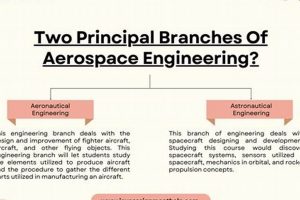
The field encompassing the design, development, and production of aircraft that operate within Earth’s atmosphere is distinct from the broader engineering discipline focusing on vehicles and systems operating both within and outside the atmosphere. One area deals primarily with flight within the air, while the other addresses flight in air and space. Consider the design of a commercial airliner focused on fuel efficiency and passenger comfort compared to the design of a satellite intended for communication or observation in orbit. These examples highlight the operational environment as a key differentiator.
Understanding the distinction is vital for individuals pursuing careers in aviation and space exploration. This knowledge informs educational choices, research focus, and professional specializations. Historically, the field primarily concerned with atmospheric flight predates that which encompassed space-bound vehicles. The advancement of rocket technology and satellite development necessitated a more inclusive field to address the challenges of operating in the vacuum of space and the extreme conditions encountered during atmospheric reentry.
This article will delve into the specific characteristics, core principles, and career paths associated with each specialization. Differences in curriculum, required skills, and industry applications will be examined. Furthermore, the future trends and emerging technologies shaping both domains will be discussed, providing a comprehensive overview of their distinct roles within the broader landscape of flight and space technology.
Key Considerations in Specializing
The choice between specializing in one engineering discipline or the other requires careful consideration of individual interests, aptitudes, and career aspirations. A thorough self-assessment is crucial.
Tip 1: Evaluate Foundational Knowledge. A solid understanding of physics, mathematics, and computer science is paramount. Deficiencies in these areas may necessitate additional coursework or focused study before pursuing advanced studies.
Tip 2: Assess Interest in Specific Environments. A genuine interest in atmospheric phenomena and aircraft design suggests the former engineering field. Conversely, a fascination with spacecraft, orbital mechanics, and extraterrestrial environments points toward the latter.
Tip 3: Research Curriculum Differences. University programs vary significantly in their course offerings. Comparing the specific courses, research opportunities, and faculty expertise is essential for selecting a program that aligns with individual goals.
Tip 4: Explore Career Path Options. Investigate potential career paths within each specialization. Consider the types of companies, research institutions, and government agencies that employ specialists in each area, and assess whether those roles align with long-term career ambitions.
Tip 5: Consider Hands-On Experience. Seek opportunities for internships, research projects, or extracurricular activities that provide practical experience. Participation in student design competitions or engagement with industry professionals can offer valuable insights.
Tip 6: Recognize the Overlap. While distinct, significant overlap exists between the two. Many engineering principles are applicable to both. A broad foundation in engineering fundamentals can provide flexibility and adaptability throughout a career.
Strategic planning and informed decision-making are crucial for navigating the specialized landscape of engineering. A well-defined understanding of individual strengths and aspirations, coupled with thorough research, increases the likelihood of a fulfilling and successful career.
The next section will explore specific career paths and required skills sets associated with each engineering focus, providing a clearer picture of the professional landscape.
1. Atmospheric flight

Atmospheric flight, the movement of vehicles through Earth’s atmosphere, represents a core element differentiating aeronautics from the broader field that includes aerospace engineering. The design, construction, and operation of aircraft specifically optimized for performance within the atmosphere fall squarely within the domain of aeronautical engineering. These vehicles are subject to aerodynamic forces, atmospheric conditions, and gravitational constraints distinct from those encountered in space. For example, the design of a Boeing 787 relies heavily on optimizing lift-to-drag ratio for efficient long-distance travel through the atmosphere, a consideration less critical for spacecraft designed for vacuum environments.
The mastery of atmospheric flight principles is essential for aeronautical engineers. This mastery necessitates a deep understanding of aerodynamics, propulsion systems designed for atmospheric conditions (such as jet engines), and structural materials optimized for the stresses of atmospheric flight. Consider the ongoing advancements in wing design, aimed at reducing turbulence and improving fuel efficiency. These advancements represent a direct application of atmospheric flight knowledge to the field of aeronautical engineering. Similarly, the development of advanced flight control systems, essential for safe and efficient navigation through varying atmospheric conditions, underscores the practical application of this understanding.
In conclusion, atmospheric flight forms a foundational pillar of aeronautical engineering, distinguishing it from the broader scope of aerospace engineering. The challenges and opportunities presented by atmospheric flight drive innovation in aircraft design, propulsion, and control systems. A comprehensive understanding of these principles is critical for anyone seeking to contribute to the continued advancement of aviation technology. While aerospace engineers may consider atmospheric flight as part of a broader mission profile (e.g., atmospheric entry), aeronautical engineers focus primarily, if not exclusively, on vehicles and systems operating within this specific environment.
2. Spacecraft operation

Spacecraft operation, encompassing the command, control, and monitoring of vehicles in outer space, serves as a critical delineator between aeronautics and aerospace engineering. While aeronautics focuses on flight within Earth’s atmosphere, aerospace engineering extends to the design, development, and operation of spacecraft beyond the atmosphere. Spacecraft operation inherently addresses challenges absent in aeronautical contexts, such as orbital mechanics, radiation exposure, and communication across vast distances. A direct consequence of this distinction is the specialized skill sets required. An aeronautical engineer might prioritize aerodynamic efficiency, whereas an aerospace engineer involved in spacecraft operation must prioritize maintaining stable communication links with ground stations, managing onboard power resources, and executing trajectory corrections in the vacuum of space.
The significance of spacecraft operation is underscored by its essential role in achieving mission objectives, whether scientific discovery, communication relay, or national security. Consider the operation of the James Webb Space Telescope. Its complex deployment sequence, precise mirror alignment, and ongoing data acquisition are all meticulously managed by aerospace engineers specializing in spacecraft operation. The success of this mission hinges not only on the initial design and construction of the telescope but also on the expertise of those who control it remotely. Similarly, the International Space Station relies on constant operational management to ensure the safety of its crew, the functionality of its life support systems, and the execution of its research programs. These examples demonstrate the practical importance of understanding orbital mechanics, telemetry analysis, and anomaly resolution in a space-based environment.
In summary, spacecraft operation represents a core competency within aerospace engineering, distinctly separating it from aeronautics. The unique challenges associated with operating vehicles in space necessitate specialized knowledge and skills. While both fields contribute to the advancement of flight technology, the focus on orbital mechanics, remote control, and the space environment defines the boundaries of aerospace engineering and distinguishes it from its aeronautical counterpart. Continued advancements in spacecraft operation are essential for expanding human presence in space and unlocking the potential for scientific and technological breakthroughs. However, challenges persist in areas such as mitigating space debris, ensuring cybersecurity for satellite networks, and developing autonomous spacecraft capable of operating independently for extended periods.
3. Vehicle design

Vehicle design serves as a central point of divergence between aeronautics and aerospace engineering. The specific operational environment, dictated by whether a vehicle is intended primarily for atmospheric or exo-atmospheric flight, necessitates fundamentally different design considerations. In aeronautics, vehicle design prioritizes aerodynamic efficiency, lift generation, and structural integrity within the constraints of Earth’s atmosphere. Aircraft such as the Airbus A350 exemplify this, featuring wing designs optimized for fuel efficiency and passenger comfort at cruising altitudes. Conversely, in aerospace engineering, vehicle design confronts the challenges of operating in a vacuum, enduring extreme temperature variations, and withstanding the stresses of launch and reentry. The design of the Orion spacecraft, for instance, incorporates heat shields to protect against atmospheric reentry and propulsion systems capable of orbital maneuvers, features largely irrelevant in purely aeronautical designs.
The distinct design priorities stem directly from the physics governing each environment. Atmospheric flight is heavily influenced by Bernoulli’s principle and the interaction of airfoils with the atmosphere. Vehicle design in this context focuses on minimizing drag and maximizing lift. Therefore, wing shape, fuselage streamlining, and engine placement are critical considerations. In contrast, spacecraft design emphasizes factors such as radiation shielding, thermal management, and propulsion systems optimized for vacuum conditions. Consider the development of ion thrusters, which provide efficient propulsion in space but are ineffective within Earth’s atmosphere. Material selection also differs significantly; aerospace vehicles often require specialized alloys and composite materials to withstand the extreme temperatures and radiation encountered in space.
In summary, vehicle design stands as a key differentiating factor when comparing aeronautics and aerospace engineering. The operational environment exerts a profound influence on design considerations, leading to distinct solutions for aircraft and spacecraft. Understanding these differences is essential for engineers working in either field, as it informs their approach to problem-solving and innovation. Future advancements in both areas will likely depend on continued specialization and the development of novel materials and technologies tailored to the specific challenges of atmospheric and exo-atmospheric flight. Challenges remain in areas like sustainable aviation fuels and cost-effective space access, highlighting the ongoing need for innovative design solutions in both domains.
4. Orbital Mechanics

Orbital mechanics, also known as astrodynamics, represents a critical distinction between aeronautics and aerospace engineering. Its principles govern the motion of spacecraft and celestial bodies under the influence of gravitational forces, a domain largely irrelevant to vehicles operating solely within Earth’s atmosphere. Understanding orbital mechanics is paramount for aerospace engineers involved in satellite design, mission planning, and space exploration. This knowledge enables the precise prediction and manipulation of spacecraft trajectories, ensuring mission success and efficient resource utilization.
- Keplerian Elements
The six Keplerian elements (semi-major axis, eccentricity, inclination, longitude of the ascending node, argument of periapsis, and true anomaly) provide a comprehensive description of an orbit’s size, shape, and orientation in space. Aerospace engineers utilize these elements to define target orbits, calculate orbital maneuvers, and predict spacecraft positions. For instance, determining the correct Keplerian elements is essential for placing a communication satellite into a geostationary orbit, ensuring continuous coverage over a specific geographical region. Aeronautical engineering does not require this level of understanding of celestial mechanics, because it happens within earths atmosphere.
- Orbital Maneuvers
Orbital maneuvers involve altering a spacecraft’s trajectory through the application of thrust. These maneuvers are essential for tasks such as orbital insertion, rendezvous, and deorbiting. The Hohmann transfer orbit, a common technique for transferring between two circular orbits, exemplifies the application of orbital mechanics principles. Aerospace engineers must calculate the required thrust magnitude and direction, as well as the precise timing of the maneuver, to achieve the desired orbital change. Correct calculation is vital in missions such as launching space telescopes that would then be used in space to do its purpose.
- Perturbations
Real-world orbits are subject to perturbations, deviations from idealized Keplerian motion caused by factors such as the gravitational influence of other celestial bodies, atmospheric drag (in low Earth orbit), and solar radiation pressure. Accurate modeling of these perturbations is crucial for long-duration missions. Aerospace engineers employ sophisticated mathematical models to predict and compensate for these effects, ensuring that spacecraft remain on their intended trajectories. Perturbations must be taken seriously when dealing in space, while there are instances of perturbances in earth, its effects are smaller and manageable.
- Interplanetary Trajectories
Designing trajectories for interplanetary missions requires advanced knowledge of orbital mechanics, including patched conic approximations and gravity assists. These techniques enable spacecraft to travel vast distances with minimal fuel consumption. Mission planners utilize complex computer simulations to optimize trajectories, taking into account the positions of planets, the Sun’s gravitational influence, and the spacecraft’s propulsion capabilities. When launching an interplanetary spacecraft, knowing the dynamics of planet and the sun is vital for this action because you might lose the spaceship and the spacecraft will be in the mercy of the unknown. On earth, aerodynamics is one factor to launching rockets.
In conclusion, orbital mechanics provides the theoretical framework for understanding and manipulating spacecraft motion, a domain largely absent in aeronautical engineering. The principles of orbital mechanics enable the design of efficient missions, the precise control of spacecraft trajectories, and the exploration of our solar system. While aeronautical engineering focuses on flight within Earth’s atmosphere, aerospace engineering leverages orbital mechanics to extend human reach beyond our planet. The expertise required to accurately model orbital dynamics and plan orbital maneuvers highlights a crucial divergence between the two disciplines, underscoring the specialized skill sets required for space-based activities.
5. Propulsion systems

Propulsion systems represent a critical intersection between aeronautics and aerospace engineering, yet distinct requirements arise from the operational environments within and beyond Earth’s atmosphere. The design, functionality, and optimization of these systems are tailored to the specific challenges posed by atmospheric flight versus space travel, making propulsion a key differentiator between the two fields.
- Air-Breathing Engines
Air-breathing engines, such as turbojets, turbofans, and ramjets, rely on atmospheric air for combustion. These engines are the mainstay of aeronautical propulsion, powering commercial airliners, military aircraft, and various other atmospheric vehicles. The design and efficiency of air-breathing engines are heavily influenced by factors such as altitude, airspeed, and ambient temperature. Optimization involves complex aerodynamic analyses and advanced material science to maximize thrust and minimize fuel consumption within the atmosphere. While certain hypersonic aerospace vehicles may utilize air-breathing engines for a portion of their flight profile, their primary application remains within the realm of aeronautics.
- Rocket Engines
Rocket engines, unlike air-breathing engines, carry their own oxidizer, enabling them to operate in the vacuum of space. These engines are essential for spacecraft propulsion, orbital maneuvers, and interplanetary travel. Rocket engine design involves considerations such as specific impulse (a measure of engine efficiency), thrust-to-weight ratio, and propellant selection. Chemical rockets, using liquid or solid propellants, are the most common type, but advanced concepts like ion thrusters and nuclear propulsion are also being explored for future space missions. Rocket engines are the domain of aerospace engineering, critical for achieving and maintaining flight outside the atmosphere, an area where air-breathing engines are ineffective.
- Hybrid Propulsion Systems
Hybrid propulsion systems combine elements of both air-breathing and rocket engines to achieve greater versatility. For example, a rocket-based combined cycle (RBCC) engine can operate as a ramjet in the atmosphere and transition to rocket mode in space. These systems are particularly relevant for vehicles designed for both atmospheric and exo-atmospheric flight, such as reusable launch vehicles and hypersonic aircraft. The development of hybrid propulsion systems requires expertise in both aeronautics and aerospace engineering, blurring the lines between the two disciplines. The design challenges lie in integrating the disparate technologies and optimizing performance across a wide range of operating conditions.
- Electric Propulsion
Electric propulsion systems, such as ion thrusters and Hall-effect thrusters, use electric fields to accelerate ionized propellant, generating thrust. While these systems produce relatively low thrust levels, they offer significantly higher specific impulse compared to chemical rockets, making them ideal for long-duration space missions. Electric propulsion is primarily used for station-keeping, orbit raising, and deep-space exploration. The development and application of electric propulsion technologies fall squarely within the domain of aerospace engineering, as they are not suitable for atmospheric flight due to their low thrust-to-weight ratio. As space exploration becomes more ambitious, the demand for efficient and reliable electric propulsion systems is expected to grow.
In summary, the design and application of propulsion systems provide a clear illustration of the distinctions between aeronautics and aerospace engineering. While air-breathing engines are the workhorses of atmospheric flight, rocket engines and electric propulsion systems are essential for space travel. Hybrid systems represent a convergence of these technologies, enabling vehicles to operate in both environments. Understanding the nuances of propulsion technology is crucial for engineers working in either field, as it directly impacts vehicle performance, mission capabilities, and overall system efficiency. Future advancements in propulsion are likely to drive innovation in both aeronautics and aerospace engineering, enabling new possibilities for air travel and space exploration.
6. Material science

Material science plays a pivotal role in both aeronautics and aerospace engineering, albeit with varying emphasis and requirements dictated by the operational environment of each discipline. The selection, development, and application of materials are crucial for ensuring structural integrity, performance efficiency, and overall mission success.
- High Strength-to-Weight Ratio Materials
Both aeronautical and aerospace applications demand materials with a high strength-to-weight ratio to minimize structural mass and maximize payload capacity. In aeronautics, aluminum alloys, titanium alloys, and composite materials (such as carbon fiber reinforced polymers) are commonly used in aircraft structures to achieve this goal. For example, the Boeing 787 Dreamliner utilizes a significant amount of composite materials in its fuselage and wings, resulting in improved fuel efficiency. In aerospace engineering, the requirements are even more stringent due to the added stresses of launch and the harsh conditions of space. Materials like beryllium and advanced composites are employed in spacecraft structures to withstand extreme temperatures and radiation exposure.
- High-Temperature Materials
Aerospace vehicles, particularly those designed for atmospheric reentry, encounter extremely high temperatures due to aerodynamic heating. Material science plays a crucial role in developing materials capable of withstanding these extreme temperatures without compromising structural integrity. Ceramic matrix composites (CMCs) and heat-resistant alloys are used in thermal protection systems (TPS) to shield spacecraft from the intense heat generated during reentry. The Space Shuttle, for instance, utilized ceramic tiles as part of its TPS. In aeronautics, high-temperature materials are essential for engine components, such as turbine blades, which operate under extreme thermal stress. Nickel-based superalloys are commonly used in these applications to maintain strength and creep resistance at elevated temperatures.
- Radiation-Resistant Materials
Spacecraft operating in Earth orbit or deep space are exposed to high levels of ionizing radiation, which can degrade material properties and damage sensitive electronic components. Material science addresses this challenge by developing radiation-resistant materials and coatings. For example, tantalum and tungsten are used as shielding materials to protect electronic components from radiation damage. The choice of materials for spacecraft electronics must also consider their radiation susceptibility. In contrast, radiation resistance is generally less of a concern in aeronautics, as aircraft operate within the protective shield of Earth’s atmosphere.
- Corrosion-Resistant Materials
Both aircraft and spacecraft are susceptible to corrosion, which can compromise structural integrity and lead to catastrophic failures. Material science focuses on developing corrosion-resistant materials and surface treatments to mitigate this risk. Aluminum alloys are widely used in aircraft structures due to their good corrosion resistance, but they are often treated with protective coatings to further enhance their durability. Spacecraft materials must also withstand corrosion from exposure to atomic oxygen and other reactive species in the space environment. Passivation techniques and protective coatings are employed to prevent corrosion and ensure long-term reliability.
In summary, material science provides the foundation for selecting and developing materials that meet the stringent requirements of both aeronautics and aerospace engineering. While both disciplines share the need for high strength-to-weight ratio materials, aerospace applications require additional considerations such as high-temperature resistance and radiation resistance. The ongoing advancement of material science is crucial for enabling future progress in both fields, leading to safer, more efficient, and more capable aircraft and spacecraft. The unique needs and environments of the two engineering fields will ensure that new materials and engineering applications remain distinct for aeronautics vs aerospace engineering.
7. Control systems
Control systems represent a cornerstone technology in both aeronautics and aerospace engineering, enabling the safe and efficient operation of aircraft and spacecraft. The complexity and demands placed upon these systems vary significantly depending on the operational environment, leading to distinct design considerations for each discipline.
- Flight Control Surfaces and Actuation Systems
In aeronautics, control systems govern the movement of flight control surfaces (ailerons, elevators, rudder) to manipulate the aircraft’s attitude and trajectory within the atmosphere. Actuation systems, which may be hydraulic, electric, or fly-by-wire, translate pilot inputs or autopilot commands into precise movements of these surfaces. A commercial airliner’s autopilot system, for example, utilizes complex algorithms to maintain altitude, heading, and airspeed, even in turbulent conditions. Conversely, spacecraft control systems may employ reaction wheels, control moment gyros, or thrusters to adjust orientation in the vacuum of space, where aerodynamic control surfaces are ineffective. The International Space Station, for instance, uses control moment gyros to maintain its orientation without expending propellant.
- Navigation and Guidance Systems
Navigation and guidance systems provide aircraft and spacecraft with information about their position, velocity, and attitude, enabling them to follow predetermined trajectories or reach specific destinations. Aeronautical navigation systems often rely on inertial navigation systems (INS), GPS, and radio beacons to determine position. Aircraft autopilots integrate navigation data to follow flight plans and execute approaches to airports. Aerospace guidance systems, on the other hand, must account for orbital mechanics and the gravitational influence of celestial bodies. Spacecraft utilize star trackers, sun sensors, and onboard accelerometers to determine their orientation and position in space. Trajectory control algorithms, often based on Kalman filtering, are used to minimize errors and maintain accurate navigation during long-duration missions.
- Stability Augmentation Systems
Stability augmentation systems enhance the inherent stability of aircraft and spacecraft, improving handling qualities and reducing pilot workload. In aeronautics, these systems may include yaw dampers, which counteract Dutch roll oscillations, and active flutter suppression systems, which prevent structural vibrations. Military aircraft often incorporate sophisticated stability augmentation systems to enable precise maneuvering at high speeds and altitudes. In aerospace engineering, stability augmentation systems are crucial for maintaining the orientation of spacecraft in the presence of disturbances such as solar radiation pressure and gravity gradient torques. Reaction wheels and thrusters are used to counteract these disturbances and maintain stable pointing for scientific instruments or communication antennas.
- Autonomous Control Systems
Autonomous control systems enable aircraft and spacecraft to operate without direct human intervention, performing tasks such as reconnaissance, surveillance, and exploration. Unmanned aerial vehicles (UAVs) utilize autonomous control systems to follow pre-programmed flight paths, avoid obstacles, and collect data. These systems rely on advanced sensors, such as lidar and cameras, to perceive their environment and make decisions in real-time. In aerospace engineering, autonomous control systems are essential for long-duration space missions and planetary exploration. Spacecraft equipped with autonomous navigation and control capabilities can perform scientific observations, collect samples, and return data to Earth without constant human supervision.
In conclusion, control systems are indispensable for both aeronautics and aerospace engineering, enabling the safe and efficient operation of vehicles in diverse environments. While both disciplines rely on feedback control principles and advanced algorithms, the specific technologies and design considerations differ significantly. Aeronautical control systems prioritize aerodynamic control and atmospheric navigation, whereas aerospace control systems focus on orbital mechanics, attitude control in a vacuum, and autonomous operation in remote environments. The ongoing development of advanced control systems is crucial for enabling future progress in both air and space travel.
Frequently Asked Questions
This section addresses common inquiries regarding the distinctions and similarities between the fields of aeronautics and aerospace engineering, providing clarity on their respective scopes and applications.
Question 1: Is aerospace engineering simply a more advanced version of aeronautical engineering?
Aerospace engineering is not merely an advanced iteration of aeronautical engineering; rather, it is a broader field encompassing both atmospheric and exo-atmospheric flight. Aeronautical engineering is specifically focused on the design, development, and operation of aircraft that operate within Earth’s atmosphere, while aerospace engineering extends to spacecraft and related technologies operating beyond the atmosphere.
Question 2: Can an aeronautical engineer work on spacecraft design?
While aeronautical engineers possess a strong foundation in aerodynamics and structural mechanics relevant to aircraft design, spacecraft design requires specialized knowledge of orbital mechanics, propulsion systems for vacuum environments, and materials capable of withstanding extreme temperatures and radiation. Aeronautical engineers may transition to spacecraft design roles with additional training and experience, but direct entry is uncommon.
Question 3: What are the primary differences in the curriculum for aeronautical and aerospace engineering programs?
Aeronautical engineering curricula typically emphasize aerodynamics, aircraft structures, propulsion systems for atmospheric flight, and flight control systems. Aerospace engineering curricula include these topics but also incorporate orbital mechanics, spacecraft propulsion, satellite communications, and spacecraft design. Aerospace programs generally require a stronger background in mathematics and physics due to the complexities of spaceflight.
Question 4: Is it possible to specialize in both aeronautics and aerospace engineering concurrently?
While some universities may offer dual degree programs or specialized tracks that combine elements of both aeronautics and aerospace engineering, pursuing expertise in both fields concurrently is challenging due to the breadth and depth of knowledge required. It is more common to specialize in one field and gain additional knowledge in the other through coursework or professional experience.
Question 5: What career paths are typically available for graduates of aeronautical and aerospace engineering programs?
Aeronautical engineering graduates find employment in aircraft design and manufacturing, airline operations, air traffic control, and government regulatory agencies. Aerospace engineering graduates pursue careers in spacecraft design and manufacturing, satellite operations, space exploration, and related research institutions. Both fields offer opportunities in research and development, testing, and project management.
Question 6: How has historical trends affect aeronautics vs aerospace engineering?
Historically, aeronautics emerged as a distinct field prior to the advent of spaceflight. The development of rocket technology and the initiation of space exploration efforts necessitated the creation of aerospace engineering as a broader discipline encompassing both atmospheric and exo-atmospheric activities. The Cold War space race further accelerated the growth and specialization within both fields, leading to significant advancements in aircraft and spacecraft technology.
In summary, while both aeronautics and aerospace engineering share a common foundation in engineering principles, their distinct focus on atmospheric versus exo-atmospheric flight leads to significant differences in curriculum, skill sets, and career opportunities. Understanding these differences is crucial for individuals seeking to specialize in either field.
The next section will delve into the future trends and emerging technologies shaping both domains, providing insight into the evolving landscape of air and space technology.
Aeronautics vs. Aerospace Engineering
This article has explored the fundamental distinctions between aeronautics and aerospace engineering, outlining their unique focuses, operational environments, and technical requirements. The examination of atmospheric flight, spacecraft operation, vehicle design, orbital mechanics, propulsion systems, material science, and control systems has revealed the specialized knowledge and skill sets demanded by each discipline.
Continued advancements in both aeronautics and aerospace engineering are vital for addressing global challenges and expanding the boundaries of human knowledge. Understanding the nuances between these fields will empower future engineers to contribute to innovations in air travel, space exploration, and the development of sustainable technologies for both atmospheric and exo-atmospheric environments. The pursuit of excellence in both realms remains paramount for progress in the 21st century and beyond.