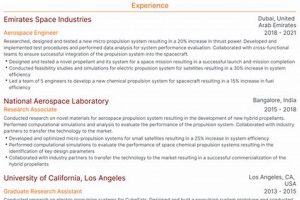
A document articulating an applicant’s qualifications, aspirations, and reasons for pursuing graduate studies in the field concerned. It serves as a critical component of the application package, offering insights beyond academic transcripts and test scores. This written submission provides a narrative of the applicant’s past experiences, current interests, and future goals within the selected area of study. For example, a candidate might detail their undergraduate research in propulsion systems, their motivation stemming from a childhood fascination with aviation, and their ambition to contribute to advancements in sustainable air travel.
The significance of this document lies in its ability to demonstrate an applicant’s suitability and commitment to advanced learning. It allows admissions committees to assess an individual’s passion, problem-solving skills, and alignment with the program’s research focus. Historically, while application forms and standardized tests have been used, this personalized narrative has become increasingly important as institutions seek students with intrinsic motivation and clear vision. The benefits derived from a well-crafted submission include a stronger application, improved chances of acceptance, and a clearer understanding of the applicant’s own objectives.
The subsequent sections will delve into the essential elements comprising a compelling submission, strategies for highlighting relevant experiences, and advice on tailoring the content to specific institutional requirements. Attention will be given to common pitfalls to avoid and techniques for demonstrating a genuine enthusiasm for contributing to the field. The objective is to provide a framework for crafting a powerful statement that effectively showcases the applicant’s potential for success.
Crafting a Compelling Statement
This section provides actionable strategies for constructing a strong articulation of intent when applying to graduate programs. Adhering to these guidelines can significantly enhance an application’s competitiveness.
Tip 1: Articulate Specific Research Interests: A vague expression of interest in the field is insufficient. Clearly define areas of specialization, such as computational fluid dynamics, space systems engineering, or advanced materials. Provide examples of research topics within these areas that resonate with the applicant.
Tip 2: Showcase Relevant Experience: Detail any prior experiences, including internships, research projects, or relevant coursework, and quantify the impact. For example, rather than stating “Assisted with wind tunnel testing,” specify “Conducted wind tunnel tests on airfoil designs, resulting in a 15% reduction in drag coefficient.”
Tip 3: Align Goals with Program Strengths: Research faculty expertise and program resources. Explicitly connect the applicant’s aspirations with the specific opportunities available within the desired program. Acknowledge professors whose research aligns with the applicant’s interests.
Tip 4: Demonstrate a Clear Understanding of the Field: Illustrate familiarity with current challenges and future trends in aerospace engineering. Discuss relevant technological advancements, such as electric propulsion, autonomous systems, or sustainable aviation practices, to demonstrate informed perspective.
Tip 5: Emphasize Problem-Solving Skills: Highlight instances where the applicant effectively addressed technical challenges. Describe the problem, the approach used, and the outcome achieved, demonstrating critical thinking and analytical abilities.
Tip 6: Maintain Conciseness and Clarity: Avoid overly complex language and unnecessary jargon. Focus on conveying information in a clear and concise manner. Employ strong action verbs and avoid passive voice to enhance readability.
Tip 7: Proofread Meticulously: Errors in grammar and spelling undermine the applicant’s credibility. Thoroughly proofread the document and seek feedback from others to ensure accuracy and professionalism.
These strategies aim to present a clear, compelling narrative that highlights an applicant’s qualifications, aspirations, and suitability for graduate-level studies. Adherence to these principles can significantly increase the likelihood of acceptance.
The subsequent discussion will explore common errors to avoid and further refine the construction of a persuasive document.
1. Research alignment

Research alignment constitutes a cornerstone of an effective application. This alignment reflects the extent to which an applicant’s research interests and goals correspond with the expertise and ongoing projects of faculty within the target department. A lack of this alignment weakens the application, suggesting a mismatch between the applicant’s aspirations and the resources available at the institution. Establishing this connection demonstrates due diligence and a realistic understanding of the program’s capabilities.
The consequences of neglecting research alignment are multifaceted. Admissions committees prioritize candidates whose interests directly contribute to or benefit from existing research initiatives. For example, an applicant interested in hypersonic vehicle design should identify faculty specializing in aerodynamics or propulsion systems relevant to that domain. Vaguely expressing interest without referencing specific faculty or projects suggests a lack of preparation and focus. Conversely, a targeted application highlighting compatible research areas strengthens the candidate’s profile, signaling a potential for immediate and meaningful contributions.
In summary, aligning research interests with faculty expertise is essential for a successful application. This component demonstrates an understanding of the program’s strengths and the applicant’s potential to contribute to ongoing research. Failing to establish this connection weakens the application and suggests a mismatch between the applicant’s goals and the institution’s resources. A strong research alignment strengthens the narrative and significantly enhances the likelihood of acceptance.
2. Quantifiable experience

Quantifiable experience, a cornerstone of a persuasive aerospace engineering statement of purpose, denotes the practice of expressing accomplishments and contributions using numerical metrics and concrete data. It shifts the emphasis from generalized claims of participation or involvement to a demonstration of tangible results. This approach serves as a mechanism for validating skills and illustrating the impact of an applicant’s previous endeavors. The inclusion of quantifiable data enhances credibility and provides admissions committees with objective evidence of capabilities. For instance, rather than stating “Improved the performance of a drone,” an applicant might articulate, “Increased the drone’s flight endurance by 18% through optimized airfoil design and motor selection.” The latter statement provides a specific, measurable outcome, lending weight to the applicant’s claim.
The practical significance of integrating quantifiable experience within the statement of purpose extends to its effect on application review. Admissions committees often evaluate numerous applications, and those that provide concrete evidence of achievement stand out. Consider a student who interned at a propulsion company. Instead of writing, “Contributed to engine testing,” the applicant could state, “Analyzed data from 50+ engine tests, identifying a correlation between fuel injector pressure and combustion efficiency, leading to a recommendation for a 7% increase in pressure.” This specificity demonstrates analytical skills and a proactive approach. Moreover, quantifying experience allows for direct comparison between candidates, enabling the committee to identify individuals who have demonstrably exceeded expectations or achieved significant outcomes.
In summary, the strategic incorporation of quantifiable experience is paramount in crafting an effective aerospace engineering statement of purpose. It transforms subjective assertions into objective evidence, enhancing credibility and facilitating a more informed evaluation by admissions committees. The challenge lies in identifying and articulating meaningful metrics that accurately reflect the impact of past experiences. By focusing on concrete results and using data to support claims, applicants can significantly strengthen their narratives and increase their chances of admission.
3. Faculty Connection
Establishing a demonstrable connection with faculty members within the intended aerospace engineering program is a critical component of a successful statement of purpose. This connection signals a clear understanding of the department’s research focus, faculty expertise, and potential opportunities for collaboration, thereby strengthening the applicant’s overall profile.
- Demonstrating Familiarity with Faculty Research
Applicants must explicitly demonstrate knowledge of specific faculty members’ research areas and contributions. This goes beyond a superficial understanding; it requires in-depth familiarity with publications, projects, and research methodologies. For example, referencing a particular professor’s work on computational fluid dynamics for hypersonic vehicles demonstrates a targeted interest and suggests a potential for meaningful contributions to their research group. It indicates the applicant has invested time in understanding the department’s intellectual landscape.
- Articulating Alignment of Research Interests
The statement should clearly articulate how the applicant’s research interests align with those of specific faculty members. This requires identifying overlapping areas of expertise and expressing a desire to contribute to existing projects. If an applicant is interested in advanced materials for aerospace structures, the statement should explicitly connect this interest to faculty members working in that domain. This alignment suggests a potential for synergy and enhances the likelihood of a fruitful research experience.
- Highlighting Relevant Skills and Experiences
Applicants should showcase relevant skills and experiences that complement the research interests of targeted faculty members. This could include specific software proficiency, experimental techniques, or theoretical knowledge. For example, an applicant with experience in finite element analysis should highlight this skill when expressing interest in a faculty member’s work on structural mechanics. This demonstrates the applicant’s preparedness and potential to contribute immediately to ongoing research efforts.
- Expressing a Desire for Collaboration
The statement should explicitly express a desire to collaborate with specific faculty members on research projects. This demonstrates initiative and a proactive approach to research. Applicants should articulate how their skills and interests can contribute to the faculty member’s research goals and express a willingness to learn from their expertise. This establishes a foundation for a potential mentor-mentee relationship and enhances the applicant’s overall appeal.
In conclusion, actively cultivating and explicitly articulating a connection with faculty within the statement of purpose demonstrates genuine interest, preparedness, and a clear understanding of the aerospace engineering program’s research environment. This connection serves as a powerful indicator of an applicant’s potential for success and significantly enhances their chances of admission. This element helps transform the document from a general application to a tailored argument for a mutually beneficial relationship with the faculty and institution.
4. Field awareness

In the context of an aerospace engineering statement of purpose, field awareness signifies a comprehensive understanding of current challenges, emerging trends, and significant advancements within the aerospace industry and its related academic disciplines. This understanding demonstrates that an applicant is not only academically prepared but also possesses a forward-looking perspective and the capacity to contribute meaningfully to the field’s future.
- Understanding Current Challenges
Field awareness requires a grasp of the pressing issues facing the aerospace sector, such as sustainable aviation, space debris mitigation, and the development of autonomous flight systems. Demonstrating knowledge of these challenges in the statement of purpose indicates an ability to identify areas where research and innovation are critically needed. For example, acknowledging the environmental impact of traditional jet fuel and expressing interest in researching alternative propulsion methods highlights both awareness and a proactive mindset.
- Knowledge of Emerging Technologies
A strong statement will showcase awareness of cutting-edge technologies reshaping the aerospace landscape, including additive manufacturing, advanced composite materials, and artificial intelligence applications in flight control and data analysis. Citing specific examples, such as the use of topology optimization in aircraft design or the application of machine learning to predict engine failures, illustrates an applicant’s engagement with the latest developments and their potential to leverage these technologies in future research.
- Grasp of Regulatory and Ethical Considerations
Beyond technical knowledge, field awareness also encompasses an understanding of the regulatory frameworks and ethical considerations governing aerospace activities. This includes familiarity with international space law, FAA regulations, and the ethical implications of autonomous systems. A statement that addresses these aspects demonstrates a holistic perspective and a commitment to responsible innovation. For instance, acknowledging the challenges of ensuring equitable access to space or the potential risks of autonomous weapon systems indicates a nuanced understanding of the broader societal implications of aerospace engineering.
- Appreciation for Interdisciplinary Connections
Aerospace engineering is inherently interdisciplinary, drawing on expertise from fields such as materials science, computer science, and electrical engineering. A statement of purpose that acknowledges these connections and highlights relevant interdisciplinary skills demonstrates a broad perspective and an ability to collaborate effectively with experts from diverse backgrounds. Examples include discussing the role of advanced sensors in improving aircraft safety or the importance of cybersecurity in protecting satellite communications systems.
Integrating field awareness into an aerospace engineering statement of purpose transforms it from a simple recitation of past achievements into a compelling vision for future contributions. By demonstrating an understanding of the industry’s challenges, emerging technologies, regulatory landscape, and interdisciplinary connections, applicants can showcase their readiness to engage with the complex and evolving world of aerospace engineering and position themselves as valuable assets to the program and the field as a whole.
5. Problem-solving

Problem-solving skills are paramount within the field of aerospace engineering, and the statement of purpose serves as a key platform to demonstrate proficiency in this area. The ability to identify, analyze, and resolve complex technical challenges is intrinsic to the discipline, and a successful applicant must effectively convey their capabilities in this regard. This section explores how demonstrable problem-solving abilities can be strategically incorporated into the statement to strengthen the overall application.
- Articulation of Technical Challenges Faced
The statement should explicitly detail specific technical challenges encountered during prior academic or professional experiences. This requires going beyond a mere description of tasks performed and instead focusing on the obstacles overcome. For example, an applicant might describe the challenges associated with designing a lightweight, high-strength composite wing structure, highlighting the complexities of material selection, load analysis, and manufacturing constraints. Detailing the specific hurdles faced demonstrates an understanding of the complexities inherent in aerospace engineering projects.
- Explanation of Methodologies Employed
Crucially, the statement must articulate the methodologies employed to address these challenges. This includes outlining the analytical techniques, computational tools, and experimental procedures utilized in the problem-solving process. An applicant could explain their use of computational fluid dynamics (CFD) software to optimize airfoil designs, detailing the iterative process of simulation, analysis, and refinement. By illustrating the problem-solving approach, the applicant demonstrates a structured and methodical mindset.
- Quantification of Results and Impact
Whenever possible, the statement should quantify the results achieved through problem-solving efforts. This involves presenting concrete data and metrics that demonstrate the positive impact of the applicant’s actions. For instance, an applicant might state that their optimized airfoil design resulted in a 15% reduction in drag, leading to a significant improvement in aircraft fuel efficiency. By providing quantifiable results, the applicant provides tangible evidence of their problem-solving abilities and their contributions to project success.
- Demonstration of Adaptability and Resilience
Aerospace engineering projects often encounter unforeseen setbacks and require adaptability and resilience. The statement should highlight instances where the applicant had to adjust their approach in response to unexpected challenges or failures. An example would be describing how an applicant adapted their experimental design after encountering equipment malfunctions, demonstrating resourcefulness and the ability to learn from mistakes. Showcasing adaptability and resilience underscores the applicant’s capacity to thrive in a demanding and dynamic environment.
In conclusion, effectively integrating descriptions of problem-solving experiences into the statement of purpose serves to underscore an applicant’s readiness for the rigors of graduate-level study in aerospace engineering. By detailing the challenges faced, the methodologies employed, the results achieved, and the lessons learned, applicants can present a compelling case for their admission to the program. These narratives must demonstrate both technical competence and the capacity for critical thinking, traits highly valued within the field.
6. Conciseness
Conciseness is a critical attribute of an effective statement of purpose for aerospace engineering graduate program applications. The document’s inherent limitations necessitate efficient communication. Admissions committees often review a substantial volume of applications, making brevity a virtue. Irrelevant details or verbose prose diminishes the impact of crucial qualifications and research interests. The statement must present a focused narrative, highlighting the applicant’s most compelling experiences and aspirations within the specified word or page limit. Overly elaborate explanations or tangential information dilute the message and reduce the likelihood of conveying the applicant’s suitability for the program.
Practical application of conciseness involves strategic editing and precise language. An applicant should avoid passive voice and replace lengthy phrases with direct, action-oriented verbs. Specific examples illustrating quantifiable achievements are more impactful than generalized statements. For instance, instead of stating “Contributed to the design of an aircraft,” a concise alternative would be “Designed a wing component reducing drag by 5%.” Eliminating redundant information and focusing on key accomplishments optimizes the statement’s readability and strengthens its persuasive impact. Furthermore, tailoring the content to directly address the program’s specific research areas and faculty expertise ensures that every sentence contributes meaningfully to the overall narrative.
The challenge in achieving conciseness lies in effectively distilling complex experiences and ideas into a succinct and compelling narrative. However, the benefits are significant. A concise statement of purpose demonstrates an applicant’s ability to communicate effectively, a skill highly valued in the aerospace engineering profession. It also ensures that the most important information is easily accessible to the admissions committee, increasing the likelihood that the applicant’s qualifications will be fully appreciated. Ultimately, conciseness enhances the overall impact of the statement, positioning the applicant as a focused, articulate, and well-prepared candidate for graduate study.
Frequently Asked Questions
The following section addresses common inquiries regarding the formulation and purpose of statements of intent for aerospace engineering graduate program applications. These responses aim to clarify expectations and provide guidance for prospective applicants.
Question 1: What is the optimal length for this document?
While specific requirements vary across institutions, a typical length is one to two pages, single-spaced, using a standard font size (11 or 12 point) and reasonable margins. Adherence to the institution’s specified length is critical. Exceeding the stated limit may negatively impact the application’s evaluation.
Question 2: How much emphasis should be placed on past academic achievements versus future research goals?
A balanced approach is recommended. Past academic achievements demonstrate foundational knowledge and capabilities, while future research goals illustrate vision and alignment with the program’s focus. The statement should clearly connect prior experiences to aspirations, showing a logical progression toward the intended research area.
Question 3: Is it acceptable to reuse portions of this document from other applications?
While leveraging previously written material may seem efficient, tailoring the statement to each specific program is essential. Institutions seek applicants who demonstrate a genuine interest in their particular research areas and faculty. A generic document suggests a lack of focused interest and may weaken the application.
Question 4: Should weaknesses in academic performance be addressed in the statement?
Addressing weaknesses can be beneficial if done strategically. Focus on explaining the circumstances that contributed to the underperformance and, more importantly, emphasize the steps taken to overcome those challenges. Frame the experience as a learning opportunity that fostered resilience and growth. Avoid dwelling on the negativity; instead, showcase a commitment to improvement.
Question 5: What is the appropriate tone to adopt in the statement?
A professional, enthusiastic, and confident tone is recommended. Avoid overly informal language or excessive humility. The statement should convey a clear sense of purpose, intellectual curiosity, and a genuine passion for aerospace engineering. The applicant’s voice should be authentic and engaging, reflecting their unique perspective and aspirations.
Question 6: How important is it to proofread the statement carefully?
Meticulous proofreading is paramount. Grammatical errors, typos, and stylistic inconsistencies detract from the overall credibility of the applicant. A polished, error-free statement demonstrates attention to detail and a commitment to excellence, qualities highly valued in the field of aerospace engineering. Seeking feedback from others before submission is strongly advised.
These FAQs provide a foundational understanding of key considerations in preparing a compelling statement of purpose. The following section will delve further into common pitfalls to avoid, thereby maximizing the applicant’s chances of success.
The next section will address common pitfalls to avoid to help improve this statement.
Conclusion
The preceding exploration has illuminated essential facets of an effective aerospace engineering statement of purpose. Critical elements, including research alignment, quantifiable experience, faculty connection, field awareness, problem-solving skills, and conciseness, collectively form a robust foundation for conveying an applicant’s suitability for graduate studies. Emphasis has been placed on the strategic articulation of relevant experiences, highlighting quantifiable results, and demonstrating a clear understanding of the field’s challenges and opportunities.
The creation of a compelling articulation requires diligence and thoughtful consideration. A well-crafted statement serves as a crucial differentiator in the competitive landscape of graduate admissions. Prospective applicants are encouraged to approach this task with meticulous attention, recognizing its significant impact on the trajectory of their academic and professional careers. The document represents a vital opportunity to showcase potential and contribute meaningfully to the advancement of aerospace engineering.