The capabilities of professionals in this field encompass a wide range of activities related to the design, development, testing, and production of aircraft and spacecraft. This includes, but is not limited to, the creation of aerodynamic models, propulsion systems, structural analysis, and control systems. For instance, these engineers may work on developing more fuel-efficient jet engines, designing the next generation of satellites, or improving the safety and reliability of space launch vehicles.
The contributions of these specialists are vital to advancements in air travel, space exploration, and national security. Their expertise ensures safer and more efficient air transportation, facilitates scientific research in space, and contributes to the development of technologies with both civilian and military applications. Historically, breakthroughs in these areas have led to significant societal and economic benefits, including increased global connectivity and technological innovation.
The subsequent sections will delve into specific tasks these engineers undertake, the technologies they employ, the challenges they face, and the career paths they pursue, providing a more detailed understanding of their multifaceted role in modern society.
Guidance for Aspiring Professionals
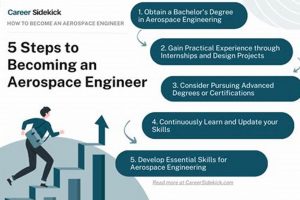
The following advice is geared toward individuals contemplating a career in this technically demanding and rewarding field. Careful consideration of these points may aid in navigating the academic and professional landscape.
Tip 1: Develop a Strong Foundation in Mathematics and Physics: A comprehensive understanding of calculus, differential equations, linear algebra, and fundamental physics principles is indispensable. These concepts form the basis for most aerospace engineering analyses and designs.
Tip 2: Cultivate Proficiency in Computer-Aided Design (CAD) and Simulation Software: Familiarity with industry-standard software like CATIA, SolidWorks, ANSYS, and MATLAB is crucial for design, analysis, and simulation of aerospace systems.
Tip 3: Seek Opportunities for Hands-On Experience: Internships, research projects, and participation in student organizations focused on aerospace engineering (e.g., AIAA design competitions) provide invaluable practical experience and networking opportunities.
Tip 4: Specialize in a Specific Area of Interest: The field encompasses diverse specializations such as aerodynamics, propulsion, structures, control systems, and avionics. Identifying a specific area of interest early on allows for focused development of relevant skills and knowledge.
Tip 5: Develop Strong Communication and Teamwork Skills: Aerospace projects typically involve multidisciplinary teams. The ability to effectively communicate technical information, collaborate with colleagues, and contribute to team goals is essential.
Tip 6: Stay Current with Technological Advancements: The aerospace industry is constantly evolving. Continuous learning and staying abreast of emerging technologies, such as additive manufacturing, advanced materials, and artificial intelligence, are critical for long-term career success.
Tip 7: Consider Graduate Education: A Master’s or Doctoral degree can significantly enhance career prospects, particularly for roles involving research, development, or advanced design.
By diligently pursuing these recommendations, prospective professionals can significantly increase their preparedness and competitiveness in this dynamic and challenging field.
The subsequent concluding remarks will summarize the key insights and offer a final perspective on the significance of this engineering discipline.
1. Design Aircraft

Aircraft design represents a core function within the broader scope of aerospace engineering. It necessitates a comprehensive understanding of aerodynamics, structural mechanics, materials science, and propulsion systems, directly reflecting what aerospace engineers are fundamentally equipped to do.
- Aerodynamic Optimization
Aircraft design requires the optimization of aerodynamic surfaces to minimize drag and maximize lift. This involves computational fluid dynamics simulations and wind tunnel testing to refine wing shapes, control surfaces, and overall fuselage design. The Boeing 787 Dreamliner, for example, incorporates advanced wing designs to improve fuel efficiency, demonstrating a practical application of this facet.
- Structural Integrity and Lightweighting
Ensuring structural integrity while minimizing weight is a critical consideration. This involves selecting appropriate materials, such as aluminum alloys, composites, and titanium, and designing structural components to withstand aerodynamic loads and internal pressures. The Airbus A350 utilizes carbon fiber reinforced polymer (CFRP) extensively to reduce weight and improve fuel efficiency.
- Integration of Propulsion Systems
Integrating propulsion systems, such as jet engines or turboprops, into the aircraft design requires careful consideration of performance, efficiency, and noise reduction. The placement of engines, intake design, and exhaust nozzle geometry are critical aspects. The Pratt & Whitney geared turbofan engine exemplifies advancements in propulsion system design for improved fuel consumption and reduced emissions.
- Control Systems and Avionics Integration
Integrating control systems and avionics into the aircraft design involves designing flight control surfaces, autopilot systems, navigation systems, and communication systems. These systems must be reliable, redundant, and integrated seamlessly with the aircraft’s overall design. Fly-by-wire systems, such as those used in the F-35 fighter jet, exemplify the complexity and importance of control system integration.
These facets of aircraft design underscore the multifaceted skillset aerospace engineers bring to the table. From optimizing aerodynamic performance to ensuring structural integrity and integrating complex systems, their work directly impacts the safety, efficiency, and performance of modern aircraft.
2. Develop Spacecraft

Spacecraft development is a critical area where the expertise of aerospace engineers manifests directly. It involves a complex integration of various engineering disciplines to create vehicles capable of operating in the harsh environment of space. The process encompasses design, analysis, manufacturing, testing, and operation, all requiring a deep understanding of physics, materials, and systems engineering.
- Orbital Mechanics and Trajectory Design
Precise determination of spacecraft trajectories is paramount for mission success. This requires the application of orbital mechanics principles to calculate optimal launch windows, transfer orbits, and orbital maintenance maneuvers. Engineers use software tools to model gravitational forces, atmospheric drag, and other perturbations to ensure accurate trajectory planning. NASA’s Voyager missions, for example, relied on complex trajectory design to achieve multiple planetary flybys.
- Environmental Control and Life Support Systems (ECLSS)
For crewed spacecraft, ECLSS are essential to provide a habitable environment for astronauts. These systems regulate temperature, pressure, air composition, and water supply, while also managing waste. The International Space Station (ISS) incorporates a sophisticated ECLSS to support long-duration human spaceflight, showcasing the complexity of these systems.
- Power Generation and Distribution
Spacecraft require reliable power sources to operate their onboard systems. Solar arrays are a common choice, converting sunlight into electricity. Radioisotope thermoelectric generators (RTGs) are used for missions to distant planets where sunlight is limited. Efficient power distribution is also critical, with engineers designing systems to manage power loads and prevent failures. The Juno spacecraft, orbiting Jupiter, utilizes large solar arrays to generate power in the outer solar system.
- Communication Systems
Maintaining communication with spacecraft is essential for telemetry, command, and data transfer. Engineers design and implement communication systems that can transmit and receive signals over vast distances, often using high-gain antennas and advanced modulation techniques. The Deep Space Network (DSN) is a global network of antennas that supports communication with numerous spacecraft, highlighting the importance of robust communication infrastructure.
The capabilities to develop spacecraft are central to the expertise of aerospace engineers. Their contributions are crucial for pushing the boundaries of space exploration, scientific discovery, and technological advancement. The success of past and future missions relies on their ability to integrate complex systems and overcome the challenges of operating in the space environment.
3. Analyze Structures
Structural analysis is a foundational competency, directly dictating what aerospace engineers are equipped to do. It ensures the integrity and safety of air and space vehicles under extreme operational conditions, preventing catastrophic failures and maintaining mission objectives.
- Finite Element Analysis (FEA)
FEA allows engineers to simulate the behavior of complex structures under various loads and environmental conditions. This involves dividing the structure into smaller elements and applying mathematical equations to predict stress, strain, and deformation. For instance, FEA is used extensively in the design of aircraft wings to ensure they can withstand aerodynamic forces during flight, directly influencing what aircraft engineers are able to achieve in terms of safety and performance.
- Material Selection and Testing
Choosing appropriate materials is crucial for structural integrity. Aerospace engineers evaluate materials based on their strength, weight, temperature resistance, and corrosion resistance. They conduct rigorous testing, including tensile tests, fatigue tests, and impact tests, to verify material properties and ensure they meet design requirements. The selection of titanium alloys for critical components in spacecraft exemplifies the importance of material selection in ensuring structural reliability. Their choice enables spacecraft engineers to achieve ambitious goals in space exploration.
- Load Path Analysis
Understanding how loads are distributed throughout a structure is essential for identifying potential weak points. Load path analysis involves tracing the flow of forces from the point of application to the supporting structure. This helps engineers optimize the design to minimize stress concentrations and prevent failures. For example, in the design of a fuselage, load path analysis ensures that the aerodynamic forces are effectively transferred to the frame, which showcases structural analysis enabling engineers to ensure the integrity of such complex components.
- Damage Tolerance and Fracture Mechanics
All structures are susceptible to damage over time. Damage tolerance analysis assesses the ability of a structure to withstand damage, such as cracks or corrosion, without catastrophic failure. Fracture mechanics principles are used to predict crack growth rates and determine inspection intervals. This approach is vital for ensuring the safety of aging aircraft fleets, with regular inspections playing a critical role in identifying and repairing damage before it leads to a critical failure. Through this approach aerospace engineers guarantee safety of these aircraft.
The facets described above highlight that structural analysis is not merely an ancillary task but is integral to what aerospace engineers do, directly impacting the safety, performance, and longevity of aerospace vehicles. By employing these methods, aerospace engineers can design robust and reliable structures that meet the demanding requirements of flight and space missions.
4. Optimize Performance

The pursuit of optimized performance is central to the activities undertaken within the field of aerospace engineering. It directly influences the efficiency, safety, and capabilities of aircraft and spacecraft, demonstrating a core aspect of what aerospace engineers are fundamentally concerned with.
- Aerodynamic Efficiency Improvements
Enhancements in aerodynamic efficiency are paramount for reducing fuel consumption and increasing flight range. Aerospace engineers employ computational fluid dynamics (CFD) and wind tunnel testing to refine the aerodynamic shapes of aircraft and spacecraft. For instance, the design of winglets on commercial airliners, derived from extensive aerodynamic analysis, minimizes induced drag, leading to significant fuel savings. Therefore, optimize performance is the core capability that helps aerospace engineers to produce such efficient designs.
- Propulsion System Optimization
Optimizing propulsion systems involves improving the thrust-to-weight ratio and fuel efficiency of engines. This includes advancements in compressor design, turbine blade materials, and combustion chamber technology. The development of high-bypass turbofan engines, which significantly reduce fuel consumption compared to older designs, exemplifies the importance of propulsion system optimization. These improvements showcases core activities of what an engineer can do.
- Structural Weight Reduction
Minimizing structural weight is essential for enhancing aircraft and spacecraft performance. Engineers achieve this through the use of lightweight materials, such as aluminum alloys, titanium, and composite materials, and by optimizing structural designs to reduce material usage while maintaining strength and stiffness. The extensive use of carbon fiber reinforced polymers in the Boeing 787 Dreamliner is a prime example of structural weight reduction strategies. Thus, such weight reduction strategies shows capability of the aerospace engineer.
- Flight Control System Enhancement
Advanced flight control systems enhance stability, maneuverability, and safety. This involves designing control laws that optimize aircraft response to pilot inputs and external disturbances. Fly-by-wire systems, which replace mechanical linkages with electronic controls, enable more precise and efficient control of the aircraft. These sophisticated systems are essential for modern fighter jets and commercial airliners, highlighting the importance of flight control system optimization. And it shows a practical scenario of what aerospace engineers can do.
These diverse facets of performance optimization underscore the breadth of what aerospace engineers address in their pursuit of better aircraft and spacecraft. By continuously refining designs, materials, and systems, these engineers contribute to advancements that improve efficiency, reduce environmental impact, and expand the capabilities of air and space vehicles.
5. Advance Technology
The capacity to advance technology is intrinsically linked to the capabilities within aerospace engineering. This reflects a core responsibility to develop, refine, and integrate cutting-edge solutions to meet the evolving demands of air and space travel. The following outlines several facets demonstrating this relationship.
- Development of Advanced Materials
Aerospace engineers are at the forefront of developing advanced materials with enhanced strength-to-weight ratios, temperature resistance, and durability. This involves researching and testing new alloys, composites, and ceramics to create lighter, stronger, and more resilient structures for aircraft and spacecraft. The development of carbon-carbon composites for the Space Shuttle’s thermal protection system exemplifies this effort. This is a prime example of advancing technology that defines what aerospace engineers can do.
- Implementation of Additive Manufacturing (3D Printing)
Additive manufacturing, or 3D printing, is revolutionizing aerospace manufacturing by enabling the creation of complex geometries and customized parts with reduced material waste and lead times. Aerospace engineers are actively involved in developing and implementing additive manufacturing techniques for producing engine components, structural parts, and even entire small satellites. The use of 3D-printed fuel nozzles in GE’s LEAP engine demonstrates the potential of this technology to improve engine performance and reduce manufacturing costs. Therefore, implementation of additive manufacturing is advancing technology that directly showcases capabilities of aerospace engineers.
- Integration of Artificial Intelligence (AI) and Machine Learning (ML)
AI and ML are being integrated into various aspects of aerospace engineering, from flight control systems to predictive maintenance and autonomous navigation. Aerospace engineers are developing AI algorithms to optimize flight paths, predict component failures, and enable autonomous operation of unmanned aerial vehicles (UAVs) and spacecraft. The use of AI in autopilot systems for commercial airliners showcases its ability to improve safety and efficiency. Therefore, integration of AI and ML showcases capabilities and responsibilities of aerospace engineers.
- Advancements in Hypersonic Technology
Hypersonic technology, involving flight at speeds greater than Mach 5, presents significant technical challenges related to aerodynamics, propulsion, and thermal management. Aerospace engineers are actively researching and developing hypersonic vehicles for both military and civilian applications, including high-speed transportation and space access. The development of scramjet engines and heat-resistant materials are critical components of this effort. Advancement in the hypersonic technology showcases responsibilities that aerospace engineers shoulder.
These facets underscore the central role of aerospace engineers in advancing technology. Their ability to innovate, develop, and implement cutting-edge solutions is essential for pushing the boundaries of air and space travel and maintaining global competitiveness in the aerospace industry.
Frequently Asked Questions
This section addresses common inquiries regarding the scope and responsibilities of professionals in the aerospace engineering field.
Question 1: What specific types of vehicles do aerospace engineers design?
Aerospace engineers design a broad spectrum of vehicles, including commercial airliners, military aircraft, spacecraft, satellites, missiles, and drones. Their designs encompass both atmospheric and exo-atmospheric vehicles.
Question 2: What are the primary areas of specialization within aerospace engineering?
Common specializations include aerodynamics, propulsion, structures, control systems, avionics, and astrodynamics. Individual engineers may focus on one or more of these areas throughout their careers.
Question 3: How do aerospace engineers contribute to the safety of air travel?
These engineers contribute to air travel safety through rigorous design, testing, and analysis of aircraft structures, control systems, and propulsion systems. They also develop and implement safety standards and procedures.
Question 4: What software tools are commonly used by aerospace engineers?
Common software tools include CAD (Computer-Aided Design) software such as CATIA and SolidWorks, FEA (Finite Element Analysis) software such as ANSYS, CFD (Computational Fluid Dynamics) software such as Fluent, and programming languages like MATLAB.
Question 5: How does environmental sustainability factor into aerospace engineering designs?
Environmental sustainability is a growing concern, leading to designs that prioritize fuel efficiency, reduced emissions, and noise reduction. Research into alternative fuels and electric propulsion systems is also becoming increasingly important.
Question 6: What role do aerospace engineers play in space exploration?
Aerospace engineers are critical to space exploration, designing spacecraft, launch vehicles, and life support systems for human and robotic missions. They also contribute to the development of technologies for in-situ resource utilization and planetary habitation.
In summary, aerospace engineers possess a diverse range of skills and responsibilities, contributing to advancements in air travel, space exploration, and national security.
The subsequent concluding remarks will summarize the core capabilities and offer a final perspective on this engineering discipline.
Conclusion
The preceding discussion has elucidated the multifaceted capabilities inherent in the field of aerospace engineering. From the initial design phases to the final implementation and operation of aircraft and spacecraft, these engineers are instrumental in ensuring structural integrity, optimizing performance, and advancing technological frontiers. The ability to analyze, innovate, and problem-solve across a broad spectrum of challenges defines their crucial role in the advancement of air and space travel.
The ongoing evolution of technology and the ever-increasing demands of space exploration necessitate continued innovation and expertise within this discipline. A continued commitment to research, education, and the development of novel solutions is paramount to maintaining progress and addressing the complex challenges that lie ahead, ultimately shaping the future of aerospace endeavors.