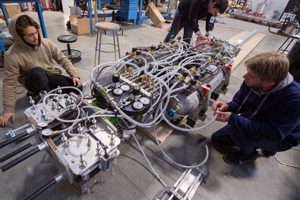
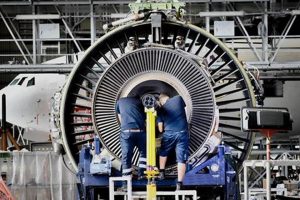
The application of computer programming, specifically utilizing the C++ language, to the design, development, testing, and analysis of aircraft and spacecraft systems is fundamental to modern aviation and space exploration. This involves creating software for flight control, simulation, data processing, embedded systems, and mission planning. For example, C++ can be used to develop the autopilot system in an airplane or the control software for a satellite.
The significance of this multidisciplinary approach stems from its ability to model complex physical phenomena, optimize performance, and ensure safety in critical applications. It allows engineers to simulate flight dynamics, predict structural behavior, and manage onboard resources with high precision. Historically, increased computational power and the evolution of programming languages have enabled increasingly sophisticated aerospace systems, leading to greater efficiency, reliability, and autonomy.
The following sections will delve into specific areas where this integration of software and aerospace principles is particularly relevant, exploring topics such as control systems, computational fluid dynamics, embedded systems, and the development of specialized software tools for the industry.
Guidance for Practitioners in the Field
This section provides actionable advice for professionals and students engaged in applying C++ within aerospace engineering. Adherence to these principles can improve code quality, project efficiency, and overall system performance.
Tip 1: Prioritize Robustness and Reliability. Employ rigorous testing methodologies and adhere to coding standards designed for safety-critical applications. Implement error handling and fault tolerance mechanisms to mitigate potential failures in real-time systems. For example, use assertions and defensive programming techniques to identify and address potential issues during development.
Tip 2: Optimize for Performance. Aerospace applications often demand high-performance computing and real-time responsiveness. Profile code to identify performance bottlenecks and employ optimization strategies such as loop unrolling, vectorization, and memory management techniques. Consider using specialized libraries and data structures optimized for numerical computation.
Tip 3: Emphasize Code Maintainability and Readability. Follow established coding conventions and document code thoroughly. Use meaningful variable names, modular design principles, and consistent formatting to enhance code understanding and reduce the risk of errors during maintenance and future modifications.
Tip 4: Leverage Existing Libraries and Frameworks. Explore and utilize established C++ libraries and frameworks relevant to aerospace applications, such as those for linear algebra, numerical integration, and simulation. This can significantly reduce development time and improve code reliability compared to writing custom solutions from scratch.
Tip 5: Employ Version Control System. Using version control system like Git is a must. It will helps keep the source code be maintainable. Every version change can be traced back. The project can be reviewed easier and avoid potential source code damage.
Tip 6: Implement proper CI/CD pipeline Automate the build, test, and deployment processes by setting up a proper CI/CD pipeline. This will minimize manual work and also ensure the code and the whole system is always under checking. Issues will be detected as soon as possible during the development process.
By adopting these tips, engineers can enhance the quality, performance, and reliability of aerospace systems that depend on C++ software. The result is improved safety, efficiency, and innovation within the field.
The subsequent sections will discuss real-world case studies demonstrating how this blend of software expertise and aerospace engineering principles drives technological advancement.
1. Real-time Systems

The criticality of real-time systems within aerospace engineering necessitates a programming paradigm capable of delivering deterministic performance. C++, with its ability to directly manage memory and optimize execution speed, is often selected for developing these systems where timing constraints are paramount for safety and functionality.
- Deterministic Execution
Real-time systems require predictable execution times. C++ allows for precise control over memory allocation and resource management, reducing the likelihood of unpredictable garbage collection pauses or other delays common in higher-level languages. In flight control systems, for example, consistent and predictable execution of control algorithms is essential for maintaining stability.
- Low-Level Hardware Access
Interfacing with hardware components such as sensors, actuators, and communication interfaces is a fundamental requirement of real-time aerospace systems. C++ provides direct access to memory addresses and hardware registers, enabling efficient control over these components. An example is directly controlling the servo motors in a flight surface control system or reading data from an inertial measurement unit (IMU).
- Resource Management
Real-time systems often operate in resource-constrained environments with limited memory and processing power. C++’s capabilities for manual memory management and efficient data structures allow developers to optimize resource utilization. Onboard a spacecraft, where power and computing resources are limited, C++ can be employed to develop efficient algorithms for data compression and transmission.
- Concurrency and Parallelism
Many real-time aerospace systems involve multiple concurrent tasks executing simultaneously. C++ supports multithreading and parallel programming, enabling developers to design systems that can efficiently utilize multi-core processors. This is crucial for applications such as radar processing, where multiple data streams need to be processed in parallel to detect and track objects in real-time.
The deterministic performance, low-level access, and resource management capabilities of C++ make it a suitable choice for developing real-time systems in aerospace engineering. The selection of C++ allows for precise control and optimization, which are crucial for ensuring the safety, reliability, and performance of critical aerospace systems.
2. Flight Control Software

Flight control software represents a core element of modern aerospace engineering, critically reliant on the capabilities afforded by languages such as C++. It governs the stability, maneuverability, and overall safety of aircraft and spacecraft by interpreting pilot inputs and sensor data to precisely control flight surfaces and propulsion systems.
- Stability Augmentation
Stability augmentation systems, often implemented in C++, automatically compensate for aerodynamic instabilities to improve handling characteristics. This is particularly crucial in aircraft with unconventional designs or operating under turbulent conditions. Real-world examples include the fly-by-wire systems in modern fighter jets, where software proactively adjusts control surfaces to maintain stable flight even during aggressive maneuvers.
- Guidance and Navigation
Flight control software integrates guidance and navigation algorithms, allowing for autonomous flight along predefined trajectories. C++ is employed to process data from GPS, inertial sensors, and other navigation aids to determine position, velocity, and attitude. Such systems are foundational for autopilot functionality in commercial airliners and the autonomous navigation of unmanned aerial vehicles (UAVs).
- Redundancy and Fault Tolerance
Critical flight control systems incorporate redundancy to mitigate the impact of hardware or software failures. C++ enables the implementation of voting logic and error detection mechanisms, ensuring continuous operation even in the presence of faults. Commercial aircraft often employ triple or quadruple redundancy in their flight control computers, with C++ code constantly monitoring for discrepancies and switching to backup systems if necessary.
- Sensor Fusion
Flight control systems rely on a variety of sensors to gather information about the aircraft’s state and its environment. C++ algorithms perform sensor fusion, combining data from disparate sources to provide a comprehensive and accurate representation of the aircraft’s situation. This is exemplified by the integration of data from airspeed sensors, accelerometers, and gyroscopes to precisely estimate the aircraft’s attitude and velocity.
The successful implementation of these facets hinges on the performance and reliability that C++ facilitates. The languages capabilities in low-level memory management and real-time processing are essential for the safety-critical applications inherent in flight control. This interplay between C++’s technical attributes and the demands of aerospace engineering ensures the continued evolution and reliability of modern flight systems. The next section will discuss another related topic.
3. Embedded Systems Development

Embedded systems development constitutes a critical component of modern aerospace engineering, particularly within the scope of software and hardware integration. These systems, typically implemented using C++, are responsible for a diverse range of functions, from managing engine control to overseeing navigation and communication protocols. The development process involves programming microcontrollers and microprocessors to execute specific tasks with high efficiency and reliability. Examples include flight controllers, inertial measurement units (IMUs), and satellite communication systems, where C++ provides the necessary control over hardware resources and the ability to meet stringent real-time constraints. Effective development methodologies, including rigorous testing and validation, are crucial to ensure the safe and dependable operation of these systems within aerospace applications.
The importance of embedded systems stems from their capacity to automate and optimize complex processes within aerospace vehicles and infrastructure. For instance, an embedded system within an aircraft engine monitors various parameters such as temperature, pressure, and fuel flow, making real-time adjustments to ensure optimal performance and minimize emissions. Similarly, satellites utilize embedded systems for attitude control, communication relay, and data processing. The ability to customize and optimize these systems using C++ allows aerospace engineers to tailor solutions to the specific needs of each application, maximizing efficiency and minimizing size, weight, and power consumption.
Understanding the intricacies of embedded systems development is essential for aerospace engineers seeking to design and implement advanced solutions. Challenges in this area include managing resource constraints, ensuring real-time performance, and complying with stringent safety standards. Despite these challenges, the integration of robust embedded systems, enabled by the flexibility and power of C++, remains indispensable for advancing aerospace technology and ensuring the safety and efficiency of air and space travel. The efficient development of Embedded systems in C++ have profound effect in aerospace industry.
4. Simulation and Modeling

Simulation and modeling are indispensable components within the domain of aerospace engineering, significantly enhanced by the utilization of C++. These techniques enable engineers to predict the behavior of complex systems, such as aircraft or spacecraft, under various operational conditions without the need for physical prototypes. The capability to model aerodynamic forces, structural stresses, and control system responses using C++ facilitates iterative design improvements and the identification of potential issues early in the development cycle. For instance, computational fluid dynamics (CFD) simulations, often coded in C++, allow engineers to analyze airflow around a wing design and optimize its shape for maximum lift and minimum drag. Such simulations reduce the cost and time associated with traditional wind tunnel testing.
The application of simulation and modeling extends to diverse areas, including flight dynamics, propulsion systems, and space mission planning. C++ enables the creation of high-fidelity models that accurately represent the underlying physics of these systems. In the context of space mission planning, C++ simulations can be employed to optimize trajectories, predict satellite orbital behavior, and assess the feasibility of various mission scenarios. This allows for informed decision-making and the mitigation of risks associated with complex and costly space operations. Furthermore, real-time simulation environments, often developed in C++, are used for pilot training and the evaluation of new flight control strategies.
In conclusion, simulation and modeling, supported by the performance and flexibility of C++, form a cornerstone of modern aerospace engineering. These techniques provide engineers with the tools to design, analyze, and optimize complex systems, ultimately leading to safer, more efficient, and more innovative aerospace technologies. The practical significance of this understanding lies in its ability to drive advancements in aircraft design, space exploration, and other critical areas of the field, while also minimizing costs and risks associated with development and operation. Future challenges include the development of even more accurate and efficient simulation methods to tackle increasingly complex aerospace systems.
5. Data Processing & Analysis

Data processing and analysis are integral to aerospace engineering, underpinning critical functions from design validation to operational performance monitoring. The efficient handling and interpretation of large datasets derived from simulations, experiments, and in-flight systems are essential for informed decision-making and continuous improvement. C++ is often employed to develop the necessary software tools and algorithms for this purpose due to its performance characteristics and ability to manage complex data structures.
- Telemetry Data Processing
Telemetry data from aircraft and spacecraft provides real-time insights into system performance. C++ software processes this data to monitor parameters such as engine performance, flight control surface positions, and environmental conditions. For example, analysis of telemetry data from a satellite can reveal anomalies in power consumption, indicating a potential failure in a subsystem. This information enables engineers to take corrective actions, either autonomously or through ground control intervention.
- Computational Fluid Dynamics (CFD) Analysis
CFD simulations generate massive datasets representing the flow of air around aerospace vehicles. C++ tools are used to analyze these datasets, extracting key performance metrics such as lift, drag, and pressure distribution. This analysis allows engineers to optimize aerodynamic designs for improved efficiency and stability. For instance, CFD analysis of an aircraft wing can identify areas of high drag, prompting design modifications to reduce fuel consumption.
- Structural Health Monitoring
Sensors embedded in aircraft and spacecraft structures generate data on stress, strain, and vibration. C++ algorithms process this data to detect anomalies that could indicate structural damage or fatigue. This monitoring enables proactive maintenance and prevents catastrophic failures. For example, analyzing vibration patterns in a helicopter rotor blade can identify cracks or other defects, allowing for timely repairs and preventing accidents.
- Image and Signal Processing
Aerospace applications often involve the processing of images and signals from sensors such as cameras, radar, and lidar. C++ is used to develop algorithms for tasks such as object detection, tracking, and image enhancement. This is critical for applications such as autonomous navigation, remote sensing, and surveillance. For example, C++ algorithms can process radar data to detect and track other aircraft, enabling collision avoidance systems.
The examples above highlight the diverse applications of data processing and analysis in aerospace engineering and showcase the role C++ plays in enabling these capabilities. From real-time monitoring of critical systems to detailed analysis of complex simulations, the ability to efficiently process and interpret data is essential for ensuring the safety, reliability, and performance of aerospace vehicles and systems.
Frequently Asked Questions Regarding C++ in Aerospace Engineering
This section addresses common inquiries and clarifies important considerations regarding the use of C++ programming within the aerospace engineering field.
Question 1: Is C++ the only viable programming language for aerospace applications?
While C++ is prevalent due to its performance characteristics and low-level control capabilities, it is not the sole option. Languages such as Python and Ada are also used, particularly for higher-level tasks or where safety certification requirements necessitate different approaches. The choice depends on the specific application and its associated constraints.
Question 2: What are the primary advantages of using C++ in aerospace engineering?
C++ provides a balance of performance, control, and flexibility, enabling developers to create efficient and reliable software for critical aerospace systems. Its ability to directly manage memory, optimize execution speed, and interface with hardware makes it suitable for real-time applications and embedded systems.
Question 3: What are the common challenges encountered when using C++ in aerospace projects?
Challenges include managing memory safely and efficiently, ensuring real-time performance, adhering to stringent coding standards, and mitigating the risk of errors in safety-critical systems. Rigorous testing, code reviews, and adherence to established best practices are essential for addressing these challenges.
Question 4: What specific areas of aerospace engineering benefit most from C++ expertise?
Flight control systems, embedded systems development, simulation and modeling, and data processing and analysis are particularly reliant on C++ skills. These areas require high-performance computing, real-time responsiveness, and precise control over hardware resources.
Question 5: How does the use of C++ contribute to the safety and reliability of aerospace systems?
By enabling the development of robust and deterministic software, C++ helps to ensure the safe and reliable operation of critical aerospace systems. Its ability to implement fault-tolerant designs, error detection mechanisms, and redundancy strategies minimizes the risk of failures and enhances overall system resilience.
Question 6: What are the key skills and knowledge required to effectively utilize C++ in aerospace engineering?
Proficiency in C++ programming, including memory management, object-oriented design, and real-time programming techniques, is essential. A solid understanding of aerospace engineering principles, such as flight dynamics, control theory, and embedded systems, is also crucial for effectively applying C++ to solve real-world aerospace problems.
In summary, C++ remains a significant tool within the aerospace field. While challenging, its effective application contributes substantially to the safety and advancement of aerospace technologies.
The subsequent section will present case studies illustrating the practical application of this skill set.
cpp aerospace engineering
This exploration has demonstrated the fundamental role of cpp aerospace engineering in enabling the design, development, and operation of modern aircraft and spacecraft. The ability to create robust, efficient, and reliable software systems is critical for flight control, simulation, data processing, and numerous other essential aerospace functions. The low-level control and high performance afforded by C++ have historically made it a key technology within the industry.
Given the increasing complexity of aerospace systems and the growing demand for autonomous capabilities, the mastery of cpp aerospace engineering will remain a crucial asset for professionals entering and advancing within this field. The pursuit of innovation, coupled with a commitment to safety and reliability, will continue to drive the evolution of this specialized domain. Future advancements will likely depend on the continued integration of sophisticated software solutions within every facet of aerospace activity.