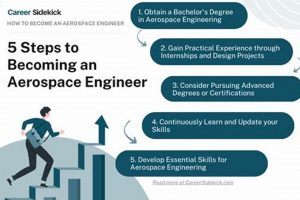
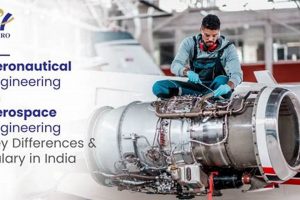
Institutions providing superior instruction and resources in the field of flight vehicle design, development, and manufacturing, as well as space exploration technologies, are crucial for advancing the field. These programs typically offer specialized curricula, state-of-the-art facilities, and opportunities for research and industry collaboration. For example, a top-ranked program may offer courses in aerodynamics, propulsion, and space systems engineering, alongside access to wind tunnels and advanced simulation software.
Attending one of these highly-regarded institutions provides substantial advantages. Graduates often possess enhanced career prospects, gaining access to competitive positions in government agencies, private sector companies, and research organizations. Historically, pioneering breakthroughs in aviation and space technology have frequently emerged from research conducted within these academic environments, contributing significantly to national technological progress.
The subsequent sections will explore key criteria in evaluating such programs, examine notable institutions excelling in this field, and offer guidance for prospective students navigating the application process.
Guidance for Aspiring Aerospace Engineers
Selecting the appropriate educational path is critical for a successful career in aerospace engineering. The following guidance aims to assist prospective students in making informed decisions regarding their academic pursuits.
Tip 1: Research Curriculum Rigor. Thoroughly examine the program’s coursework, ensuring it encompasses fundamental aerospace engineering principles, advanced topics, and opportunities for specialization. A strong curriculum forms the bedrock of future expertise.
Tip 2: Assess Faculty Expertise. Investigate the qualifications and research interests of the faculty. Professors with extensive industry experience or distinguished research records can provide invaluable mentorship and insights.
Tip 3: Evaluate Research Opportunities. Determine the availability of undergraduate research opportunities. Participation in research projects provides practical experience, fosters critical thinking skills, and strengthens a student’s profile.
Tip 4: Consider Laboratory and Facilities Access. Confirm access to well-equipped laboratories, wind tunnels, and computational resources. Hands-on experience with state-of-the-art equipment is crucial for developing practical engineering skills.
Tip 5: Explore Internship and Co-op Programs. Prioritize programs that offer robust internship or co-operative education opportunities with leading aerospace companies or government agencies. Practical experience accelerates professional development.
Tip 6: Investigate Accreditation Status. Verify that the program holds accreditation from a recognized accrediting body, such as ABET. Accreditation ensures the program meets established quality standards.
Tip 7: Review Graduate Placement Rates. Examine the program’s track record in placing graduates in relevant aerospace engineering positions or graduate programs. A high placement rate signifies the program’s effectiveness in preparing students for their careers.
Adhering to these guidelines facilitates a strategic approach to selecting the educational institution that best aligns with individual academic and professional aspirations. Rigorous curriculum, experienced faculty, research opportunities, access to top-notch facilities, and industry connections are all vital factors.
The subsequent conclusion will summarize the key elements discussed and emphasize the long-term benefits of attending a leading aerospace engineering program.
1. Accreditation

Accreditation serves as a crucial validation of an aerospace engineering program’s quality and adherence to established industry standards. For institutions aspiring to be considered among the “best colleges in aerospace engineering,” accreditation is not merely a formality but a fundamental requirement. It signifies that the program has undergone rigorous evaluation by an independent body, confirming its curriculum, faculty qualifications, facilities, and student outcomes meet specified benchmarks. This process directly influences the perceived and actual value of the degree obtained.
The Accreditation Board for Engineering and Technology (ABET) is the predominant accrediting agency for engineering programs in the United States. ABET accreditation ensures a program meets the educational needs of graduates, preparing them for entry into the profession. For example, an aerospace engineering program lacking ABET accreditation might face difficulty in securing partnerships with major aerospace companies for internships or research collaborations, thus hindering students’ practical experience. Similarly, graduates from non-accredited programs may encounter challenges in obtaining professional engineering licensure, potentially limiting career advancement.
In summary, accreditation forms a vital link in the equation of “best colleges in aerospace engineering.” It provides assurance of program quality, enhances career prospects for graduates, and fosters industry trust. Institutions prioritizing accreditation demonstrate a commitment to providing a high-quality education, ultimately contributing to the advancement of the aerospace engineering field. Neglecting this aspect can significantly detract from an institution’s overall standing and the future success of its students.
2. Faculty Expertise

Faculty expertise is a cornerstone of the institutions recognized as “best colleges in aerospace engineering.” The intellectual capital and practical experience of the faculty directly impact the quality of education and research opportunities available to students. Highly knowledgeable and accomplished professors not only impart fundamental engineering principles but also inspire innovation and critical thinking. Their research endeavors advance the field, and their industry connections provide students with valuable networking and internship prospects. For instance, a program with faculty members renowned for their contributions to hypersonic vehicle design or satellite propulsion systems is inherently better positioned to offer cutting-edge instruction and research opportunities in those areas.
The influence of faculty expertise extends beyond the classroom and laboratory. Professors often serve as mentors, guiding students through their academic and professional journeys. Their insights into real-world engineering challenges, gleaned from years of experience, are invaluable in preparing students for the complexities of the aerospace industry. Consider the impact of a professor who has consulted on NASA missions or contributed to the development of advanced aircraft technologies. Such experience provides a direct link between theoretical knowledge and practical application, enabling students to gain a deeper understanding of the field. Furthermore, active faculty involvement in professional organizations and standards committees ensures the curriculum remains current and aligned with industry needs.
In summation, the presence of distinguished and experienced faculty is a defining characteristic of “best colleges in aerospace engineering.” Their expertise drives both academic excellence and research innovation, contributing significantly to the development of future aerospace engineers. The investment in attracting and retaining top-tier faculty is, therefore, an investment in the long-term success of the program and its graduates, solidifying the institution’s reputation as a leader in the field. A weak faculty base invariably compromises the quality of education and research, undermining the institution’s ability to compete with top-tier programs.
3. Research Opportunities

Active involvement in research is a distinguishing characteristic of the institutions recognized as “best colleges in aerospace engineering.” These opportunities extend beyond traditional coursework, providing students with invaluable hands-on experience and fostering critical thinking skills essential for success in the field.
- Advancement of Knowledge
Participation in research allows students to contribute to the advancement of aerospace engineering knowledge. Working alongside faculty on cutting-edge projects, students gain exposure to the latest technologies and methodologies. This direct involvement fosters a deeper understanding of complex concepts and encourages innovation. For instance, students may contribute to research on advanced materials for spacecraft or the development of more efficient propulsion systems.
- Skill Development
Research activities cultivate essential engineering skills beyond theoretical knowledge. Students develop proficiency in experimental design, data analysis, and technical communication. They learn to apply engineering principles to solve real-world problems, strengthening their problem-solving abilities and analytical thinking. For example, designing and conducting wind tunnel experiments or simulating flight dynamics requires a practical application of theoretical knowledge.
- Career Preparation
Research experience significantly enhances career prospects for graduates of “best colleges in aerospace engineering.” Prospective employers often seek candidates with proven research experience, demonstrating their ability to contribute to innovation and problem-solving. A strong research background provides a competitive edge when seeking employment in the aerospace industry or pursuing advanced degrees. Participation in research projects often leads to publications or presentations at conferences, further enhancing a student’s resume.
- Faculty Mentorship
Research provides unique opportunities for students to work closely with faculty mentors. These collaborations foster strong relationships and provide invaluable guidance and support. Faculty mentors share their expertise, provide constructive feedback, and help students develop their research skills. This mentorship can be instrumental in shaping a student’s career path and providing a foundation for future success.
The integration of robust research opportunities is a hallmark of “best colleges in aerospace engineering.” These experiences not only enhance students’ technical skills but also cultivate their critical thinking abilities and prepare them for leadership roles in the aerospace industry. Institutions that prioritize research provide a fertile ground for innovation and contribute significantly to the advancement of the field.
4. Industry Partnerships

The efficacy of aerospace engineering programs is often significantly enhanced by strategic alliances with industry leaders. These partnerships, a common hallmark of institutions recognized as “best colleges in aerospace engineering,” provide a crucial bridge between academic theory and real-world application. The effect is multi-faceted, enriching curricula, facilitating research, and improving career prospects for graduates. Without substantial industry engagement, even the most theoretically rigorous programs may lack the practical context necessary for students to excel in the highly competitive aerospace sector. For instance, collaborative projects with Boeing or Lockheed Martin expose students to cutting-edge technologies and industry-standard practices, something rarely replicable within a purely academic setting.
These collaborations frequently manifest in several forms: joint research initiatives, sponsored projects, internship programs, and guest lectures from industry experts. Joint research, for example, allows faculty and students to work alongside engineers from companies such as SpaceX on challenges directly relevant to the industry’s future. Internship programs, often a direct result of these partnerships, provide students with practical experience, enabling them to apply classroom knowledge to solve real-world problems. Further, industry experts, invited as guest lecturers, offer insights into current trends, challenges, and opportunities within the aerospace sector. All these experiences result in a learning environment that transcends traditional academic boundaries and better prepares students for the transition from university to professional life.
In summary, robust industry partnerships are an indispensable component of “best colleges in aerospace engineering.” These alliances provide invaluable opportunities for students to gain practical experience, contribute to real-world projects, and establish professional networks. While theoretical knowledge forms the foundation of an aerospace education, industry collaboration provides the essential context and practical skills necessary for graduates to succeed in a rapidly evolving field. The presence and strength of these partnerships should, therefore, be a critical consideration for prospective students evaluating aerospace engineering programs.
5. Curriculum Rigor

Curriculum rigor forms a fundamental determinant of institutional standing within the field of aerospace engineering. Programs identified as “best colleges in aerospace engineering” invariably feature demanding and comprehensive curricula designed to equip students with the theoretical knowledge and practical skills necessary for success. A less rigorous curriculum, conversely, may fail to adequately prepare graduates for the challenges inherent in the aerospace industry, potentially limiting their career prospects and contributions to the field. For example, a curriculum neglecting advanced topics in computational fluid dynamics or control systems would disadvantage students seeking to work on modern aircraft design or autonomous spacecraft navigation.
The impact of curriculum rigor extends beyond academic performance. Institutions emphasizing rigorous coursework often attract and retain faculty with advanced expertise and a commitment to research. These faculty members, in turn, enhance the quality of instruction and research opportunities available to students. Consider the Massachusetts Institute of Technology (MIT), whose aerospace engineering program is renowned for its demanding curriculum covering a broad spectrum of topics, from aerodynamics and propulsion to space systems and robotics. This rigor, combined with access to state-of-the-art facilities and research opportunities, produces graduates who are highly sought after by aerospace companies and government agencies. Conversely, a program lacking sufficient curriculum depth and breadth may struggle to attract top-tier faculty and provide students with the competitive edge necessary to succeed in the field.
In conclusion, curriculum rigor is an indispensable characteristic of “best colleges in aerospace engineering.” It serves as a catalyst for academic excellence, attracts accomplished faculty, and enhances career opportunities for graduates. While challenging, a rigorous curriculum provides the foundation for future innovation and leadership in the aerospace industry. Programs seeking to elevate their standing within the field must prioritize curriculum development and ensure that their coursework meets the evolving demands of the aerospace profession. A lack of rigor ultimately undermines the program’s ability to produce highly skilled and competitive aerospace engineers.
6. Facilities Quality
The caliber of facilities significantly influences the learning and research environment within aerospace engineering programs. Institutions vying for recognition as “best colleges in aerospace engineering” demonstrably invest in cutting-edge infrastructure to support comprehensive education and groundbreaking research initiatives.
- Wind Tunnels and Aerodynamics Laboratories
These facilities are essential for studying airflow dynamics and aerodynamic performance of aircraft and spacecraft. A top-tier institution would maintain subsonic, supersonic, and hypersonic wind tunnels, equipped with advanced instrumentation for precise data acquisition. For example, a program with a well-maintained hypersonic wind tunnel allows students and researchers to conduct experiments relevant to high-speed flight and re-entry vehicles, furthering understanding in these critical areas. Without these facilities, the program will be limited in practical aerodynamics experimentation.
- Propulsion and Combustion Laboratories
Laboratories dedicated to propulsion research provide space for investigating engine design, combustion processes, and fuel efficiency. Advanced facilities include test stands for evaluating rocket engines, gas turbines, and ramjets. A program equipped with these resources allows for the study of next-generation propulsion technologies, such as electric propulsion and alternative fuels. A lack of advanced propulsion facilities will hinder experimentation in this critical area.
- Space Systems Design and Simulation Centers
Centers focused on space systems design offer resources for simulating the complexities of orbital mechanics, satellite communications, and spacecraft operations. High-fidelity simulation software and hardware-in-the-loop testing facilities allow students and researchers to model and analyze satellite performance in realistic environments. These simulation tools are essential for designing reliable and efficient space missions. Without these systems, the program would be unable to provide hands-on experience in space systems design.
- Materials Testing and Manufacturing Laboratories
These laboratories house equipment for characterizing the mechanical properties of aerospace materials and developing advanced manufacturing techniques. Facilities typically include tensile testing machines, electron microscopes, and additive manufacturing systems. A program with strong materials testing capabilities allows for the investigation of novel materials for aerospace applications, such as composites and lightweight alloys. Without these laboratories, students would be unable to perform cutting-edge research in materials science.
In summary, investment in high-quality facilities is a defining feature of programs recognized as “best colleges in aerospace engineering.” These resources provide students with hands-on experience, enable groundbreaking research, and prepare graduates for success in a rapidly evolving field. The presence of advanced wind tunnels, propulsion laboratories, simulation centers, and materials testing facilities enhances the educational experience and distinguishes leading institutions from their peers.
Frequently Asked Questions Regarding Top Aerospace Engineering Programs
The following addresses common inquiries concerning the selection, application process, and characteristics of leading aerospace engineering programs.
Question 1: What criteria define a program as one of the “best colleges in aerospace engineering?”
Accreditation, faculty expertise, research opportunities, industry partnerships, curriculum rigor, and facilities quality are all critical indicators. A program excelling in these areas is generally considered among the leading institutions.
Question 2: How important is ABET accreditation when considering aerospace engineering programs?
ABET accreditation is crucial. It signifies that a program meets established quality standards, ensuring that graduates possess the knowledge and skills necessary for professional practice. Employers often prioritize graduates from ABET-accredited programs.
Question 3: Do all “best colleges in aerospace engineering” offer undergraduate research opportunities?
While not a universal guarantee, undergraduate research opportunities are highly prevalent in leading programs. These opportunities allow students to engage in hands-on research, develop critical thinking skills, and enhance their career prospects.
Question 4: How much emphasis is placed on industry experience for faculty at these top programs?
Institutions recognized as “best colleges in aerospace engineering” typically prioritize faculty with significant industry experience. Such experience enriches the curriculum, provides students with real-world insights, and facilitates valuable networking opportunities.
Question 5: Is a graduate degree necessary to succeed in aerospace engineering after attending one of these top colleges?
While a graduate degree is not strictly required for all positions, it can significantly enhance career advancement opportunities and specialization options. Graduates from leading programs are well-positioned to pursue advanced degrees if desired.
Question 6: What steps should prospective students take to increase their chances of acceptance into these highly competitive programs?
A strong academic record, relevant extracurricular activities, compelling letters of recommendation, and a well-crafted personal essay are all essential. Demonstrating a passion for aerospace engineering through participation in science fairs, robotics clubs, or related activities can further strengthen an application.
Selecting an aerospace engineering program requires careful consideration of various factors. Evaluating accreditation status, faculty expertise, research opportunities, and curriculum rigor are essential steps in identifying the institution that best aligns with individual goals.
The subsequent section will summarize key takeaways and emphasize the enduring value of investing in a high-quality aerospace engineering education.
Conclusion
The preceding discussion has examined the multifaceted characteristics that define “best colleges in aerospace engineering.” Accreditation, faculty expertise, research opportunities, industry partnerships, curriculum rigor, and facilities quality have been identified as essential components of a program’s overall merit. Aspiring aerospace engineers are advised to carefully evaluate these factors when making their educational choices. Institutions excelling in these areas are demonstrably better equipped to prepare graduates for successful careers and leadership roles within the aerospace industry.
Selecting an educational path represents a significant investment in one’s future. A rigorous and comprehensive aerospace engineering education, obtained from a highly-regarded institution, can provide a distinct competitive advantage in an increasingly demanding field. Continued advancements in aerospace technology necessitate a commitment to academic excellence and lifelong learning. Prioritizing quality and comprehensive preparation are vital for aspiring engineers seeking to contribute meaningfully to the advancement of aerospace engineering.