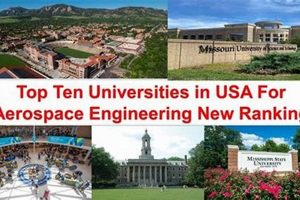
Institutions offering curricula focused on the design, development, and testing of aircraft and spacecraft represent a key component of the advanced technology sector. These establishments provide structured learning environments where students gain theoretical knowledge and practical experience in areas such as aerodynamics, propulsion, materials science, and control systems. As an example, several prominent technological universities offer specialized degrees at the undergraduate and graduate levels designed to prepare individuals for careers in the aerospace industry.
The existence of these programs is vital for fostering innovation and maintaining a competitive edge in the global aerospace market. Graduates contribute to advancements in air transportation, space exploration, and national defense. Historically, government investment and public interest in space and aviation have driven the establishment and growth of these academic departments, shaping the landscape of engineering education and research.
The following sections will delve into various aspects related to selecting appropriate institutions for pursuing studies in this field, highlighting key program features, research opportunities, and career pathways available to graduates.
Guidance for Prospective Students
Selecting the appropriate academic path requires careful consideration of individual goals and program attributes. The following points provide guidance for prospective students exploring opportunities in aerospace engineering.
Tip 1: Evaluate Curriculum Depth and Breadth: Examine the course catalog to assess the range of topics covered, ensuring a balance between core engineering principles and specialized aerospace subjects such as orbital mechanics and flight dynamics. A comprehensive curriculum provides a strong foundation for future career growth.
Tip 2: Assess Research Opportunities: Research experience is highly valuable. Investigate available research labs, faculty expertise, and ongoing projects. Active participation in research enhances practical skills and can lead to publications and conference presentations.
Tip 3: Consider Accreditation and Rankings: Accreditation from recognized bodies, such as ABET, indicates adherence to quality standards. While rankings should not be the sole determinant, they can provide insights into institutional reputation and resources.
Tip 4: Review Faculty Expertise: The quality of faculty significantly impacts the learning experience. Investigate faculty research interests, publications, and industry experience. Strong faculty provide valuable mentorship and guidance.
Tip 5: Explore Internship and Co-op Programs: Practical experience is crucial for career readiness. Look for programs that offer structured internship or co-op opportunities with aerospace companies or government agencies. These experiences provide valuable industry exposure.
Tip 6: Investigate Career Services and Alumni Networks: A strong career services department can assist with resume preparation, interview skills, and job placement. An active alumni network provides valuable connections and mentorship opportunities.
Tip 7: Consider Location and Cost of Living: The location of the institution can impact access to industry events and job opportunities. Evaluate the cost of living in the surrounding area and the overall affordability of the program.
These guidelines serve as a framework for navigating the selection process. Careful research and thoughtful consideration will contribute to a successful academic and professional trajectory.
The subsequent sections will explore the potential career paths that become available following the completion of such a program of study.
1. Program Accreditation

Program accreditation serves as a critical indicator of quality and rigor within university aerospace engineering programs. Accreditation, typically provided by organizations such as ABET (Accreditation Board for Engineering and Technology), signifies that a program has undergone a thorough evaluation and meets established standards for curriculum content, faculty qualifications, and student outcomes. Institutions offering unaccredited programs may not provide students with the necessary foundation for professional licensure or advanced studies. Consequently, accreditation acts as a de facto benchmark for employers seeking qualified engineering graduates.
The effect of accreditation on universities with aerospace engineering programs is multifaceted. It necessitates continuous program improvement through self-assessment, peer review, and adherence to evolving industry standards. This, in turn, fosters a culture of excellence and accountability within the academic environment. For example, universities seeking or maintaining ABET accreditation for their aerospace engineering programs must demonstrate that students achieve specific learning outcomes related to problem-solving, design, and communication. Real-world examples include institutions like Purdue University and Georgia Tech, whose accredited aerospace engineering programs are widely recognized for producing highly skilled graduates who contribute significantly to the aerospace industry.
In summary, program accreditation is inextricably linked to the credibility and value of an aerospace engineering education. It provides assurance to prospective students, employers, and the public that a program meets established quality standards. While securing accreditation requires ongoing effort and commitment from the institution, the benefits including enhanced reputation, improved student outcomes, and greater career opportunities for graduates are substantial, underscoring its vital role in shaping the landscape of universities with aerospace engineering programs. Failure to prioritize and maintain accreditation presents significant challenges to the long-term viability and success of such programs.
2. Research Facilities

The presence and quality of research facilities are fundamentally linked to the efficacy and reputation of aerospace engineering programs within universities. These facilities serve as crucial platforms for both faculty-led research and student training, enabling the advancement of knowledge and the development of practical skills relevant to the aerospace industry.
- Wind Tunnels
Wind tunnels are essential for aerodynamic testing and analysis. They allow students and researchers to simulate flight conditions and study the effects of airflow on aircraft and spacecraft designs. For example, a university might use a wind tunnel to optimize the wing design of a new unmanned aerial vehicle (UAV), thereby improving its lift-to-drag ratio and fuel efficiency. Access to advanced wind tunnel technology directly enhances the program’s ability to conduct cutting-edge research and educate students in aerodynamics.
- Propulsion Laboratories
Propulsion laboratories are dedicated to the study and development of engines and propulsion systems. These facilities often include test stands for evaluating engine performance, combustion chambers for analyzing fuel efficiency, and diagnostic equipment for identifying potential issues. A university with a strong propulsion laboratory can conduct research on advanced propulsion technologies such as scramjets or electric propulsion, potentially leading to breakthroughs in space exploration and high-speed flight.
- Materials Testing Laboratories
Materials testing laboratories are critical for assessing the mechanical properties of materials used in aerospace structures. These labs employ equipment for tensile testing, fatigue testing, and non-destructive evaluation (NDE) to ensure the structural integrity of components under extreme conditions. Research in this area can lead to the development of lighter, stronger, and more durable materials for aircraft and spacecraft, improving performance and safety. For example, a university might use a materials testing laboratory to investigate the effects of radiation on composite materials intended for use in spacecraft.
- Flight Simulation Facilities
Flight simulation facilities provide a realistic environment for pilot training, control system development, and human factors research. These facilities often include full-motion simulators with high-fidelity visuals and realistic cockpit controls. Universities use flight simulators to train aerospace engineering students in flight dynamics, aircraft control, and pilot-vehicle interface design, preparing them for careers in aircraft design, flight testing, and airline operations.
These examples demonstrate how robust research facilities directly contribute to the quality and competitiveness of universities with aerospace engineering programs. Access to such resources enables innovative research, hands-on training, and the development of highly skilled graduates who can contribute to the advancement of the aerospace field. These facilities not only benefit the students and faculty but also serve as a catalyst for attracting funding, fostering collaborations with industry, and enhancing the overall prestige of the institution.
3. Faculty Expertise

The strength and depth of faculty expertise within universities offering aerospace engineering programs are paramount to the overall quality and impact of the education provided. Faculty serve as the primary conduit for transferring knowledge, conducting research, and fostering innovation within the field. Their qualifications, experience, and research interests directly influence the curriculum, research opportunities, and the caliber of graduates produced.
- Academic Credentials and Research Background
The academic credentials of faculty members, typically including doctoral degrees from reputable institutions, demonstrate their mastery of aerospace engineering principles. A robust research background, evidenced by publications in peer-reviewed journals and presentations at conferences, signifies their active involvement in advancing the field. For example, faculty members specializing in computational fluid dynamics (CFD) with extensive publications on turbulence modeling contribute directly to the program’s ability to offer advanced courses and conduct cutting-edge research in this area. This expertise is essential for training students in modern simulation techniques used in aircraft design and analysis.
- Industry Experience and Professional Certifications
Industry experience provides faculty with practical insights into the challenges and opportunities within the aerospace sector. Faculty members who have worked in companies designing aircraft, developing spacecraft, or managing aerospace projects bring valuable real-world perspectives to the classroom. Professional certifications, such as professional engineer (PE) licenses, demonstrate their adherence to ethical and technical standards. For example, a faculty member with prior experience at NASA in mission control can provide students with invaluable knowledge of spacecraft operations and systems engineering, enhancing their readiness for careers in the space industry.
- Teaching Pedagogy and Mentorship Abilities
Effective teaching pedagogy is crucial for conveying complex aerospace engineering concepts to students. Faculty members who employ innovative teaching methods, such as active learning strategies, simulations, and design projects, enhance student engagement and comprehension. Strong mentorship abilities are equally important for guiding students in their academic and career pursuits. Faculty members who actively mentor students, providing guidance on research projects, internships, and career opportunities, contribute significantly to their professional development. For example, a faculty member who advises a student team participating in a design competition provides invaluable hands-on experience and mentorship, fostering their problem-solving skills and teamwork abilities.
- Connections to Industry and Government Agencies
Faculty members with strong connections to industry and government agencies can provide students with access to internships, research opportunities, and networking events. These connections facilitate the transfer of knowledge and technology between academia and the professional world. For example, a faculty member who collaborates with a local aerospace company on a research project can create opportunities for students to work on real-world problems and gain valuable industry experience. These connections also help to ensure that the curriculum remains relevant and aligned with the needs of the aerospace industry.
The collective expertise of faculty members significantly shapes the academic environment within universities offering aerospace engineering programs. Institutions with a strong faculty, characterized by a combination of academic credentials, industry experience, teaching skills, and professional connections, provide students with a superior educational experience and prepare them for successful careers in the aerospace field. These attributes not only enhance the program’s reputation but also foster a culture of innovation and excellence within the department, driving advancements in aerospace engineering research and education.
4. Curriculum Depth

Curriculum depth represents a critical determinant of the quality and effectiveness of aerospace engineering programs at universities. It encompasses the breadth and complexity of topics covered, the level of theoretical rigor, and the opportunities for specialization within the curriculum. Programs characterized by insufficient depth may fail to adequately prepare graduates for the multifaceted challenges of the aerospace industry.
- Core Engineering Principles
A deep curriculum necessitates a strong foundation in fundamental engineering disciplines such as mathematics, physics, thermodynamics, fluid mechanics, and structural analysis. This involves not only introductory courses but also advanced treatments that explore the underlying principles and their application to aerospace-specific problems. For instance, a comprehensive program would delve into advanced topics in computational fluid dynamics (CFD) for aerodynamic analysis or finite element analysis (FEA) for structural design. The absence of such depth can limit a graduate’s ability to solve complex engineering challenges.
- Aerospace Specializations
Beyond core engineering principles, a deep curriculum offers specialized courses covering key areas of aerospace engineering, including aerodynamics, propulsion, control systems, orbital mechanics, spacecraft design, and aerospace materials. The curriculum should provide opportunities for students to delve into these areas through advanced coursework, research projects, and design experiences. For example, a program might offer specialized courses in hypersonics, advanced propulsion systems, or satellite communications. The depth of coverage in these areas directly impacts a graduate’s preparedness for specific roles within the aerospace industry.
- Design Experience
A critical element of curriculum depth is the inclusion of significant design experiences, culminating in a capstone design project. This project requires students to integrate their knowledge and skills to address a realistic aerospace engineering problem, such as designing an aircraft, spacecraft, or aerospace system. The design experience should involve multiple phases, including conceptual design, preliminary design, detailed design, and testing. The depth of the design experience directly correlates with a graduate’s ability to apply theoretical knowledge to practical engineering problems.
- Research Opportunities
Curriculum depth is also enhanced through opportunities for undergraduate and graduate students to engage in research projects. Participation in research allows students to delve deeper into specific areas of aerospace engineering, develop critical thinking skills, and contribute to the advancement of knowledge in the field. For instance, a student might participate in research on advanced materials for spacecraft or the development of new control algorithms for autonomous aircraft. The availability and depth of research opportunities significantly impact the educational experience and prepare students for careers in research and development.
The interplay between these facets of curriculum depth directly impacts the ability of universities with aerospace engineering programs to produce competent and innovative graduates. Institutions that prioritize curriculum depth provide students with the necessary knowledge, skills, and experiences to excel in the demanding and rapidly evolving aerospace industry, distinguishing them from programs that offer only a superficial exposure to the field.
5. Industry Partnerships
Industry partnerships represent a critical component of effective aerospace engineering programs within universities, serving as a bridge between academic theory and practical application in the professional realm. These collaborations provide students with valuable opportunities for experiential learning, contribute to curriculum relevance, and drive innovation through joint research initiatives.
- Internship and Co-op Programs
Structured internship and co-operative education programs provide students with hands-on experience in aerospace companies, government agencies, and research laboratories. These opportunities enable students to apply theoretical knowledge to real-world engineering challenges, develop essential technical skills, and gain valuable insights into industry practices. For example, a university may partner with a major aircraft manufacturer to offer internships in design engineering, manufacturing, or flight testing. The implications of these programs extend beyond individual student development, fostering a pipeline of qualified graduates for the aerospace industry and strengthening the university’s reputation.
- Sponsored Research and Development
Industry-sponsored research and development projects enable universities to conduct cutting-edge research with direct relevance to industry needs. These collaborations provide funding for research laboratories, equipment, and graduate student support. For example, a university might partner with a propulsion company to develop advanced engine technologies or with a satellite manufacturer to improve satellite communication systems. The benefits of sponsored research extend to both parties, providing industry with access to academic expertise and innovation, while allowing universities to address real-world problems and train students in relevant research areas.
- Curriculum Development and Guest Lectures
Industry partnerships inform curriculum development by providing insights into the skills and knowledge required for success in the aerospace field. Industry professionals may participate in curriculum advisory boards, provide feedback on course content, and deliver guest lectures. These contributions ensure that the curriculum remains aligned with industry needs and prepares students for the evolving demands of the workforce. For example, an engineer from a leading aerospace company might deliver a guest lecture on the latest advancements in composite materials, exposing students to cutting-edge technologies and industry best practices.
- Equipment and Software Donations
Industry partnerships often involve the donation of equipment and software to university aerospace engineering programs. These donations provide students with access to state-of-the-art tools and technologies used in the aerospace industry, enhancing their skills and preparing them for professional practice. For example, an aerospace company might donate advanced CAD software or wind tunnel equipment to a university, enabling students to gain hands-on experience with industry-standard tools. The impact of these donations is significant, providing students with a competitive edge in the job market and fostering innovation through access to advanced technologies.
The facets of industry partnerships collectively enhance the quality and relevance of aerospace engineering programs within universities. These collaborations provide students with invaluable opportunities for experiential learning, contribute to curriculum development, drive innovation through joint research initiatives, and enhance access to industry-standard tools and technologies. As a result, universities with strong industry partnerships are better positioned to produce highly skilled graduates who can contribute to the advancement of the aerospace field. Strong partnership program can attract talents for universities with aerospace engineering programs
6. Career Placement
Career placement, referring to the success of graduates in securing employment within their field of study, represents a key metric for evaluating the effectiveness of universities with aerospace engineering programs. It serves as a tangible outcome of the education and training provided, reflecting the program’s ability to prepare students for the demands of the aerospace industry.
- Industry Demand and Program Alignment
The demand for aerospace engineers in sectors such as aviation, space exploration, and defense directly influences career placement rates. Universities that align their curricula with industry needs, incorporating emerging technologies and addressing current challenges, enhance the employability of their graduates. For example, programs emphasizing skills in areas like autonomous systems or advanced materials are likely to see higher placement rates due to the increasing demand for these specialties.
- Career Services and Employer Relations
The strength of a university’s career services department and its relationships with aerospace employers significantly impact career placement. Career services provide resources such as resume workshops, interview training, and job fairs, while strong employer relationships facilitate internships, co-op programs, and direct recruitment. Universities with robust career services and established connections with industry leaders tend to have higher placement rates, providing graduates with more opportunities for employment.
- Program Reputation and Alumni Network
The reputation of an aerospace engineering program and the strength of its alumni network influence career placement. Programs with a strong reputation attract top students and faculty, and graduates from these programs are often highly sought after by employers. An active alumni network provides mentorship, networking opportunities, and job leads, further enhancing career placement prospects. Universities with well-established reputations and strong alumni networks typically have higher placement rates, reflecting the value placed on their graduates by the aerospace industry.
- Geographic Location and Industry Presence
The geographic location of a university and its proximity to major aerospace hubs impact career placement. Universities located near aerospace companies or government agencies provide students with greater access to internships, research opportunities, and employment prospects. For example, universities located in states with a significant aerospace presence, such as California, Washington, and Texas, tend to have higher placement rates due to the concentration of aerospace jobs in those areas.
In summary, career placement is a multifaceted outcome directly linked to the quality and effectiveness of universities with aerospace engineering programs. Factors such as industry demand, career services, program reputation, and geographic location all contribute to the employment success of graduates, underscoring the importance of considering these elements when evaluating aerospace engineering programs and selecting institutions for study.
7. Program Cost

Program cost is a substantial consideration for prospective students evaluating universities with aerospace engineering programs. The financial investment extends beyond tuition fees and encompasses various direct and indirect expenses. A comprehensive understanding of these costs is essential for informed decision-making.
- Tuition and Fees
Tuition and mandatory fees constitute the most significant component of program cost. These charges vary considerably depending on the institution’s public or private status, its location, and its overall prestige. For example, tuition at a private university with a renowned aerospace engineering program may be substantially higher than that at a state-supported institution. The implications include limiting accessibility for students from diverse socioeconomic backgrounds and necessitating careful financial planning.
- Living Expenses
Living expenses, including housing, food, transportation, and personal expenses, represent another substantial cost. These expenses are heavily influenced by the location of the university. Living in a major metropolitan area will typically result in significantly higher costs compared to a rural setting. For instance, attending a university in a major city can double the overall cost of attendance due to increased rent and transportation expenses. The ability to secure on-campus housing can mitigate some of these costs.
- Textbooks and Supplies
Textbooks, course materials, and specialized equipment represent a non-negligible expense for aerospace engineering students. The cost of textbooks can be substantial, particularly for upper-level courses requiring specialized texts and software licenses. For example, specialized simulation software can run into hundreds or thousands of dollars. Universities may offer access to certain software through student licenses or lab access, potentially reducing individual student costs.
- Opportunity Cost
Opportunity cost refers to the income a student forgoes while pursuing their education. This cost is particularly relevant for older students or those with prior work experience. For example, an individual leaving a full-time engineering position to pursue a graduate degree in aerospace engineering incurs a significant opportunity cost in terms of lost wages. This factor should be considered alongside direct program costs when evaluating the overall financial investment.
These facets of program cost collectively impact the accessibility and affordability of universities with aerospace engineering programs. Prospective students must carefully evaluate these factors alongside program quality, career placement rates, and personal preferences to make informed decisions regarding their educational investments. Universities seeking to attract a diverse student body must address cost concerns through scholarships, financial aid programs, and efforts to reduce overall expenses.
Frequently Asked Questions Regarding Universities with Aerospace Engineering Programs
The following questions address common inquiries and concerns regarding the selection, admission, and characteristics of institutions offering aerospace engineering curricula.
Question 1: What constitutes accreditation for an aerospace engineering program, and why is it significant?
Accreditation, often provided by ABET (Accreditation Board for Engineering and Technology), signifies that a program meets established standards for curriculum, faculty, and student outcomes. Accreditation assures quality and serves as a benchmark for employers.
Question 2: How important are research facilities in determining the quality of an aerospace engineering program?
Research facilities, such as wind tunnels, propulsion labs, and materials testing labs, are critical for hands-on training and cutting-edge research. These facilities enhance the learning experience and contribute to the program’s reputation.
Question 3: What role does faculty expertise play in shaping the learning experience within an aerospace engineering program?
Faculty expertise, encompassing academic credentials, industry experience, and teaching abilities, directly impacts the curriculum, research opportunities, and mentorship available to students. Strong faculty contribute to a superior educational experience.
Question 4: What are the key components of a deep and comprehensive aerospace engineering curriculum?
A deep curriculum includes a strong foundation in core engineering principles, specialized courses in aerospace areas (aerodynamics, propulsion, etc.), significant design experience, and research opportunities. This comprehensive approach prepares graduates for complex engineering challenges.
Question 5: How do industry partnerships benefit students enrolled in aerospace engineering programs?
Industry partnerships provide opportunities for internships, sponsored research, curriculum input, and equipment donations. These collaborations enhance the practical relevance of the education and improve career prospects.
Question 6: What factors influence the career placement rates of graduates from aerospace engineering programs?
Career placement is influenced by industry demand, career services, program reputation, alumni networks, and geographic location. Universities that align their curricula with industry needs and provide robust career support tend to have higher placement rates.
These questions and answers provide essential information for prospective students navigating the landscape of universities offering aerospace engineering programs. Careful consideration of these factors is crucial for selecting an institution that aligns with individual academic and professional goals.
The following section will offer a conclusive summary, highlighting major themes.
Universities with Aerospace Engineering Programs
This exploration has systematically examined the critical attributes of institutions offering aerospace engineering curricula. The analysis considered program accreditation, research facilities, faculty expertise, curriculum depth, industry partnerships, career placement, and program cost. Each element contributes uniquely to the overall quality and value proposition of these academic offerings, collectively shaping the educational experience and career prospects for graduates.
Prospective students are encouraged to conduct thorough research, evaluating institutions against the criteria outlined herein. A strategic investment in aerospace engineering education requires a comprehensive understanding of these factors, ensuring alignment with individual aspirations and maximizing the potential for success in a dynamic and demanding field. The future of aerospace innovation depends on the informed choices of the next generation of engineers.
![Top Universities: Best Aerospace Engineering Programs in USA [2024] | Innovating the Future of Flight with Reliable Aviation Solutions](https://mixaerospace.com/wp-content/uploads/2026/04/th-122-300x200.jpg "Top Universities: Best Aerospace Engineering Programs in USA [2024] Innovating the Future of Flight with Reliable Aviation Solutions")