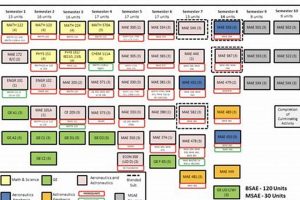
A structured curriculum outlines the specific courses and sequence needed to fulfill the requirements for a bachelor’s degree in the field concerned with the design, development, and testing of aircraft and spacecraft. This educational roadmap typically encompasses foundational coursework in mathematics, physics, and chemistry, followed by specialized subjects such as aerodynamics, propulsion, materials science, and orbital mechanics. For example, a student might begin with calculus and linear algebra, subsequently progressing to fluid dynamics and structural analysis.
Adhering to this pre-defined academic pathway is crucial for ensuring students acquire the necessary knowledge and skills to succeed in this demanding profession. A well-designed educational framework provides a systematic approach to learning complex engineering principles, fostering critical thinking and problem-solving abilities. Furthermore, it prepares graduates for entry-level positions in the aerospace industry and provides a foundation for advanced studies and research.
The following sections will delve into the typical components, specializations, and considerations involved in constructing and navigating a bachelor’s level curriculum for this exacting branch of engineering. These include a review of core coursework, elective options, experiential learning opportunities, and advice for selecting a concentration area.
The following recommendations offer insights for students pursuing a structured curriculum in aerospace engineering, aimed at optimizing academic performance and career readiness. Diligent application of these principles is essential for success in this challenging field.
Tip 1: Solidify Foundational Knowledge. A strong grasp of mathematics, physics, and computer science is paramount. Invest extra time in mastering calculus, differential equations, and linear algebra, as these concepts underpin most subsequent engineering coursework. Proficiency in programming languages like MATLAB or Python is equally crucial for simulations and data analysis.
Tip 2: Prioritize Core Coursework. Focus on excelling in core aerospace engineering subjects such as aerodynamics, structural analysis, propulsion, and flight dynamics. These form the bedrock of expertise and will be heavily relied upon in future professional endeavors. Seek out supplementary resources, such as textbooks and online tutorials, to deepen understanding.
Tip 3: Select a Specialization Strategically. Aerospace engineering offers various areas of concentration, including astronautics, aeronautics, propulsion systems, and control systems. Choose a specialization that aligns with personal interests and career aspirations, considering factors such as market demand and research opportunities.
Tip 4: Seek Experiential Learning Opportunities. Internships, co-op programs, and research experiences are invaluable for applying theoretical knowledge to real-world problems. These opportunities provide practical skills, industry connections, and a competitive edge in the job market. Actively pursue these opportunities and make the most of them.
Tip 5: Engage in Hands-on Projects. Participate in design-build-test projects, such as designing and building a model aircraft or a rocket. These projects foster teamwork, problem-solving skills, and a deeper understanding of engineering principles. Consider joining student organizations like AIAA to gain access to such projects.
Tip 6: Cultivate Strong Communication Skills. Effective communication is essential for aerospace engineers. Develop strong written and oral communication skills through technical writing courses, presentations, and group projects. Clear and concise communication is crucial for collaborating with colleagues and conveying technical information to stakeholders.
Tip 7: Network with Professionals. Attend industry conferences, career fairs, and networking events to connect with aerospace professionals. Building relationships with engineers and recruiters can provide valuable insights into the industry and increase job prospects. Utilize online platforms like LinkedIn to expand the professional network.
These guidelines are intended to assist students in effectively navigating and excelling within a demanding academic framework. By emphasizing foundational knowledge, strategic specialization, and practical experience, students can maximize their potential for success in this dynamic and rewarding field.
The subsequent section will address potential career paths and opportunities available to graduates of such engineering programs, providing a comprehensive overview of the professional landscape.
1. Core Coursework

Core coursework constitutes the bedrock upon which an aerospace engineering degree plan is built. These courses provide a comprehensive understanding of fundamental principles essential for the analysis, design, and operation of aerospace vehicles and systems. Neglecting a strong foundation in these core areas undermines a graduate’s ability to contribute effectively to the field. For instance, a thorough understanding of thermodynamics is essential for designing efficient propulsion systems, while expertise in fluid mechanics is crucial for aerodynamic analysis of aircraft wings.
These courses typically encompass subjects such as aerodynamics, propulsion, structural analysis, flight dynamics, and control systems. A deficiency in any of these areas can have cascading effects. For example, inadequate knowledge of structural analysis could lead to designs that fail under stress, compromising safety and performance. Similarly, a weak understanding of control systems can hinder the ability to design stable and responsive flight control algorithms. The curriculum’s structure ensures a logical progression, with each core course building upon previous knowledge and preparing students for more advanced topics and specializations.
In summary, core coursework is not merely a set of required classes but rather the essential building blocks of an aerospace engineering education. A mastery of these core subjects ensures that graduates possess the fundamental skills and knowledge necessary to tackle complex engineering problems, contribute to innovation, and uphold the highest standards of safety and performance within the aerospace industry. Their prominence within the overall framework is non-negotiable for a successful career in this field.
2. Specializations

The structure of a curriculum incorporates opportunities for specialization, allowing students to concentrate their studies in a sub-discipline of interest. These specialized tracks are integral to tailoring the curriculum to individual career goals and industry demands. The availability of these options ensures the curriculum remains current and relevant, aligning with emerging technological advancements. Without specialization options, the curriculum risks becoming too broad, lacking the depth necessary for graduates to excel in specific roles within the aerospace sector. For example, a student interested in spacecraft design might specialize in astronautics, focusing on orbital mechanics, spacecraft propulsion, and satellite systems, while another drawn to aircraft development might select aeronautics, delving into aerodynamics, aircraft structures, and flight control systems.
The selection of a specific track directly influences the elective courses students undertake, the research projects they engage in, and the internships they pursue. This focused approach enables students to develop advanced skills and knowledge in their chosen area, making them more competitive for specialized positions upon graduation. For example, a student specializing in propulsion systems might take advanced courses in combustion and rocket propulsion, participate in research related to advanced engine designs, and complete an internship at a company specializing in jet engine manufacturing. This focused experience significantly enhances their expertise and marketability within the propulsion field.
In essence, specializations are a critical component of the curriculum, providing the means for students to acquire in-depth knowledge and skills in specific areas of aerospace engineering. These tailored tracks facilitate the development of highly skilled professionals who can contribute meaningfully to innovation and technological advancement within their chosen sub-disciplines. The integration of relevant specializations is thus essential for ensuring the curriculum remains responsive to the evolving needs of the aerospace industry, thereby preparing graduates for successful and impactful careers.
3. Experiential Learning
Experiential learning constitutes a critical element in a comprehensive aerospace engineering structure. It bridges the gap between theoretical knowledge acquired in the classroom and the practical application of that knowledge in real-world scenarios. Internships, co-op programs, research projects, and design-build-test activities serve as the primary avenues for such learning. These experiences provide opportunities to apply engineering principles, develop problem-solving skills, and understand the complexities of the aerospace industry. A student designing and testing a wind tunnel model, for instance, directly experiences the principles of aerodynamics, gaining insights unattainable through lectures alone. Consequently, the inclusion of such opportunities is not merely supplemental but integral to a well-rounded program.
The practical application of theoretical concepts through experiential learning directly impacts a graduate’s readiness for the workforce. Employers actively seek candidates with demonstrated experience in applying engineering principles to real-world problems. Participation in research projects, for example, allows students to contribute to cutting-edge advancements in the field while developing crucial research skills. Similarly, internships at aerospace companies provide exposure to industry practices, engineering workflows, and professional standards. The absence of such experience can place graduates at a significant disadvantage in the competitive job market. The impact of this education method on employment opportunities cannot be overstated, making it a fundamental investment in a student’s future career.
In summary, integrating robust opportunities for experiential learning within the overall structure cultivates a deeper understanding of aerospace engineering principles, enhances practical skills, and improves career prospects. These experiences are not ancillary but rather essential components that ensure graduates are not only knowledgeable but also capable of contributing effectively to the aerospace industry. The challenges in implementing such programs, such as resource allocation and coordination with industry partners, are outweighed by the profound benefits they offer in preparing future aerospace engineers.
4. Accreditation Standards
Accreditation standards exert a significant influence on the design and implementation of aerospace engineering curricula. These standards, typically established by organizations such as ABET (Accreditation Board for Engineering and Technology), define the criteria that programs must meet to demonstrate their quality and effectiveness. A primary effect of these standards is to ensure that graduates possess the necessary knowledge, skills, and abilities to enter the aerospace engineering profession. For example, ABET standards mandate that graduates demonstrate proficiency in areas such as problem-solving, design, communication, and ethical responsibility. Consequently, programs must incorporate coursework, projects, and assessments that specifically address these competencies.
Accreditation serves as a critical component of a robust curriculum, providing a framework for continuous improvement and accountability. Programs undergo periodic reviews to assess their compliance with the established standards. This process encourages faculty to regularly evaluate and update the curriculum to reflect advancements in the field and address emerging industry needs. For instance, the rise of unmanned aerial vehicles (UAVs) has prompted many programs to incorporate coursework related to UAV design, control, and applications, directly aligning with the evolving demands of the aerospace industry. Accreditation also informs prospective students and employers about the quality and rigor of a particular program, influencing enrollment decisions and hiring practices. An accredited program signals to employers that its graduates have met a recognized standard of competence.
In summary, accreditation standards are integral to the design, evaluation, and continuous improvement of aerospace engineering curricula. By ensuring that programs adhere to established criteria for quality and effectiveness, accreditation promotes the development of competent and well-prepared aerospace engineers. The practical significance of understanding accreditation standards lies in their role in guiding curriculum development, informing student choice, and assuring employers of the quality and capabilities of program graduates. Challenges remain in keeping standards current with the rapid pace of technological change, requiring ongoing collaboration between accreditation bodies, academic institutions, and industry stakeholders.
5. ABET Requirements

ABET requirements are a foundational element directly shaping aerospace engineering degree plans. These requirements act as a national and international benchmark, ensuring a consistent level of quality and relevance across accredited programs. They dictate specific learning outcomes that graduates must demonstrate, covering areas such as problem-solving, design, communication, and an understanding of ethical and professional responsibilities. The curriculum must be designed to facilitate the achievement of these outcomes. As an example, a course on aircraft design will need to incorporate elements that allow students to demonstrate their ability to design a system, component, or process to meet desired needs within realistic constraints, aligning directly with ABET’s design-related outcome.
The influence of ABET extends beyond specific course content. The accreditation process requires programs to demonstrate a system for continuous improvement, including regular assessment of student learning and curriculum adjustments based on feedback. This iterative process ensures that the curriculum remains current and responsive to the evolving needs of the aerospace industry. For instance, if assessment data reveals a weakness in students’ understanding of composite materials, a program might add a new module to its materials science course or incorporate more hands-on laboratory work with composite structures. Furthermore, ABET requires programs to have clearly defined educational objectives that align with the needs of their constituents, including students, employers, and the broader community. These objectives, in turn, shape the specific content and structure of the curriculum.
In summary, ABET requirements are not merely a set of guidelines but a fundamental driving force behind the design, implementation, and continuous improvement of aerospace engineering degree plans. Their practical significance lies in ensuring that graduates possess the skills and knowledge necessary to succeed in the aerospace industry and contribute to society in a responsible and ethical manner. While maintaining accreditation can be a resource-intensive process, the benefits of ensuring program quality and graduate preparedness far outweigh the challenges. Therefore, a thorough understanding of ABET requirements is crucial for both program administrators and students pursuing an aerospace engineering degree.
6. Program Outcomes

Program outcomes represent the measurable knowledge, skills, and behaviors that graduates of an aerospace engineering degree plan are expected to demonstrate upon completion of their studies. These outcomes serve as a crucial link between the curriculum’s design and its intended impact on students’ capabilities. The degree plan, therefore, is strategically structured to ensure that students systematically acquire and refine these defined attributes. For instance, if a program outcome stipulates the ability to design and conduct experiments, the curriculum will incorporate laboratory courses, design projects, and research opportunities that directly foster these skills. The selection of specific courses, assignments, and assessment methods is driven by the need to achieve these predefined program outcomes. In effect, program outcomes dictate the pedagogical approach and content selection within the curriculum.
The practical significance of understanding program outcomes lies in their role as benchmarks for both students and educators. Students can use these outcomes to guide their learning efforts, focusing on developing the specific skills and knowledge deemed essential for success in the aerospace engineering profession. Educators, in turn, utilize program outcomes to evaluate the effectiveness of their teaching methods and curriculum design. Regular assessment of student performance against these outcomes allows for data-driven improvements to the degree plan. For example, if a program outcome related to effective communication is not consistently met, the curriculum might be revised to include more opportunities for technical writing and oral presentations. This continuous improvement loop, driven by the assessment of program outcomes, ensures the degree plan remains relevant and effective.
In summary, program outcomes are integral to the structure and purpose of an aerospace engineering degree plan. They define the intended capabilities of graduates, guide curriculum design and assessment, and provide a framework for continuous improvement. The practical significance of this connection lies in ensuring that the degree plan effectively prepares students for successful careers in the aerospace industry and that the program remains responsive to evolving industry needs. Challenges may arise in accurately measuring and assessing complex skills such as creativity and innovation, but ongoing efforts to refine assessment methods are crucial for ensuring the continued relevance and effectiveness of aerospace engineering education.
Frequently Asked Questions
This section addresses common inquiries regarding the structure and requirements of a formal educational track in aerospace engineering. Clarification of these points is essential for prospective students and those seeking a deeper understanding of this field.
Question 1: What fundamental subjects constitute the foundation of an aerospace engineering curriculum?
The underpinning of such curricula typically includes calculus, differential equations, linear algebra, physics (mechanics, electromagnetism, thermodynamics), and chemistry. These disciplines provide the analytical and scientific basis necessary for advanced engineering coursework.
Question 2: How does a specialization impact the curriculum’s structure?
Specializations, such as astronautics, aeronautics, or propulsion systems, allow students to focus on specific areas within aerospace engineering. This concentration influences elective course selection, research project involvement, and internship opportunities, tailoring the academic experience to individual career aspirations.
Question 3: What role does experiential learning play in this educational framework?
Experiential learning, encompassing internships, co-op programs, research projects, and design-build-test activities, provides practical application of theoretical knowledge. This hands-on experience enhances problem-solving skills and prepares graduates for the demands of the aerospace industry.
Question 4: What are the primary functions of accreditation standards in aerospace engineering programs?
Accreditation standards, such as those established by ABET, ensure that programs meet specific criteria for quality and effectiveness. These standards guarantee that graduates possess the necessary knowledge, skills, and abilities to enter the aerospace engineering profession.
Question 5: How do ABET requirements shape the content and structure of a degree curriculum?
ABET requirements dictate specific learning outcomes that graduates must demonstrate, covering areas such as problem-solving, design, communication, and ethical responsibility. The curriculum must be designed to facilitate the achievement of these outcomes, influencing course content and assessment methods.
Question 6: What is the significance of program outcomes in evaluating the effectiveness of a curriculum?
Program outcomes represent the measurable knowledge, skills, and behaviors that graduates are expected to demonstrate. They serve as benchmarks for evaluating the curriculum’s effectiveness and driving continuous improvement efforts.
In summary, this overview clarifies the key elements and considerations surrounding a structured aerospace engineering educational path, emphasizing the importance of foundational knowledge, practical experience, and adherence to established standards.
The next section will address potential career paths and opportunities available to graduates of such engineering programs, providing a comprehensive overview of the professional landscape.
Conclusion
This examination of the aerospace engineering degree plan underscores its multifaceted nature. It is a carefully structured curriculum, shaped by foundational subjects, specialization options, experiential learning opportunities, and rigorous accreditation standards like those set forth by ABET. The success of any such structured learning path hinges on its ability to impart essential knowledge and skills, preparing graduates to contribute meaningfully to the field.
Understanding the intricacies of this educational roadmap is crucial for prospective students, educators, and industry stakeholders alike. Continued refinement of these structured paths is vital for ensuring future generations of aerospace engineers are equipped to address the complex challenges and opportunities that lie ahead. Therefore, ongoing collaboration between academic institutions, industry partners, and accreditation bodies is essential to maintain the relevance and rigor of aerospace engineering education.

![[IIT Aero Expert] Abhay Singh: Aerospace Engineering Insights | Innovating the Future of Flight with Reliable Aviation Solutions](https://mixaerospace.com/wp-content/uploads/2026/05/th-139-300x200.jpg "[IIT Aero Expert] Abhay Singh: Aerospace Engineering Insights Innovating the Future of Flight with Reliable Aviation Solutions")