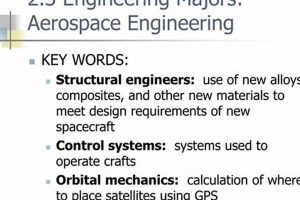
The multifaceted nature of aerospace engineering encompasses a diverse array of specializations, each addressing specific challenges and opportunities within the design, development, testing, and maintenance of aircraft and spacecraft. These areas of focus range from the theoretical to the applied, requiring a deep understanding of physics, mathematics, and materials science. Examples include aerodynamics, propulsion, structural analysis, and control systems, each critical to the success of aerospace endeavors.
Focused expertise is essential to advancing the capabilities and safety of air and space vehicles. Historically, the development of increasingly sophisticated aircraft and spacecraft has been driven by specialization, allowing engineers to concentrate on improving performance, efficiency, and reliability within their respective domains. This has resulted in substantial progress in areas such as fuel efficiency, flight control, and materials performance, leading to safer and more capable air and space transportation.
The following sections will delve into some of the key areas of concentration, examining the fundamental principles, applications, and ongoing research within each domain. These areas represent the core knowledge base and skill sets required for professionals working in this advanced technological sector.
Guidance for Aspiring Professionals
The following guidance is intended to provide prospective aerospace engineers with insights into navigating the complexities of the field and maximizing their potential for success.
Tip 1: Cultivate a Strong Foundation in Core Sciences: A thorough understanding of physics, mathematics, and computer science is paramount. Success in specific areas rests upon the solid base provided by fundamental scientific and mathematical principles.
Tip 2: Gain Practical Experience Through Internships: Seek internships with aerospace companies or research institutions. This hands-on experience provides invaluable exposure to real-world challenges and allows application of theoretical knowledge.
Tip 3: Specialize Strategically: Identify areas of interest within the broad domain and pursue specialized knowledge through advanced coursework, research projects, or professional certifications. Specialization increases marketability and expertise.
Tip 4: Develop Strong Analytical and Problem-Solving Skills: Aerospace engineering inherently involves complex problems requiring rigorous analytical thinking. Cultivate these skills through challenging projects and continuous learning.
Tip 5: Enhance Communication Proficiency: The ability to clearly and effectively communicate technical information is crucial. Practice written and oral communication skills, including technical report writing and presentations.
Tip 6: Embrace Continuous Learning: The aerospace sector is constantly evolving. Stay abreast of the latest advancements through journals, conferences, and professional development courses. Lifelong learning is essential for career longevity.
Tip 7: Network with Professionals: Attend industry events and connect with engineers and researchers. Networking can provide valuable insights, mentorship opportunities, and potential career paths.
The successful navigation of a career in the target domain hinges on a combination of rigorous academic preparation, practical experience, and a commitment to continuous learning and professional development. By prioritizing these key areas, aspiring professionals can increase their chances of success in this demanding and rewarding field.
The concluding section will summarize the main points of this discussion and offer a final perspective on the significance of this engineering discipline.
1. Aerodynamics

Aerodynamics, a fundamental branch of fluid mechanics, is inextricably linked to various domains within aerospace engineering. Its principles govern the interaction between air and moving objects, shaping the design and performance characteristics of aircraft and spacecraft. Understanding aerodynamic forces and phenomena is critical for ensuring efficient and stable flight.
- Lift Generation
Lift, the force that counteracts gravity, is generated by the flow of air over the wings of an aircraft. The design of airfoils, the cross-sectional shape of wings, is optimized to create a pressure difference between the upper and lower surfaces, resulting in upward lift. Without sufficient lift, an aircraft cannot achieve or maintain flight. Aerodynamic considerations are paramount in airfoil design to maximize lift while minimizing drag, thereby enhancing aircraft efficiency.
- Drag Reduction
Drag, the force that opposes motion through the air, significantly impacts an aircraft’s fuel consumption and speed. Aerodynamic design focuses on minimizing drag through streamlining, surface finish optimization, and the management of boundary layer flow. Reducing drag leads to improved fuel efficiency, increased range, and enhanced overall performance. For instance, the shape of an aircraft’s fuselage and the design of winglets contribute to drag reduction.
- Stability and Control
Aerodynamic forces play a crucial role in maintaining an aircraft’s stability and enabling controlled maneuvers. Control surfaces, such as ailerons, elevators, and rudders, are used to manipulate airflow and generate moments that allow the pilot to control the aircraft’s attitude and direction. Aerodynamic analysis is essential for determining the size and placement of these control surfaces to ensure responsive and predictable handling characteristics.
- High-Speed Aerodynamics
At high speeds, particularly those approaching or exceeding the speed of sound, aerodynamic phenomena become more complex. Compressibility effects, shock waves, and sonic booms can significantly impact aircraft performance and stability. Specialized aerodynamic designs, such as swept wings and area ruling, are employed to mitigate these effects. The study of high-speed aerodynamics is crucial for developing supersonic and hypersonic aircraft.
In summation, the principles of aerodynamics are central to numerous aspects of aerospace engineering, influencing the design, performance, and safety of aircraft and spacecraft. From lift generation and drag reduction to stability and control, a thorough understanding of aerodynamic phenomena is essential for engineers working in this field. These facets highlight the importance of aerodynamics as a foundational element within the broader spectrum of aerospace engineering disciplines.
2. Propulsion Systems

Propulsion systems represent a critical domain within aerospace engineering, encompassing the design, development, and analysis of mechanisms that generate thrust to propel aircraft and spacecraft. This area is integral to achieving flight, enabling space exploration, and ensuring efficient air transportation. Without effective propulsion systems, the theoretical advancements in other disciplines within aerospace engineering would remain unrealized.
- Engine Design and Performance
Engine design involves optimizing thermodynamic cycles, combustion processes, and fluid dynamics to maximize thrust output while minimizing fuel consumption and emissions. This necessitates a deep understanding of gas turbine engines, ramjets, scramjets, and rocket engines, each suited to different flight regimes and mission requirements. For example, the design of a high-bypass turbofan engine for a commercial airliner focuses on fuel efficiency at subsonic speeds, while a rocket engine prioritizes high thrust-to-weight ratio for space launch.
- Combustion and Fuel Technology
Efficient combustion is paramount for generating the energy required for thrust. Research in combustion focuses on optimizing fuel-air mixing, flame stability, and minimizing the formation of pollutants. Advancements in fuel technology, such as the development of biofuels and synthetic fuels, aim to reduce the environmental impact of air transportation. For instance, the use of lean-burn combustion techniques in modern gas turbine engines reduces NOx emissions.
- Nozzle Design and Thrust Vectoring
The nozzle is a critical component of a propulsion system that converts thermal energy into kinetic energy, accelerating exhaust gases to generate thrust. Nozzle design involves optimizing the geometry to achieve efficient expansion and thrust. Thrust vectoring, the ability to control the direction of thrust, enhances aircraft maneuverability. Military aircraft often utilize thrust vectoring nozzles to achieve exceptional agility during aerial combat.
- System Integration and Testing
Integrating a propulsion system into an aircraft or spacecraft requires careful consideration of factors such as weight, drag, cooling, and control interfaces. Rigorous testing, both on the ground and in flight, is essential to validate performance and ensure reliability. Wind tunnel testing, static firing tests, and flight tests are commonly employed to evaluate propulsion system characteristics under realistic operating conditions.
In summary, the development and refinement of propulsion systems remain a central focus within aerospace engineering. Innovations in engine design, combustion technology, nozzle performance, and system integration are critical for advancing the capabilities of air and space vehicles. These interconnected elements underscore the dynamic nature and enduring significance of propulsion systems within the diverse fields of aerospace engineering.
3. Structural Mechanics

Structural mechanics is an indispensable discipline within the broader scope of aerospace engineering. It focuses on the analysis and design of structures to withstand various loads and environmental conditions encountered during flight or space travel. Its importance lies in ensuring the safety, reliability, and performance of aerospace vehicles.
- Stress and Strain Analysis
Stress and strain analysis forms the foundation of structural mechanics. It involves determining the internal forces and deformations within a structure subjected to external loads. This analysis is critical for identifying areas of high stress concentration, which are prone to failure. For example, finite element analysis (FEA) is widely used to simulate stress distribution in aircraft wings under aerodynamic loads, ensuring that the structure can withstand the operational stresses without failure.
- Material Selection and Behavior
The selection of appropriate materials is paramount in aerospace structural design. Materials must possess high strength-to-weight ratios, resistance to fatigue, corrosion, and extreme temperatures. Structural mechanics incorporates the study of material properties and behavior under different loading conditions. Composite materials, such as carbon fiber reinforced polymers, are increasingly used in aircraft structures due to their high strength and low weight, enabling improved fuel efficiency and performance.
- Structural Stability and Buckling
Structural stability refers to the ability of a structure to maintain its shape and resist sudden deformation under compressive loads. Buckling is a phenomenon where a slender structure collapses due to instability. Aerospace engineers must design structures to prevent buckling under operational loads. For example, aircraft fuselages are often stiffened with stringers and frames to enhance their buckling resistance, ensuring structural integrity during flight.
- Fatigue and Fracture Mechanics
Fatigue is the progressive and localized structural damage that occurs when a material is subjected to cyclic loading. Fracture mechanics deals with the study of crack propagation and failure in structures. Aerospace structures are susceptible to fatigue due to repeated flight cycles. Engineers employ fatigue analysis and fracture mechanics to predict the lifespan of structural components and implement maintenance schedules to prevent catastrophic failures. Non-destructive testing methods, such as ultrasonic inspection, are used to detect cracks and defects before they reach a critical size.
The principles and applications of structural mechanics are fundamental to the successful design and operation of aerospace vehicles. By ensuring structural integrity, preventing failures, and optimizing material usage, structural mechanics plays a vital role in advancing the capabilities and safety within aerospace engineering as a whole. This highlights the critical interdependency between structural mechanics and the other specialized domains within the broader engineering sector.
4. Control Engineering
Control engineering, a vital component within aerospace engineering, focuses on the design and implementation of systems that regulate the behavior of aircraft, spacecraft, and related equipment. Precise and reliable control is paramount for ensuring stability, maneuverability, and overall performance in the challenging operational environments characteristic of air and space travel. The effective application of control principles is a fundamental prerequisite for achieving safe and efficient aerospace operations.
The connection between control and the broader domain is exemplified in several critical areas. Flight control systems, for instance, employ feedback loops and sophisticated algorithms to maintain desired altitude, heading, and airspeed, counteracting the effects of turbulence and other disturbances. Autopilots utilize control to automate flight operations, reducing pilot workload and enhancing precision during long-duration missions. Attitude control systems on spacecraft precisely orient the vehicle for communication, observation, or orbital maneuvers. Real-world examples include the fly-by-wire systems in modern commercial aircraft, which enhance safety and efficiency by augmenting pilot inputs with computer-controlled adjustments, and the precision guidance systems used in spacecraft for rendezvous and docking maneuvers.
A comprehensive understanding of control engineering principles is essential for aerospace professionals. The design of robust and reliable control systems requires a solid foundation in mathematics, physics, and computer science, as well as specialized knowledge of control theory, signal processing, and system identification. Challenges include dealing with uncertainties in system dynamics, external disturbances, and sensor noise. Advanced control techniques, such as adaptive control and robust control, are employed to address these challenges and ensure reliable performance. The integration of these control systems represents a core element in realizing the potential of aerospace engineering.
5. Materials Science

Materials science is a cornerstone of aerospace engineering, dictating the feasible limits and performance characteristics of aircraft and spacecraft. The properties of materials directly influence structural integrity, weight, thermal resistance, and overall durability of aerospace vehicles. Without advancements in materials science, progress in other fields within aerospace engineering would be severely constrained. The selection and application of appropriate materials are pivotal in addressing the extreme conditions encountered during flight and space exploration.
The practical application of materials science in aerospace is readily apparent in various components. High-strength aluminum alloys, for instance, are commonly used in aircraft fuselages to provide structural support while minimizing weight. Titanium alloys, known for their high strength-to-weight ratio and corrosion resistance, are employed in critical engine components such as turbine blades. Composite materials, such as carbon fiber reinforced polymers, are increasingly replacing traditional materials in aircraft wings and control surfaces due to their superior strength, stiffness, and weight reduction potential. The development of heat-resistant materials is equally crucial for spacecraft components, particularly those exposed to extreme temperatures during atmospheric reentry. Thermal protection systems (TPS) utilize advanced ceramic materials and ablative coatings to shield spacecraft from the intense heat generated during reentry, safeguarding the vehicle and its occupants.
In conclusion, materials science is an indispensable element within aerospace engineering, enabling the design and construction of high-performance, safe, and reliable aircraft and spacecraft. Continued research and development in this field are essential for pushing the boundaries of aerospace technology, enabling the creation of more efficient, durable, and capable vehicles for air and space exploration. Overcoming the challenges associated with material selection and performance in extreme environments remains a critical focus for aerospace engineers, ensuring continued progress in this dynamic field.
6. Avionics
Avionics, a portmanteau of aviation and electronics, constitutes a critical and integrated domain within aerospace engineering. It encompasses the electronic systems used on aircraft, satellites, and spacecraft, including communication, navigation, flight control, and display systems. The efficacy of these systems directly impacts the safety, efficiency, and operational capabilities of aerospace vehicles. Therefore, advancements and reliability within avionics are paramount to progress across other specialized areas.
The interconnection between avionics and other elements is evident in numerous practical applications. For instance, modern flight control systems rely on sophisticated sensors and actuators to maintain stability and execute pilot commands, requiring seamless integration of electronics, software, and mechanical components. Navigation systems, such as GPS and inertial navigation units (INS), provide precise positioning information, enabling accurate flight planning and execution. Communication systems facilitate real-time data exchange between aircraft and ground stations, supporting air traffic control and weather monitoring. Furthermore, display systems present critical flight information to the pilot, enhancing situational awareness and decision-making capabilities. Without reliable and accurate avionics, the performance and safety of even the most aerodynamically advanced or structurally robust aircraft would be severely compromised. Examples are advanced instrumentation of boeing 787 which allow it for automatic landing or the complex satellite control systems used for earth observation which all falls in Avionics scope.
In summary, avionics is an essential and integral facet within aerospace engineering. Its contribution extends far beyond mere electronic components, impacting the fundamental capabilities and safety characteristics of air and space vehicles. The continued development and refinement of avionics systems will remain a crucial focus for aerospace engineers, driving progress and innovation across the entire sector. The challenges involved include ensuring resilience to electromagnetic interference, developing autonomous systems for unmanned aerial vehicles, and integrating artificial intelligence to enhance decision-making capabilities, all demanding constant progress in electronics field. These elements underscore the critical role of avionics in the ongoing evolution of aerospace technology.
Frequently Asked Questions
The following questions address common inquiries and misconceptions regarding the various areas within aerospace engineering. The intention is to provide clear and concise information for individuals seeking a deeper understanding of the specializations.
Question 1: What are the primary areas of specialization within aerospace engineering?
The primary areas of specialization encompass aerodynamics, propulsion systems, structural mechanics, control engineering, materials science, and avionics. Each domain focuses on distinct aspects of aircraft and spacecraft design, development, and operation.
Question 2: Why is specialization important in aerospace engineering?
Specialization allows engineers to develop in-depth knowledge and expertise in specific areas, enabling them to contribute to complex projects effectively. The multidisciplinary nature of aerospace engineering necessitates focused expertise for optimal design and performance.
Question 3: How do the different aerospace engineering disciplines interact with each other?
The various disciplines are highly interdependent. For example, aerodynamic considerations influence the design of propulsion systems, while structural mechanics dictates material selection and load-bearing capabilities. Collaboration and integration across these domains are essential for successful aerospace projects.
Question 4: What educational background is required to specialize in a particular area of aerospace engineering?
A bachelor’s degree in aerospace engineering or a related field is typically required. Advanced degrees, such as a master’s or doctorate, are often necessary for specializing in research-intensive areas or pursuing leadership positions.
Question 5: What are some of the emerging trends in aerospace engineering specializations?
Emerging trends include the development of advanced composite materials, electric propulsion systems, autonomous flight control, and hypersonic technologies. These areas represent significant opportunities for innovation and advancement within the field.
Question 6: How does one choose a specialization within aerospace engineering?
The selection of a specialization should align with individual interests, aptitudes, and career goals. Gaining practical experience through internships or research projects can help clarify preferences and identify areas of strength.
The specializations within aerospace engineering are not mutually exclusive but rather interconnected aspects of a complex field. A comprehensive understanding of these diverse areas is crucial for anyone seeking to contribute to the advancement of air and space technology.
The subsequent section will provide a summary of the key concepts discussed and offer a concluding perspective on the importance of aerospace engineering.
Conclusion
This exposition has illuminated the multifaceted nature of fields in aerospace engineering. The significance of each specialization, from aerodynamics and propulsion to structural mechanics, control engineering, materials science, and avionics, has been underscored. These are not isolated disciplines, but interconnected domains each essential to the design, development, and operation of safe and effective aerospace vehicles. Understanding their unique contributions is crucial for appreciating the comprehensive nature of this engineering sector.
Continued progress within fields in aerospace engineering will undoubtedly shape the future of air and space travel. Sustained investment in research, development, and education is vital to ensure that future generations of engineers are equipped to address the complex challenges and capitalize on the opportunities that lie ahead. The ongoing advancement of these domains is integral to maintaining global leadership in aerospace technology and realizing the full potential of air and space exploration.