The foundational knowledge required for the design, development, and analysis of aircraft and spacecraft is a critical element in this specialized discipline. It encompasses the core principles of aerodynamics, propulsion, structural mechanics, and control systems. For instance, understanding the principles of lift generation is essential for designing efficient aircraft wings.
A solid grasp of these core concepts is vital for innovation and advancement within the field. These principles provide the bedrock for addressing complex challenges, such as improving fuel efficiency, enhancing flight safety, and exploring new frontiers in space exploration. Historically, a strong grounding in these areas has been the catalyst for breakthroughs ranging from the development of jet engines to the exploration of Mars.
This article will explore various essential aspects of this discipline, including fluid dynamics, materials science, and orbital mechanics, demonstrating their practical applications and relevance to modern aerospace challenges.
Guidance on Mastering Core Principles
Proficiency in the aerospace domain requires a deep understanding of its fundamental tenets. The following tips are designed to aid in the acquisition and application of this essential knowledge.
Tip 1: Prioritize Foundational Courses: Establish a strong basis in mathematics, physics, and computer science. These subjects provide the tools necessary for understanding complex aerospace systems. For example, a firm grasp of calculus is crucial for analyzing aerodynamic forces.
Tip 2: Engage in Hands-On Projects: Supplement theoretical knowledge with practical experience. Participating in design competitions, building model aircraft, or contributing to research projects provides invaluable experience. Such activities reinforce theoretical concepts through real-world application.
Tip 3: Utilize Simulation Software: Become proficient in industry-standard simulation software. Tools like MATLAB, ANSYS, and SolidWorks allow for the modeling and analysis of aircraft and spacecraft performance. Understanding these tools is crucial for predicting and optimizing system behavior.
Tip 4: Seek Mentorship from Experienced Professionals: Learn from the insights and experience of seasoned engineers. Mentors can provide guidance, share industry knowledge, and offer career advice. Connecting with professionals accelerates learning and provides valuable perspectives.
Tip 5: Stay Current with Technological Advancements: The aerospace field is constantly evolving. Regularly read industry publications, attend conferences, and participate in continuing education programs. Staying abreast of new technologies and trends is essential for maintaining expertise.
Tip 6: Develop Strong Problem-Solving Skills: Aerospace engineering involves complex challenges that require analytical thinking. Practice breaking down problems into manageable components, identifying key variables, and applying appropriate solutions. A systematic approach to problem-solving is vital.
Tip 7: Cultivate Effective Communication Skills: Clearly communicate technical information to both technical and non-technical audiences. Strong written and oral communication skills are essential for collaborating with teams, presenting research findings, and documenting designs.
Mastering these principles is crucial for success in the dynamic aerospace sector. By focusing on fundamental knowledge, practical experience, and continuous learning, individuals can contribute significantly to this exciting field.
These tips provide a foundation for continued exploration of advanced topics within aerospace engineering, paving the way for innovation and problem-solving in the field.
1. Aerodynamics Principles

Aerodynamics principles form a cornerstone within the broader discipline, significantly influencing aircraft and spacecraft design, performance, and safety. The study of air in motion and its interaction with solid objects is essential. A comprehensive understanding of aerodynamics dictates how an aircraft generates lift, overcomes drag, and maintains stability. For instance, the design of an aircraft wing is directly based on aerodynamic principles to maximize lift-to-drag ratio, improving fuel efficiency and flight range.
The implications of aerodynamics extend beyond aircraft. Spacecraft design necessitates a comprehension of aerodynamic heating during atmospheric re-entry, influencing the choice of heat shield materials and the vehicle’s shape. Similarly, the design of wind turbines, a critical component of renewable energy infrastructure, relies heavily on aerodynamic optimization to capture maximum energy from wind flow. Furthermore, computational fluid dynamics (CFD) modeling, a key tool in modern engineering, allows for the simulation and analysis of aerodynamic phenomena, enabling engineers to refine designs and predict performance characteristics before physical prototypes are constructed.
In summary, a solid grounding in aerodynamics is indispensable for any aerospace engineer. Its principles are fundamental to the development of efficient, safe, and high-performing systems across various aerospace applications. Overlooking these core concepts would hinder progress in aircraft design, spacecraft engineering, and many other related fields. The pursuit of innovation in aerospace necessitates a deep understanding and practical application of these critical principles.
2. Structural Integrity
Structural integrity, a critical component of aerospace studies, ensures that aircraft and spacecraft can withstand the various stresses encountered during operation. Its connection to core principles is deeply ingrained; a deficiency in any aspect of structural design can lead to catastrophic failure. Understanding load paths, material properties, and failure mechanisms is essential for all aerospace engineers. For example, the Comet airliner disasters of the 1950s highlighted the dangers of neglecting metal fatigue, leading to a significant shift in design and testing protocols. Ignoring structural considerations undermines the safety and reliability of flight vehicles.
Practical applications of structural integrity principles include rigorous testing and analysis methods. Finite element analysis (FEA) is routinely employed to simulate stress distributions in complex structures. Non-destructive testing (NDT) techniques such as ultrasonic inspection and radiography are used to detect flaws before they propagate to failure. Furthermore, advanced materials like carbon fiber composites are increasingly utilized to reduce weight while maintaining strength. These methods collectively ensure that aerospace vehicles can endure extreme conditions, including high accelerations, temperature variations, and aerodynamic loads.
Ensuring structural integrity remains a continual challenge due to the ever-increasing demands of modern aerospace missions. Factors such as the desire for lighter structures, longer operational lifespans, and operation in extreme environments necessitate ongoing research and development. By adhering to rigorous standards and integrating structural considerations into the core design process, engineers can mitigate risks and enhance the safety and performance of aircraft and spacecraft.
3. Propulsion Systems

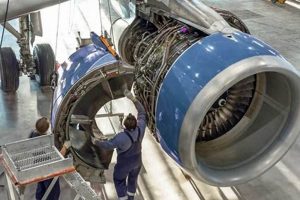
Propulsion systems are an indispensable facet of aerospace engineering, intrinsically linked to the fundamental principles governing flight and space travel. The efficacy of any airborne or spacefaring vehicle is directly contingent upon its ability to generate sufficient thrust to overcome drag and gravity. Consequently, a thorough understanding of thermodynamics, fluid mechanics, and combustion is paramount for aerospace engineers specializing in propulsion. For instance, the design of a jet engine necessitates precise calculations of airflow, fuel injection, and turbine blade geometry to optimize thrust output and fuel efficiency. Similarly, rocket engine design requires a deep understanding of chemical kinetics and nozzle expansion to maximize exhaust velocity.
The practical applications of propulsion principles extend across diverse aerospace domains. In commercial aviation, improvements in engine technology have led to significant reductions in fuel consumption and emissions. The development of high-bypass turbofan engines, for example, has revolutionized air travel by providing greater thrust with lower fuel burn. In space exploration, advanced propulsion systems are critical for enabling long-duration missions. Ion propulsion, while providing relatively low thrust, offers exceptional fuel efficiency, making it suitable for interplanetary travel. The selection and design of propulsion systems are therefore central considerations in the planning and execution of any aerospace endeavor.
Mastery of propulsion system fundamentals presents ongoing challenges due to the continuous demand for greater performance, efficiency, and environmental sustainability. Research into alternative fuels, advanced combustion techniques, and novel propulsion concepts is essential to address these challenges. A comprehensive grasp of these principles is crucial for aerospace engineers to contribute meaningfully to the advancement of air and space travel. The future of aerospace innovation relies heavily on the development and refinement of propulsion technologies grounded in these fundamental principles.
4. Control Theory

Control theory is fundamentally intertwined with the core principles of aerospace engineering, serving as the essential discipline that ensures the stable and predictable operation of complex systems in flight and space. Its importance arises from the inherent need to manage and counteract disturbances affecting aircraft and spacecraft, guaranteeing that these vehicles adhere to desired trajectories and orientations. Without control systems, achieving stable flight, accurate navigation, or precise orbital maneuvers would be infeasible. For example, the autopilot system in a commercial airliner relies on control theory principles to maintain altitude, heading, and airspeed, even in turbulent conditions. This illustrates how real-time feedback and corrective actions, integral to control systems, are vital for safe and efficient air travel. The practical significance of this understanding lies in the ability to design robust control systems that can adapt to changing environments and unforeseen events.
Further analysis reveals that various control strategies are employed in aerospace applications, each tailored to specific requirements. Proportional-Integral-Derivative (PID) controllers are commonly used for basic stabilization tasks, while more sophisticated methods like Model Predictive Control (MPC) are implemented for optimizing performance in complex scenarios. For instance, MPC is often utilized in spacecraft attitude control systems to minimize fuel consumption during long-duration missions. Adaptive control techniques are also deployed to account for uncertainties in system parameters or environmental conditions, ensuring reliable performance even when precise models are unavailable. The development and implementation of these control strategies require a solid understanding of mathematical modeling, system identification, and stability analysis. Furthermore, the increasing prevalence of autonomous systems in aerospace has intensified the demand for advanced control algorithms that can handle complex decision-making tasks.
In conclusion, control theory forms an indispensable part of the aerospace engineering landscape, ensuring the safe, stable, and efficient operation of aircraft and spacecraft. Challenges remain in designing control systems that can cope with increasingly complex and uncertain environments. Continued research into advanced control techniques, coupled with practical application and rigorous testing, will be crucial for advancing the capabilities of future aerospace vehicles and systems. The connection between control theory and the broader fundamentals of aerospace engineering is a symbiotic one, where progress in one area directly contributes to advancements in the other.
5. Materials Science

The selection and application of materials is paramount in aerospace engineering due to the extreme conditions encountered by aircraft and spacecraft. Materials science directly impacts the performance, safety, and longevity of aerospace vehicles. Cause-and-effect relationships are prevalent: choosing lightweight alloys results in improved fuel efficiency, while employing heat-resistant composites enables survival during atmospheric re-entry. The core principles of aerospace depend heavily on materials science to meet stringent requirements, such as high strength-to-weight ratios, resistance to corrosion, and ability to withstand extreme temperatures. For instance, the use of titanium alloys in jet engines allows for higher operating temperatures, leading to greater thrust and efficiency. The integration of advanced composites in aircraft structures reduces weight, contributing to improved fuel economy and payload capacity. Neglecting materials science fundamentals can lead to catastrophic consequences, as evidenced by historical structural failures attributed to inadequate material selection or processing. Therefore, materials science is not merely a supporting discipline but an integral component of aerospace engineering.
Practical applications of materials science extend across all facets of aerospace design and manufacturing. The development of new aluminum-lithium alloys has enabled significant weight reduction in aircraft fuselages. The implementation of ceramic matrix composites in thermal protection systems shields spacecraft from the intense heat generated during atmospheric re-entry. Furthermore, research into self-healing materials promises to extend the lifespan of aerospace components by automatically repairing minor damage. Nanomaterials are also being explored for their potential to enhance the strength, durability, and sensing capabilities of aerospace structures. These advancements demonstrate the ongoing evolution of materials science and its direct impact on the capabilities of aerospace systems. The proper selection and utilization of these materials require a deep understanding of their properties, processing techniques, and performance characteristics under operational conditions.
In conclusion, materials science is inextricably linked to aerospace engineering, providing the foundation for designing and constructing high-performance, reliable, and safe aircraft and spacecraft. Addressing the challenges of extreme environments, stringent weight requirements, and demands for increased durability necessitates continuous innovation in materials science. By understanding the fundamental principles governing material behavior, engineers can push the boundaries of aerospace technology, enabling advancements in air travel, space exploration, and national defense. The symbiotic relationship between these two disciplines is essential for realizing the future of aerospace.
6. Orbital Mechanics
Orbital mechanics, also known as astrodynamics, is a crucial sub-discipline within aerospace engineering focused on the motion of spacecraft and other celestial bodies. It applies principles of physics and mathematics to predict and control the trajectories of objects in space. Comprehending orbital mechanics is fundamental for mission planning, satellite deployment, and space exploration, serving as a cornerstone of aerospace engineering endeavors.
- Kepler’s Laws and Orbital Elements
Kepler’s Laws, describing planetary motion, form the bedrock of orbital mechanics. These laws, coupled with orbital elements (semi-major axis, eccentricity, inclination, etc.), provide a framework for defining and predicting orbits. For instance, determining the correct semi-major axis is crucial for placing a satellite in a geosynchronous orbit. Understanding these elements is essential for designing stable and predictable satellite trajectories.
- Orbital Maneuvers and Delta-V
Orbital maneuvers, such as changing altitude or inclination, require precise application of thrust. Delta-V, representing the change in velocity needed for a maneuver, dictates the fuel requirements for a mission. Hohmann transfers, a fuel-efficient method for changing orbits, exemplify the application of these principles. Calculating delta-V budgets accurately is essential for mission feasibility and resource allocation.
- Perturbations and Orbit Maintenance
Real-world orbits deviate from idealized Keplerian orbits due to gravitational perturbations from the Sun, Moon, and other planets, as well as atmospheric drag. These perturbations can significantly alter satellite trajectories over time. Orbit maintenance maneuvers are therefore necessary to counteract these effects and keep satellites on their intended paths. This involves continuously monitoring orbital parameters and applying corrective thrust when needed.
- Interplanetary Trajectory Design
Designing trajectories for interplanetary missions, such as missions to Mars or Jupiter, is a complex task requiring advanced knowledge of orbital mechanics. Gravity assists, where a spacecraft uses the gravity of a planet to alter its trajectory and velocity, are often employed to reduce fuel consumption. These missions depend on accurate calculations of planetary positions, launch windows, and trajectory optimization techniques.
These interconnected elements of orbital mechanics are vital for aerospace engineers involved in designing and executing space missions. A thorough understanding of these principles enables the efficient and reliable operation of satellites, the exploration of distant planets, and the advancement of space technology. Mastery of orbital mechanics is thus indispensable for contributing to the future of space exploration and utilization, solidifying its place as a fundamental aspect of aerospace engineering.
Frequently Asked Questions
This section addresses common inquiries regarding the foundational principles of aerospace engineering. The intent is to clarify key concepts and provide insights into the subject’s core components.
Question 1: What are the core disciplines comprising aerospace engineering fundamentals?
Aerospace engineering encompasses aerodynamics, propulsion, structural mechanics, materials science, and control systems. These disciplines are integrated to design, develop, and maintain aircraft and spacecraft.
Question 2: Why is aerodynamics considered a cornerstone of aerospace engineering?
Aerodynamics governs the forces of lift, drag, and moment acting on aircraft and spacecraft. Understanding these principles is crucial for designing efficient and stable vehicles capable of flight.
Question 3: How does materials science contribute to advancements in aerospace technology?
Materials science enables the development of lightweight, high-strength materials that can withstand extreme temperatures and stresses. These materials are essential for improving vehicle performance and durability.
Question 4: What role does control theory play in ensuring flight stability?
Control theory provides the framework for designing systems that maintain stability and control of aircraft and spacecraft. These systems utilize feedback mechanisms to counteract disturbances and ensure desired trajectories.
Question 5: Why is propulsion system design critical for both atmospheric and space vehicles?
Propulsion systems generate the thrust required to overcome drag and gravity, enabling flight in the atmosphere and maneuvers in space. Efficient and reliable propulsion systems are fundamental to mission success.
Question 6: How does structural mechanics ensure the safety and reliability of aerospace vehicles?
Structural mechanics focuses on analyzing the stresses and strains within aerospace structures to prevent failure. This involves understanding load paths, material properties, and failure mechanisms to design robust and safe vehicles.
A solid foundation in these principles is essential for individuals pursuing careers in aerospace engineering. Understanding these interconnected disciplines facilitates innovation and problem-solving within the field.
The following section will delve into further resources for continuing your exploration into the world of aerospace engineering.
Conclusion
This exposition has detailed the essential principles comprising “fundamentals of aerospace engineering.” Aerodynamics, propulsion, structural integrity, control theory, materials science, and orbital mechanics collectively form the bedrock upon which advancements in air and space travel are built. A comprehensive understanding of these intertwined disciplines is not merely beneficial, but rather, a prerequisite for success in this demanding field.
As aerospace technology continues to evolve, a commitment to mastering these core principles remains paramount. Further exploration, rigorous application, and continuous learning will equip future engineers to address the complex challenges and realize the boundless opportunities that lie ahead in the skies and beyond.