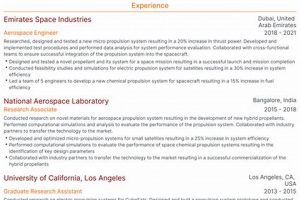
A document outlining a candidate’s qualifications for positions focused on the creation, testing, and improvement of aircraft and spacecraft is vital for professionals in this field. This document typically includes sections detailing education, experience, skills, and projects directly relevant to aerospace engineering. For example, it would highlight expertise in CAD software, materials science, aerodynamics, and specific design projects undertaken, such as wing design or propulsion system analysis.
This career document serves as a critical first impression for potential employers. Its effectiveness can significantly influence the candidate’s ability to secure interviews and ultimately, job offers. Historically, its format has evolved from simple, text-based summaries to visually appealing and keyword-optimized presentations that emphasize quantifiable achievements and demonstrated competencies in increasingly specialized areas of aerospace technology.
Therefore, understanding the key components, optimal formatting, and effective strategies for presenting one’s qualifications within this specific context is paramount. The subsequent discussion will delve into these aspects, providing insights on how to create a compelling and impactful application package for aerospace design engineering roles.
Crafting an Effective Application for Aerospace Design Engineering Roles
The following recommendations are designed to enhance the clarity, impact, and overall effectiveness of a submission targeting aerospace design engineering positions. Adherence to these guidelines can significantly improve a candidate’s chances of securing an interview.
Tip 1: Quantify Accomplishments. Instead of simply listing responsibilities, provide concrete examples of achievements with measurable results. For instance, rather than stating “Designed aircraft components,” specify “Designed wing components, reducing drag by 15% and improving fuel efficiency by 8% as validated by wind tunnel testing.”
Tip 2: Tailor Content to Specific Job Descriptions. Carefully review each job posting and customize the document to highlight skills and experiences that directly match the employer’s requirements. Generic documents are less effective than those demonstrating a clear understanding of the target role and company needs.
Tip 3: Emphasize Relevant Technical Skills. Aerospace design engineering demands proficiency in specialized software and tools. Prominently feature expertise in CAD/CAM software (e.g., CATIA, SolidWorks), simulation tools (e.g., ANSYS, MATLAB), and programming languages (e.g., Python, C++) directly applicable to the target role.
Tip 4: Showcase Project Portfolio. Include a section detailing relevant academic or professional projects. Provide brief descriptions of the project goals, your specific contributions, and the outcomes achieved. Include quantifiable metrics to demonstrate the project’s success and the candidate’s impact.
Tip 5: Optimize for Applicant Tracking Systems (ATS). Many companies use ATS software to screen applications. Use keywords from the job description throughout the document to ensure it is properly parsed and ranked by the system. Avoid using overly creative formatting that may hinder ATS readability.
Tip 6: Highlight Specialized Knowledge. Emphasize any specialized knowledge or certifications relevant to the aerospace industry, such as FAA regulations, materials science expertise, or specific design methodologies. Demonstrating in-depth knowledge within a particular area can significantly enhance a candidate’s appeal.
Tip 7: Maintain a Clean and Professional Format. Employ a clear and concise layout that is easy to read and visually appealing. Use a professional font, consistent formatting, and ample white space to enhance readability. Proofread carefully for errors in grammar and spelling.
By incorporating these recommendations, individuals seeking employment in aerospace design engineering can create an application that effectively showcases their skills, experience, and potential contributions to prospective employers. A well-crafted document significantly increases the likelihood of securing interviews and advancing in the hiring process.
The subsequent sections will further explore common pitfalls and advanced strategies for maximizing the impact of this critical career document.
1. Skills demonstration

Effective conveyance of abilities is paramount in an aerospace design engineering application. The document serves as a primary tool for showcasing a candidate’s proficiency in areas critical to the field. Consequently, the absence of clear and compelling skill representation directly hinders a candidate’s prospect of securing relevant employment. Demonstrable proficiency in CAD/CAM software, finite element analysis, computational fluid dynamics, and materials science are frequently sought by potential employers. Without adequate depiction of these and other relevant skills, an application’s efficacy is significantly diminished.
The incorporation of concrete examples further strengthens the connection between a candidate’s abilities and the requirements of aerospace design roles. For example, explicitly stating “Proficient in CATIA V5, utilized for the design and analysis of aircraft fuselage components resulting in a 10% weight reduction” is more impactful than simply stating “CATIA proficient.” Such demonstration provides direct evidence of the application of skills towards achieving tangible outcomes. Moreover, this level of detail enables recruiters to readily assess the candidate’s suitability for specific project requirements.
Ultimately, the degree to which a candidate successfully articulates their expertise through demonstrable skills directly impacts their competitiveness within the job market. A well-structured, skill-focused document that provides concrete examples and quantifiable results significantly enhances a candidate’s chances of securing interviews and ultimately, positions in aerospace design engineering. Failure to adequately emphasize demonstrable skills represents a critical deficiency which diminishes the document’s overall effectiveness.
2. Project highlights

Project highlights represent a critical component of a document intended to showcase the qualifications of an aerospace design engineer. These sections provide tangible evidence of an applicant’s abilities and experience, translating theoretical knowledge into practical application. The inclusion of well-articulated project details directly impacts an employer’s assessment of a candidate’s potential to contribute to real-world engineering challenges. For instance, a documented involvement in a university-sponsored CubeSat project, detailing design, analysis, and testing responsibilities, can significantly strengthen the document’s impact. Absent such demonstrable experience, the document relies solely on stated skills and educational background, which may prove insufficient to differentiate a candidate in a competitive job market.
The effectiveness of project highlights is further amplified when accompanied by quantifiable results. Instead of merely stating “Participated in wind tunnel testing,” a more impactful statement would read “Led wind tunnel testing efforts for a novel airfoil design, resulting in a 12% reduction in drag coefficient.” Such quantification provides concrete evidence of the candidate’s contribution and the project’s success. Furthermore, referencing specific software tools used during the project, such as ANSYS or MATLAB, demonstrates familiarity with industry-standard practices. A well-crafted project section directly addresses an employer’s primary concern: the candidate’s ability to apply their knowledge to solve engineering problems and deliver measurable outcomes.
In summary, project highlights serve as a cornerstone of an effective document targeting aerospace design engineering positions. These sections provide tangible proof of a candidate’s skills, experience, and ability to deliver results. A comprehensive and well-documented project portfolio, accompanied by quantifiable metrics and references to relevant software tools, significantly enhances the document’s impact and increases the likelihood of securing interviews. The absence of such highlights weakens the overall application, reducing the candidate’s competitiveness and potential for success in the hiring process.
3. Quantifiable results
The inclusion of verifiable metrics within application materials targeting aerospace design engineering roles is paramount for demonstrating a candidate’s value proposition. These measurable outcomes provide tangible evidence of a candidate’s abilities and contributions to past projects, thereby enhancing the credibility and impact of the document.
- Enhanced Project Credibility
The presence of quantifiable results transforms claims of achievement into verifiable facts. For example, stating a design reduced weight by 15% provides more compelling evidence than simply stating “improved design.” This level of specificity allows prospective employers to objectively assess the impact of the candidate’s work and directly correlate it to potential contributions to their organization. Project credibility hinges on data-backed accomplishments, eliminating ambiguity and fostering trust.
- Improved Performance Measurement
Quantifiable results enable employers to evaluate a candidate’s past performance in relation to specific performance indicators. If an applicant can demonstrate they improved aerodynamic efficiency by a certain percentage or reduced manufacturing costs on a previous project by a specific dollar amount, it allows employers to see what specific key performance indicators the potential candidate can help improve in their role. It allows for clear cut measurements for what the candidate has achieved and can also achieve in the future.
- Differentiation from Other Candidates
In a competitive applicant pool, the ability to present verifiable metrics can significantly differentiate a candidate. Where multiple applicants may possess similar skill sets and experience, quantifiable results provide a distinct advantage by showcasing tangible achievements. For instance, two candidates may claim proficiency in CAD software, but only one may be able to demonstrate that their design work resulted in a measurable reduction in material waste or assembly time.
- Alignment with Company Objectives
The inclusion of quantifiable results demonstrates a candidate’s understanding of business objectives and their ability to contribute to the bottom line. Whether it is cost savings, efficiency gains, or performance improvements, measurable outcomes showcase a candidate’s awareness of how their work impacts the organization’s overall success. This alignment with company objectives can be a decisive factor in the hiring process, as it signals a candidate’s potential to contribute to achieving strategic goals.
By effectively incorporating quantifiable results into application materials, aerospace design engineers can significantly enhance their candidacy and increase their likelihood of securing coveted positions. These metrics serve as compelling evidence of a candidate’s skills, experience, and potential contributions to prospective employers, ultimately bolstering their competitiveness in the aerospace job market.
4. Software proficiency
The demonstration of software proficiency is a critical component of any application intended for aerospace design engineering roles. This section highlights the essential connection between a candidate’s mastery of relevant software tools and the overall strength and effectiveness of an application.
- Design and Modeling Capabilities
Expertise in CAD/CAM software, such as CATIA, SolidWorks, and NX, is essential for creating and modifying designs of aircraft and spacecraft components. An application should clearly state the candidate’s experience with these tools, specifying the types of designs they have created and the complexity of the models they have handled. For example, experience in designing a complete wing assembly using CATIA, as opposed to only designing a simple bracket, provides a stronger impression of proficiency. Such details provide tangible evidence of the candidate’s design and modeling capabilities.
- Simulation and Analysis Competence
Proficiency in simulation and analysis software, including ANSYS, ABAQUS, and MATLAB, is crucial for evaluating the performance and reliability of aerospace designs. Applications should articulate the candidate’s experience with conducting simulations, such as finite element analysis (FEA) for structural integrity and computational fluid dynamics (CFD) for aerodynamic performance. Specifying the types of analyses performed, such as thermal stress analysis or flutter analysis, and the size and complexity of the models analyzed, underscores the candidate’s simulation and analysis competence.
- Data Analysis and Programming Skills
Data analysis and programming skills, often demonstrated through proficiency in languages like Python, MATLAB, and C++, are increasingly important for aerospace design engineers. An application should showcase the candidate’s ability to analyze large datasets, develop custom tools for design optimization, and automate repetitive tasks. For example, describing the development of a Python script to automate airfoil analysis from CFD results can highlight the candidate’s programming and data analysis abilities, showcasing valuable skills.
- Configuration Management and PLM Software
Experience with product lifecycle management (PLM) and configuration management software, such as Teamcenter or Windchill, is valuable for managing complex aerospace projects and ensuring data integrity. Applications should specify the candidate’s experience with these tools, including their role in managing design changes, tracking revisions, and ensuring compliance with industry standards. Demonstrating familiarity with configuration control processes and the ability to manage complex product data underscores the candidate’s understanding of industry best practices.
In conclusion, software proficiency is a central element of a compelling application targeting aerospace design engineering roles. A thorough and detailed articulation of software skills, supported by concrete examples of their application, significantly enhances the document’s impact and increases the likelihood of securing interviews. Candidates should ensure that their software proficiencies are prominently featured and tailored to the specific requirements of each job posting, showcasing their ability to contribute to the design, analysis, and development of aerospace systems.
5. Industry relevance

The concept of industry relevance is paramount when constructing application materials for aerospace design engineering positions. This aspect encapsulates the degree to which a candidate’s skills, experiences, and knowledge align with the current needs and trends within the aerospace sector. Consequently, a document failing to demonstrate industry relevance will likely be deemed uncompetitive, regardless of other strengths.
- Alignment with Current Technologies
The aerospace industry is characterized by rapid technological advancements. A document must showcase familiarity with contemporary design methodologies, materials science breakthroughs, and emerging technologies such as additive manufacturing, advanced composites, and autonomous systems. For example, describing experience with designing components for unmanned aerial vehicles (UAVs) or working with advanced materials like carbon fiber reinforced polymers (CFRP) demonstrates a commitment to staying current with industry trends. This information should be demonstrated through relevant industry experience.
- Understanding Regulatory Standards
The aerospace sector operates under stringent regulatory frameworks established by agencies such as the FAA, EASA, and other international bodies. A comprehensive document must demonstrate an awareness of these regulations and the candidate’s ability to adhere to industry standards and best practices. Mentioning experience with complying with airworthiness requirements, design certification processes, or safety regulations enhances the document’s credibility. Understanding and showing previous experience in these areas are crucial for industry relevance.
- Addressing Industry Challenges
The aerospace industry faces ongoing challenges related to fuel efficiency, emissions reduction, noise pollution, and cybersecurity. An effective document should demonstrate an understanding of these challenges and highlight any experience the candidate has in developing solutions to address them. For instance, detailing involvement in projects aimed at designing more fuel-efficient aircraft or developing cybersecurity protocols for aerospace systems can showcase the candidate’s commitment to addressing critical industry needs. This demonstrates alignment with current industry trends.
- Adaptation to Market Demands
The aerospace market is dynamic, influenced by factors such as airline profitability, defense spending, and space exploration initiatives. A document must demonstrate a candidate’s ability to adapt to changing market demands and contribute to projects that align with current industry priorities. This may involve showcasing experience with designing cost-effective solutions, developing innovative technologies for emerging markets, or supporting the development of space exploration programs. Adaption in the field shows a candidates commitment to adapting to market demands and showing skills that align with company priorities.
In conclusion, industry relevance forms a vital foundation for application materials targeting aerospace design engineering positions. A document that effectively showcases alignment with current technologies, regulatory standards, industry challenges, and market demands will significantly enhance a candidate’s competitiveness. By demonstrating a commitment to staying current and contributing to the advancement of the aerospace sector, applicants can increase their likelihood of securing coveted roles and advancing their careers in this dynamic and demanding field.
Frequently Asked Questions
The following addresses common inquiries regarding the creation and optimization of application documents for aerospace design engineering roles.
Question 1: What is the ideal length for a document targeting aerospace design engineering positions?
The optimal length is generally one to two pages. Focus should be on conciseness and relevance. Content must be tailored to highlight the skills and experiences most pertinent to the specific job requirements. Extraneous information detracts from the overall impact.
Question 2: Should a portfolio be included with the application, or should it be a separate submission?
Whether a portfolio is integrated or submitted separately depends on the employer’s instructions. If permitted, incorporating a brief summary of key projects within the main document and providing a link to an online portfolio is an effective strategy. Ensure the online portfolio is well-organized and showcases relevant projects with detailed descriptions and visual aids.
Question 3: How should salary expectations be addressed in the application?
Salary expectations are typically best addressed during the interview stage. Unless explicitly requested in the job posting, it is generally advisable to avoid mentioning salary requirements in the initial application. Research industry standards and the specific company’s compensation practices to prepare for discussions later in the hiring process.
Question 4: What is the best approach for handling gaps in employment history?
Gaps in employment history should be addressed transparently and proactively. Provide a brief explanation for the gap, such as pursuing further education, caring for family members, or undertaking personal development activities. Emphasize any skills or experiences gained during the gap that are relevant to the aerospace design engineering role.
Question 5: Should references be listed directly on the document, or should they be provided separately?
It is generally preferable to provide references separately, upon request. Including a statement such as “References available upon request” is sufficient. This allows for greater control over who is contacted and ensures that references are only provided to serious prospective employers.
Question 6: How important is the use of action verbs when describing past responsibilities?
The use of strong action verbs is crucial for effectively conveying past responsibilities and accomplishments. Action verbs, such as “designed,” “analyzed,” “implemented,” and “optimized,” create a more dynamic and impactful presentation of the candidate’s contributions. These verbs should be used to quantify achievements whenever possible.
The preceding answers offer guidance on some of the most frequently encountered questions related to application document preparation. Addressing these issues effectively can significantly enhance the candidate’s prospects for securing a position in the aerospace design engineering field.
The subsequent section will explore potential resources and support available to those seeking to refine their application materials.
Aerospace Design Engineer Resume
This exploration has underscored the vital role of the “aerospace design engineer resume” in facilitating career advancement within this specialized field. The document serves as a critical interface between aspiring professionals and potential employers, effectively conveying skills, experience, and qualifications. A well-structured and thoughtfully curated presentation of relevant competencies is paramount for securing interview opportunities and ultimately, employment within the highly competitive aerospace sector. Emphasis on quantifiable results, software proficiency, and demonstrated industry relevance are crucial elements that distinguish successful applications.
Therefore, meticulous attention to detail and a strategic approach to content development are essential for maximizing the effectiveness of this career document. While resources and support may be available to aid in the refinement process, the ultimate responsibility for crafting a compelling and accurate representation of one’s professional capabilities rests with the individual. The application document serves as a gateway to a challenging and rewarding career in aerospace design engineering; its construction should be approached with diligence and a clear understanding of industry expectations.