The knowledge and skills imperative for individuals seeking to design, develop, and test aircraft, spacecraft, and related systems are multifaceted. A robust foundation in mathematics, physics, and computer science is essential for success in this demanding field. Furthermore, specialized instruction in aerodynamics, propulsion, materials science, and structural analysis forms the core of the preparation required. Without this formal learning, contributing meaningfully to the advancement of flight technology becomes exceptionally challenging.
Acquiring mastery in these disciplines provides a distinct advantage in the highly competitive aerospace industry. It opens doors to groundbreaking research, innovative design, and critical problem-solving. Throughout history, advancements in flight have relied on individuals with a deep understanding of engineering principles, pushing the boundaries of what is possible in air and space travel. This knowledge base empowers engineers to create safer, more efficient, and more sustainable solutions for the future of aviation and space exploration.
The subsequent sections will delve into specific degree programs, essential coursework, practical experience opportunities, and the importance of continuing professional development within the aerospace engineering domain. Exploration of accreditation standards and career pathways will also be presented.
Essential Guidance for Aspiring Aerospace Engineers
The following advice is geared toward those pursuing a career in aerospace engineering, highlighting critical factors that contribute to success in this demanding field.
Tip 1: Prioritize a Strong Foundation in STEM Disciplines. A thorough understanding of mathematics, physics, and computer science is non-negotiable. Consistent dedication to these subjects is the cornerstone of a successful aerospace engineering education.
Tip 2: Select an Accredited Program. Ensure the chosen institution’s aerospace engineering program is accredited by ABET (Accreditation Board for Engineering and Technology). Accreditation signifies adherence to rigorous educational standards and enhances career prospects.
Tip 3: Engage in Hands-on Projects. Seek opportunities to participate in practical projects, such as designing and building drones, rockets, or aircraft components. These experiences solidify theoretical knowledge and develop essential problem-solving skills.
Tip 4: Pursue Internships and Co-op Programs. Gaining real-world experience through internships or cooperative education programs is highly valuable. Exposure to industry practices provides a competitive edge in the job market.
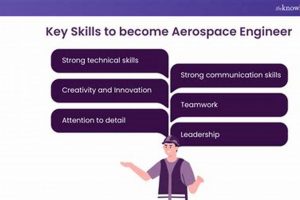
Tip 5: Develop Strong Communication Skills. Aerospace engineers must effectively communicate complex technical information to colleagues, clients, and stakeholders. Cultivate both written and verbal communication skills through coursework and extracurricular activities.
Tip 6: Specialize in a Specific Area. Consider specializing in a particular area of aerospace engineering, such as aerodynamics, propulsion, or structural analysis. Focused expertise increases marketability and allows for deeper contributions to the field.
Tip 7: Stay Current with Industry Trends. The aerospace industry is constantly evolving. Remain informed about the latest technologies, research findings, and regulatory changes through professional publications, conferences, and continuing education.
Adhering to these guidelines enhances the prospects of securing a fulfilling and impactful career in the aerospace sector. It prepares individuals to contribute meaningfully to the advancement of flight technology.
The following section will further elaborate on degree programs and the curriculum within the aerospace engineering field.
1. Mathematics Proficiency

Mathematics proficiency forms a critical, foundational element within the necessary academic preparation for aerospace engineers. This proficiency transcends basic arithmetic; it demands mastery of calculus, differential equations, linear algebra, and numerical methods. These mathematical tools are not mere theoretical constructs but rather the essential language used to model and analyze the complex physical phenomena encountered in aerospace engineering. A deficient understanding of these mathematical principles directly impedes the ability to design efficient airfoils, optimize rocket trajectories, or analyze the structural integrity of spacecraft.
Consider the design of an aircraft wing. Achieving optimal lift and minimizing drag requires sophisticated calculations involving fluid dynamics, which are inherently mathematical. Similarly, determining the optimal thrust profile for a rocket launch necessitates solving differential equations that govern the rocket’s motion through the atmosphere. Furthermore, the structural analysis of an aircraft frame under stress relies heavily on finite element analysis, a numerical method underpinned by advanced linear algebra. Without a solid mathematical foundation, these core aspects of aerospace engineering become inaccessible.
In summary, mathematics proficiency is not simply a desirable trait but an indispensable prerequisite for effective participation in the aerospace engineering field. A strong command of these mathematical tools provides the basis for understanding, analyzing, and ultimately solving the intricate engineering challenges inherent in the design and development of aerospace vehicles. Deficiencies in this area directly translate into compromised design capabilities and reduced problem-solving efficacy, impacting the safety, efficiency, and performance of aerospace systems. Therefore, rigorous mathematical training is an essential component of any credible aerospace engineering curriculum.
2. Physics Principles

The mastery of physics principles is an indispensable component of effective aerospace engineer education. A thorough comprehension of mechanics, thermodynamics, electromagnetism, and optics forms the bedrock upon which all advanced aerospace engineering concepts are built. The design and analysis of aircraft and spacecraft depend fundamentally on the application of these principles. For instance, understanding Newton’s laws of motion is critical for calculating aerodynamic forces and determining vehicle stability. Likewise, the design of propulsion systems relies heavily on thermodynamic principles governing energy transfer and fluid dynamics. Failure to grasp these core concepts directly impairs an engineer’s ability to develop safe, efficient, and functional aerospace systems.
Consider the re-entry of a spacecraft into the Earth’s atmosphere. This process involves extreme heating due to atmospheric friction. Aerospace engineers must apply principles of thermodynamics and heat transfer to design thermal protection systems that can withstand these intense conditions and protect the spacecraft and its occupants. Similarly, the design of satellite communication systems relies on the principles of electromagnetism and optics to ensure reliable signal transmission and reception. The accurate calculation of stress and strain in aircraft structures, essential for ensuring structural integrity, requires a solid understanding of mechanics and material science. These examples underscore the pervasive role of physics principles in aerospace engineering practice.
In summation, a comprehensive education in physics principles is not merely supplemental but fundamentally necessary for individuals pursuing careers in aerospace engineering. The ability to apply these principles to real-world problems is paramount for the development of innovative and reliable aerospace technologies. Challenges remain in effectively integrating theoretical physics knowledge with practical engineering applications, highlighting the need for continued emphasis on hands-on learning and problem-based education within aerospace engineering curricula. The broader theme revolves around ensuring that future aerospace engineers possess the essential scientific foundation required to advance the field and address the evolving challenges of air and space travel.
3. Computer Science

The integration of computer science principles into aerospace engineer education is no longer a supplementary element but rather a fundamental requirement. Modern aerospace systems are inherently complex and software-driven, necessitating a deep understanding of computational methods and programming techniques for effective design, analysis, and operation.
- Computational Fluid Dynamics (CFD)
CFD utilizes numerical methods and algorithms to solve and analyze problems involving fluid flows. Aerospace engineers employ CFD software to simulate airflow around aircraft wings, predict drag coefficients, and optimize aerodynamic designs. This reduces the need for extensive wind tunnel testing, saving time and resources. Inadequate understanding of CFD principles can lead to inaccurate simulations and flawed designs.
- Embedded Systems Programming
Aircraft and spacecraft rely heavily on embedded systems for flight control, navigation, and sensor data processing. Aerospace engineers must be proficient in programming these systems, often using languages like C or C++. An example includes programming the autopilot system, which requires precise control algorithms to maintain stable flight. Insufficient knowledge of embedded systems programming can compromise the reliability and safety of these critical functions.
- Data Analysis and Machine Learning
The aerospace industry generates vast amounts of data from simulations, flight tests, and operational systems. Aerospace engineers leverage data analysis techniques and machine learning algorithms to extract valuable insights, optimize performance, and predict potential failures. For instance, machine learning can be used to detect anomalies in engine performance data, allowing for proactive maintenance and preventing costly breakdowns. Neglecting data analysis and machine learning skills limits the ability to leverage this wealth of information for improved decision-making.
- Modeling and Simulation
Aerospace engineers use computer-aided design (CAD) and simulation software to create virtual prototypes of aircraft and spacecraft. These models allow for early-stage testing and optimization before physical prototypes are built. Simulation tools are used to analyze structural integrity, thermal performance, and other critical factors. Without proficiency in modeling and simulation, engineers risk developing designs that are not feasible or that fail to meet performance requirements.
The aforementioned facets demonstrate the critical role of computer science within the aerospace engineering landscape. The ability to effectively apply computational methods and programming techniques is essential for addressing the complex challenges inherent in designing and operating modern aerospace systems. Failure to integrate these skills into aerospace engineer education diminishes the ability to innovate, optimize performance, and ensure the safety and reliability of future aerospace vehicles.
4. Specialized Courses

The acquisition of specialized knowledge through focused coursework is a critical element in aerospace engineer education. While foundational principles in mathematics, physics, and computer science are essential, specialized courses provide the in-depth understanding required to address the unique challenges within the aerospace field. These courses equip aspiring engineers with the tools and knowledge necessary to design, analyze, and test aerospace systems effectively.
- Aerodynamics
Aerodynamics delves into the study of air in motion and its interaction with solid objects, most notably aircraft wings. This area encompasses boundary layer theory, airfoil design, and computational fluid dynamics (CFD) applications. For example, aerodynamics principles dictate the shape of aircraft wings to maximize lift and minimize drag. A thorough grounding in aerodynamics is vital for designing efficient and stable aircraft. Insufficient knowledge in this area can result in designs that are aerodynamically unsound, leading to reduced performance or instability during flight.
- Propulsion Systems
Propulsion systems focuses on the design, analysis, and operation of engines used in aircraft and spacecraft. This includes jet engines, rocket engines, and other advanced propulsion technologies. A typical course covers thermodynamics, combustion, and nozzle design. The selection of a propulsion system directly affects an aircraft’s speed, range, and payload capacity. Without a deep understanding of propulsion systems, engineers cannot effectively design engines that meet the specific requirements of an aerospace vehicle.
- Structural Analysis
Structural analysis involves assessing the strength and stability of aerospace structures under various loads and environmental conditions. This includes finite element analysis (FEA), stress analysis, and material selection. Aircraft and spacecraft structures must withstand significant stresses during flight, and structural analysis ensures that they are designed to do so safely. For instance, the analysis of an aircraft wing under flight loads ensures that it can withstand the stresses without failing. Deficiencies in structural analysis skills can lead to designs that are structurally weak, increasing the risk of catastrophic failure.
- Orbital Mechanics
Orbital mechanics explores the principles governing the motion of spacecraft in orbit around celestial bodies. This area encompasses orbital maneuvers, trajectory design, and satellite positioning. Orbital mechanics is essential for planning space missions, designing satellite constellations, and predicting the behavior of spacecraft in orbit. Without this knowledge, engineers cannot accurately predict the trajectory of a spacecraft, hindering mission success. Deficiencies in orbital mechanics can jeopardize missions that require precise orbital maneuvers, such as satellite deployment or rendezvous operations.
These specialized courses form a crucial bridge between theoretical foundations and practical applications in the aerospace domain. They enable engineers to address specific design and operational challenges with informed expertise, contributing directly to the advancement and safety of aerospace technology. The depth and breadth of specialized coursework directly correlate with an aerospace engineer’s ability to contribute meaningfully to the industry.
5. Practical Experience

Practical experience serves as a critical bridge between theoretical knowledge acquired in aerospace engineer education and the real-world application of that knowledge in the aerospace industry. It provides aspiring engineers with opportunities to develop essential skills, solve complex problems, and gain valuable insights into the profession. This hands-on engagement is often the differentiating factor between a competent graduate and a highly sought-after professional.
- Internships and Co-op Programs
Internships and cooperative education (co-op) programs offer structured opportunities to work alongside experienced engineers on real-world projects. This exposure provides invaluable insights into industry practices, project management, and team collaboration. For example, an intern might assist in the design of an aircraft wing, perform stress analysis on a spacecraft component, or develop software for flight control systems. These experiences allow students to apply their academic knowledge in a professional setting, refine their skills, and network with potential employers. Without such opportunities, the transition from academia to industry can be significantly more challenging.
- Research Projects
Participation in research projects, whether at the undergraduate or graduate level, provides students with opportunities to engage in cutting-edge aerospace research. These projects often involve designing and building experimental apparatus, conducting tests, and analyzing data. For instance, a student might work on developing new materials for lightweight aircraft structures or investigating novel propulsion concepts. Research projects foster critical thinking, problem-solving, and independent learning skills, preparing students for the demands of a research-intensive career. These experiences enhance the knowledge base and professional portfolio of the student.
- Design-Build-Test Projects
Design-build-test (DBT) projects challenge students to design, build, and test a physical aerospace system, such as a drone, a rocket, or a small aircraft. These projects integrate multiple engineering disciplines and require students to work in teams to overcome a variety of challenges. For example, a DBT project might involve designing a rocket to reach a specific altitude, building the rocket using composite materials, and testing its performance through launch and recovery. DBT projects foster teamwork, project management, and practical engineering skills that are highly valued by employers. Participation in this project provides great knowledge from start to end of aerospace product development.
- Student Competitions
Participation in student aerospace competitions, such as those organized by AIAA (American Institute of Aeronautics and Astronautics), provides students with opportunities to showcase their skills and compete against teams from other universities. These competitions often involve designing, building, and flying an aircraft or spacecraft to meet specific mission requirements. For example, a competition might challenge students to design an aircraft that can carry a specific payload over a given distance. Student competitions promote innovation, teamwork, and the development of practical engineering skills. Success in these competitions significantly enhances the profile of aspiring aerospace engineers.
The integration of practical experience into aerospace engineer education is paramount for producing well-rounded and competent professionals. These experiences provide valuable opportunities to apply theoretical knowledge, develop essential skills, and gain insights into the realities of the aerospace industry. By actively seeking out and engaging in internships, research projects, DBT projects, and student competitions, aspiring aerospace engineers can significantly enhance their career prospects and contribute meaningfully to the advancement of the field. The absence of sufficient practical application within a purely theoretical education can leave graduates ill-equipped to tackle the complexities and challenges of real-world aerospace engineering projects.
Frequently Asked Questions Regarding Aerospace Engineer Education Needed
The following section addresses common inquiries concerning the educational requirements for aspiring aerospace engineers, providing clarity on various aspects of the field.
Question 1: What is the minimum level of formal schooling required to become an aerospace engineer?
A bachelor’s degree in aerospace engineering or a closely related field (e.g., mechanical engineering with an aerospace specialization) is generally considered the minimum requirement for entry-level positions. Further advanced degrees, such as a master’s or doctorate, may be required for research-oriented roles or specialized positions.
Question 2: Is accreditation of the aerospace engineering program crucial?
Yes, accreditation from ABET (Accreditation Board for Engineering and Technology) is highly recommended. Graduation from an ABET-accredited program ensures that the curriculum meets rigorous industry standards and enhances career prospects.
Question 3: Beyond core engineering courses, what specific subjects are considered essential for aerospace engineering?
Essential subjects include aerodynamics, propulsion, structural analysis, orbital mechanics, and control systems. A strong foundation in mathematics, physics, and computer science is also crucial.
Question 4: How important is practical experience, such as internships, in aerospace engineering education?
Practical experience gained through internships, co-op programs, or research projects is highly valued. These experiences provide opportunities to apply theoretical knowledge to real-world problems and develop essential skills.
Question 5: What role does computer science play in aerospace engineer education?
Computer science is increasingly important due to the reliance on computational tools for design, analysis, and simulation. Proficiency in programming languages, computer-aided design (CAD) software, and computational fluid dynamics (CFD) is highly beneficial.
Question 6: Is continued professional development necessary after obtaining a degree in aerospace engineering?
Yes, the aerospace industry is constantly evolving, necessitating continued professional development to stay abreast of the latest technologies, research findings, and regulatory changes. Participation in conferences, workshops, and continuing education courses is recommended.
In summary, a comprehensive education in aerospace engineering encompasses a strong foundation in core engineering principles, specialized coursework, practical experience, and a commitment to lifelong learning. Adhering to these guidelines enhances the prospects of a successful career in the field.
The subsequent section will explore career pathways available after completing relevant aerospace engineer education.
Aerospace Engineer Education Needed
This exploration has underscored the multifaceted requirements inherent in aerospace engineer education. Mastery of foundational STEM disciplines, specialized coursework encompassing aerodynamics and propulsion, and significant practical experience are essential components. The acquisition of these competencies prepares individuals to address the complex challenges within the aerospace industry.
The ongoing advancement of aerospace technology necessitates a commitment to rigorous education and continuous professional development. Investment in relevant academic pursuits and practical application ensures the sustained innovation and safety that are paramount to future progress in air and space exploration. Future engineers should consider education as the main key for their career.