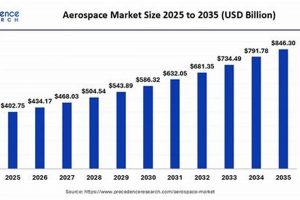
The availability and potential for employment within the aerospace engineering field constitute the career outlook for professionals in this discipline. This encompasses factors such as projected growth rates, industry demand, and the impact of technological advancements on the need for skilled individuals capable of designing, developing, and testing aircraft, spacecraft, and related systems. For example, an increase in commercial space exploration initiatives typically correlates with improved opportunities for those with expertise in propulsion systems and spacecraft design.
Understanding this employment landscape is crucial for individuals considering a career in aerospace engineering. It allows for informed decision-making regarding education, specialization, and career planning. A positive outlook often signifies a stable and rewarding career path, attracting talent to the field and fueling innovation. Historically, periods of significant advancements in aviation and space exploration have consistently been linked to heightened demand for engineers in this sector.
The following sections will delve into the current state of hiring within the aerospace sector, examining specific areas of growth, potential challenges, and strategies for maximizing career opportunities. It will also analyze the influence of emerging technologies and evolving industry trends on the future direction of employment for these specialized engineers.
Maximizing career potential within the aerospace engineering field requires strategic planning and proactive engagement with industry trends. Understanding key factors influencing hiring decisions and cultivating relevant skills significantly enhances employability.
Tip 1: Prioritize advanced education and specialized training. Pursuing a Master’s degree or doctorate, particularly in areas like propulsion, aerodynamics, or structural analysis, strengthens qualifications and increases competitiveness for specialized roles.
Tip 2: Develop a strong understanding of industry-standard software and tools. Proficiency in CAD/CAM software (e.g., CATIA, SolidWorks), simulation software (e.g., ANSYS, MATLAB), and programming languages (e.g., Python, C++) is highly valued by employers.
Tip 3: Seek internship or co-op opportunities within aerospace companies. Practical experience provides invaluable insights into real-world engineering challenges and establishes professional connections that can lead to full-time employment.
Tip 4: Cultivate strong communication and teamwork skills. Aerospace projects are inherently collaborative, requiring engineers to effectively communicate technical information and work cohesively within diverse teams.
Tip 5: Stay informed about emerging technologies and industry trends. Developments in areas like additive manufacturing, artificial intelligence, and sustainable aviation are reshaping the industry, and demonstrating awareness of these trends is crucial.
Tip 6: Build a professional network through industry events and online platforms. Attending conferences, joining professional organizations (e.g., AIAA), and actively engaging on platforms like LinkedIn can expand professional contacts and provide access to job opportunities.
Tip 7: Tailor resumes and cover letters to specific job requirements. Emphasizing relevant skills and experiences that align with the employer’s needs demonstrates a clear understanding of the role and increases the likelihood of securing an interview.
Adopting these strategies provides a solid foundation for navigating the aerospace engineering employment arena. By focusing on education, skill development, practical experience, and professional networking, individuals can significantly enhance their career trajectory.
The subsequent sections will explore common challenges faced by aerospace engineers seeking employment and offer insights into overcoming these obstacles.
1. Industry Growth

Industry growth serves as a primary driver influencing the career outlook for aerospace engineers. Expansion within the aerospace sector directly correlates with increased demand for qualified professionals to design, develop, and maintain advanced systems.
- Commercial Space Exploration
The burgeoning commercial space sector, involving companies engaged in space tourism, satellite deployment, and resource extraction, necessitates a highly skilled workforce. Engineers with expertise in areas like propulsion systems, spacecraft design, and mission control are essential for these ventures. For example, the expansion of companies like SpaceX and Blue Origin has generated significant hiring activity within the aerospace engineering field.
- Sustainable Aviation Technologies
Growing concerns regarding environmental impact are driving investments in sustainable aviation technologies. This includes the development of electric and hybrid-electric aircraft, as well as alternative fuels. Engineers specializing in aerodynamics, propulsion, and materials science are needed to advance these technologies and meet the demand for more fuel-efficient and environmentally friendly aircraft. Companies such as Boeing and Airbus are actively pursuing these advancements, thereby influencing engineer demand.
- Advanced Air Mobility (AAM)
The AAM sector, focused on the development of urban air mobility solutions such as electric vertical takeoff and landing (eVTOL) aircraft, presents a novel area of expansion. This burgeoning industry requires engineers with expertise in aircraft design, autonomous systems, and air traffic management. The development and testing of eVTOL aircraft by companies like Joby Aviation and Archer Aviation has created increased opportunity.
- Defense and National Security
Ongoing investments in defense and national security programs continue to support the employment of aerospace engineers. The development of advanced military aircraft, missile defense systems, and satellite technologies requires a substantial engineering workforce. Government contracts with companies like Lockheed Martin and Northrop Grumman are indicative of ongoing demand in this sector.
Collectively, these elements of industry growth indicate a favorable outlook for those entering or advancing within the aerospace engineering profession. The emergence of new sectors, coupled with ongoing developments in traditional aerospace domains, is expected to sustain demand for skilled engineers in the foreseeable future. This growth makes “aerospace engineer job prospects” more positive overall.
2. Technological Advancements

Technological advancements stand as a crucial determinant in shaping the employment landscape for aerospace engineers. The rapid pace of innovation necessitates a workforce equipped with specialized knowledge and adaptable skills, thereby directly influencing the types and availability of positions within the sector.
- Additive Manufacturing (3D Printing)
Additive manufacturing, or 3D printing, is revolutionizing the production of aerospace components. This technology enables the creation of complex geometries with reduced material waste and lead times. Aerospace engineers with expertise in additive manufacturing processes, materials science, and design optimization are increasingly sought after to leverage these capabilities. The integration of 3D printed parts into aircraft and spacecraft is growing, creating opportunities for those skilled in this area. For example, GE Aviation uses 3D printing to produce fuel nozzles for its LEAP engines.
- Artificial Intelligence and Machine Learning
Artificial intelligence (AI) and machine learning (ML) are transforming various aspects of aerospace engineering, from aircraft design and flight control systems to predictive maintenance and air traffic management. Engineers proficient in AI/ML algorithms, data analysis, and software development are in high demand to develop and implement these solutions. Applications include autonomous flight control systems, predictive maintenance of aircraft components, and optimization of flight routes. Boeing, for example, utilizes AI in its manufacturing processes and aircraft design.
- Advanced Materials
The development of advanced materials, such as composites, nanomaterials, and high-temperature alloys, is crucial for enhancing the performance, durability, and efficiency of aircraft and spacecraft. Aerospace engineers with expertise in materials science, structural analysis, and manufacturing processes are needed to design and implement these materials in aerospace applications. These materials enable the creation of lighter, stronger, and more heat-resistant components, leading to improved aircraft performance and fuel efficiency. The increasing use of carbon fiber composites in aircraft structures exemplifies this trend.
- Hypersonic Technology
The pursuit of hypersonic flight, involving speeds exceeding Mach 5, presents significant engineering challenges and opportunities. The development of hypersonic vehicles requires engineers with expertise in aerodynamics, propulsion, thermal management, and materials science. This field requires specialized knowledge of scramjet engines, high-temperature materials, and advanced aerodynamic designs. Government and private sector investments in hypersonic technology are driving demand for engineers with these skills.
These technological advancements collectively contribute to the evolving demands and required skills within the aerospace engineering profession. Adapting to these changes through continuous learning and specialization is essential for securing and advancing career prospects in this dynamic field. The integration of these technologies directly impacts what knowledge, and therefore which engineers, are required in the industry.
3. Government Funding

Government funding constitutes a significant factor influencing career opportunities for aerospace engineers. Governmental allocations towards research and development, defense programs, and space exploration initiatives directly impact the demand for engineers with specialized expertise.
- Defense Spending
Allocations for defense programs represent a substantial source of funding for aerospace engineering projects. Government contracts with private companies for the design, development, and maintenance of military aircraft, missile systems, and related technologies generate numerous positions for engineers. Fluctuations in defense spending can directly affect the availability of these positions. For instance, increased investment in next-generation fighter jets or missile defense systems leads to greater demand for engineers specializing in aerodynamics, propulsion, and avionics.
- Space Exploration Programs
Government-funded space exploration programs, such as those administered by NASA, support research and development activities related to spacecraft, launch vehicles, and space-based technologies. These initiatives provide employment opportunities for aerospace engineers in areas like spacecraft design, propulsion systems, robotics, and mission control. Long-term commitments to space exploration, such as lunar or Martian missions, ensure a sustained need for skilled engineers. Conversely, budget cuts to these programs can result in workforce reductions.
- Research and Development Grants
Government agencies offer research and development grants to universities and private companies to advance aerospace technologies. These grants fund research projects in areas like advanced materials, propulsion systems, and autonomous flight control. The availability of these grants stimulates innovation and creates opportunities for engineers to participate in cutting-edge research. Furthermore, these projects often lead to the development of new technologies and the creation of spin-off companies, further expanding employment opportunities.
- Infrastructure Development
Government investment in airport infrastructure and air traffic management systems indirectly impacts aerospace engineer job prospects. The expansion of airport capacity and the modernization of air traffic control systems require engineers with expertise in areas such as airport planning, airspace design, and navigation systems. These projects contribute to the overall efficiency and safety of air travel, creating a demand for skilled engineers.
In summary, government funding plays a crucial role in shaping the employment outlook for aerospace engineers. Governmental support for defense, space exploration, research, and infrastructure development directly influences the demand for engineers with specialized skills and expertise. Monitoring government spending patterns and policy decisions is essential for understanding and anticipating career opportunities within the aerospace engineering field.
4. Global Competition

Global competition significantly influences career opportunities for aerospace engineers. The aerospace industry operates on an international scale, with companies and nations vying for market share, technological leadership, and talent. This competitive landscape shapes the demand for engineers, their required skill sets, and the locations where opportunities are concentrated.
- International Market Share
The competition for international market share in aircraft manufacturing, satellite deployment, and related services directly impacts employment. Companies seeking to expand their global presence require skilled engineers to develop competitive products and services, driving demand for qualified personnel. For example, the rivalry between Boeing and Airbus compels both companies to invest in engineering talent to maintain or increase their market share.
- Technological Innovation
Global competition fosters innovation, leading to a continuous demand for engineers capable of developing cutting-edge technologies. Companies strive to outpace competitors by developing more efficient aircraft, advanced propulsion systems, and innovative spacecraft designs. This pursuit of technological superiority necessitates a workforce with advanced skills and specialized knowledge. The competition between nations in developing hypersonic technology is a prime example of this phenomenon.
- Outsourcing and Offshoring
The ability to outsource or offshore engineering work to countries with lower labor costs can impact domestic employment opportunities. Companies may choose to relocate certain engineering functions to reduce expenses, potentially affecting the demand for engineers in specific regions. However, this trend can also create opportunities for engineers with specialized skills who can manage and oversee outsourced projects.
- International Collaboration
Despite the competitive nature of the aerospace industry, international collaboration is also prevalent. Joint ventures and partnerships between companies and governments from different countries can create opportunities for engineers to work on large-scale projects, fostering knowledge sharing and cross-cultural collaboration. The International Space Station is a notable example of a collaborative effort that has generated numerous engineering positions.
In conclusion, global competition exerts a multifaceted influence on the employment of aerospace engineers. While it may lead to outsourcing pressures, it also stimulates innovation, expands market opportunities, and fosters international collaboration. The ability to adapt to this dynamic environment, acquire in-demand skills, and embrace global perspectives is crucial for engineers seeking to thrive in the international aerospace arena.
5. Education Requirements
The educational background of an aspiring aerospace engineer is a critical determinant in shaping subsequent career opportunities. Specific academic qualifications, areas of specialization, and ongoing professional development efforts directly influence competitiveness in the job market and access to advanced roles within the industry.
- Bachelor’s Degree in Aerospace Engineering or Related Field
A bachelor’s degree in aerospace engineering or a closely related field, such as mechanical or electrical engineering, is typically the minimum educational requirement for entry-level positions. This foundational degree provides a comprehensive understanding of core engineering principles, including aerodynamics, propulsion, structural analysis, and control systems. For example, graduates with a strong academic record from reputable engineering programs are generally more competitive for entry-level roles in design, testing, and manufacturing.
- Advanced Degrees (Master’s and Ph.D.)
Advanced degrees, such as a Master’s or Ph.D. in aerospace engineering or a specialized sub-discipline, can significantly enhance career prospects, particularly for roles involving research, development, and advanced design. These degrees provide in-depth knowledge and research experience, making graduates more attractive to employers seeking expertise in specific areas like propulsion systems, advanced materials, or autonomous flight control. Many research positions at NASA and leading aerospace companies require a Ph.D.
- Specialized Coursework and Certifications
Targeted coursework and certifications in areas relevant to specific career interests can enhance job prospects. Examples include certifications in CAD/CAM software, project management, or specific aerospace technologies. Specialized knowledge in areas like computational fluid dynamics (CFD) or finite element analysis (FEA) is often highly valued by employers. Participation in relevant workshops and training programs demonstrates a commitment to professional development and can provide a competitive advantage in the job market.
- Accreditation and Program Reputation
The accreditation and reputation of the educational program significantly influence the perceived value of the degree. Accreditation by organizations like ABET (Accreditation Board for Engineering and Technology) ensures that the program meets rigorous quality standards. Graduates from well-regarded programs often benefit from stronger industry connections and a higher likelihood of securing employment. Employers often prioritize graduates from accredited programs when evaluating candidates.
In conclusion, educational qualifications exert a powerful influence on “aerospace engineer job prospects”. A strong academic foundation, advanced degrees, specialized training, and program accreditation all contribute to a candidate’s competitiveness in the job market. Investing in education and continuous professional development is crucial for individuals seeking to establish a successful and rewarding career in aerospace engineering. These educational foundations are therefore key to positive career paths.
6. Economic Conditions

The prevailing state of economic conditions wields a considerable influence on “aerospace engineer job prospects.” Macroeconomic trends, including periods of expansion or contraction, directly impact investment levels within the aerospace sector, consequently affecting the demand for skilled engineering personnel. For example, during economic recessions, airlines may defer aircraft orders, leading to reduced production rates at aircraft manufacturers and subsequent workforce reductions, including engineering staff. Conversely, periods of economic growth typically witness increased air travel, higher defense spending, and greater investment in space exploration, creating a more favorable job market for aerospace engineers. This cause-and-effect relationship highlights the importance of economic stability as a key component influencing professional trajectories within the field.
Furthermore, specific economic indicators such as interest rates and inflation can influence investment decisions within the aerospace industry. Lower interest rates may encourage companies to borrow money for capital investments, such as developing new aircraft or expanding production facilities, thereby generating more engineering jobs. Inflationary pressures, on the other hand, can increase project costs, potentially leading to project delays or cancellations and a corresponding decrease in demand for engineers. Geopolitical stability is also interwoven with economic forecasts; increased global tensions often result in heightened defense spending, benefiting engineers involved in military aircraft and related systems. The practical significance of understanding this connection allows individuals entering or advancing in the profession to anticipate market shifts and adjust their skill development strategies accordingly.
In summary, economic conditions act as a crucial external force shaping the employment landscape for aerospace engineers. Recognizing the intricate relationship between economic indicators, investment patterns, and industry-specific activities is essential for both job seekers and seasoned professionals. While the cyclical nature of economic fluctuations presents challenges, a proactive awareness of these dynamics can facilitate informed career planning and enhance resilience in a fluctuating job market. Therefore, monitoring economic forecasts and industry trends becomes a vital component of navigating a career in this technologically advanced, yet economically sensitive, field.
Frequently Asked Questions
This section addresses common queries and clarifies uncertainties regarding employment opportunities for aerospace engineers, providing accurate and concise information.
Question 1: What are the primary factors influencing the current job market for aerospace engineers?
Several factors impact the employment landscape, including industry growth in sectors such as commercial space exploration and sustainable aviation, technological advancements in areas like additive manufacturing and AI, government funding for defense and space programs, global competition, educational requirements, and overall economic conditions.
Question 2: How important is a graduate degree for career advancement in aerospace engineering?
While a bachelor’s degree is typically required for entry-level positions, a Master’s or Ph.D. can significantly enhance career prospects, particularly for roles involving research, development, and advanced design. Advanced degrees demonstrate specialized expertise and are often necessary for securing positions at leading research institutions and aerospace companies.
Question 3: Which skills are most in-demand for aerospace engineers in the current job market?
In-demand skills include proficiency in industry-standard software (CAD/CAM, simulation tools), knowledge of advanced materials and manufacturing processes (including additive manufacturing), expertise in AI and machine learning applications, and strong communication and teamwork abilities. Adaptability and a willingness to learn new technologies are also highly valued.
Question 4: How does government funding impact the availability of aerospace engineering jobs?
Government funding for defense programs, space exploration initiatives, and research and development grants plays a crucial role in shaping employment opportunities. Fluctuations in government spending can directly affect the demand for engineers with specialized expertise in these areas. Therefore, monitoring government budget allocations is essential for understanding career trends.
Question 5: Does global competition affect the potential for domestic aerospace engineers?
Yes, global competition influences domestic employment through factors such as international market share dynamics, technological innovation pressures, outsourcing and offshoring trends, and the prevalence of international collaboration in aerospace projects. Adaptation to the global landscape is critical for domestic engineers.
Question 6: What strategies can aerospace engineers employ to improve their job prospects?
Strategies include pursuing advanced education, developing specialized skills, gaining practical experience through internships, building a professional network, staying informed about emerging technologies, and tailoring resumes and cover letters to specific job requirements. Proactive career planning is essential for success.
The aerospace engineering field offers varied and potentially rewarding careers for skilled professionals. Understanding the influences and navigating the job market effectively are key.
The following section will summarize the main points.
Aerospace Engineer Job Prospects
This exploration of aerospace engineer job prospects has underscored the multifaceted nature of factors influencing employment within this field. From the dynamic impact of industry growth and technological advancements to the crucial role of government funding and global competition, the landscape presents both opportunities and challenges. Successful navigation requires a commitment to continuous learning, specialized skill development, and proactive engagement with evolving industry trends. Education, coupled with practical experience, remains paramount, with advanced degrees and targeted certifications significantly enhancing competitiveness. Furthermore, an understanding of economic conditions and geopolitical influences provides a crucial context for anticipating market shifts and adapting career strategies accordingly. The information presented highlights the essential elements for success in this demanding profession.
The future of aerospace engineering lies in the hands of skilled professionals who are prepared to embrace innovation and address the complex challenges facing the industry. As technology advances and global demands evolve, the need for talented engineers will continue. A proactive approach to career development, coupled with a deep understanding of the forces shaping the industry, will be critical for realizing long-term success in this dynamic and vital field. Continuing education and monitoring of career options should be performed consistently to find the best role.