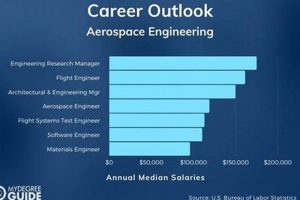
Academic programs providing instruction in the design, development, and testing of aircraft and spacecraft constitute a crucial component of aerospace education. These programs encompass a broad spectrum of subjects, from fundamental scientific principles to advanced engineering techniques, all tailored to the specific requirements of the aerospace sector. An example is a university curriculum including fluid dynamics, propulsion systems, and structural analysis, all essential for students pursuing careers in this field.
The significance of such academic pursuits lies in their ability to equip individuals with the knowledge and skills necessary to address the challenges inherent in the aerospace industry. A strong educational foundation facilitates innovation in areas such as air travel, space exploration, and defense technologies. Historically, advancements in aviation and astronautics have been directly linked to the availability of specialized educational opportunities.
Subsequent sections will delve into the specific disciplines within the aerospace domain, examine relevant curricula, and highlight the career pathways available to graduates of these focused programs. The subsequent analysis will also address the continuous evolution of instructional methods within this dynamic field.
Guidance for Prospective Aerospace Professionals
The following recommendations are designed to assist individuals considering educational paths focused on the design, development, and testing of flight-capable machines and associated systems. These suggestions aim to optimize academic and professional preparation for the rigors of the field.
Tip 1: Cultivate a Strong Foundation in STEM Disciplines. A robust understanding of mathematics, physics, and computer science is paramount. Coursework in calculus, differential equations, linear algebra, classical mechanics, electromagnetism, and programming are foundational for advanced aerospace studies.
Tip 2: Seek Early Exposure to Aerospace Concepts. Participate in relevant extracurricular activities such as rocketry clubs, aviation workshops, or internships. Such experiences provide practical insight and a competitive advantage in university admissions and future employment.
Tip 3: Select a Program with a Strong Curriculum and Accreditation. Prioritize institutions with ABET (Accreditation Board for Engineering and Technology) accreditation. Review the curriculum to ensure it covers core aerospace topics such as aerodynamics, propulsion, structural analysis, and control systems.
Tip 4: Engage in Research Opportunities. Seek opportunities to work with faculty on research projects. Active involvement in research enhances analytical skills, fosters innovation, and demonstrates a commitment to advancing the field.
Tip 5: Develop Proficiency in Simulation and Modeling Tools. Familiarity with industry-standard software such as MATLAB, ANSYS, and SolidWorks is essential. Acquire practical experience using these tools through coursework, projects, or self-study.
Tip 6: Network with Professionals in the Industry. Attend industry conferences, join professional organizations such as the American Institute of Aeronautics and Astronautics (AIAA), and connect with aerospace engineers and researchers. Networking can provide valuable insights into career paths and job opportunities.
Tip 7: Consider Specialization. While a broad foundation is crucial, identify areas of specific interest within aerospace, such as propulsion, avionics, or space systems engineering. Focused expertise can lead to specialized career opportunities.
Adherence to these guidelines will improve preparedness and increase the likelihood of success for those embarking on a path to becoming aerospace professionals. The subsequent discussions will cover career development and other important aspects.
The article will conclude by addressing the continued innovation of engineering program.
1. Aerodynamics

Aerodynamics is a fundamental component of academic programs focused on aircraft and spacecraft design. Its principles govern the interaction between a vehicle and the air through which it moves. Comprehension of these principles is crucial for engineers aiming to optimize flight performance, ensure stability, and enhance overall efficiency.
- Lift Generation
Lift, the force that counteracts gravity, is paramount for sustained flight. Aerodynamic instruction details the generation of lift through airfoil design and angle of attack. Real-world examples include wing shapes optimized for specific aircraft types, and its implications within specialized education provide a framework for understanding flight mechanics.
- Drag Reduction
Minimizing drag, or air resistance, directly impacts fuel efficiency and vehicle speed. Education in drag reduction encompasses streamlining techniques, boundary layer control, and the application of computational fluid dynamics (CFD). Aircraft designs demonstrating this principles range from the SR-71 Blackbird to modern aircraft winglets, showing how design impacts performance.
- Stability and Control
Aerodynamic stability ensures a vehicle’s ability to maintain a desired flight path. Control surfaces, such as ailerons, elevators, and rudders, manipulate airflow to achieve controlled maneuvers. The study of stability and control systems is critical in flight safety, as seen with automatic stabilizers of commercial aircraft.
- Compressible Flow
At high speeds, air compressibility becomes a significant factor. Aerodynamic education addresses the behavior of airflow at transonic and supersonic speeds, including shock wave formation and its impact on vehicle performance. This is reflected in supersonic aircraft design, where shock waves are often minimized for improved efficiency.
These facets of aerodynamics, deeply embedded in specialized courses, are essential for future design and operation of vehicles in an aeronautical field. Proficiency in these areas allows for the effective development of innovative solutions for current and future aerospace challenges.
2. Propulsion Systems

Propulsion systems form a cornerstone of aerospace engineering curricula, functioning as the enabling technology for sustained atmospheric and space flight. Instruction in this area addresses the fundamental principles of energy conversion, fluid dynamics, thermodynamics, and combustion, directly influencing the design and performance characteristics of both aircraft and spacecraft. Without a rigorous understanding of these systems, the creation of efficient, reliable, and safe aerospace vehicles is impossible. An example of its importance is the development of high-bypass turbofan engines, achieved through advancements in compressor and turbine design covered in related courses, which dramatically improved fuel efficiency in commercial aviation. The link between specialized instruction in propulsion and tangible improvements in aerospace technology is therefore evident.
Practical applications of propulsion systems knowledge extend beyond engine design to encompass a wide range of related fields. The analysis of rocket engine performance, covered in advanced propulsion courses, is essential for space exploration and satellite deployment. Optimization of combustion processes, a core element of such courses, directly impacts emissions reduction and the development of environmentally sustainable propulsion technologies. Furthermore, understanding the intricacies of various propulsion methods from gas turbines to ramjets to electric propulsion is crucial for selecting the appropriate technology for specific mission requirements. The application of Computational Fluid Dynamics (CFD) to simulate engine performance and optimize designs, another skill taught in related academic offerings, further demonstrates the practical significance of specialized education in this domain.
The study of propulsion systems presents inherent challenges, demanding a synthesis of theoretical knowledge and practical application. The complexity of combustion processes, the extreme operating conditions within engines, and the stringent safety requirements all necessitate a comprehensive and rigorous academic foundation. However, the rewards of mastering this field are significant, offering opportunities to contribute to the ongoing evolution of air and space travel and to address pressing global challenges such as climate change and energy security. The constant improvement and innovation of related courses ensure that future engineers will be equipped for the latest advancements.
3. Structural Mechanics
Structural mechanics, within the context of academic programs focused on aerospace engineering, represents the study of how solid objects deform and withstand forces. Its inclusion is paramount due to the extreme operational environments encountered by aircraft and spacecraft. Any structural failure in these vehicles can have catastrophic consequences, underscoring the direct link between the theoretical knowledge imparted in specialized instruction and the safety of flight operations. For instance, the Comet airliner disasters of the 1950s, attributed to metal fatigue issues not fully understood at the time, highlight the critical need for a comprehensive understanding of structural mechanics principles.
Specific knowledge gained through courses in structural mechanics is directly applicable to the design and analysis of aircraft fuselages, wings, and other load-bearing components. Students learn to calculate stress distributions, predict material failure under various loading conditions, and optimize structural designs to minimize weight while maintaining adequate strength. Finite element analysis (FEA) software, commonly used in industry, is often integrated into related coursework to provide practical experience in simulating structural behavior. The development of composite materials, increasingly utilized in aerospace structures due to their high strength-to-weight ratios, relies heavily on a thorough grounding in structural mechanics principles. The use of these materials on the Boeing 787 Dreamliner demonstrates a direct application of these engineering techniques.
In summary, structural mechanics is an indispensable component of courses related to aerospace engineering. It bridges the gap between theoretical understanding and practical application, enabling engineers to design safe, reliable, and efficient aerospace vehicles. The challenges associated with increasingly stringent performance requirements and the use of novel materials necessitate ongoing advancements in structural mechanics education and research. Failure to adequately address this domain can have significant ramifications for the aerospace industry and public safety.
4. Control Theory

Control theory is an indispensable element within academic programs concerned with the design, development, and operation of aerospace vehicles. It furnishes the theoretical foundation and analytical tools necessary to design and implement systems that govern the behavior of complex dynamic systems, crucial for achieving stable, predictable, and efficient flight. The absence of robust control systems can lead to instability, performance degradation, or, in the worst-case scenario, catastrophic failure. An example of this importance is evident in the development of autopilots for commercial aircraft, which rely heavily on control theory principles to maintain stable flight paths, manage altitude, and execute precise maneuvers, thereby reducing pilot workload and improving overall safety.
The practical application of control theory in courses extends across multiple facets of aerospace vehicle design and operation. Guidance, navigation, and control (GNC) systems, essential for autonomous flight and space missions, are rooted in control theory. These systems use sensors to measure vehicle state, algorithms to determine desired actions, and actuators to implement those actions, constantly adapting to changing conditions and disturbances. For instance, satellite attitude control systems utilize control theory to maintain a specific orientation in space, enabling precise targeting of instruments and communication with ground stations. Furthermore, the design of flight control surfaces, such as ailerons, elevators, and rudders, and their integration with automatic control systems, requires a thorough understanding of control theory concepts such as feedback, stability analysis, and system response. The use of fly-by-wire systems, prevalent in modern aircraft, exemplifies the sophisticated integration of control theory in aerospace engineering.
In summary, control theory is a critical element in the design and operational efficacy of aerospace vehicles. The challenges of operating in dynamic and often unpredictable environments necessitate a deep understanding of control principles. As aerospace vehicles become increasingly complex and autonomous, the role of control theory will only continue to grow in importance. Future advancements in areas such as adaptive control, robust control, and artificial intelligence-based control systems will further enhance the capabilities and reliability of aerospace platforms. Therefore, the constant evolution of control methods and course adaptation are key to the progression of the study.
5. Spacecraft Design
Spacecraft design, as a discipline within courses related to aerospace engineering, represents a highly specialized area focusing on the creation of vehicles capable of functioning in the extreme environment of space. It necessitates the integration of numerous engineering principles, including structural mechanics, thermal management, propulsion, and communications. The proper execution of spacecraft design is critical for the success of space missions, whether for scientific exploration, communication, or national security. A flawed design can lead to mission failure, loss of valuable data, and significant financial repercussions. The Challenger and Columbia disasters, though stemming from multiple factors, underscore the potential consequences of design flaws and the importance of rigorous engineering practices. Specialized curricula therefore aims to equip future engineers to avoid similar tragic outcomes.
The practical applications of spacecraft design knowledge are extensive and varied. Students learn to design spacecraft structures capable of withstanding launch loads and the vacuum of space, thermal control systems to maintain components within operational temperature ranges, and power systems to provide necessary electrical energy. Coursework often includes designing communication systems for transmitting data to and from Earth, propulsion systems for orbital maneuvers and interplanetary travel, and attitude control systems to maintain desired spacecraft orientation. For example, instruction on designing radiation-hardened electronics protects onboard systems from solar and cosmic radiation, ensuring reliable operation throughout mission duration. Simulation tools, design software, and hands-on projects supplement classroom learning, bridging the gap between theory and practice. These techniques help students to prepare for real world scenarios in the space industries.
In summary, spacecraft design, as integral to aerospace engineering curricula, focuses on equipping engineers with the knowledge and skills required to create functional and reliable spacecraft. Meeting stringent mission requirements while contending with the harsh realities of the space environment poses substantial challenges. Continuous advancements in materials science, propulsion technology, and electronics necessitate ongoing evolution of spacecraft design methodologies and course adaptations. The future of space exploration and utilization hinges on the ability of engineers to innovate in spacecraft design, which underscores the significance of rigorous academic preparation in this specialized field.
Frequently Asked Questions
The following section addresses common inquiries regarding academic paths concerned with the design, construction, and testing of aerospace vehicles and their constituent systems. The information provided is intended to offer clarity and guidance to prospective students and professionals.
Question 1: What foundational knowledge is essential prior to pursuing programs focused on aerospace vehicle engineering?
A strong understanding of mathematics, encompassing calculus, differential equations, and linear algebra, is paramount. Additionally, a solid grounding in physics, particularly mechanics, thermodynamics, and electromagnetism, is crucial. Familiarity with computer programming and numerical methods is also highly beneficial.
Question 2: Which undergraduate majors provide optimal preparation for graduate-level study focused on the design and development of aerospace systems?
A bachelor’s degree in aerospace engineering is the most direct path. However, degrees in mechanical engineering, electrical engineering, computer science, or physics can also provide a suitable foundation, provided that relevant coursework is undertaken.
Question 3: What are the core subject areas covered in specialized courses?
Core areas include aerodynamics, propulsion, structural mechanics, control theory, and spacecraft design. Depending on the specific program and specialization, additional subjects such as avionics, materials science, and systems engineering may also be included.
Question 4: What types of hands-on experience are typically incorporated into the specialized programs?
Laboratory experiments, design projects, and internships are common components. These experiences provide students with opportunities to apply theoretical knowledge to practical problems and develop essential skills in areas such as computer-aided design (CAD), simulation, and testing.
Question 5: What career paths are typically pursued by graduates with training in the development and testing of aerospace systems?
Common career paths include aerospace engineer (design, analysis, testing), research scientist, systems engineer, project manager, and consultant. Graduates may find employment in aerospace companies, government agencies, research laboratories, or academic institutions.
Question 6: How is the continuous advancement of courses addressed to meet the evolving demands of the aerospace sector?
Curricula are regularly updated to reflect the latest technological advancements and industry trends. Faculty members actively engage in research and collaborate with industry partners to ensure that instruction remains relevant and cutting-edge. Accreditation processes also play a vital role in maintaining program quality and ensuring alignment with industry standards.
In conclusion, a rigorous academic foundation, coupled with practical experience, is essential for success in the dynamic field of aerospace. Continuous learning and adaptation are critical for remaining competitive in this evolving industry.
The following section discusses career options for aerospace professionals.
Conclusion
This discussion has provided an overview of fundamental concepts central to specialized training. The examination encompassed key areas such as aerodynamics, propulsion systems, structural mechanics, control theory, and spacecraft design, emphasizing their integrated role in shaping the next generation of aerospace professionals. The academic rigor and practical application inherent in such studies are essential for navigating the complexities of modern aerospace engineering.
The ongoing evolution of technology and the increasing demand for innovation necessitate a commitment to continuous learning within the aerospace sector. Those seeking to contribute to the advancement of air and space travel must embrace a dedication to mastering the principles and practices discussed herein. The future of aerospace engineering relies on the expertise and ingenuity cultivated through rigorous academic preparation.