The credentials required for a career path focused on designing, developing, and testing aircraft, spacecraft, and related systems typically involve formal education at the university level. This academic preparation equips individuals with the foundational knowledge and specialized skills necessary for success in this technologically advanced field. An example includes a Bachelor of Science program that emphasizes aerodynamics, propulsion, and structural analysis.
Possessing the appropriate academic qualifications is paramount for gaining entry into this competitive profession. It provides a demonstrable understanding of core engineering principles and advanced concepts, enabling individuals to contribute meaningfully to the industry’s ongoing innovation and advancements. Historically, formal education has served as a critical filter, ensuring a baseline level of competence and preparing future engineers to tackle complex challenges.
The following sections will explore the specific educational pathways, including undergraduate and graduate programs, along with the relevant specializations and skill sets that are most beneficial for aspiring professionals. Furthermore, the role of accreditation and professional certifications will be discussed, highlighting their impact on career prospects and professional development.
Guidance for Pursuing a Career in Aerospace Engineering
The pursuit of a career in aerospace engineering necessitates strategic planning and a commitment to rigorous academic preparation. The following guidance highlights key considerations for individuals seeking to enter this demanding field.
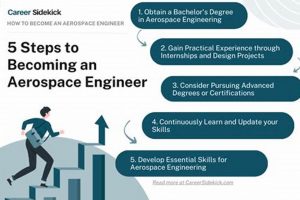
Tip 1: Prioritize a strong foundation in mathematics and physics. Proficiency in calculus, differential equations, linear algebra, and classical mechanics is essential for comprehending advanced engineering concepts. Engage in supplementary learning activities, such as problem-solving workshops and independent study, to solidify understanding.
Tip 2: Select an accredited undergraduate program. Accreditation ensures that the curriculum meets industry standards and prepares graduates for professional practice. Investigate the program’s faculty expertise, research opportunities, and industry connections.
Tip 3: Consider specializing in a specific area of aerospace engineering. Options include aerodynamics, propulsion, structural analysis, control systems, and astrodynamics. Specialization allows for the development of deep expertise and enhances career prospects in a particular niche.
Tip 4: Seek internships and research opportunities. Practical experience is invaluable for developing technical skills and building a professional network. Actively pursue internships at aerospace companies or research positions at universities.
Tip 5: Develop proficiency in computer-aided design (CAD) and simulation software. Familiarity with industry-standard tools, such as CATIA, SolidWorks, and ANSYS, is highly desirable. Participate in training courses and practice using these tools on independent projects.
Tip 6: Cultivate strong communication and teamwork skills. Aerospace engineering projects often involve multidisciplinary teams. Effective communication and collaboration are crucial for achieving project goals. Participate in team-based projects and seek opportunities to present technical information to diverse audiences.
Tip 7: Consider pursuing a graduate degree. A Master’s or Doctoral degree can enhance career prospects and open doors to more specialized roles in research and development. Evaluate the potential benefits of advanced study based on individual career aspirations.
Adhering to these guidelines can significantly increase the likelihood of success in the challenging but rewarding field of aerospace engineering. A proactive and strategic approach to education and professional development is essential for long-term career advancement.
The subsequent sections will delve into the various career paths available to aerospace engineers and the ongoing trends shaping the industry.
1. Bachelor's essential

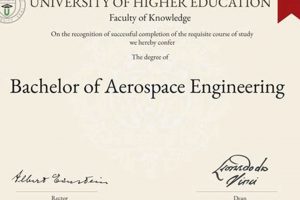
A baccalaureate degree functions as the fundamental credential for individuals aspiring to a career in aerospace engineering. Its attainment signifies the completion of a structured curriculum designed to impart core engineering principles and specialized aerospace knowledge, establishing a necessary foundation for professional practice.
- Entry-Level Positions
A Bachelor of Science in Aerospace Engineering is typically the minimum educational requirement for securing entry-level positions in the field. These roles may include design engineering, testing, or manufacturing support. For instance, a new graduate may work on component design or contribute to testing protocols for aircraft systems, demonstrating the practical application of their academic training.
- Core Engineering Principles
Undergraduate curricula provide a comprehensive grounding in fundamental engineering disciplines such as thermodynamics, fluid mechanics, materials science, and control systems. These principles are essential for understanding the behavior and performance of aerospace vehicles and their constituent systems. A strong grasp of these basics allows engineers to apply theoretical knowledge to real-world challenges.
- Industry Expectations
Employers in the aerospace sector, including government agencies and private corporations, typically mandate a Bachelor’s degree as a prerequisite for employment. This requirement reflects the complexity of the work and the need for a solid understanding of engineering fundamentals. Compliance with this standard ensures a baseline level of competence and preparedness among the workforce.
- Career Advancement Limitations
While a Bachelor’s degree facilitates entry into the profession, career advancement opportunities may be limited without further education. Advanced positions in research and development or specialized engineering roles often require a Master’s or Doctoral degree. Therefore, continuous learning and professional development are crucial for long-term career progression.
The emphasis on a Bachelor’s degree underscores its critical role in providing the foundational knowledge and skills necessary for individuals to contribute effectively to the aerospace engineering field. While advanced degrees may be pursued for specialized roles and career advancement, the Bachelor’s remains an indispensable first step.
2. Accreditation Matters
Accreditation plays a pivotal role in ensuring the quality and relevance of academic programs, particularly concerning the educational preparation inherent in the acquisition of credentials specific to the field of aerospace engineering. The accreditation status of an aerospace engineering program significantly impacts the value and recognition of the resulting qualifications.
- Program Quality Assurance
Accreditation bodies, such as ABET (Accreditation Board for Engineering and Technology), evaluate aerospace engineering programs against rigorous standards. These standards encompass curriculum content, faculty qualifications, laboratory facilities, and student outcomes. Accreditation signifies that the program meets established benchmarks for engineering education, providing assurance to prospective students and employers regarding the program’s quality and rigor. For example, a program lacking adequate laboratory equipment or qualified faculty may not achieve accreditation, indicating potential deficiencies in the educational experience.
- Industry Recognition and Employer Confidence
Graduates of accredited aerospace engineering programs are generally viewed more favorably by employers within the aerospace sector. Employers recognize that accredited programs adhere to industry best practices and prepare graduates with the necessary skills and knowledge to contribute effectively to their organizations. Hiring managers often prioritize candidates from accredited institutions, as it reduces the risk of employing individuals with substandard training. Conversely, a qualification from a non-accredited program may be viewed with skepticism, potentially limiting employment opportunities.
- Licensure and Professional Registration
In many jurisdictions, professional licensure or registration is required for engineers to practice independently or offer engineering services to the public. Accreditation can be a prerequisite for obtaining licensure, as licensing boards often recognize accredited programs as meeting the educational requirements for eligibility. For instance, in the United States, most state licensing boards require graduation from an ABET-accredited engineering program. Therefore, attending a non-accredited program may preclude individuals from pursuing professional licensure, hindering their career advancement.
- Graduate Studies Eligibility
Admission to graduate programs in aerospace engineering and related fields frequently requires a Bachelor’s degree from an accredited institution. Graduate schools typically view accreditation as a marker of academic quality and rigor, ensuring that applicants possess the necessary foundation for advanced study. Individuals holding degrees from non-accredited programs may face additional hurdles in gaining admission to graduate programs, such as completing remedial coursework or demonstrating equivalent knowledge through standardized examinations.
These facets highlight the importance of accreditation when considering educational pathways within aerospace engineering. The presence of accreditation serves as a key indicator of program quality, enhances career prospects, and facilitates licensure and further academic pursuits. Therefore, prospective students should prioritize attendance at accredited institutions to maximize the value and recognition of their aerospace engineering qualifications.
3. Master's Benefits
The acquisition of a Master’s degree in aerospace engineering offers tangible advantages that extend beyond the scope of a baccalaureate education, impacting both career progression and technical expertise. The connection between a Master’s degree and the professional trajectory in this field is characterized by enhanced specialization and increased competitiveness. The pursuit of advanced studies represents a proactive step towards acquiring a more refined skill set, directly addressing the evolving demands of the aerospace industry. For instance, engineers holding a Master’s degree are often preferred for roles involving advanced research and development, reflecting the value placed on in-depth knowledge and analytical capabilities. This preference stems from the understanding that advanced coursework equips individuals with the tools to tackle complex engineering challenges and contribute to innovative solutions.
Moreover, the completion of a Master’s program allows for concentrated study within specific sub-disciplines of aerospace engineering, such as propulsion, aerodynamics, or structural mechanics. This focused expertise is particularly beneficial for engineers seeking to contribute to specialized projects or assume leadership roles within technical teams. An example of this could be an engineer with a Master’s degree specializing in computational fluid dynamics (CFD) leading simulations for aircraft design optimization. The practical significance lies in the ability to apply advanced theoretical knowledge to solve real-world engineering problems, resulting in increased efficiency, improved performance, and enhanced safety in aerospace systems.
In summary, the pursuit of a Master’s degree within the framework of “degrees needed for aerospace engineering” presents a compelling pathway for professionals seeking to elevate their careers and enhance their technical capabilities. The challenges inherent in advanced study are counterbalanced by the prospective rewards of increased specialization, improved employability, and the opportunity to contribute meaningfully to the advancement of aerospace technology. The pursuit of a master’s degree supports the broader theme of life-long learning and professional development, both crucial for sustained success in this rapidly evolving field.
4. Doctorate
The attainment of a doctoral degree signifies a commitment to advanced research within the field of aerospace engineering. This level of academic achievement distinguishes individuals who seek to contribute novel knowledge and innovative solutions to complex challenges, exceeding the scope of typical professional practice.
- Advanced Theoretical Knowledge
A doctoral program emphasizes the development of advanced theoretical knowledge in specialized areas of aerospace engineering, such as computational fluid dynamics, advanced materials, or propulsion systems. Students engage in rigorous coursework and independent research, culminating in a dissertation that demonstrates original contributions to the field. For example, a doctoral candidate might develop a new algorithm for simulating turbulent flow around aircraft wings, leading to more accurate predictions of aerodynamic performance. This facet necessitates a deep understanding of mathematical principles and the ability to apply them to complex engineering problems.
- Independent Research and Innovation
The central component of a doctoral program is independent research, which requires students to formulate research questions, design experiments, analyze data, and disseminate findings through publications and presentations. This process fosters critical thinking, problem-solving skills, and the ability to generate novel solutions. For instance, a doctoral student might investigate the use of new composite materials in spacecraft structures, leading to lighter and more durable designs. The implications of this facet extend beyond academia, contributing to advancements in aerospace technology and industry practices.
- Leadership in Research and Development
Individuals with doctoral degrees are often sought after for leadership roles in research and development organizations within the aerospace industry. They possess the expertise and experience necessary to guide research teams, manage complex projects, and drive innovation. For example, a Ph.D. holder might lead a team of engineers in developing a new generation of rocket engines, overseeing all aspects of the project from initial design to testing and validation. Their advanced knowledge and research skills enable them to tackle challenging technical problems and contribute to the long-term growth of the industry.
- Academia and Teaching
A doctoral degree is generally required for pursuing academic careers in aerospace engineering. University professors conduct research, teach courses, and mentor students, contributing to the education and training of future generations of engineers. For example, a professor with a Ph.D. in aerospace engineering might teach courses on aerodynamics, propulsion, and spacecraft design, while also conducting research on advanced propulsion systems. This facet ensures the continued development and dissemination of knowledge within the field.
These facets of doctoral-level research underscore its critical role in advancing the field of aerospace engineering. While not a universal requirement for all aerospace engineering positions, a doctorate provides a distinct advantage for those seeking to push the boundaries of knowledge and contribute to the next generation of aerospace technologies. The pursuit of a doctoral degree within the scope of “degrees needed for aerospace engineering” represents a commitment to innovation and leadership, shaping the future of the industry.
5. Specializations Crucial

The relevance of specialized knowledge within the field of aerospace engineering is inextricably linked to the educational qualifications required for professional practice. Focusing on a specific area during academic training enhances an individual’s marketability and capacity to contribute meaningfully to the industry. This specialization often begins during the later stages of a degree program, where targeted coursework and research opportunities allow for in-depth exploration of niche areas.
- Enhanced Technical Proficiency
Specialization enables the development of advanced technical skills and knowledge within a specific area of aerospace engineering, such as aerodynamics, propulsion, or control systems. For instance, an engineer specializing in aerodynamics might focus on computational fluid dynamics to optimize aircraft wing designs for improved fuel efficiency. This focused expertise enhances their ability to solve complex problems and contribute to innovation within their chosen field. The role of specialized knowledge becomes particularly evident in high-performance engineering roles.
- Targeted Career Opportunities
Employers in the aerospace industry often seek candidates with specialized expertise to fill specific roles within their organizations. A degree supplemented with targeted specialization makes an individual more competitive for these positions. As an example, a company developing satellite communication systems might prioritize candidates with a strong background in astrodynamics and orbital mechanics. This strategic alignment between academic focus and career aspirations increases the likelihood of securing employment in a desired area of the industry.
- Contribution to Innovation
Specialized knowledge is frequently a prerequisite for contributing to cutting-edge research and development efforts. Engineers with expertise in specific areas are better equipped to identify and address complex challenges, driving innovation within the field. Consider the development of hypersonic vehicles: engineers specializing in high-temperature materials and advanced propulsion systems are essential for overcoming the technical hurdles associated with this emerging technology. They create opportunities for the application of such experience and know-how.
- Adaptation to Industry Trends
The aerospace industry is constantly evolving, with new technologies and challenges emerging regularly. Specialization allows engineers to adapt to these trends by focusing their studies and research on areas of growing importance. For instance, the increasing demand for unmanned aerial vehicles (UAVs) has created a need for engineers specializing in autonomous control systems and sensor integration. By anticipating and responding to industry trends through specialized training, individuals can maintain their relevance and contribute to the long-term growth of the field.
In summation, the cultivation of specialized knowledge within the framework of educational qualifications for aerospace engineering is of paramount importance. The acquisition of in-depth expertise enhances technical proficiency, opens doors to targeted career opportunities, facilitates contributions to innovation, and enables adaptation to evolving industry trends. Strategic selection of a specialization that aligns with both individual interests and industry needs is crucial for maximizing career prospects in this dynamic and demanding field.
6. Math Proficiency
A robust comprehension of mathematics is fundamental to successful academic and professional pursuits in aerospace engineering. The rigor inherent in this discipline necessitates proficiency in a range of mathematical concepts and techniques. Consequently, curricula for the credentials required in this field place significant emphasis on developing and refining mathematical abilities.
- Calculus Foundation
Calculus serves as the bedrock upon which many aerospace engineering principles are built. Concepts such as differentiation and integration are essential for analyzing rates of change, determining areas and volumes, and solving differential equations that govern fluid flow, heat transfer, and structural mechanics. For instance, understanding calculus is crucial for calculating the lift and drag forces acting on an aircraft wing or determining the optimal trajectory for a spacecraft. An incomplete calculus foundation severely limits the capacity to analyze and design aerospace systems effectively.
- Differential Equations Applications
Differential equations are ubiquitous in aerospace engineering, describing the dynamic behavior of various systems. These equations model phenomena such as aircraft flight dynamics, rocket propulsion, and satellite orbit determination. Solving differential equations allows engineers to predict and control the behavior of these systems. As an example, understanding differential equations is critical for designing autopilot systems that maintain stable flight or for predicting the long-term trajectory of a satellite subject to gravitational perturbations. The degrees needed for aerospace engineering thus demand a strong grasp of this area.
- Linear Algebra Utility
Linear algebra provides the tools for analyzing systems of linear equations, which arise frequently in aerospace engineering. This includes structural analysis, where linear algebra is used to determine the stresses and strains in aircraft components, and control systems design, where it is used to analyze the stability and performance of feedback control loops. A practical example is the use of linear algebra to model the behavior of a truss structure supporting an aircraft wing or to design a control system that stabilizes the attitude of a spacecraft. Proficiency in linear algebra is crucial for solving these types of problems efficiently and accurately.
- Numerical Methods Necessity
Many aerospace engineering problems are too complex to be solved analytically, requiring the use of numerical methods. These methods involve approximating solutions using computational algorithms. Examples include finite element analysis for structural simulations, computational fluid dynamics for airflow simulations, and numerical integration for orbit propagation. Engineers working in these areas must possess a strong understanding of numerical methods and their limitations. The credibility associated with “degrees needed for aerospace engineering” relies on this facet.
These mathematical proficiencies are integral components of the academic preparation required for a career in aerospace engineering. Without a strong mathematical foundation, individuals will struggle to grasp the fundamental principles and apply them to real-world problems. Therefore, aspiring aerospace engineers must prioritize the development of these skills throughout their academic journey.
7. Physics knowledge
A thorough understanding of physics principles is a prerequisite for success in aerospace engineering, fundamentally shaping the curriculum of “degrees needed for aerospace engineering”. The ability to apply these principles is essential for analyzing, designing, and testing aerospace systems.
- Classical Mechanics Application
Classical mechanics forms the foundation for understanding the motion of objects under the influence of forces, crucial for analyzing aircraft flight dynamics and spacecraft trajectory. Principles such as Newton’s laws of motion and conservation of energy are directly applicable to designing stable and efficient aerospace vehicles. For instance, calculating the necessary thrust to achieve a desired orbital altitude requires a solid grasp of classical mechanics. A deficit in this area would impede the ability to predict and control the behavior of aerospace systems.
- Thermodynamics Relevance
Thermodynamics governs the behavior of energy and its transformations, essential for designing propulsion systems such as jet engines and rocket engines. Understanding concepts like heat transfer, entropy, and enthalpy is critical for optimizing engine efficiency and minimizing fuel consumption. Developing advanced cooling systems for hypersonic vehicles, for example, relies heavily on thermodynamic principles. The curriculum within “degrees needed for aerospace engineering” emphasizes this relevance, shaping students to comprehend such challenges.
- Electromagnetism Importance
Electromagnetism is vital for the design and operation of various aerospace systems, including communication systems, radar systems, and electric propulsion systems. Comprehending Maxwell’s equations and the behavior of electromagnetic waves is necessary for developing reliable and efficient communication links between spacecraft and ground stations. Advanced antenna designs and plasma propulsion systems rely heavily on electromagnetism. Hence, it is of vital importance to the skills acquired in “degrees needed for aerospace engineering”.
- Fluid Mechanics Significance
Fluid mechanics deals with the behavior of fluids (liquids and gases) and is essential for understanding aerodynamics, which governs the lift and drag forces acting on aircraft. Principles such as Bernoulli’s equation and the Navier-Stokes equations are used to analyze airflow around aircraft wings and to optimize their shapes for maximum performance. Designing efficient airfoils and understanding turbulence are heavily rooted in fluid mechanics, solidifying its significant place in the realm of “degrees needed for aerospace engineering.”
These facets illustrate the integral role of physics knowledge in aerospace engineering. The “degrees needed for aerospace engineering” are structured to provide students with a strong foundation in these principles, preparing them to address the complex challenges inherent in designing and operating aerospace systems. The application of physics principles is not merely theoretical but is essential for innovation and problem-solving in this technologically advanced field.
Frequently Asked Questions about the Educational Credentials for Aerospace Engineering
The following questions address common inquiries and concerns regarding the academic qualifications necessary to pursue a career in aerospace engineering. The responses aim to provide clarity and guidance for aspiring professionals in this demanding field.
Question 1: What is the minimum educational requirement to become an aerospace engineer?
The minimum educational requirement is typically a Bachelor of Science degree in Aerospace Engineering or a closely related field, such as mechanical engineering with a specialization in aerospace. This qualification provides the fundamental knowledge and skills necessary for entry-level positions.
Question 2: Is a Master’s degree essential for career advancement in aerospace engineering?
While not strictly essential for all positions, a Master’s degree significantly enhances career prospects. It provides specialized knowledge and skills, making individuals more competitive for advanced roles in research and development, design, and management.
Question 3: How important is accreditation for aerospace engineering programs?
Accreditation, particularly from organizations such as ABET, is highly important. Accreditation ensures that the program meets industry standards and provides a quality education, which is recognized and valued by employers. Graduates from accredited programs are often preferred for employment and licensure.
Question 4: Are there specific specializations within aerospace engineering that are more in demand?
Yes, certain specializations are consistently in high demand due to evolving industry needs. These include areas such as aerodynamics, propulsion, structural analysis, control systems, and astrodynamics. Focusing on a specific specialization can enhance career opportunities.
Question 5: How crucial is proficiency in mathematics and physics for aerospace engineering?
Proficiency in mathematics and physics is absolutely crucial. These subjects form the foundation for understanding engineering principles and solving complex problems related to aerospace systems. A strong grasp of calculus, differential equations, linear algebra, and classical mechanics is essential.
Question 6: Is a doctoral degree (Ph.D.) necessary to pursue research in aerospace engineering?
A doctoral degree is typically required for leading independent research efforts and pursuing academic positions. While not essential for all research roles, a Ph.D. signifies expertise and the capacity to generate original contributions to the field.
In summary, strategic educational planning, including the selection of an accredited program, the pursuit of specialized knowledge, and the development of strong mathematical and scientific skills, is paramount for individuals seeking a successful career in aerospace engineering.
The following section will address specific job opportunities and their relationship to the aerospace engineering skill set.
Conclusion
The preceding exploration underscores the critical role that academic qualifications play in the field of aerospace engineering. Specifically, the types of “degrees needed for aerospace engineering” reflect the complex and demanding nature of the profession. The discussion has emphasized the importance of a strong foundation in mathematics and physics, specialized knowledge within specific sub-disciplines, and the value of accreditation in ensuring program quality. These elements collectively shape the educational landscape for aspiring aerospace engineers.
The pursuit of appropriate academic credentials should be viewed as a strategic investment in a future career. The rigor inherent in aerospace engineering demands a commitment to continuous learning and professional development. Future professionals are encouraged to carefully evaluate their educational pathways, aligning their studies with industry needs and individual career aspirations. The impact of thoughtful academic preparation extends beyond individual success, contributing to the advancement of aerospace technology and the security of global aerospace systems.
![Best Work Environment for Aerospace Engineers [2024] | Innovating the Future of Flight with Reliable Aviation Solutions](https://mixaerospace.com/wp-content/uploads/2026/04/th-277-300x200.jpg "Best Work Environment for Aerospace Engineers [2024] Innovating the Future of Flight with Reliable Aviation Solutions")