Aerospace engineering is the primary field of engineering concerned with the design, development, testing, and production of aircraft and spacecraft. It encompasses two major overlapping branches: aeronautical engineering, focused on vehicles that operate within Earth’s atmosphere, and astronautical engineering, dealing with vehicles designed for operation in outer space. This discipline integrates principles from aerodynamics, propulsion, materials science, structural analysis, and control systems to create safe, efficient, and innovative solutions for air and space travel. For instance, developing a new commercial airliner or designing a satellite both fall under the purview of this engineering domain.
The significance of this field is profound. It drives advancements in transportation, communication, and scientific discovery. The development of faster, more fuel-efficient aircraft has revolutionized global travel, while satellite technology enables worldwide communication networks and provides critical data for weather forecasting, environmental monitoring, and navigation. Historically, the pursuit of flight and space exploration has spurred technological innovation, leading to breakthroughs that have benefited numerous other industries. From the early pioneers of aviation to the contemporary engineers pushing the boundaries of space exploration, the field has consistently played a pivotal role in shaping human progress.
Subsequent sections will delve into specific areas of focus within this broad discipline. These will include discussions of aerodynamic principles, propulsion systems, materials utilized in construction, control and navigation systems, and the challenges and opportunities presented by ongoing research and development efforts.
Essential Considerations in Aerospace Engineering
This section presents critical considerations vital for success in the field. These recommendations are based on established principles and proven practices relevant to the discipline.
Tip 1: Prioritize a Strong Foundation in Mathematics and Physics. A comprehensive understanding of calculus, differential equations, linear algebra, and Newtonian mechanics is indispensable for analyzing complex systems and solving engineering problems. Consistently reinforce these fundamentals through practice and application.
Tip 2: Develop Proficiency in Computer-Aided Design (CAD) and Simulation Software. Modern aerospace engineering heavily relies on digital tools for design, analysis, and simulation. Mastering software packages such as CATIA, ANSYS, and MATLAB is crucial for efficient workflow and accurate predictions of system behavior.
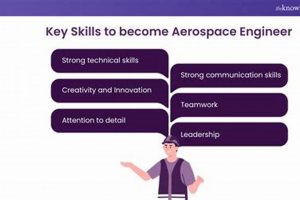
Tip 3: Cultivate Effective Communication and Collaboration Skills. Aerospace projects are typically large-scale and involve multidisciplinary teams. The ability to communicate technical information clearly and concisely, both verbally and in writing, is essential for successful collaboration and project outcomes.
Tip 4: Emphasize Understanding of Aerodynamic Principles. A deep knowledge of fluid dynamics and its impact on aircraft and spacecraft design is paramount. Study airfoil design, boundary layer theory, and computational fluid dynamics (CFD) to analyze and optimize vehicle performance.
Tip 5: Focus on Materials Science and Structural Analysis. The selection and analysis of materials are critical for ensuring structural integrity and minimizing weight. Acquire expertise in material properties, stress analysis, and failure mechanisms to design robust and reliable aerospace components.
Tip 6: Gain Practical Experience Through Internships and Projects. Applying theoretical knowledge in real-world scenarios is invaluable. Seek out internship opportunities or participate in hands-on projects to gain practical experience in design, manufacturing, and testing.
Tip 7: Stay Current with Emerging Technologies. The field is constantly evolving with advancements in areas such as additive manufacturing, autonomous systems, and advanced materials. Continuously update knowledge and skills to remain competitive in the job market and contribute to innovation.
Adhering to these recommendations will enhance preparedness and contribute to success within the complex and demanding field. A solid foundation, practical skills, and a commitment to lifelong learning are key attributes.
The subsequent conclusion will summarize the core aspects of aerospace engineering explored within this article.
1. Aerodynamics

Aerodynamics represents a cornerstone within the expansive discipline. Its principles govern the interaction of air with moving objects, influencing the design, performance, and safety of aircraft and spacecraft. Understanding aerodynamics is paramount to achieving efficient and stable flight.
- Lift Generation
Lift, the force that counteracts gravity, is fundamentally an aerodynamic phenomenon. Aircraft wings are designed with specific airfoil shapes to generate lift as air flows over them. The curved upper surface causes air to travel faster, resulting in lower pressure, while the flatter lower surface experiences higher pressure. This pressure difference creates an upward force. The Wright brothers’ early experiments with wing shapes were critical to understanding and controlling lift, leading to sustained powered flight.
- Drag Reduction
Drag is the resistance encountered by an object moving through the air. Minimizing drag is essential for improving fuel efficiency and increasing speed. Aerodynamic design focuses on streamlining shapes to reduce turbulence and pressure drag. For instance, the sleek designs of modern jetliners are a direct result of efforts to minimize drag, allowing them to fly at higher speeds with reduced fuel consumption.
- Stability and Control
Aerodynamic surfaces, such as ailerons, elevators, and rudders, are used to control the stability and maneuverability of aircraft. These control surfaces alter the airflow around the aircraft, generating forces that cause it to rotate or change direction. Proper aerodynamic design ensures that these control surfaces are effective and responsive, enabling pilots to maintain stable flight and execute maneuvers safely.
- High-Speed Aerodynamics
At high speeds, particularly those approaching or exceeding the speed of sound, the behavior of air becomes more complex. Shock waves form, leading to increased drag and potential instability. Understanding high-speed aerodynamics is critical for designing supersonic and hypersonic aircraft and spacecraft. The development of swept wings and other advanced aerodynamic features has enabled aircraft to fly at supersonic speeds while mitigating the adverse effects of shock waves.
These aerodynamic principles are integral to all aspects. The efficient and safe operation of aircraft and spacecraft depends on a thorough understanding and application of these concepts. From the design of a small drone to the development of a hypersonic vehicle, aerodynamics plays a critical role in shaping the capabilities and performance of aerospace systems.
2. Propulsion Systems
Propulsion systems are an indispensable component within the comprehensive field. These systems generate the necessary force to propel aircraft through the atmosphere and spacecraft through the vacuum of space. Their design and efficiency directly impact the performance, range, and operational capabilities of aerospace vehicles, making them central to aeronautical and astronautical endeavors.
- Jet Engines in Aviation
Jet engines are the primary propulsion source for most commercial and military aircraft. These engines operate by drawing in air, compressing it, mixing it with fuel, and igniting the mixture. The expanding exhaust gases generate thrust, propelling the aircraft forward. Different types of jet engines, such as turbofans, turbojets, and turboprops, are designed for specific speed ranges and operating conditions. The development of more efficient jet engines has been a constant focus, leading to reduced fuel consumption and increased range for modern aircraft. For example, the high-bypass turbofan engines used on large airliners contribute significantly to their fuel efficiency.
- Rocket Engines in Space Exploration
Rocket engines are essential for spacecraft propulsion, as they can operate independently of an atmosphere. These engines generate thrust by expelling hot gases produced from the combustion of propellants. Chemical rocket engines, which use liquid or solid propellants, are the most common type. However, other types, such as ion engines and nuclear thermal rockets, are being developed for future space missions. The Saturn V rocket, used in the Apollo program, employed powerful liquid-fueled rocket engines to launch astronauts to the Moon. The development of reusable rocket engines, like those used on SpaceX’s Falcon 9, has significantly reduced the cost of space access.
- Propellant Types and Performance
The choice of propellant significantly affects the performance of a propulsion system. Liquid propellants, such as liquid hydrogen and liquid oxygen, offer high performance but require complex storage and handling systems. Solid propellants are simpler to store but typically provide lower performance. Hybrid rocket engines, which use a combination of solid and liquid propellants, offer a compromise between performance and simplicity. The selection of the optimal propellant depends on the specific mission requirements, including thrust, duration, and storage constraints. For instance, long-duration space missions often require high-performance liquid propellants to minimize propellant mass.
- Advanced Propulsion Concepts
Ongoing research and development efforts are focused on advanced propulsion concepts that could revolutionize space travel. These include technologies such as electric propulsion, which uses electric fields to accelerate ions and generate thrust, and fusion propulsion, which harnesses the energy released from nuclear fusion reactions. Electric propulsion offers high efficiency and can enable long-duration missions to distant destinations. Fusion propulsion, while still in the early stages of development, has the potential to provide very high thrust and specific impulse, enabling rapid interplanetary travel. These advanced propulsion concepts could significantly expand the capabilities of future space exploration missions.
The examples illustrate the multifaceted nature. From enabling global air travel to facilitating space exploration, propulsion systems are at the forefront. Continued innovation in this area is crucial for pushing the boundaries of what is possible in both aeronautics and astronautics.
3. Materials Science

Materials science is a critical enabler within the domain. The properties of the materials used directly determine the performance, safety, and longevity of aircraft and spacecraft. Selection and application of suitable materials require deep understanding of their behavior under extreme conditions, including high stress, temperature variations, and exposure to corrosive environments.
- High Strength-to-Weight Ratio Materials
Achieving a high strength-to-weight ratio is paramount in. Reducing weight improves fuel efficiency and payload capacity. Materials such as aluminum alloys, titanium alloys, and composite materials (e.g., carbon fiber reinforced polymers) are commonly employed due to their exceptional strength relative to their density. For example, the Boeing 787 Dreamliner utilizes composite materials extensively in its fuselage and wings, resulting in significant weight savings and improved fuel economy.
- High-Temperature Materials
Components exposed to extreme temperatures, such as those in jet engines and spacecraft heat shields, require materials with high melting points and resistance to oxidation and thermal stress. Nickel-based superalloys and ceramic matrix composites are often used in these applications. The space shuttle’s heat shield tiles, made of silica-based ceramics, protected the vehicle from the intense heat generated during re-entry into Earth’s atmosphere.
- Corrosion and Fatigue Resistance
Aircraft and spacecraft operate in harsh environments that can lead to corrosion and fatigue failure. Materials must be selected and treated to resist these degradation mechanisms. Stainless steels, aluminum alloys with protective coatings, and advanced polymers are used to enhance corrosion resistance. Fatigue-resistant designs and regular inspections are also essential to prevent catastrophic failures. The Aloha Airlines Flight 243 incident highlighted the importance of fatigue monitoring and prevention in aging aircraft.
- Advanced Materials for Emerging Technologies
Ongoing research focuses on developing advanced materials for future aerospace applications, including shape memory alloys, metamaterials, and self-healing materials. Shape memory alloys can be used in actuators and deployable structures, while metamaterials offer unique electromagnetic properties for antennas and sensors. Self-healing materials can repair damage autonomously, extending the lifespan and reliability of aerospace components. These emerging materials hold promise for revolutionizing aerospace design and performance.
The strategic selection and application of appropriate materials is not merely a design consideration but a fundamental driver of technological advancement. The integration of innovative materials contributes directly to enhanced efficiency, increased safety, and expanded capabilities within the field.
4. Structural Analysis

Structural analysis is an indispensable element of aerospace engineering, ensuring the integrity and reliability of aircraft and spacecraft under diverse operational loads. The consequences of structural failure in aerospace vehicles can be catastrophic, making rigorous analysis a paramount concern. This engineering discipline applies principles of mechanics, materials science, and computational methods to assess the ability of aerospace structures to withstand forces and stresses without deformation or failure. Understanding the interplay between applied loads, material properties, and structural geometry is central to ensuring safe and efficient designs.
The integration of structural analysis in aerospace design is exemplified by the development of aircraft wings. These structures must withstand aerodynamic forces, gravitational loads, and vibrations experienced during flight. Structural engineers utilize finite element analysis (FEA) software to simulate these conditions, predict stress distributions, and identify potential weak points. The design of the Airbus A380, for instance, involved extensive structural analysis to ensure the massive aircraft could withstand the stresses of takeoff, flight, and landing. Similarly, the design of spacecraft structures, such as the International Space Station, requires meticulous structural analysis to ensure they can withstand the stresses of launch, orbital maneuvers, and prolonged exposure to the space environment.
In conclusion, structural analysis is fundamentally linked to aerospace engineering, serving as a critical gatekeeper for safety and performance. Its application spans design, testing, and maintenance phases, ensuring the robustness and reliability of aerospace vehicles. Challenges in structural analysis persist, including the modeling of complex geometries, the accurate representation of material behavior under extreme conditions, and the prediction of long-term fatigue. Addressing these challenges is crucial for advancing the capabilities of aerospace engineering and enabling future innovations in air and space travel.
5. Control Systems

Control systems are integral to the functionality and safety within aerospace engineering. These systems govern the stability, maneuverability, and overall performance of aircraft and spacecraft, enabling them to execute intended flight paths and accomplish mission objectives. The design and implementation of robust control systems are essential for navigating the complexities of atmospheric flight and space travel.
- Flight Control Systems in Aircraft
Aircraft flight control systems enable pilots to precisely manage the orientation and trajectory of the aircraft. These systems utilize control surfaces such as ailerons, elevators, and rudders to generate aerodynamic forces that alter the aircraft’s attitude. Modern fly-by-wire systems replace mechanical linkages with electronic signals, enhancing responsiveness and allowing for advanced control algorithms. For example, the flight control system of a commercial airliner maintains stability during turbulence and facilitates automated landings, improving passenger safety and comfort.
- Guidance, Navigation, and Control (GNC) Systems in Spacecraft
Spacecraft rely on GNC systems to navigate through space and maintain their designated orbits. These systems employ sensors, such as star trackers and inertial measurement units, to determine the spacecraft’s position and orientation. Control algorithms then command thrusters or reaction wheels to adjust the spacecraft’s trajectory and attitude. The GNC system of a satellite ensures it remains in the correct orbit to provide communication services or collect scientific data. Similarly, interplanetary spacecraft require sophisticated GNC systems to navigate vast distances and accurately reach their destinations.
- Autopilot Systems
Autopilot systems automate many aspects of flight, reducing pilot workload and improving efficiency. These systems can maintain altitude, heading, and airspeed, and even execute complex maneuvers such as holding patterns and instrument approaches. Autopilots are essential for long-duration flights, where pilot fatigue can be a concern. Modern autopilot systems integrate with flight management systems (FMS) to optimize fuel consumption and flight path based on real-time conditions. The autopilot system in a modern aircraft allows it to fly pre-programmed routes with minimal pilot intervention.
- Stability Augmentation Systems
Stability augmentation systems (SAS) enhance the inherent stability of aircraft, improving handling characteristics and reducing pilot workload. These systems use sensors to detect disturbances and automatically apply corrective control inputs to counteract unwanted motions. SAS are particularly important in aircraft with inherent instability or those operating in turbulent conditions. For example, helicopters often incorporate SAS to improve stability and reduce pilot fatigue during hovering and maneuvering.
In summary, control systems are vital for the safe and effective operation within aerospace engineering. From stabilizing commercial airliners to guiding spacecraft across interplanetary distances, these systems play a critical role in enabling human exploration and utilization of air and space. Advancements in control theory, sensor technology, and computational power will continue to drive improvements in the performance and reliability of aerospace control systems, enabling increasingly complex and ambitious missions.
Frequently Asked Questions
The following addresses common inquiries regarding aspects of aerospace engineering, providing concise and factual responses to enhance understanding of the discipline.
Question 1: What are the fundamental differences between aeronautical and astronautical engineering?
Aeronautical engineering focuses on the design and development of aircraft that operate within Earth’s atmosphere. Astronautical engineering, conversely, is concerned with spacecraft and other vehicles intended for operation in outer space. While there is significant overlap in core principles, astronautical engineering addresses challenges unique to the space environment, such as vacuum conditions and orbital mechanics.
Question 2: What are the typical educational requirements for pursuing a career in aerospace engineering?
A bachelor’s degree in aerospace engineering or a closely related field is generally required for entry-level positions. Advanced roles may necessitate a master’s or doctoral degree. A strong foundation in mathematics, physics, and computer science is essential. Accreditation from recognized engineering bodies is also crucial for professional licensure.
Question 3: Which areas within aerospace engineering offer the most promising career opportunities?
Several areas demonstrate high growth potential. These include the development of sustainable aviation technologies, the design of autonomous aerial vehicles (drones), and the advancement of space exploration capabilities. Specialization in areas such as artificial intelligence and advanced materials can further enhance career prospects.
Question 4: What are the primary software tools used by aerospace engineers?
Aerospace engineers rely on a range of specialized software tools for design, analysis, and simulation. Common examples include CATIA, ANSYS, MATLAB, and Simulink. Proficiency in these tools is critical for effective participation in aerospace projects.
Question 5: How does aerospace engineering contribute to broader societal benefits?
Aerospace engineering innovations have far-reaching implications. These include advancements in air transportation, satellite communications, weather forecasting, and Earth observation. Furthermore, technologies developed for aerospace applications often find use in other industries, such as medicine and energy.
Question 6: What are the key challenges currently facing the field of aerospace engineering?
Significant challenges include reducing the environmental impact of air travel, developing cost-effective access to space, and ensuring the safety and reliability of autonomous systems. Addressing these challenges requires ongoing research and development efforts and multidisciplinary collaboration.
Aerospace engineering is a field that demands a commitment to continuous learning and adaptation. Understanding these aspects is crucial for both aspiring engineers and those seeking a broader appreciation of the impact of the discipline.
Conclusion
This exploration of everything about aerospace engineering has traversed the core disciplines that define the field. From the fundamental principles of aerodynamics and propulsion to the critical considerations of materials science, structural analysis, and control systems, a comprehensive understanding is paramount. The intricate interplay of these elements is essential for the design, development, and safe operation of both aircraft and spacecraft.
The continued advancement of this engineering domain is vital for progress across numerous sectors, from transportation and communication to scientific exploration and national security. Sustained investment in research, education, and innovation is critical to ensure that this field continues to address the challenges of the present and unlock the possibilities of the future. The pursuit of excellence in aerospace engineering remains a crucial endeavor for the betterment of society.