The process of entering the field concerned with the design, development, testing, and production of aircraft and spacecraft involves a strategic combination of academic preparation, skill development, and professional networking. For example, a prospective professional might pursue a relevant undergraduate degree, engage in extracurricular projects, and seek internship opportunities.
Success in this area offers opportunities for innovation and contribution to advancements in air travel, space exploration, and defense technologies. Historically, individuals entering related disciplines have played pivotal roles in shaping global transportation systems and expanding humankind’s understanding of the universe, driving economic growth and national security.
Subsequent sections will detail educational pathways, essential skills, relevant experience, and networking strategies that are crucial for navigating the entry process. Information on academic specializations, skill-building opportunities, and securing valuable practical experience will be presented.
The following strategies are designed to provide guidance for those seeking a career in the field. Adherence to these recommendations can improve prospects and prepare individuals for the challenges of the industry.
Tip 1: Emphasize a Strong Foundation in STEM. A comprehensive understanding of mathematics, physics, and computer science is essential. Focus on excelling in these subjects during secondary and post-secondary education.
Tip 2: Pursue a Relevant Undergraduate Degree. A bachelor’s degree in a closely related field, such as aerospace engineering, mechanical engineering, or electrical engineering, is typically required. Consider specializing in areas like aerodynamics, propulsion, or structural mechanics.
Tip 3: Seek Out Internships and Research Opportunities. Practical experience is highly valued. Participate in internships at aerospace companies or research labs to gain hands-on experience and build a professional network.
Tip 4: Develop Proficiency in Relevant Software. Familiarize yourself with industry-standard software such as CAD (Computer-Aided Design), CAE (Computer-Aided Engineering), and simulation tools. Demonstrate this proficiency through projects and coursework.
Tip 5: Join Professional Organizations. Membership in organizations such as the American Institute of Aeronautics and Astronautics (AIAA) provides access to networking opportunities, industry events, and resources for professional development.
Tip 6: Consider Advanced Education. A master’s degree or Ph.D. can enhance career prospects, particularly for roles involving research and development or specialized engineering disciplines. Focus on a specific area of interest within the aerospace field.
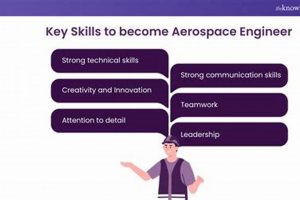
Tip 7: Cultivate Strong Communication and Teamwork Skills. Aerospace projects often involve collaboration across diverse teams. Develop the ability to effectively communicate technical concepts and work collaboratively on complex projects.
Tip 8: Build a Portfolio of Projects. Showcase your skills and experience by creating a portfolio of engineering projects. This can include design projects, research papers, or software applications. Highlight the technical challenges you addressed and the results you achieved.
By focusing on academic excellence, practical experience, and professional development, individuals can enhance their qualifications and increase their likelihood of success. Proactive engagement and continuous learning are important elements for long-term advancement in this field.
The subsequent section will focus on potential career paths and long-term strategies for those actively engaged within this domain.
1. Academic Foundation

A robust academic foundation forms the bedrock upon which any successful entry into the aerospace engineering profession is built. The depth and breadth of an individual’s understanding of fundamental scientific and mathematical principles directly influence their ability to comprehend, analyze, and contribute to the complex challenges inherent in the field.
- Mathematical Proficiency
Advanced mathematics, including calculus, differential equations, linear algebra, and numerical methods, provides the essential tools for modeling and simulating aerospace systems. For instance, calculating aerodynamic forces on an aircraft wing requires a strong grasp of calculus. Deficiencies in these areas can significantly impede one’s ability to solve engineering problems and limit career opportunities.
- Physics Comprehension
A thorough understanding of classical mechanics, thermodynamics, fluid dynamics, and electromagnetism is crucial for analyzing the behavior of aircraft and spacecraft. Knowing the principles of thermodynamics is crucial to design efficient propulsion systems. A weak grasp of these concepts makes it difficult to analyze performance and reliability.
- Computer Science Fundamentals
Proficiency in programming languages, data structures, algorithms, and numerical simulation techniques is increasingly vital due to the reliance on computational tools in aerospace design and analysis. For example, designing control systems and running simulations requires strong coding skills. Lack of programming competency can severely restrict participation in cutting-edge projects.
- Core Engineering Principles
Beyond fundamental sciences, knowledge of core engineering disciplines like statics, dynamics, materials science, and control systems is essential. Understanding material properties allows engineers to select appropriate materials for aerospace structures. A lack of understanding in these areas inhibits effective decision-making in design and analysis.
In summary, a solid grounding in mathematics, physics, computer science, and core engineering principles is an indispensable prerequisite for individuals seeking to enter the field. Mastery of these areas enables prospective professionals to tackle complex engineering problems and contribute meaningfully to advancements. This strong foundation greatly facilitates the acquisition of more specialized knowledge and skills required for success.
2. Practical Experience

Gaining practical experience serves as a critical bridge between theoretical knowledge and real-world application in aerospace engineering. Its significance cannot be overstated; demonstrating applied skills and industry exposure is a substantial differentiator for aspiring professionals.
- Internships in Aerospace Firms
Internships offer direct exposure to engineering workflows, design processes, and project management within established aerospace organizations. For example, an internship at Boeing might involve contributing to the design of aircraft components or assisting with testing procedures. These experiences provide invaluable insights and demonstrate an ability to integrate into professional environments.
- Research Opportunities in Academic Labs
Participation in research projects within university laboratories allows for the application of theoretical concepts to solve real-world engineering challenges. Examples include designing and testing experimental aircraft models, developing new propulsion systems, or analyzing satellite data. Such experience demonstrates the ability to conduct independent research and contribute to scientific advancements.
- Hands-On Engineering Projects
Engaging in personal or group engineering projects, such as designing and building a drone or a rocket, offers valuable practical skills in design, fabrication, and testing. These projects showcase initiative, problem-solving abilities, and the capacity to translate concepts into functional prototypes, directly addressing tangible engineering issues.
- Volunteering and Extracurricular Activities
Participation in engineering-related clubs or volunteer projects, such as designing and building competition robots or assisting with community engineering initiatives, demonstrates teamwork, leadership, and a commitment to applying engineering skills in practical settings. These experiences provide opportunities to hone technical abilities and develop interpersonal skills essential for collaborative engineering environments.
The integration of practical experiences with academic training provides a well-rounded skill set that enhances the prospects of individuals entering the field. The ability to demonstrate applied knowledge and tangible accomplishments through internships, research, projects, and extracurricular activities is a considerable asset when pursuing opportunities within the aerospace industry.
3. Software Proficiency
The aerospace engineering field is heavily reliant on specialized software tools for design, analysis, simulation, and manufacturing. Developing proficiency in these software applications is not merely beneficial but essential for aspiring professionals.
- CAD (Computer-Aided Design) Software
CAD software, such as CATIA, SolidWorks, and AutoCAD, is fundamental for creating detailed 3D models of aircraft and spacecraft components. Engineers use these tools to design everything from fuselage structures to engine parts. Proficiency in CAD allows for precise design iteration and ensures manufacturability, directly impacting the viability of engineering solutions.
- CAE (Computer-Aided Engineering) Software
CAE software, including ANSYS and Abaqus, enables the simulation and analysis of structural integrity, thermal behavior, and fluid dynamics of aerospace designs. Engineers use CAE tools to predict performance under various operating conditions, optimizing designs before physical prototypes are created. Competence in CAE is crucial for ensuring the safety and efficiency of aerospace systems.
- CFD (Computational Fluid Dynamics) Software
CFD software, like Fluent and OpenFOAM, is used to simulate airflow around aircraft and spacecraft. This allows engineers to optimize aerodynamic performance, reduce drag, and improve fuel efficiency. Mastery of CFD techniques enables data-driven design decisions, critical for achieving optimal aerodynamic characteristics.
- Programming Languages for Aerospace Applications
Programming languages such as MATLAB, Python, and C++ are utilized for developing custom tools, automating analyses, and controlling flight systems. MATLAB is often used for simulation and control system design, while Python is prevalent in data analysis and scripting. C++ is crucial for embedded systems and real-time applications in flight control systems. Fluency in these languages enables the creation of tailored solutions for specific aerospace challenges.
Acquiring and demonstrating software proficiency provides a significant competitive advantage for individuals pursuing entry into the aerospace engineering profession. The ability to effectively utilize these tools directly enhances an engineer’s capacity to contribute to the design, analysis, and development of advanced aerospace technologies.
4. Networking Opportunities
Networking is a critical, often underemphasized, component of entering the aerospace engineering field. It provides access to information, mentorship, and career opportunities often unavailable through conventional channels, effectively shortening the path into the industry.
- Industry Conferences and Events
Attendance at industry-specific conferences and events, such as those hosted by the American Institute of Aeronautics and Astronautics (AIAA), facilitates direct interaction with practicing engineers, researchers, and recruiters. Such interactions can lead to informational interviews, mentorship opportunities, and even job prospects. The ability to discuss technical topics and express professional interest in person can significantly enhance an individual’s profile.
- Professional Organizations and Societies
Active participation in professional organizations, like the Society of Women Engineers (SWE) or the National Society of Black Engineers (NSBE), provides a platform for building relationships with peers and established professionals. These organizations often host workshops, seminars, and career fairs, offering valuable resources for skill development and job searching. Membership demonstrates commitment and provides access to exclusive networking events.
- University Alumni Networks
Leveraging university alumni networks provides access to graduates working in the aerospace sector. Alumni can offer career advice, insights into specific companies, and introductions to hiring managers. Engaging with alumni demonstrates initiative and taps into a pre-existing network of individuals invested in the success of fellow graduates.
- Online Professional Platforms
Utilizing online professional platforms, such as LinkedIn, allows individuals to connect with aerospace professionals, join industry-related groups, and participate in discussions. These platforms facilitate the creation of a professional online presence, showcasing skills and experience to potential employers. Active engagement in online communities can lead to new contacts and opportunities.
In summation, strategic engagement in networking activities enhances prospects by providing avenues for mentorship, access to unadvertised opportunities, and visibility within the aerospace engineering community. These connections translate to a tangible advantage in navigating the complexities of entering this specialized field.
5. Advanced Education
Advanced education, particularly at the master’s or doctoral level, significantly impacts entry into specific niches and advancement within the aerospace engineering field. It allows for specialization, deepens technical knowledge, and often becomes a prerequisite for roles involving research, development, and leadership.
- Specialized Knowledge and Skills
Master’s programs offer focused curricula in areas such as aerodynamics, propulsion, structural mechanics, and astrodynamics. An individual seeking a career in designing high-performance aircraft wings may pursue a master’s degree with a concentration in aerodynamics, acquiring specialized knowledge not typically covered in undergraduate studies. These specialized skills are directly applicable to advanced engineering challenges.
- Research and Development Opportunities
Doctoral programs emphasize original research and the development of new technologies. A candidate with a Ph.D. in aerospace engineering might conduct research on novel materials for spacecraft construction or develop innovative propulsion systems. These endeavors are essential for pushing the boundaries of aerospace technology and are often required for leadership roles in research institutions and advanced development teams.
- Enhanced Problem-Solving Capabilities
Advanced education fosters the development of critical thinking and problem-solving skills through rigorous coursework, independent research, and dissertation work. Graduate-level studies often involve tackling complex engineering problems with limited information and requiring creative solutions. Such enhanced problem-solving skills are highly valued in the aerospace industry, where engineers must address intricate challenges related to safety, efficiency, and performance.
- Career Advancement Potential
Holding an advanced degree can open doors to leadership positions and higher-level engineering roles. For example, a master’s degree may be required for project management roles or senior engineering positions within aerospace firms. A Ph.D. can lead to research director positions or faculty appointments in universities. The higher level of education often translates to greater career opportunities and increased earning potential.
The pursuit of advanced education complements the foundational aspects of acquiring expertise and gaining professional advantages when entering the field. The depth of understanding, research experience, and specialized knowledge gained through advanced studies significantly contribute to an individual’s capacity to contribute meaningfully to the advancements and innovations that define the aerospace engineering domain.
Frequently Asked Questions
This section addresses common queries regarding pathways into aerospace engineering. It aims to provide clear, concise answers to assist aspiring professionals in navigating their career preparation.
Question 1: What undergraduate degree is optimal for a career in aerospace engineering?
While a Bachelor of Science in Aerospace Engineering is a direct route, degrees in Mechanical Engineering, Electrical Engineering, and Physics provide suitable foundations. Selection should consider individual aptitudes and specialized interests within the aerospace domain.
Question 2: Is prior experience essential to secure an entry-level position?
While not always mandatory, practical experience through internships, research projects, or relevant extracurricular activities significantly enhances candidacy. Employers value demonstrated application of theoretical knowledge.
Question 3: What are the most valuable software skills for prospective aerospace engineers?
Proficiency in CAD (e.g., CATIA, SolidWorks), CAE (e.g., ANSYS, Abaqus), and programming languages (e.g., MATLAB, Python) is highly advantageous. Mastery of these tools facilitates design, analysis, and simulation tasks.
Question 4: How important is networking in securing a position?
Networking is a crucial aspect of career advancement. Engaging with industry professionals through conferences, professional organizations, and online platforms can provide valuable insights and opportunities.
Question 5: Is advanced education, such as a master’s degree, required for all aerospace engineering roles?
While not universally required for entry-level positions, advanced degrees often open doors to specialized roles in research, development, and management. Master’s or doctoral degrees are frequently prerequisites for advancement to senior positions.
Question 6: What are the most important non-technical skills for aerospace engineers?
Effective communication, teamwork, problem-solving, and critical thinking skills are essential. Aerospace projects typically involve collaboration across diverse teams, requiring the ability to convey complex technical information and address challenges effectively.
In summary, a combination of appropriate education, practical experience, technical proficiency, and interpersonal skills constitutes the key elements for a successful entry into the field. Proactive development in these areas is highly recommended.
The subsequent section will delve into resources available to those pursuing a career in this sector.
Conclusion
This exploration of “how to get into aerospace engineering” has highlighted the multifaceted approach required to enter this demanding, yet rewarding, field. Essential components include a rigorous academic foundation in STEM disciplines, practical experience gained through internships and projects, proficiency in industry-standard software, and proactive engagement in networking opportunities. Furthermore, the pursuit of advanced education often proves advantageous for specialized roles and career advancement.
Successful entry into this sector necessitates a commitment to continuous learning, adaptation to evolving technologies, and a dedication to excellence in engineering principles. While the path may present challenges, the potential to contribute to advancements in air travel, space exploration, and technological innovation underscores the enduring significance of this discipline. Aspiring professionals are encouraged to diligently pursue these outlined strategies, equipping themselves for a meaningful and impactful career within aerospace engineering.