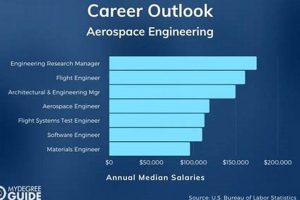
The relationship between these two engineering disciplines involves substantial overlap and distinct specializations. One field focuses on the design, development, testing, and production of aircraft and spacecraft. The other encompasses a broader range of engineering principles related to machines, energy, and motion. As an example, while designing a jet engine involves aspects of both areas, the mechanical design principles are broadly applicable across various industries, whereas the aerospace focus is specific to flight vehicles.
Understanding the interconnection between these fields is crucial for technological advancement. A foundation in broader mechanical engineering principles allows for innovation in aerospace applications. Conversely, challenges and advancements in aerospace often drive innovation in other mechanical systems. Historically, many aerospace innovations have stemmed from or led to improvements in other areas, illustrating the value of understanding the interconnectedness.
The subsequent sections will delve into the specific skills, knowledge domains, and career paths associated with each discipline, highlighting both the common ground and the differentiating factors. The analysis will also consider how evolving technologies are further blurring, or conversely, sharpening the distinctions between these core engineering fields.
The following guidance offers practical advice for individuals considering pursuing or working within either, or both, of these closely related engineering disciplines.
Tip 1: Establish a Strong Foundation in Fundamental Principles: A thorough understanding of core mechanical engineering principlesthermodynamics, fluid mechanics, heat transfer, and solid mechanicsis essential, regardless of specialization. These principles are the building blocks upon which more specialized aerospace concepts are built.
Tip 2: Explore Specialization Early: Identify areas of interest within either field. Mechanical engineers may specialize in areas like robotics or manufacturing, while aerospace engineers might focus on propulsion systems, aerodynamics, or structural design. Early exploration allows for targeted skill development.
Tip 3: Develop Proficiency in CAD and Simulation Software: Expertise in software tools such as CAD (Computer-Aided Design) packages and FEA (Finite Element Analysis) software is invaluable. These tools are fundamental for design, analysis, and optimization in both domains. For example, utilizing CAD to model aircraft components or simulating stress under load.
Tip 4: Cultivate Interdisciplinary Collaboration Skills: Success in either discipline often hinges on the ability to work effectively in teams with individuals from diverse backgrounds. Develop strong communication and collaboration skills to facilitate knowledge sharing and problem-solving.
Tip 5: Seek Hands-on Experience Through Internships or Projects: Practical experience is crucial for translating theoretical knowledge into real-world applications. Internships or participation in engineering projects provide valuable opportunities to apply skills, learn from experienced professionals, and build a professional network.
Tip 6: Embrace Continuous Learning: Engineering is a rapidly evolving field. Stay abreast of emerging technologies, industry trends, and new methodologies through continuous professional development, participation in conferences, and engagement with professional organizations.
Tip 7: Consider a Dual Degree or Specialization: For individuals with a strong interest in both fields, a dual degree or a specialized master’s program that bridges the gap between aerospace and mechanical engineering may be a valuable option.
These tips highlight the importance of a solid foundation, specialization, practical skills, and continuous learning. By following this advice, individuals can increase their chances of success in the competitive and demanding fields of aerospace and mechanical engineering.
The conclusion of this article will further synthesize the key differences and similarities between the disciplines, solidifying a comprehensive understanding.
1. Overlapping Fundamental Principles

The assertion that there exists a tangible link between fundamental principles in aerospace and mechanical engineering is demonstrably true. Both disciplines rely heavily on a core body of knowledge, encompassing areas such as thermodynamics, fluid mechanics, heat transfer, and solid mechanics. The application of these principles, however, varies depending on the specific engineering context. For example, the design of a gas turbine engine, a common area of focus in both fields, necessitates a strong grasp of thermodynamic cycles, fluid flow characteristics, and material properties. The underlying principles governing these aspects remain constant, irrespective of whether the turbine is intended for use in an aircraft or a power generation facility.
The reliance on shared fundamental principles has a profound impact on the educational pathways and skill sets required for engineers in both disciplines. A mechanical engineering curriculum invariably includes coursework that is directly applicable to aerospace applications, and vice versa. This overlap allows engineers to transition between fields with relative ease, provided they are willing to acquire specialized knowledge specific to the new domain. For example, a mechanical engineer with expertise in computational fluid dynamics (CFD) can readily apply their skills to analyze airflow around an aircraft wing, provided they gain an understanding of relevant aerodynamic principles and regulations.
In summary, the existence of overlapping fundamental principles forms a crucial link between aerospace and mechanical engineering. This interconnectedness is not merely theoretical; it manifests in shared educational requirements, transferable skills, and the ability for engineers to transition between fields. Understanding the nature and extent of this overlap is essential for both students considering a career in either discipline and practicing engineers seeking to broaden their expertise or explore new career opportunities. This foundational connection reinforces the understanding that while distinct specializations exist, they are built upon a shared base of core engineering knowledge.
2. Distinct Application Domains
The differentiation between aerospace and mechanical engineering becomes clear when examining their respective application domains. Aerospace engineering fundamentally concerns itself with the design, development, and maintenance of vehicles operating within the atmosphere or in space. This includes aircraft, spacecraft, satellites, and missiles. Mechanical engineering, conversely, encompasses a much broader range of applications, dealing with machines, energy systems, manufacturing processes, robotics, and a multitude of other areas not exclusively related to flight. The distinct focus influences the specific skills and knowledge required in each field, despite the shared foundation of engineering principles.
The application domains significantly shape the nature of the challenges encountered and the solutions pursued within each discipline. Aerospace engineers grapple with issues of aerodynamics, structural integrity under extreme conditions, propulsion system efficiency, and satellite communication. Mechanical engineers, while potentially addressing similar underlying principles, apply them to a wider array of contexts. For example, a mechanical engineer might design a more efficient internal combustion engine for automobiles, while an aerospace engineer focuses on a jet engine designed to maximize thrust and minimize weight for aircraft. This domain-specific expertise necessitates specialized training and professional development.
In summary, the “is aerospace engineering mechanical engineering” question is answered negatively, in part, due to these differing domains. While the disciplines share fundamental principles, the application of these principles is dictated by the specific context of the domain. The distinct application domains influence the required skill sets, design considerations, and problem-solving approaches. Recognizing this distinction is critical for individuals pursuing careers in engineering, allowing them to align their education and experience with their desired field of specialization and to appreciate the breadth and depth of each discipline.
3. Specialized Skill Sets

The delineation between aerospace and mechanical engineering is further clarified by examining the specialized skill sets cultivated within each domain. While both fields draw upon a common foundation of engineering principles, the application of these principles leads to the development of unique expertise, contributing to the answer to the question of “is aerospace engineering mechanical engineering”.
- Aerodynamics and Flight Mechanics
Aerospace engineers develop a profound understanding of aerodynamics, encompassing lift, drag, and stability of flight vehicles. This skillset allows for the design of efficient airfoils, control surfaces, and overall aircraft configurations. For instance, the design of a modern airliner wing requires a deep understanding of boundary layer control, transonic flow phenomena, and the interaction between wing shape and flight performance.
- Propulsion Systems Design
The design and analysis of propulsion systems, including jet engines, rocket engines, and electric propulsion systems, constitutes a core competency for aerospace engineers. This involves expertise in thermodynamics, combustion, fluid dynamics, and heat transfer. The development of a new rocket engine, for example, necessitates a detailed understanding of nozzle design, propellant chemistry, and the structural integrity of high-temperature components.
- Spacecraft Systems Engineering
Aerospace engineers specializing in spacecraft design acquire expertise in orbital mechanics, attitude control, thermal management, and power systems. They are responsible for integrating these systems to ensure the reliable operation of satellites and other space-based platforms. Developing a satellite for Earth observation, for instance, demands precise calculations of orbital parameters, efficient solar panel design, and robust communication links.
- Advanced Materials and Structures for extreme operating environment
The use of advanced materials and structures is also vital in aerospace and mechanical engineering; therefore, the specialization of aerospace engineers is toward the use of materials and structures for extreme operating environment. Such as designing a hypersonic flight vehicle requires expertise in high-temperature materials, thermal protection systems, and structural dynamics to ensure the vehicle can withstand the aerodynamic loads and thermal stresses.
These specialized skill sets, unique to aerospace engineering, underscore the distinct nature of the discipline. While a mechanical engineer might possess a general understanding of aerodynamics or propulsion, the depth and focus of expertise required for aerospace applications necessitate specialized training and experience. This divergence in specialized skill sets provides further evidence that aerospace engineering, while related, is a distinct field from mechanical engineering.

The utilization of shared analytical tools represents a significant intersection between aerospace and mechanical engineering, influencing the perceived relationship. These tools, including computational fluid dynamics (CFD) software, finite element analysis (FEA) packages, and various simulation and modeling platforms, serve as essential instruments for both disciplines. The availability and application of these tools can create an impression of overlap. For example, both aerospace and mechanical engineers might employ CFD to analyze fluid flow; however, the specific application differs. Aerospace engineers use CFD to model airflow around aircraft wings, while mechanical engineers might analyze fluid flow in a piping system. The underlying tool is the same, but the engineering problem and interpretation of results are distinct.
The existence of shared analytical tools stems from the common foundation of scientific and engineering principles upon which both disciplines are built. These tools enable engineers to simulate complex physical phenomena, optimize designs, and predict performance characteristics. FEA, for instance, is used to analyze stress and strain in structures, whether it be an aircraft fuselage (aerospace) or a bridge (civil/mechanical). The common analytical approach, facilitated by the same software, underscores a shared methodology, but does not imply that aerospace engineering is a subset of mechanical engineering. Rather, it suggests that both draw upon a common toolbox for solving engineering problems.
In summary, while the presence of shared analytical tools might suggest a degree of similarity, the actual application and interpretation of results are heavily influenced by the specific domain. Both aerospace and mechanical engineers utilize these tools to address unique challenges within their respective fields. Therefore, shared analytical tools do not negate the distinctions between these two engineering disciplines. This understanding highlights the importance of considering the context in which these tools are employed, rather than solely focusing on their common usage.
5. Different Certification Paths

Distinct certification paths provide tangible evidence that aerospace engineering and mechanical engineering are separate and distinct disciplines. While both fields are regulated and require demonstration of competency, the specific certifications available and the criteria for obtaining them reflect the specialized knowledge and skills associated with each engineering branch. This divergence significantly contributes to the understanding that one is not merely a subset of the other.
For example, in many countries, professional engineering licensure involves passing examinations tailored to specific engineering disciplines. A mechanical engineer seeking licensure might focus on topics such as thermodynamics, machine design, or manufacturing processes. Conversely, an aerospace engineer’s examination would likely emphasize aerodynamics, propulsion systems, and aerospace structures. These different examination contents and specialized requirements highlight the unique bodies of knowledge associated with each profession. Furthermore, organizations such as the American Institute of Aeronautics and Astronautics (AIAA) offer certifications specific to the aerospace field, which would be less relevant or applicable to a mechanical engineer working outside the aerospace sector. These certifications enhance an engineer’s credibility and demonstrate specialized expertise within the aerospace domain. This contrasts with mechanical engineering certifications that highlight expertise in areas like heating, ventilation, and air conditioning (HVAC) systems or pressure vessel design. These specializations require a different core knowledge set.
In conclusion, the existence of distinct certification paths reinforces the notion that aerospace and mechanical engineering, while sharing a common foundation, are separate disciplines with unique areas of specialization and expertise. These separate paths serve as a formal recognition of the specialized knowledge required for competent practice in each field, underscoring the importance of understanding the nuances of each discipline for career planning and professional development.
6. Variable Industry Focus

The divergence in industry focus serves as a defining characteristic that differentiates aerospace engineering from mechanical engineering. This difference is central to understanding that the latter is not inclusive of the former. Each discipline directs its expertise towards distinct sectors, influencing the nature of projects undertaken, the skills required, and the career paths available.
- Aerospace Sector Specialization
Aerospace engineering is predominantly concentrated in industries related to aircraft, spacecraft, and related technologies. This encompasses manufacturers of commercial and military aircraft, satellite developers, space exploration companies, and defense contractors. Aerospace engineers within these sectors focus on designing, testing, and improving the performance, safety, and efficiency of flight vehicles and related systems. For example, an aerospace engineer might work on optimizing the aerodynamic design of a new commercial airliner, while a mechanical engineer working within the same company might be focused on improving the manufacturing processes of the airplane seats.
- Broad Mechanical Engineering Application
Mechanical engineering spans a vastly wider range of industries, including automotive, manufacturing, energy, robotics, HVAC, and biomedical engineering. Mechanical engineers find employment in companies that produce machinery, develop energy systems, design automation equipment, and create medical devices. This breadth of application allows mechanical engineers to apply their skills to a diverse array of products and processes. For example, a mechanical engineer could be developing a new type of wind turbine for renewable energy generation, while another could be designing robotic arms for assembly lines.
- Regulatory and Safety Considerations
The aerospace industry is characterized by stringent regulatory requirements and an unwavering emphasis on safety. Aerospace engineers must adhere to rigorous standards set by aviation authorities and space agencies. This necessitates a deep understanding of safety protocols, risk assessment, and quality control procedures. For instance, the design of aircraft components is subject to strict scrutiny to ensure structural integrity and passenger safety. In contrast, while safety is also a concern in many mechanical engineering applications, the regulatory environment and safety critical aspects may not be as demanding as in the aerospace sector. A mechanical engineer designing a consumer product, for example, may face different regulatory requirements and safety considerations than an aerospace engineer designing an aircraft engine.
- Impact on Career Trajectories
The differing industry focuses profoundly influence career trajectories for engineers in each discipline. Aerospace engineers typically progress within the aerospace sector, specializing in areas such as aerodynamics, propulsion, or spacecraft systems. Mechanical engineers, due to the breadth of their field, have a wider range of career options, potentially moving between industries or specializing in diverse areas like robotics, thermal systems, or manufacturing. The specialized career paths reflects a fundamental difference between these two and the question of “is aerospace engineering mechanical engineering”.
The variable industry focus highlights a fundamental distinction between aerospace engineering and mechanical engineering, solidifying the understanding that the former is not simply a subset of the latter. The unique demands, regulatory environment, and career opportunities within each sector demonstrate that while some shared principles exist, the practical application of engineering knowledge is heavily influenced by the specific industry in which the engineer operates.
7. Evolving Technological Boundaries
The convergence of several technological advancements is reshaping the traditional boundaries between aerospace and mechanical engineering. These advancements blur some distinctions while simultaneously creating new specializations and areas of focus. The dynamic nature of these changes is essential in considering the interconnectedness of these disciplines.
- Additive Manufacturing and Advanced Materials
Additive manufacturing (3D printing) and advanced materials are revolutionizing both aerospace and mechanical engineering. In aerospace, these technologies enable the creation of lightweight, high-strength components with complex geometries, improving aircraft performance and fuel efficiency. Mechanical engineers are utilizing these same advancements to produce customized parts, optimize manufacturing processes, and create innovative products across various industries. For example, 3D-printed turbine blades with intricate cooling channels are now common in both jet engines (aerospace) and power generation facilities (mechanical). The shared use of these technologies leads to cross-disciplinary innovation, yet the specific design constraints and performance metrics differ significantly between the two fields.
- Autonomy and Robotics
The increasing reliance on autonomy and robotics is impacting both aerospace and mechanical engineering. Autonomous flight control systems, unmanned aerial vehicles (UAVs), and robotic spacecraft are transforming aerospace operations. Simultaneously, mechanical engineers are developing advanced robotic systems for manufacturing, logistics, and healthcare. The integration of sensors, artificial intelligence, and control systems is a common thread; however, the operational environments and safety considerations vary considerably. For example, autonomous drones require sophisticated algorithms for navigation and obstacle avoidance, while industrial robots need precise control and safety mechanisms to operate safely alongside human workers. Therefore while shared tools autonomy and robotics impact how each is practiced.
- Digital Twins and Simulation Technologies
The creation of digital twins and the use of advanced simulation technologies are transforming the design, testing, and maintenance of complex systems in both fields. A digital twin is a virtual replica of a physical asset, allowing engineers to monitor performance, predict failures, and optimize operations. Aerospace engineers use digital twins to simulate aircraft performance under various flight conditions, while mechanical engineers use them to optimize the operation of manufacturing plants or energy systems. The convergence of these technologies enables more efficient design processes and predictive maintenance strategies, but the specific data requirements and model complexities differ. This leads to engineers specializing in simulation for their respective fields.
- Electrification and Sustainable Technologies
The shift towards electrification and sustainable technologies is driving innovation in both aerospace and mechanical engineering. Electric propulsion systems for aircraft, hybrid electric vehicles, and renewable energy technologies are gaining prominence. Aerospace engineers are exploring electric aircraft designs to reduce emissions and improve efficiency. Mechanical engineers are developing more efficient batteries, electric motors, and energy storage systems. While the underlying principles of electromagnetism and energy conversion are shared, the specific challenges and design constraints differ substantially. Electrical system requirements for aircraft entail stringent safety and weight considerations, which have driven aerospace engineers to acquire distinct skill sets in high-power density and reliability for such systems.
These evolving technological boundaries illustrate the complex and dynamic relationship between aerospace and mechanical engineering. While some technologies are blurring the lines between these disciplines, others are creating new areas of specialization and expertise. These evolving technologies lead the aerospace and mechanical engineers to become further specialized rather than generalized. A nuanced understanding of these trends is crucial for engineers seeking to navigate the evolving landscape and contribute to future innovations in both fields. So, the answer is: “is aerospace engineering mechanical engineering” is NO.
Frequently Asked Questions
The following questions address common misconceptions and clarify the relationship between the fields of aerospace and mechanical engineering, particularly concerning the assertion that aerospace engineering is simply a sub-discipline of mechanical engineering.
Question 1: Are the fundamental courses for aerospace and mechanical engineering identical?
While both disciplines require a solid foundation in mathematics, physics, and core engineering principles like thermodynamics and fluid mechanics, aerospace engineering programs quickly diverge to include specialized coursework in aerodynamics, propulsion, orbital mechanics, and aerospace structures. Mechanical engineering programs, in contrast, explore a broader range of topics, such as manufacturing processes, robotics, and thermal systems.
Question 2: Can a mechanical engineer readily design an aircraft wing?
A mechanical engineer possesses a strong foundation in structural analysis and materials science, which is beneficial. However, aircraft wing design requires specialized knowledge of aerodynamics, flight mechanics, aeroelasticity, and aviation regulations. Without specific training in these areas, a mechanical engineer would likely lack the necessary expertise to design an aircraft wing effectively.
Question 3: Do aerospace and mechanical engineers use the same software tools?
Both disciplines utilize tools like CAD (Computer-Aided Design) software and FEA (Finite Element Analysis) packages. However, the application and context differ. Aerospace engineers use these tools to simulate airflow around aircraft or analyze stress in spacecraft structures, while mechanical engineers might use them to design machine components or analyze heat transfer in engines. Though the software is shared, the simulation parameters, material properties, and performance metrics are tailored to the specific engineering domain.
Question 4: Is a mechanical engineering license sufficient to practice aerospace engineering?
Professional engineering licensure is typically discipline-specific. A mechanical engineering license demonstrates competency in mechanical engineering principles and practices. While some overlap exists, practicing aerospace engineering often requires specific knowledge and experience beyond the scope of a mechanical engineering license. Additional certifications from aerospace-specific organizations may be necessary or beneficial.
Question 5: Are job opportunities in aerospace generally available to mechanical engineers?
While a mechanical engineering degree can provide a pathway into some aerospace roles, specialized positions often require aerospace-specific education and experience. Mechanical engineers may find opportunities in areas like manufacturing or structural analysis within aerospace companies, but roles directly involving aircraft or spacecraft design typically favor candidates with aerospace engineering backgrounds.
Question 6: Does the increasing convergence of technology mean the distinction between aerospace and mechanical engineering will disappear?
While technological advancements like additive manufacturing and autonomous systems are blurring some lines, they also create new areas of specialization within each field. The fundamental differences in application, design constraints, and regulatory environments suggest that aerospace and mechanical engineering will remain distinct disciplines, albeit with increasing opportunities for collaboration and cross-disciplinary innovation.
In summary, while there are undeniable connections and shared principles between aerospace and mechanical engineering, the specialized knowledge, skills, and industry focus solidify their distinct identities.
The next section will provide a final conclusion summarizing the core arguments discussed throughout this analysis.
Is Aerospace Engineering Mechanical Engineering
This analysis has explored the relationship between aerospace engineering and mechanical engineering, demonstrating that while substantial overlap exists in fundamental principles and analytical tools, significant distinctions warrant their classification as separate disciplines. The differing application domains, specialized skill sets, distinct certification paths, variable industry focus, and evolving technological boundaries collectively refute the notion that one is merely a subset of the other. Each discipline requires a unique depth of knowledge and expertise to address its specific challenges and opportunities.
Continued advancements in technology will undoubtedly further shape the intersection of these fields, creating new collaborative possibilities. However, a clear understanding of their individual characteristics remains crucial for informed career decisions, effective interdisciplinary collaboration, and continued innovation within the broader engineering landscape. Recognizing the nuanced differences between aerospace and mechanical engineering is essential for driving progress in both sectors and beyond.