The anticipated need for professionals designing, developing, testing, and maintaining aircraft, spacecraft, and related systems constitutes a crucial factor for individuals considering this field. This projection encompasses anticipated growth, replacement of retiring workers, and potential shifts in the industry landscape.
Understanding these future employment prospects is beneficial for several reasons. It informs educational choices, allowing prospective students to align their skills with areas of projected demand. It also guides career development, enabling current professionals to adapt to evolving industry needs and enhance their long-term employability. Historically, fluctuations in governmental funding, technological advancements, and global economic conditions have all influenced employment patterns within this sector.
This discussion will delve into the key factors influencing the aforementioned projections, examine specific areas of growth and potential challenges, and provide insights into the skills and qualifications most sought after by employers. The analysis will also consider the impact of emerging technologies and evolving global market dynamics on the trajectory of professional opportunities in this area.
Considering the future employment landscape is essential for those pursuing or advancing a career. Diligent planning and proactive skill development can significantly enhance long-term professional success.
Tip 1: Focus on Specialization: Concentrating expertise in high-demand areas, such as autonomous systems, advanced materials, or sustainable aviation, enhances marketability. Example: Develop proficiency in computational fluid dynamics (CFD) for aircraft design.
Tip 2: Acquire Cross-Disciplinary Skills: Integrate knowledge from different fields, such as computer science, electrical engineering, or data analytics, to tackle complex challenges. Example: Learn machine learning to improve aircraft performance.
Tip 3: Seek Internships and Research Opportunities: Gain practical experience and build a professional network through internships, co-ops, or research projects. Example: Participate in a NASA-sponsored student research program.
Tip 4: Maintain Continuous Learning: Stay updated on the latest technological advancements and industry trends through professional development courses and certifications. Example: Obtain a certification in project management.
Tip 5: Develop Strong Communication Skills: Effectively communicate technical concepts to both technical and non-technical audiences. Example: Practice presenting research findings at conferences.
Tip 6: Embrace System Engineering Approach: Integrating all the disciplines and specialty groups into a team effort forming a structured development process from concept to production to operation and disposal. Example: Applying V-model throughout the aerospace project.
Tip 7: Understand Regulatory Compliance: Become knowledgeable of industry regulations and safety standards to ensure compliance in design and operation. Example: Get familiar with FAA requirements for aircraft certification.
By implementing these strategies, individuals can significantly improve their long-term career prospects in this dynamic and challenging field. Proactive planning and continuous skill development are crucial for navigating the evolving demands of the industry.
The subsequent sections will further explore the influence of technological advancements and global market conditions on the overall employment situation.
1. Growth Projections and Professional Prospects

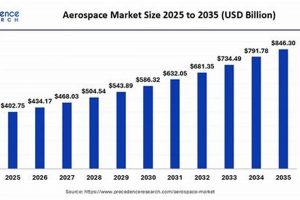
Growth projections represent a fundamental indicator of the anticipated demand for aerospace engineers, directly shaping their professional prospects. These projections are based on a variety of economic, technological, and geopolitical factors that influence the overall health and trajectory of the aerospace industry.
- Commercial Aviation Expansion
The increasing demand for air travel globally drives the need for new aircraft and improvements to existing fleets. This expansion translates to increased opportunities for aerospace engineers involved in design, manufacturing, and maintenance. For example, Boeing and Airbus’s long-term forecasts for aircraft deliveries directly inform estimates for the number of engineers needed to support production.
- Space Exploration and Development
Renewed interest in space exploration, coupled with private sector investment in space tourism and satellite technology, creates openings for engineers specializing in spacecraft design, propulsion systems, and mission planning. NASA’s Artemis program and companies like SpaceX contribute significantly to the demand for these specialized skills.
- Defense and National Security
Ongoing investment in defense systems and national security technologies ensures a consistent need for engineers skilled in aircraft design, missile systems, and advanced materials. Government contracts with aerospace companies like Lockheed Martin and Northrop Grumman drive employment in these areas.
- Technological Innovation and Emerging Fields
Advancements in areas like autonomous systems, electric propulsion, and sustainable aviation create new avenues for engineers with expertise in these emerging technologies. The development of unmanned aerial vehicles (UAVs) and the pursuit of environmentally friendly aircraft designs are examples driving this demand.
In summary, positive growth projections across various sectors of the aerospace industry signal favorable professional paths for qualified engineers. Individuals with expertise in high-demand areas, coupled with continuous learning and adaptation, are well-positioned to capitalize on these opportunities. Understanding these growth trends and aligning skills accordingly is paramount for career success.
2. Technological Advancement and its Influence on Aerospace Engineering Job Prospects

Technological advancement directly shapes the professional future for aerospace engineers. Innovations drive new demands for specialized skills, rendering some existing expertise obsolete while simultaneously creating novel career paths. The rapid pace of technological development necessitates continuous learning and adaptation for sustained employability. For instance, the increasing integration of composite materials in aircraft structures requires engineers with expertise in material science, structural analysis, and manufacturing processes specific to these materials. Concurrently, traditional skills in metal fabrication may become less critical.
The rise of autonomous systems exemplifies this effect. Developing unmanned aerial vehicles (UAVs) and autonomous flight control systems generates opportunities for engineers proficient in robotics, artificial intelligence, and sensor technology. Simultaneously, it may reduce the need for engineers focused solely on traditional aircraft instrumentation. Another practical application is the push toward electric propulsion. Companies developing electric aircraft require engineers specializing in battery technology, electric motor design, and power management systems. This shift necessitates a move away from traditional combustion engine expertise. Similarly, advancements in computational fluid dynamics (CFD) and simulation software demand engineers who can accurately model and analyze complex aerodynamic phenomena, enabling the design of more efficient and higher-performance aircraft.
In conclusion, technological advancement is a pivotal component influencing professional trajectories in aerospace engineering. A proactive approach to acquiring new skills, coupled with a commitment to continuous education, is essential for engineers to remain competitive and thrive in this dynamic field. Failure to adapt to evolving technologies will invariably limit career opportunities. Thus, understanding the trajectory of technological advancement is critical for both aspiring and practicing aerospace engineers.
3. Governmental Spending

Governmental spending represents a significant determinant influencing the employment prospects of aerospace engineers. Allocations for defense, space exploration, and scientific research directly impact the demand for professionals in this sector. Increased investment translates into new projects, research initiatives, and technological developments, leading to the creation of engineering positions within governmental agencies, private contractors, and research institutions.
The relationship between government funding and the employment rate is a clear cause-and-effect scenario. For example, NASA’s budget for space exploration programs, such as the Artemis mission, directly correlates with the number of aerospace engineers hired to design, build, and test spacecraft, propulsion systems, and related technologies. Similarly, Department of Defense contracts awarded to aerospace companies for the development of new aircraft, missile systems, and surveillance technologies directly support the employment of thousands of engineers. Fluctuations in governmental appropriations, stemming from changes in national priorities or economic conditions, can have a corresponding impact on the demand for engineers.
Conversely, reductions in governmental spending can lead to project cancellations, workforce reductions, and a decrease in hiring activity. The practical implication of this understanding is that aerospace engineers must remain informed about governmental budget trends and policy decisions to anticipate potential shifts in the job market. Awareness of these factors allows professionals to strategically position themselves by acquiring skills relevant to areas of anticipated government investment. Ultimately, governmental spending acts as a critical driver of opportunity within the aerospace engineering field, shaping the career trajectories of both current and future professionals.
4. Globalization Impacts
Globalization significantly influences the professional prospects for aerospace engineers. The increasing interconnectedness of global markets, coupled with international collaboration, redefines the landscape of the industry and shapes the demand for specialized expertise.
- International Collaboration on Projects
Aerospace projects are increasingly multinational endeavors, requiring engineers to collaborate with teams across different countries. This necessitates strong communication skills, cultural awareness, and the ability to navigate diverse regulatory environments. Examples include the International Space Station and joint aircraft development programs between Boeing, Airbus, and various national aerospace agencies. The implication is a greater demand for engineers with cross-cultural competencies and experience working in international teams.
- Offshoring and Outsourcing of Engineering Services
Companies frequently offshore or outsource engineering tasks to countries with lower labor costs. This can impact domestic job opportunities in certain areas while simultaneously creating opportunities in other regions. For example, design and analysis work might be outsourced to engineering firms in India or Eastern Europe, while specialized research and development remains in the United States or Europe. The effect is a shift in the geographical distribution of aerospace engineering jobs, requiring professionals to be more competitive on a global scale.
- Global Supply Chains
Aerospace manufacturing relies on complex global supply chains. Engineers are needed to manage these supply chains, ensuring the quality and timely delivery of components from various international suppliers. This requires expertise in logistics, supply chain management, and international trade regulations. Boeing’s reliance on suppliers from around the world to produce its aircraft demonstrates the importance of engineers in managing these intricate networks. The consequence is a demand for engineers with specialized knowledge of global supply chain dynamics.
- International Competition
Increased international competition in the aerospace industry, particularly from emerging economies like China, drives companies to innovate and reduce costs. This necessitates engineers who can develop cutting-edge technologies and improve manufacturing efficiency. The development of the COMAC C919, a Chinese competitor to the Boeing 737 and Airbus A320, exemplifies this trend. The effect is a need for engineers who can drive innovation and enhance competitiveness in a global market.
In summary, globalization has a profound impact on professional paths. The increasing interconnectedness of the aerospace industry necessitates engineers with a diverse skill set, including international collaboration, cross-cultural communication, and expertise in global supply chains. Adapting to these global dynamics is essential for aerospace engineers seeking to thrive in an increasingly competitive international market.
5. Skill Requirements

The demand for specific expertise fundamentally shapes the career path within aerospace engineering. Evolving technological landscapes, coupled with the changing demands of the industry, underscore the critical need for a well-defined skill set to maintain a competitive professional position.
- Proficiency in Advanced Software and Modeling Tools
Aerospace engineers rely on sophisticated software packages for design, analysis, and simulation. Proficiency in tools like CATIA, ANSYS, MATLAB, and Simulink is indispensable for tasks ranging from aircraft design to structural analysis and control system development. For instance, simulating flight dynamics using MATLAB enables engineers to optimize aircraft performance and stability. The ability to effectively utilize these software platforms enhances employability and contributes directly to project efficiency and innovation.
- Expertise in Advanced Materials and Manufacturing Techniques
The development and application of advanced materials, such as composites, alloys, and nanomaterials, are crucial for enhancing aircraft performance and reducing weight. Knowledge of advanced manufacturing techniques, including additive manufacturing (3D printing) and composite layup, is equally important. An example is the use of carbon fiber reinforced polymers in aircraft wings to increase strength while minimizing weight. This expertise is essential for designing and producing next-generation aerospace systems.
- Systems Engineering and Integration Skills
Aerospace projects are inherently complex, involving the integration of numerous subsystems and components. Systems engineering expertise, including requirements definition, system architecture design, and interface management, is vital for ensuring that all elements work together effectively. An example of this is the integration of avionics, propulsion, and control systems in a modern aircraft. The ability to manage complex systems is critical for successful project execution and contributes to the overall reliability and safety of aerospace products.
- Data Analysis and Interpretation
The increasing availability of data from sensors, simulations, and flight tests requires aerospace engineers to possess strong analytical skills. The ability to extract meaningful insights from large datasets, identify trends, and make informed decisions is essential for optimizing performance, improving safety, and reducing costs. Analyzing flight data to identify potential maintenance issues before they become critical is a practical example. Data-driven decision-making is becoming increasingly important in the aerospace industry, necessitating expertise in statistical analysis and data visualization techniques.
In conclusion, skill requirements are critical. Possessing these competencies significantly improves individual career prospects and contributes to the overall competitiveness of the aerospace industry. Continuous professional development and adaptation to emerging technologies are essential for navigating this dynamic landscape.
Frequently Asked Questions
The following section addresses common inquiries regarding the anticipated employment landscape for aerospace engineers, providing factual and objective responses based on industry trends and professional insights.
Question 1: What is the general prediction for employment growth in the aerospace engineering sector over the next decade?
Industry projections suggest moderate growth, influenced by factors such as commercial aviation expansion, increased space exploration initiatives, and ongoing defense spending. Specific growth rates are subject to change based on economic conditions and technological advancements.
Question 2: Which specific areas within aerospace engineering are expected to experience the most growth?
Areas such as autonomous systems, advanced materials, sustainable aviation, and space technology are projected to experience significant growth due to ongoing innovation and increasing demand. Expertise in these domains may offer enhanced career opportunities.
Question 3: How might governmental budget allocations influence the availability of jobs in this field?
Government funding for aerospace research, defense programs, and space exploration directly impacts job availability. Increases in government investment typically lead to greater demand for engineers, while budget cuts may result in workforce reductions.
Question 4: What impact does globalization have on career prospects for aerospace engineers?
Globalization leads to increased international collaboration, offshoring of engineering services, and competition in global markets. Aerospace engineers may need to develop cross-cultural communication skills and adapt to working in diverse teams to succeed in a globalized industry.
Question 5: What specific technical skills are most valued by employers in the current aerospace engineering job market?
Employers prioritize candidates with expertise in advanced software tools (e.g., CATIA, ANSYS), advanced materials and manufacturing techniques, systems engineering, and data analysis. Continuous learning and adaptation to new technologies are also highly valued.
Question 6: How can aspiring aerospace engineers best prepare for the future job market?
Focusing on specialization in high-demand areas, acquiring cross-disciplinary skills, seeking internships and research opportunities, and maintaining continuous learning are crucial steps. Developing strong communication skills and understanding industry regulations are also beneficial.
In essence, while specific growth predictions can fluctuate, a proactive approach to skill development and an awareness of industry trends are critical for navigating the evolving employment landscape. Staying informed and adaptable will position aerospace engineers for long-term professional success.
The next section will summarize the key points discussed in this exploration of the aerospace engineering employment outlook.
Conclusion
This exposition has meticulously examined the multifaceted nature of the anticipated professional landscape. Factors such as growth projections, technological advancements, governmental spending, globalization impacts, and the evolving skill requirements have been thoroughly analyzed to provide a comprehensive understanding of the opportunities and challenges confronting individuals in this field. The assessment underscored the importance of strategic career planning, continuous learning, and adaptation to emerging trends.
Ultimately, a clear understanding of the projected professional demand empowers stakeholders to make informed decisions, contributing to both individual career success and the sustained advancement of the aerospace sector. Monitoring the trajectory of these influences remains essential for navigating the dynamic and competitive realm of engineering and ensuring a continued contribution to aerospace innovation and development.