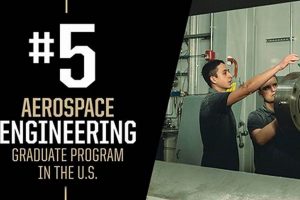
This field encompasses the design, development, and manufacturing of machines, devices, and systems. It applies principles of physics, mathematics, and materials science to analyze, model, and create solutions for a wide range of engineering challenges. A specific area within this field focuses on the engineering of aircraft, spacecraft, and related systems, extending the core principles to the unique environments of flight and space.
Its significance lies in its ability to drive innovation across numerous industries, from transportation and energy to manufacturing and healthcare. Developments in this area have historically led to improved efficiency, safety, and performance of engineered systems, ultimately contributing to societal progress and economic growth. The principles involved facilitate advancements in diverse areas, enhancing capabilities in aerial transportation, space exploration, and related technological endeavors.
The subsequent sections will delve into the specific disciplines within this broad engineering domain, exploring key principles, applications, and emerging trends that are shaping its future. This will include a detailed examination of the core subjects and skills crucial for success within this dynamic and impactful profession.
Essential Guidance for Pursuing a Career in Mechanical or Aerospace Engineering
This section provides focused advice for individuals considering or actively pursuing a career in this demanding and rewarding field. The following tips are designed to enhance preparedness and increase the likelihood of success.
Tip 1: Emphasize a Strong Foundation in Mathematics and Physics: A deep understanding of calculus, differential equations, linear algebra, and physics is fundamental. Mastery of these subjects enables effective problem-solving and modeling of complex systems. For instance, accurately predicting the aerodynamic behavior of an aircraft wing requires advanced mathematical techniques.
Tip 2: Develop Proficiency in Computer-Aided Design (CAD) and Simulation Software: Familiarity with industry-standard software such as SolidWorks, CATIA, or ANSYS is crucial for design and analysis. Proficiency allows for the creation of detailed models, performance simulations, and the optimization of designs before physical prototyping.
Tip 3: Seek Practical Experience Through Internships and Research Opportunities: Hands-on experience is invaluable. Internships at engineering firms or research opportunities at universities provide practical exposure to real-world challenges and complement theoretical knowledge. Active involvement in engineering projects builds tangible skills.
Tip 4: Cultivate Strong Communication and Teamwork Skills: Engineering projects are rarely solo endeavors. Effective communication, collaboration, and the ability to work within a team are essential for coordinating efforts and achieving project goals. Participate in group projects and develop skills in presenting technical information clearly.
Tip 5: Stay Current with Technological Advancements: The field is constantly evolving. Stay informed about emerging technologies, new materials, and innovative design approaches through professional publications, conferences, and online resources. Continuous learning ensures continued relevance and adaptability.
Tip 6: Develop Strong Problem-Solving Skills: Engineering is fundamentally about solving problems. Cultivate critical thinking, analytical skills, and a systematic approach to identifying and resolving complex issues. Practice breaking down large problems into smaller, manageable components.
These guidelines represent a strategic approach to navigating the path toward a successful career in this engineering field. By prioritizing a solid academic foundation, practical experience, and continuous professional development, aspiring engineers can maximize their potential for achievement.
The subsequent sections will explore the long-term outlook and career paths available, further solidifying the understanding of this dynamic discipline.
1. Thermodynamics

Thermodynamics, the study of energy and its transformations, holds a foundational position within fields related to machines or flight technology. It provides the principles necessary to analyze and design energy-related systems. The performance and efficiency of engines, power plants, and thermal management systems rely directly on thermodynamic principles. Without a firm grasp of thermodynamics, optimizing these systems for maximum output and minimal waste is impossible. For example, the design of a jet engine requires precise calculations of thermodynamic cycles to ensure efficient combustion and thrust generation.
In aerospace applications, thermodynamics is crucial for managing the thermal environment within spacecraft and aircraft. The design of heat shields for spacecraft re-entering the atmosphere necessitates an understanding of heat transfer and ablation processes. Similarly, the design of aircraft air conditioning systems requires thermodynamic analysis to maintain a comfortable cabin environment while minimizing energy consumption. Moreover, the development of advanced propulsion systems, such as scramjets and hypersonic vehicles, is heavily dependent on the application of advanced thermodynamic concepts to manage extreme temperatures and pressures.
A thorough understanding of thermodynamics is not merely academic; it is essential for the practical design and operation of numerous engineered systems. The continuous pursuit of higher efficiency and reduced environmental impact in the field drives ongoing research and development in thermodynamic technologies. Addressing challenges such as waste heat recovery and the development of alternative energy sources demands a deep understanding of thermodynamic principles, solidifying its importance to the field’s ongoing advancement.
2. Fluid Dynamics
Fluid dynamics is a critical subdiscipline underpinning the design and analysis of systems in fields related to machine design or flight technology. It examines the behavior of liquids and gases in motion, providing the foundation for understanding phenomena such as lift generation, drag reduction, and heat transfer in fluid environments. This understanding directly impacts the efficiency, performance, and safety of vehicles, machines, and other engineered solutions. For example, accurately predicting airflow around an aircraft wing using computational fluid dynamics (CFD) allows engineers to optimize its shape for maximum lift and minimal drag, directly affecting fuel efficiency and flight characteristics.
The application of fluid dynamics extends beyond aircraft design. It is crucial in the design of turbomachinery such as pumps, turbines, and compressors, which are vital components in power generation, propulsion systems, and industrial processes. Analyzing the flow patterns within these machines allows for the optimization of blade shapes and flow paths, leading to improved efficiency and reduced energy consumption. Moreover, understanding fluid dynamics is essential in designing efficient cooling systems for electronic devices and engines, where heat dissipation is critical for preventing overheating and ensuring reliable operation. The study of fluid dynamics enables the development of quieter and more efficient transportation, optimized energy generation, and improved industrial processes.
In summary, fluid dynamics serves as an indispensable tool for professionals working within this engineering domain. Its ability to predict and control fluid behavior is crucial for creating innovative and high-performing systems. Continuing advancements in computational methods and experimental techniques in fluid dynamics promise further improvements in the design and optimization of future technologies, addressing challenges related to energy efficiency, environmental sustainability, and the advancement of aerial and space-based systems.
3. Materials Science

Materials science plays a central role in the design and development processes within mechanical and flight-related engineering disciplines. The selection, processing, and characterization of materials directly influence the performance, durability, and safety of engineering systems. The relationship is causal: material properties dictate the operational limits of designs, and material advancements enable new engineering possibilities. For instance, the development of high-strength, lightweight alloys has directly facilitated the design of more fuel-efficient aircraft, decreasing operational costs and reducing environmental impact. Similarly, the creation of high-temperature ceramics has enabled the development of more efficient gas turbine engines, leading to increased power output and reduced emissions.
Practical applications of materials science in these engineering fields are numerous. Consider the design of a spacecraft heat shield. The shield must withstand extreme temperatures and pressures during atmospheric re-entry. Materials scientists develop specialized ceramic composites that ablate, or vaporize, in a controlled manner, dissipating heat and protecting the underlying structure. The success of this technology depends on a deep understanding of material properties at extreme conditions. Another example lies in the design of automotive components. Engineers select specific grades of steel, aluminum, and polymers based on their strength, weight, corrosion resistance, and cost, balancing performance requirements with economic considerations. The selection of appropriate bearing materials significantly impacts the lifespan and reliability of rotating machinery.
In conclusion, materials science is not merely a supporting discipline but an integral component of the engineering field in question. A thorough understanding of material properties and behavior is essential for the successful design, construction, and operation of a wide range of engineering systems. Challenges remain in developing materials that can withstand increasingly demanding operating conditions and in optimizing material usage for sustainability and resource efficiency. The ongoing collaboration between materials scientists and engineers is essential for driving innovation and addressing the evolving needs of the industry.
4. Control Systems

Control systems are fundamental to many aspects of engineering designs. They enable machines and vehicles to operate autonomously and adapt to varying conditions. In essence, control systems govern the behavior of dynamic systems, ensuring stability, accuracy, and efficiency. A fundamental connection exists between control systems and the broader engineering domain: controlled mechanisms function properly when properly controlled. A typical example involves autopilot systems in aircraft, which autonomously maintain altitude, heading, and airspeed, improving safety and reducing pilot workload. Improperly designed control systems can lead to instability, oscillations, or even system failure, highlighting the crucial role of careful design and implementation.
The practical applications of control systems are diverse and pervasive. In manufacturing, robotic arms utilize control systems to perform precise movements for assembly and welding. In the automotive industry, engine control units (ECUs) optimize fuel injection and ignition timing for maximum efficiency and reduced emissions. Spacecraft utilize complex control systems to maintain orientation, track celestial objects, and execute orbital maneuvers. Advanced drone technologies depend on sophisticated control algorithms to stabilize flight and navigate complex environments. Each of these examples demonstrates the adaptability and critical importance of control systems in a wide range of sectors.
In conclusion, control systems are indispensable components within the fields of machine and aircraft construction. Their ability to regulate and optimize dynamic system performance is crucial for ensuring safety, efficiency, and autonomy. Ongoing research in areas such as adaptive control, robust control, and nonlinear control continues to expand the capabilities and application domains of this vital engineering discipline. Challenges remain in designing control systems that can handle complex and uncertain environments, but advancements in sensing technologies and computational power promise continued progress in this area.
5. Structural Analysis

Structural analysis is a fundamental component within the broader scope of machine and flight-related engineering. It involves determining the effects of loads on physical structures and their components. This process is essential for ensuring the structural integrity, safety, and reliability of machines, aircraft, spacecraft, and other engineered systems. Failure to conduct thorough structural analysis can lead to catastrophic consequences, including structural failure, loss of life, and significant economic losses. Therefore, it plays a pivotal role in the design and certification of engineering products.
The practical applications of structural analysis are wide-ranging. In the design of an aircraft wing, for example, engineers use structural analysis techniques to determine the stress distribution under various flight conditions. This analysis informs the selection of appropriate materials and the optimization of the wing’s geometry to withstand aerodynamic loads. Similarly, in the design of a bridge, structural analysis is used to assess the load-bearing capacity of the structure and to ensure its stability under different traffic and environmental conditions. Finite element analysis (FEA) is a common tool used to model complex structures and simulate their response to applied loads. In the automotive industry, it ensures the safety of vehicles in crash scenarios.
In conclusion, structural analysis is an indispensable discipline for engineers working on machine and flight-related projects. Its rigorous application ensures the safety and reliability of engineered systems. Further advancements in computational methods and experimental techniques will continue to enhance the accuracy and efficiency of structural analysis, leading to improved designs and enhanced safety standards across various engineering sectors. Challenges remain in accurately modeling complex material behavior and predicting the long-term performance of structures under demanding operating conditions.
6. Aerodynamics

Aerodynamics, the study of air in motion and its interaction with solid objects, is an indispensable element of these engineering fields. Its principles are critical for designing efficient and effective systems that operate within or interact with the Earth’s atmosphere or other gaseous environments. A comprehensive understanding of aerodynamics is essential for optimizing performance and ensuring the stability and control of vehicles and structures.
- Lift Generation
Lift, the force that counteracts gravity and allows aircraft to fly, is fundamentally governed by aerodynamic principles. The shape of an airfoil, or wing, is designed to create a pressure differential between its upper and lower surfaces, generating lift. Aircraft design heavily depends on optimizing airfoil shapes and wing configurations to achieve the desired lift characteristics at various speeds and altitudes. For example, the design of high-lift devices, such as flaps and slats, relies on manipulating airflow to increase lift during takeoff and landing.
- Drag Reduction
Drag, the force that opposes motion through the air, directly impacts the fuel efficiency and performance of aircraft and other vehicles. Aerodynamic design focuses on minimizing drag through streamlining and other techniques. Boundary layer control, such as the use of vortex generators or laminar flow control surfaces, is implemented to reduce friction drag. The overall shape and surface finish of vehicles are carefully considered to minimize pressure drag, resulting in lower fuel consumption and higher speeds.
- Stability and Control
Aerodynamic forces significantly influence the stability and control of aircraft. Control surfaces, such as ailerons, elevators, and rudders, are used to manipulate airflow and generate moments that control the aircraft’s attitude and direction. The design and placement of these surfaces, as well as the overall aircraft configuration, are crucial for ensuring stability and maneuverability. Wind tunnel testing and computational fluid dynamics simulations are used to analyze aerodynamic stability characteristics and refine control surface designs.
- Compressible Flow Effects
At high speeds, the compressibility of air becomes significant, leading to phenomena such as shock waves and sonic booms. Aerodynamic design for supersonic and hypersonic vehicles must account for these effects to ensure stability and performance. The shape of airfoils and inlets is designed to minimize wave drag and manage heat generated by compression. Understanding and mitigating compressible flow effects are critical for developing high-speed transportation and aerospace systems.
These aerodynamic considerations are directly intertwined with the core principles of mechanical and flight-related design. From optimizing wing shapes to managing high-speed flow phenomena, aerodynamics is an essential tool for engineers. The continued pursuit of improved aerodynamic efficiency drives innovation and enables the development of advanced aerospace and transportation technologies, addressing challenges related to fuel consumption, environmental impact, and performance capabilities.
Frequently Asked Questions
This section addresses common inquiries and provides clarification on key aspects of these engineering fields. The following questions and answers aim to offer a comprehensive understanding of their scope and requirements.
Question 1: What is the fundamental difference between mechanical engineering and aerospace engineering?
Mechanical engineering is a broad discipline that encompasses the design, manufacturing, and analysis of mechanical systems. Aerospace engineering, while building upon mechanical engineering principles, specializes in the design, development, and testing of aircraft and spacecraft. The key distinction lies in the specific application areas and the environmental conditions considered.
Question 2: What are the core skills required for success in these engineering fields?
A strong foundation in mathematics, physics, and computer science is essential. Proficiency in computer-aided design (CAD) software, simulation tools, and programming languages is also crucial. Furthermore, effective communication, teamwork, and problem-solving skills are necessary for collaborating on complex projects and addressing engineering challenges.
Question 3: What career paths are available after graduating with a degree in mechanical or aerospace engineering?
Graduates can pursue careers in various industries, including aerospace, automotive, energy, manufacturing, and robotics. Specific roles may include design engineer, test engineer, research and development engineer, project manager, and consultant. Opportunities also exist in government agencies and academic institutions.
Question 4: Is advanced education, such as a master’s or doctoral degree, necessary for career advancement?
While not always required, advanced education can significantly enhance career prospects and open doors to specialized roles and research opportunities. A master’s degree can provide in-depth knowledge in a specific area, while a doctoral degree is typically necessary for pursuing a research-intensive career or a faculty position.
Question 5: What are the major challenges facing these engineering fields in the coming years?
Significant challenges include developing more sustainable and energy-efficient systems, reducing environmental impact, and addressing the growing demand for autonomous systems. Advancements in materials science, propulsion technologies, and artificial intelligence will be crucial for overcoming these challenges.
Question 6: How can individuals prepare for a career in these fields during their undergraduate studies?
Students should focus on building a strong academic foundation, participating in relevant internships and research opportunities, and joining engineering clubs and organizations. Developing practical skills through hands-on projects and seeking mentorship from experienced engineers can also be beneficial.
This information provides a foundational understanding of the key aspects of these engineering disciplines. Continued exploration and engagement are encouraged for those seeking a comprehensive perspective.
The subsequent sections will delve into the future trends and emerging technologies in this field, further enriching the understanding of this complex discipline.
Conclusion
This exploration has addressed the multifaceted nature of mechanical or aerospace engineering, encompassing its fundamental principles, essential skills, diverse applications, and potential career paths. From thermodynamics and fluid dynamics to materials science and control systems, the core disciplines underpin the design, analysis, and manufacturing of machines, aircraft, and spacecraft. The integration of these principles ensures the safety, efficiency, and reliability of engineered systems.
The future of mechanical or aerospace engineering lies in addressing challenges related to sustainability, energy efficiency, and the increasing demand for autonomous systems. Continued innovation and collaboration across disciplines are essential for advancing the field and shaping the future of technology. Further research and development are vital for pushing the boundaries of what is possible, ensuring that these engineering fields continue to contribute significantly to society and technological advancement.