A doctoral degree in aerospace engineering represents the pinnacle of academic achievement within the field. It signifies mastery of advanced concepts in areas such as aerodynamics, propulsion, materials science, and control systems. This level of expertise equips individuals with the ability to conduct original research, develop innovative technologies, and solve complex engineering problems related to aircraft, spacecraft, and related systems. For example, a graduate might design more efficient aircraft wings, develop novel rocket propulsion systems, or create advanced satellite control algorithms.
This rigorous academic path provides numerous advantages. Doctoral graduates are highly sought after for their analytical skills, problem-solving capabilities, and in-depth knowledge. Historically, those with a PhD have been instrumental in advancing aerospace technology, contributing significantly to space exploration, air transportation, and national defense. The ability to conceptualize, model, and validate complex systems is highly valued, leading to impactful innovations and discoveries.
The advanced skills and specialized knowledge gained open doors to a wide range of career paths, including research and development roles in academia, government agencies, and private industry. Further sections will explore these career options in detail, examining specific roles, responsibilities, and the impact these individuals have on the field.
Career Advancement Strategies with a PhD in Aerospace Engineering
Earning a doctoral degree in aerospace engineering provides specialized knowledge and research skills that significantly enhance career prospects. The following guidelines offer strategic advice for maximizing the value of this advanced degree.
Tip 1: Cultivate a Strong Research Portfolio: A comprehensive research portfolio, including publications in peer-reviewed journals and presentations at reputable conferences, demonstrates expertise and establishes credibility within the aerospace community. Focus research on impactful areas to attract potential employers.
Tip 2: Network Strategically: Attending industry conferences, engaging with professional organizations such as AIAA, and connecting with alumni can facilitate valuable professional relationships. Networking can lead to collaborative research opportunities and potential job prospects.
Tip 3: Gain Practical Experience: Pursuing internships or postdoctoral positions in industry or government laboratories offers practical experience that complements academic knowledge. This experience demonstrates the ability to apply theoretical knowledge to real-world problems.
Tip 4: Develop Strong Communication Skills: Effectively communicating complex technical information is crucial. Practice presenting research findings clearly and concisely, both orally and in writing. This skill is vital for securing funding, collaborating with colleagues, and leading research teams.
Tip 5: Consider a Specialization: Focusing on a specific niche within aerospace engineering, such as advanced propulsion systems, autonomous flight control, or space mission design, can increase marketability. Develop expertise in a high-demand area to enhance career opportunities.
Tip 6: Seek Mentorship: Guidance from experienced professionals can provide valuable insights into career paths, research strategies, and industry trends. Seek mentorship from professors, industry leaders, or senior researchers.
Capitalizing on these strategies can significantly enhance the career trajectory of individuals holding a PhD in aerospace engineering. Active engagement in research, networking, practical experience, and continuous skill development are essential for achieving long-term professional success.
The subsequent sections will address the diverse career paths attainable with a PhD in aerospace engineering, providing insight into specific roles and responsibilities.
1. Research and Development

The pursuit of research and development constitutes a primary avenue for individuals holding a PhD in aerospace engineering. The advanced knowledge and specialized skills acquired during doctoral studies equip graduates to lead and contribute to cutting-edge research endeavors. Their expertise drives innovation across various areas, including aerodynamics, propulsion, materials science, and control systems. These roles are often focused on addressing critical challenges and pushing the boundaries of aerospace technology.
The importance of research and development is paramount within the field. A PhD enables engineers to engage in activities such as developing new aircraft designs with improved fuel efficiency, creating advanced propulsion systems for space exploration, or designing novel materials capable of withstanding extreme temperatures and pressures. For example, a PhD holder might lead a team researching hypersonic flight, contributing to the development of future high-speed transportation systems. Or, they may contribute to the design of more sustainable aviation practices through research into alternative fuels and advanced engine technologies.
The practical significance of this involvement in research and development lies in its potential to transform the aerospace industry. It leads to tangible improvements in areas such as flight safety, performance, and environmental impact. Furthermore, the discoveries and innovations stemming from these efforts contribute to economic growth, national security, and overall societal progress. While challenges exist in securing funding and navigating the complexities of technological advancement, the transformative potential of research and development validates its central role in utilizing the expertise gained with a PhD in aerospace engineering.
2. Advanced Design Engineering

Advanced design engineering, undertaken by individuals with a PhD in aerospace engineering, involves the application of profound scientific and mathematical principles to the creation of innovative aerospace systems. It extends beyond routine engineering practices, encompassing conceptualization, modeling, simulation, and optimization to develop cutting-edge solutions for complex challenges.
- Conceptual Design and System Architecture
Aerospace engineers with doctoral degrees can lead the development of entirely new aerospace vehicle concepts and system architectures. This involves defining overall system requirements, performing trade studies, and creating preliminary designs that meet specific mission objectives. For instance, they may conceptualize a novel hypersonic aircraft, advanced satellite constellations for global internet access, or innovative space habitats for long-duration missions.
- Multidisciplinary Optimization
A PhD provides the expertise necessary to conduct multidisciplinary optimization (MDO). This advanced design process integrates diverse engineering disciplines, such as aerodynamics, structures, propulsion, and control systems, to simultaneously optimize the performance of an aerospace vehicle. For example, an engineer might employ MDO to minimize the weight and drag of an aircraft wing while simultaneously maximizing its structural integrity and aerodynamic efficiency.
- Advanced Modeling and Simulation
Doctoral-level engineers possess the skills to develop and utilize sophisticated computational models and simulations. These tools are crucial for predicting the behavior of aerospace systems under various operating conditions. This might include creating computational fluid dynamics (CFD) simulations to analyze airflow around an aircraft, finite element analysis (FEA) models to assess structural integrity, or multi-body dynamics simulations to study the motion of spacecraft components.
- Design for Extreme Environments
Many aerospace applications involve operating in extreme environments, such as the vacuum of space or the high temperatures of hypersonic flight. Advanced design engineers with PhDs are equipped to address these challenges by designing systems that can withstand these conditions. This may involve selecting specialized materials, developing innovative cooling techniques, or implementing robust control systems.
In summary, advanced design engineering represents a substantial opportunity for individuals with a PhD in aerospace engineering. It enables them to contribute meaningfully to the development of future aerospace technologies, driving innovation, and addressing critical societal needs. The skills and knowledge acquired through doctoral studies are essential for tackling the intricate challenges associated with designing high-performance, reliable, and sustainable aerospace systems. The ability to innovate and optimize complex systems contributes to advancements in air travel, space exploration, and national defense.
3. Academia and Teaching

A doctoral degree in aerospace engineering provides a strong foundation for a career in academia and teaching, offering opportunities to shape future generations of engineers and contribute to the advancement of knowledge in the field. This path allows for a blend of research, instruction, and mentorship, facilitating both personal and professional growth.
- Professor/Assistant Professor Roles
Academic positions at universities and colleges allow PhD holders to conduct original research, teach undergraduate and graduate courses, and mentor students. These roles involve securing research funding, publishing scholarly articles, and contributing to the academic community through service on committees and participation in professional organizations. For instance, a professor might lead a research lab focused on developing new propulsion technologies while also teaching courses in fluid dynamics and aerodynamics. This role demands both expertise in a specific area of aerospace engineering and a passion for education.
- Curriculum Development and Innovation
Aerospace engineering faculty contribute to the development and refinement of undergraduate and graduate curricula. This includes designing new courses, updating existing course content to reflect the latest advancements in the field, and implementing innovative teaching methods. An example could involve creating a hands-on course that allows students to design, build, and test small-scale aircraft or spacecraft, providing them with practical experience and a deeper understanding of engineering principles. Curriculum innovation ensures that students receive a relevant and up-to-date education.
- Mentorship and Student Advising
Academic positions also entail mentoring and advising students, guiding them in their academic pursuits and career planning. This includes providing research opportunities, offering guidance on course selection, and helping students prepare for internships and job opportunities. For example, a professor might advise a graduate student on their doctoral dissertation, providing feedback on their research and helping them to develop their analytical and writing skills. Effective mentorship contributes to the development of well-rounded and successful aerospace engineers.
- Research Leadership and Grant Acquisition
Academia provides the opportunity to lead research teams and secure funding for research projects. PhD holders can apply for grants from government agencies, private foundations, and industry partners to support their research endeavors. This requires developing compelling research proposals, managing research budgets, and overseeing the work of graduate students and research staff. A professor might lead a team that secures a grant to develop new materials for spacecraft that can withstand extreme temperatures and radiation, contributing to advancements in space exploration.
In summary, a career in academia and teaching offers a fulfilling avenue for individuals with a PhD in aerospace engineering. It allows them to share their knowledge and expertise with future generations, contribute to the advancement of the field through research, and play a significant role in shaping the future of aerospace technology. These multifaceted roles require a combination of technical expertise, communication skills, and a passion for education, highlighting the diverse capabilities fostered by a doctoral degree.
4. Consulting and Analysis

A PhD in aerospace engineering creates opportunities for impactful engagement in consulting and analysis roles. This advanced degree equips individuals with the capacity to provide expert advice and in-depth evaluations to a variety of organizations. The core competency lies in the ability to dissect complex aerospace-related problems, formulate analytical models, and provide data-driven recommendations. As such, consulting and analysis become viable applications of the specialized knowledge cultivated during doctoral studies. For example, an aerospace engineering consultant with a PhD might be retained by an airline to evaluate fleet efficiency, optimize flight routes, and minimize fuel consumption. The advanced analytical skills gained during their research are directly applicable to these real-world scenarios.
The roles involve performing structural analyses of aircraft components, conducting aerodynamic simulations to optimize vehicle performance, and evaluating the safety and reliability of aerospace systems. Real-world examples include providing expert testimony in aviation accident investigations, assessing the feasibility of new aerospace technologies for investors, or developing risk assessment models for space missions. Their practical understanding stems from years of academic research, positioning them as subject matter experts. The result is informed guidance and actionable strategies for clients, leading to tangible improvements in efficiency, safety, and innovation.
The importance of consulting and analysis is underscored by its direct impact on decision-making within the aerospace sector. Through the application of rigorous methodologies and advanced analytical techniques, these professionals contribute to the development of safer, more efficient, and more sustainable aerospace technologies. While challenges exist in staying abreast of rapidly evolving technologies and maintaining objectivity, the impact of informed consulting and analysis solidifies its integral connection to “what can you do with a phd in aerospace engineering”, shaping best practices and driving progress within the industry.
5. Project Management

The intersection of project management and a PhD in aerospace engineering creates a powerful synergy, enabling graduates to lead and execute complex aerospace projects effectively. The advanced technical knowledge acquired during doctoral studies, combined with the structured methodologies of project management, equips individuals with a unique skill set to navigate the challenges inherent in aerospace endeavors. A PhD provides a deep understanding of the underlying scientific and engineering principles, which is crucial for making informed decisions, mitigating risks, and ensuring project success. For instance, consider the development of a new satellite system. A project manager with a PhD in aerospace engineering possesses not only the project management skills to oversee schedules and budgets but also the technical expertise to understand the intricacies of satellite design, orbital mechanics, and communication systems. This allows for more effective communication with technical teams, better risk assessment, and more informed decision-making throughout the project lifecycle.
The practical application of this combination is evident in various areas within the aerospace industry. PhD holders may manage projects related to aircraft design and manufacturing, space exploration missions, or the development of advanced aerospace technologies. They are often responsible for defining project scope, developing schedules and budgets, managing resources, and ensuring that projects are completed on time and within budget. Furthermore, their research experience provides a strong foundation for innovation and problem-solving, enabling them to address unexpected challenges and adapt to changing circumstances. Consider a situation where a critical component fails during the testing phase of a new aircraft. A project manager with a PhD in aerospace engineering can leverage their technical expertise to quickly assess the problem, identify potential solutions, and implement corrective actions, minimizing delays and ensuring that the project stays on track. The PhD holders leadership capabilities, honed through years of research and collaboration, help to motivate and guide their teams towards achieving project objectives.
In summary, project management is an essential component of “what can you do with a phd in aerospace engineering,” offering a pathway to leadership and significant contributions to the aerospace industry. While challenges such as managing complex technical projects, coordinating diverse teams, and navigating regulatory requirements exist, the combination of technical expertise and project management skills is highly valued. It enables individuals to not only understand the intricacies of aerospace engineering but also to effectively manage the resources, schedules, and risks associated with bringing innovative aerospace technologies to fruition. By effectively managing projects, PhD-trained aerospace engineers play a crucial role in advancing the field and shaping the future of air and space travel.
6. Government and Policy
The pursuit of a PhD in aerospace engineering establishes a foundation for impactful contributions within government and policy sectors. This advanced degree equips individuals with the technical expertise necessary to inform policy decisions related to aerospace technology, national security, and space exploration. Graduates often find roles advising government agencies, contributing to regulatory frameworks, and shaping national aerospace strategies. The ability to analyze complex technical challenges and communicate findings effectively is paramount in influencing policy outcomes. For instance, a PhD-trained aerospace engineer might advise a government agency on the technical feasibility and potential impact of proposed regulations regarding unmanned aerial vehicles (UAVs) or contribute to the development of international agreements on space debris mitigation. Understanding the interplay between technology, policy, and national interests is crucial in these roles.
The practical application of this expertise manifests in various government roles. They could be involved in the development of national aerospace policies, the oversight of government-funded aerospace research programs, or the assessment of the technical capabilities of foreign aerospace systems. For example, a PhD holder might contribute to the development of national security policies related to satellite technology, advising on issues such as cybersecurity, remote sensing, and communication systems. Others may be involved in setting safety standards for commercial aviation or developing regulations for the operation of spaceports. The technical depth provided by the doctoral degree allows for a nuanced understanding of the implications of policy decisions, ensuring that they are based on sound scientific and engineering principles. Additionally, this level of expertise often leads to roles where individuals serve as technical liaisons between government agencies, industry partners, and international organizations.
In summary, a PhD in aerospace engineering opens pathways to influential positions within government and policy, impacting critical decisions related to technology development, national security, and international cooperation. While challenges exist in navigating complex political landscapes and balancing competing interests, the technical expertise and analytical skills cultivated through doctoral studies are highly valued. By contributing to informed policymaking, these individuals play a significant role in shaping the future of aerospace innovation and ensuring responsible development and utilization of aerospace technologies.
7. Leadership and Innovation

Leadership and innovation are inextricably linked to the career trajectory of individuals holding a PhD in aerospace engineering. The advanced training and research experience cultivate skills that position graduates to lead teams, drive innovation, and shape the future of the aerospace industry. The synthesis of technical expertise and leadership acumen enables them to address complex challenges and pioneer groundbreaking solutions.
- Driving Technological Advancement
A PhD equips engineers with the in-depth knowledge required to identify emerging technologies and assess their potential impact on the aerospace sector. Their research experience fosters a spirit of inquiry and experimentation, enabling them to lead efforts to develop and implement novel technologies. For example, a PhD holder might lead a team in developing advanced materials for hypersonic vehicles, pushing the boundaries of high-speed flight. Their technical understanding allows them to effectively guide research and development efforts, ensuring that resources are allocated strategically and that progress is aligned with industry needs.
- Leading Research Teams and Initiatives
The rigorous academic environment of a doctoral program cultivates leadership skills necessary for directing research teams and spearheading innovative initiatives. PhD holders often assume leadership roles in academic, government, and industrial research laboratories. These roles require the ability to articulate a clear vision, motivate team members, and manage complex projects effectively. For instance, a PhD-trained engineer could lead a research team focused on developing sustainable aviation technologies, coordinating the efforts of engineers, scientists, and technicians to achieve ambitious goals.
- Fostering a Culture of Innovation
Individuals with a PhD can play a crucial role in fostering a culture of innovation within organizations. Their deep understanding of engineering principles, coupled with their experience in research and development, allows them to identify opportunities for improvement and encourage creative problem-solving. By promoting a culture of experimentation, collaboration, and continuous learning, they can empower employees to generate novel ideas and develop innovative solutions. A PhD holder might, for example, implement a program that encourages employees to submit innovative proposals, providing them with resources and support to develop their ideas.
- Strategic Vision and Planning
Doctoral studies refine the ability to think strategically and plan for the long term. PhD holders are well-equipped to develop strategic roadmaps for technological advancement, aligning research efforts with organizational goals and market trends. They can assess the competitive landscape, identify emerging opportunities, and develop innovative strategies to maintain a competitive edge. For example, an aerospace engineering PhD might lead the development of a strategic plan for a space exploration company, outlining the company’s objectives, identifying key technologies, and defining a roadmap for achieving its goals.
In conclusion, leadership and innovation are not merely desirable qualities but essential components of “what can you do with a phd in aerospace engineering”. The technical expertise, research experience, and leadership skills cultivated through doctoral studies empower graduates to drive innovation, lead teams, and shape the future of the aerospace industry. By assuming leadership roles and fostering a culture of innovation, they contribute significantly to the advancement of aerospace technology and the betterment of society.
Frequently Asked Questions
The following addresses common inquiries concerning career prospects and opportunities associated with a doctoral degree in aerospace engineering. It provides concise, informative answers to assist in understanding the potential pathways this degree unlocks.
Question 1: Does a PhD in aerospace engineering limit career options to academia?
No, while academia is a viable path, a PhD also opens doors to advanced research and development roles in government laboratories, private industry, and consulting firms. The advanced problem-solving and analytical skills are highly valued across diverse sectors.
Question 2: What are the primary skills gained during a PhD program in aerospace engineering?
The core skills acquired include advanced mathematical modeling, computational analysis, experimental design, and independent research capabilities. Furthermore, graduates cultivate strong communication and leadership abilities through presenting research and collaborating with peers.
Question 3: How does a PhD in aerospace engineering enhance earning potential compared to a master’s degree?
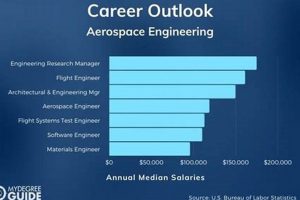
While salary varies depending on experience and specialization, a PhD generally leads to higher earning potential due to increased expertise and the ability to take on more complex and leadership-oriented roles, particularly in research-intensive positions.
Question 4: What types of research specializations are commonly pursued during a PhD in aerospace engineering?
Common specializations include aerodynamics, propulsion, materials science, structural analysis, control systems, and space mission design. The specific focus depends on individual interests and research opportunities available at the chosen institution.
Question 5: What is the typical duration of a PhD program in aerospace engineering?
The duration typically ranges from four to six years, depending on the institution, research progress, and any prior graduate-level coursework completed. This includes time spent on coursework, research, dissertation writing, and defense.
Question 6: What are some prominent aerospace companies and government agencies that hire PhD graduates in aerospace engineering?
Prominent employers include Boeing, Lockheed Martin, SpaceX, NASA, and the Air Force Research Laboratory (AFRL). These organizations seek PhD graduates for their advanced expertise in solving complex engineering problems.
This FAQ section aims to clarify potential pathways, emphasizing the blend of research expertise and problem-solving skills crucial for success in a diverse array of careers.
The following section will provide a concluding overview, summarizing key benefits and considerations when deciding to pursue a PhD in aerospace engineering.
Conclusion
The preceding exploration of “what can you do with a phd in aerospace engineering” demonstrates the diverse and impactful career paths available to graduates. This advanced degree equips individuals with the technical expertise, analytical skills, and research capabilities required to lead innovation across academia, industry, and government. From conducting cutting-edge research to shaping national policy, the skills acquired through doctoral study serve as a foundation for significant contributions to the field.
The decision to pursue a PhD in aerospace engineering represents a substantial investment in future capabilities and a commitment to advancing the boundaries of knowledge. While the path demands rigor and dedication, the potential for shaping the future of aerospace technology and contributing to societal progress remains a compelling incentive. Individuals considering this path should carefully evaluate their interests, aptitude, and career aspirations to ensure alignment with the demands and rewards of doctoral-level study.