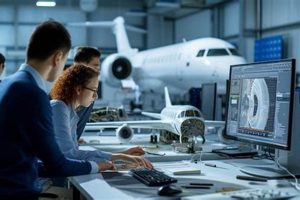
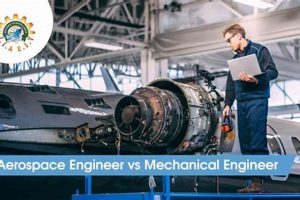
Individuals in this profession design, develop, test, and supervise the manufacturing of aircraft, spacecraft, satellites, and missiles. They work with diverse engineering principles, integrating aspects of aerodynamics, propulsion, materials science, and control systems to create functional and safe aerospace vehicles. For example, they might design a more fuel-efficient airplane wing or develop a satellite capable of accurately monitoring weather patterns.
Their expertise is crucial for advancing air travel, space exploration, and national defense. Developments within this field have historically led to significant societal benefits, including improved transportation, communication technologies, and a deeper understanding of the universe. The contributions of professionals in this discipline influence both civilian and military applications, driving innovation across multiple sectors.
Subsequent sections will delve into the specific responsibilities associated with this occupation, including typical project workflows, required skills and educational qualifications, and career progression opportunities. Furthermore, the impact of emerging technologies, such as artificial intelligence and advanced materials, on the future of this engineering field will be examined.
Guidance for Aspiring Professionals in Aerospace Engineering
The following guidelines provide valuable insights for individuals considering a career in aerospace engineering, emphasizing crucial aspects for professional development and success.
Tip 1: Establish a Strong Foundation in Mathematics and Physics: A comprehensive understanding of calculus, differential equations, linear algebra, and fundamental physics principles is indispensable. These disciplines form the bedrock of aerospace engineering principles.
Tip 2: Pursue Relevant Academic Coursework: Focus on specialized courses, including aerodynamics, propulsion, structural analysis, control systems, and orbital mechanics. A targeted curriculum enhances expertise in core aerospace domains.
Tip 3: Gain Practical Experience Through Internships: Actively seek internship opportunities at aerospace companies, research institutions, or government agencies. Real-world experience provides invaluable practical knowledge and industry connections.
Tip 4: Develop Proficiency in Computer-Aided Design (CAD) and Simulation Software: Master industry-standard software packages such as CATIA, SolidWorks, ANSYS, and MATLAB. These tools are essential for design, analysis, and simulation tasks.
Tip 5: Cultivate Strong Problem-Solving and Analytical Skills: Hone abilities to critically analyze complex engineering problems, develop innovative solutions, and effectively communicate findings through technical reports and presentations.
Tip 6: Embrace Continuous Learning and Professional Development: Stay abreast of advancements in aerospace technology, materials science, and regulatory standards. Attend conferences, workshops, and seminars to expand knowledge and network with industry experts.
Tip 7: Consider Advanced Degrees or Specialized Certifications: Pursuing a Master’s or Doctoral degree can enhance career prospects and enable specialization in a specific area of aerospace engineering. Certifications, such as those offered by professional organizations, can validate expertise.
Adherence to these recommendations will substantially increase the likelihood of success in the demanding yet rewarding field of aerospace engineering, fostering both technical proficiency and professional advancement.
The subsequent segment will examine the influence of emerging technologies on the future of aerospace engineering careers and the required adaptations to meet evolving industry demands.
1. Design and Development

Design and development constitute fundamental activities directly associated with these professionals. The capacity to innovate and transform conceptual ideas into tangible aerospace systems defines a crucial aspect of their professional identity and contribution to the field.
- Conceptualization and Requirements Definition
This initial phase involves translating mission objectives and operational requirements into specific design parameters. Professionals must define the overall architecture of the aerospace system, considering factors such as payload capacity, range, speed, and environmental conditions. For instance, in designing a new generation of commercial aircraft, conceptualization involves evaluating market demands, regulatory constraints, and technological feasibility to determine the optimal aircraft configuration.
- Detailed Design and Modeling
Following conceptualization, a detailed design phase ensues, encompassing the creation of precise engineering drawings, models, and simulations. This stage necessitates the application of specialized software tools for computer-aided design (CAD), finite element analysis (FEA), and computational fluid dynamics (CFD). For example, the design of a spacecraft’s thermal protection system requires meticulous modeling to ensure it can withstand extreme temperatures during atmospheric re-entry. Detailed designs are then tested through rigorous simulations before prototype construction.
- Prototyping and Testing
The fabrication of prototypes and subsequent testing is a vital step in validating the design’s performance and identifying potential flaws. Wind tunnel tests, structural load tests, and flight tests are conducted to evaluate the system’s behavior under realistic conditions. An example is the development of a new engine component where prototypes are subjected to extreme temperature and pressure conditions in test facilities to verify their durability and performance. The results of these tests provide valuable feedback for design refinement.
- Refinement and Optimization
Based on the results of testing and analysis, the design undergoes iterative refinement and optimization. Professionals employ engineering principles and computational tools to improve the system’s performance, efficiency, and reliability. For example, an aircraft wing design might be optimized through computational fluid dynamics simulations to reduce drag and improve lift. This iterative process continues until the design meets the required performance criteria and regulatory standards.
These facets underscore the central role of design and development in defining this specific engineering field. The iterative nature of design, from initial concept to optimized prototype, necessitates a deep understanding of engineering principles and a commitment to continuous improvement, thereby cementing the core identity of these professionals.
2. Aerospace Vehicle Expertise

Aerospace vehicle expertise is inextricably linked to the professional identity of individuals in this field. This expertise signifies a deep, comprehensive understanding of the design, construction, operation, and maintenance of diverse aerospace vehicles, ranging from commercial aircraft to satellites and spacecraft. Without this specialized knowledge, individuals cannot effectively function within the aerospace engineering domain. Expertise is not merely theoretical; it demands practical application and a nuanced grasp of the interplay between different engineering disciplines. For example, when designing a new jet engine, a professional relies upon a robust comprehension of thermodynamics, fluid mechanics, materials science, and control systems to ensure the engine’s optimal performance and safety.
The practical significance of this expertise is evident in every facet of aerospace engineering. Consider the development of a spacecraft mission to Mars. Professionals must apply their knowledge of orbital mechanics, propulsion systems, communications technologies, and life support systems to design a vehicle capable of withstanding the harsh conditions of space travel and delivering its payload safely. Furthermore, expertise extends to the continuous monitoring and maintenance of existing aerospace vehicles. Regular inspections, repairs, and upgrades are essential to ensuring the ongoing safety and reliability of these complex systems. An error in judgment or a lack of expertise in these areas can have catastrophic consequences.
In summary, aerospace vehicle expertise is not merely a desirable attribute but a foundational requirement for individuals in this profession. It underpins their ability to design, build, operate, and maintain the complex systems that define the aerospace industry. Challenges lie in the ever-evolving nature of aerospace technology, which demands continuous learning and adaptation. This expertise, when effectively applied, drives innovation, enhances safety, and ultimately enables humanity’s continued exploration and utilization of the aerospace domain.
3. Technical Problem Solvers

The designation “technical problem solvers” is fundamentally intertwined with the identity of aerospace engineers. This characteristic is not merely an ancillary skill but a core competency that defines their daily activities and overall contributions. Aerospace engineers are consistently confronted with multifaceted technical challenges that require analytical thinking, innovative solutions, and a deep understanding of scientific principles. These problems can range from optimizing the aerodynamic efficiency of an aircraft wing to developing a fault-tolerant control system for a spacecraft. The ability to effectively diagnose issues, formulate potential solutions, and rigorously test their validity is paramount to their success.
The importance of technical problem-solving skills in aerospace engineering is underscored by the complexity of the systems they design and maintain. For example, when faced with unexpected vibrations in a newly developed aircraft engine, engineers must employ advanced diagnostic techniques and computational modeling to identify the root cause of the problem. This may involve analyzing sensor data, conducting finite element simulations, and collaborating with experts in various disciplines to develop a solution that mitigates the vibrations without compromising engine performance or safety. The effectiveness of these solutions directly impacts the aircraft’s operational capabilities and the safety of its passengers.
In summary, the connection between being a “technical problem solver” and being an aerospace engineer is causal and definitional. The capacity to address complex technical challenges is not just a desirable trait but an essential requirement for success in this field. As aerospace technology continues to advance, the demand for skilled problem solvers will only intensify, further solidifying this integral connection. These challenges are not static; the constant push for greater efficiency, performance, and safety necessitates continuous innovation and adaptation in problem-solving approaches.
4. Mathematics, Science Proficient

A robust grounding in mathematics and science constitutes a non-negotiable prerequisite for individuals in aerospace engineering. These disciplines provide the foundational framework upon which all aspects of aerospace design, analysis, and problem-solving are built. Their proficiency directly impacts the engineer’s ability to conceptualize, develop, and implement innovative solutions within this demanding field.
- Mathematical Modeling and Simulation
Aerospace engineers rely extensively on mathematical models and simulations to predict the behavior of complex systems. This includes using differential equations to analyze fluid flow over aircraft wings, applying linear algebra to structural analysis, and employing statistical methods to assess the reliability of components. For instance, designing a satellite orbit requires precise calculations involving orbital mechanics, celestial mechanics, and perturbation theory to ensure the satellite maintains its desired position and functionality. Without a deep understanding of mathematical principles, the accuracy and validity of these models would be severely compromised.
- Physics-Based Design and Analysis
The principles of physics, including mechanics, thermodynamics, electromagnetism, and optics, are fundamental to aerospace engineering. Designing efficient propulsion systems requires a thorough understanding of thermodynamics and fluid mechanics. Developing robust communication systems necessitates a strong grasp of electromagnetism and signal processing. Furthermore, selecting appropriate materials for aerospace structures requires a knowledge of material science and the physical properties of different materials under extreme conditions. Understanding physics allows engineers to predict how systems will behave under stress and optimize their performance accordingly.
- Data Analysis and Interpretation
Aerospace engineers routinely deal with large quantities of data from experiments, simulations, and operational systems. Proficiency in statistical analysis and data interpretation is essential for identifying trends, validating models, and making informed decisions. For example, analyzing flight test data requires the ability to extract meaningful information from complex datasets, identify anomalies, and assess the performance of various aircraft systems. Similarly, assessing the reliability of satellite components involves analyzing failure data to identify potential weaknesses and implement preventative measures.
- Application of Scientific Principles to Innovation
Aerospace engineering is inherently an innovative field, constantly pushing the boundaries of what is possible. Engineers must be able to apply scientific principles to develop new technologies and improve existing systems. This requires a deep understanding of fundamental scientific concepts and the ability to think creatively and critically. For instance, developing new materials for hypersonic aircraft requires a thorough understanding of materials science, thermodynamics, and aerodynamics to create materials that can withstand extreme temperatures and pressures. Innovation relies on the ability to translate scientific knowledge into practical applications.
In conclusion, mathematical and scientific proficiency is not merely a desirable attribute but a core competency that defines the capabilities and contributions of aerospace engineers. It enables them to design, analyze, and improve complex aerospace systems, driving innovation and ensuring the safety and reliability of these critical technologies. Their proficiency is the foundation for advancement in the field, enabling the creation of efficient and innovative aerospace solutions.
5. System Integration Skills

System integration skills are critical to the identity and effectiveness of aerospace engineers. These skills denote the ability to harmonize disparate components into a unified, functional aerospace system. This competence transcends merely assembling parts; it encompasses a comprehensive understanding of how each element interacts with others and contributes to overall system performance. An aerospace engineer must possess the capacity to foresee potential conflicts between subsystems, to optimize performance across multiple domains, and to ensure that the integrated system meets specified requirements for safety, reliability, and efficiency. The absence of adept integration capabilities can lead to suboptimal performance, system failures, and compromised safety. These integration skills are essential during the design, development, testing, and operational phases of any aerospace project.
Consider the design of a modern commercial airliner. Numerous subsystems, including avionics, propulsion, hydraulics, environmental control, and electrical power, must operate seamlessly to ensure safe and efficient flight. Aerospace engineers are responsible for integrating these systems, ensuring that data flows correctly between them, that power demands are met, and that potential conflicts are resolved. For example, the integration of the flight control system with the autopilot requires precise coordination to prevent unintended maneuvers and maintain stability. Furthermore, integrating the passenger entertainment system without interfering with critical aircraft operations demands meticulous planning and execution. Each of these examples shows the pivotal role of system integration skills, requiring that the components should be working seamless to satisfy user. An effective integration guarantees operational reliability, safety, and passenger comfort, all of which are non-negotiable imperatives.
In summary, system integration skills constitute a defining characteristic of qualified aerospace engineers. These skills are essential for transforming individual components into functional, high-performing aerospace systems. As aerospace technology becomes increasingly complex, the demand for professionals with advanced integration expertise will continue to grow. The challenge for aerospace engineers lies in maintaining a holistic perspective, understanding the interconnectedness of various subsystems, and proactively addressing potential integration issues. Failure to do so can have dire consequences, underscoring the critical importance of these capabilities in this engineering domain.
6. Safety, Regulatory Compliance
Adherence to stringent safety standards and regulatory frameworks is not merely an operational consideration, but an intrinsic aspect of the aerospace engineering profession. Professionals in this field operate within a high-stakes environment where design choices and engineering practices directly impact human lives and the integrity of complex systems. The following facets delineate the critical role of safety and regulatory compliance in defining who aerospace engineers are.
- Design for Safety
Aerospace engineers must prioritize safety in all phases of design, from initial concept to final implementation. This involves incorporating redundant systems, fail-safe mechanisms, and rigorous testing protocols to mitigate potential hazards. For instance, the design of an aircraft’s flight control system incorporates multiple layers of redundancy to ensure continued functionality even in the event of component failures. Similarly, the structural design of spacecraft must account for extreme temperature variations and radiation exposure to ensure the safety of astronauts and the mission’s success. These safety considerations are not add-ons; they are integral to the design process.
- Regulatory Frameworks and Certification
Aerospace activities are governed by a complex web of regulations and standards promulgated by national and international agencies such as the Federal Aviation Administration (FAA) and the European Aviation Safety Agency (EASA). Aerospace engineers must possess a thorough understanding of these regulations and ensure that their designs and practices comply with all applicable requirements. For example, obtaining certification for a new aircraft requires demonstrating compliance with stringent safety standards related to structural integrity, engine performance, and avionics systems. Non-compliance can result in significant delays, financial penalties, and, in severe cases, the revocation of certification.
- Risk Assessment and Mitigation
A crucial aspect of aerospace engineering involves identifying potential risks and implementing measures to mitigate them. This includes conducting comprehensive hazard analyses, developing contingency plans, and implementing safety management systems. For example, the design of a launch vehicle involves evaluating the risks associated with each stage of flight, from liftoff to orbital insertion. Engineers must develop strategies to mitigate these risks, such as incorporating abort systems, designing for redundancy, and conducting extensive testing to identify and address potential failure modes.
- Continuous Improvement and Learning
The pursuit of safety and regulatory compliance is not a static process but a continuous endeavor. Aerospace engineers must stay abreast of the latest regulations, technological advancements, and lessons learned from past incidents. This involves participating in continuing education programs, attending industry conferences, and contributing to the development of new safety standards. For example, the investigation of an aircraft accident often leads to the identification of new safety recommendations and the development of improved design practices. This continuous learning and improvement cycle is essential for maintaining a high level of safety in the aerospace industry.
These facets underscore the fact that aerospace engineers are not solely technical experts; they are also stewards of safety and compliance. Their decisions have far-reaching consequences, and their commitment to upholding the highest standards of safety is paramount. The intersection of technical expertise, regulatory knowledge, and a proactive approach to risk management defines their professional identity and their contribution to society.
Frequently Asked Questions Regarding Aerospace Engineers
The following questions and answers aim to clarify common points of inquiry concerning the profession of aerospace engineering, providing factual and objective responses.
Question 1: What specific educational background is required to become an aerospace engineer?
A bachelor’s degree in aerospace engineering or a closely related field, such as mechanical engineering with an aerospace focus, is generally required. Advanced positions may necessitate a master’s or doctoral degree. Coursework should encompass aerodynamics, propulsion, structures, and control systems.
Question 2: What are the primary responsibilities typically associated with aerospace engineering roles?
Responsibilities include designing, developing, testing, and manufacturing aircraft, spacecraft, satellites, and related systems. Engineers may also be involved in research, project management, and regulatory compliance.
Question 3: Which industries typically employ aerospace engineers?
Aerospace engineers are primarily employed by aerospace manufacturers, government agencies (such as NASA and defense departments), research institutions, and consulting firms specializing in aerospace technologies.
Question 4: What are the key skills necessary for success in this profession?
Essential skills include a strong foundation in mathematics and physics, proficiency in computer-aided design (CAD) software, analytical problem-solving abilities, and effective communication skills for collaborating with multidisciplinary teams.
Question 5: What distinguishes aerospace engineering from other engineering disciplines?
Aerospace engineering focuses specifically on the design, development, and operation of vehicles and systems that function within the Earth’s atmosphere and in outer space, distinguishing it from other engineering fields that may focus on terrestrial applications.
Question 6: How does regulatory compliance impact the work of aerospace engineers?
Adherence to stringent safety regulations and industry standards is paramount. Aerospace engineers must ensure that all designs and processes comply with applicable regulations to guarantee the safety and reliability of aerospace systems.
In summary, the profession demands a strong educational foundation, specialized skills, and a commitment to safety and regulatory compliance. Individuals considering this career path should possess a genuine interest in aerospace technology and a dedication to continuous learning.
The concluding section will offer a brief overview of prominent figures who have significantly contributed to the advancement of aerospace engineering, highlighting their innovative work and lasting impact on the field.
The Essence of the Aerospace Engineering Profession
This exploration has illuminated the multifaceted nature of professionals in this critical domain. Individuals functioning as such are not merely designers or builders; they are integrators of complex systems, rigorous problem solvers, and unwavering proponents of safety and regulatory compliance. Their expertise spans a diverse array of disciplines, demanding a profound understanding of mathematics, physics, and engineering principles. The impact of their work resonates across various sectors, from commercial aviation and space exploration to national defense and scientific research.
The future of aerospace engineering hinges on the continued pursuit of innovation and the unwavering commitment to excellence exhibited by its practitioners. As technology continues to evolve, the demands placed upon these individuals will only intensify, requiring a dedication to lifelong learning and a steadfast focus on addressing the challenges that lie ahead. The advancement of aerospace technology depends on the continued contributions of these vital professionals, shaping the future of air and space travel.