Individuals in this profession design, develop, test, and supervise the manufacturing of aircraft, spacecraft, satellites, and missiles. These professionals might focus on areas such as aerodynamics, propulsion systems, structural design, or guidance and control systems. For example, an individual in this role might lead a team designing a new commercial airliner or develop a satellite communication system.
This occupation is vital for advancements in air travel, space exploration, and national defense. Historically, these specialists have played a critical role in innovations ranging from the first successful airplanes to lunar landings and the development of sophisticated defense systems. Their work contributes significantly to economic growth, scientific discovery, and global security.
The remaining discussion will delve into the educational requirements, essential skills, career paths, and future outlook for those pursuing a career in this dynamic and challenging field. Further, it will examine the impact of emerging technologies on the role and responsibilities of these specialists.
Guidance for Aspiring Professionals in Aerospace Engineering
The following outlines key considerations for individuals seeking a career path focused on the design, development, and testing of aircraft and spacecraft.
Tip 1: Emphasize a Strong Foundation in Mathematics and Physics: A thorough understanding of calculus, differential equations, linear algebra, and physics is paramount. These subjects form the basis for understanding aerodynamics, structural mechanics, and propulsion systems.
Tip 2: Pursue Relevant Engineering Coursework: Focus on coursework in areas such as fluid dynamics, thermodynamics, heat transfer, and control systems. These specialized courses provide the necessary knowledge base for aerospace engineering applications.
Tip 3: Gain Practical Experience Through Internships or Research: Participating in internships at aerospace companies or research opportunities at universities offers invaluable hands-on experience. These experiences allow for the application of theoretical knowledge to real-world problems.
Tip 4: Develop Proficiency in Computer-Aided Design (CAD) and Simulation Software: Familiarity with industry-standard software such as CATIA, ANSYS, or MATLAB is essential. These tools are used for design, analysis, and simulation of aerospace systems.
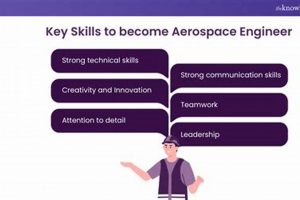
Tip 5: Cultivate Strong Problem-Solving and Analytical Skills: The ability to identify, analyze, and solve complex engineering problems is crucial. This involves developing logical reasoning, critical thinking, and attention to detail.
Tip 6: Enhance Communication and Teamwork Abilities: Aerospace projects often require collaboration with diverse teams. Effective communication, both written and verbal, is essential for conveying ideas, sharing information, and coordinating efforts.
The integration of these guidelines is intended to prepare individuals for the challenges and opportunities presented within the aerospace engineering sector. Proactive engagement with these principles should facilitate a successful and impactful career.
The subsequent section will provide a comprehensive outlook on potential career trajectories within this field.
1. Aircraft and Spacecraft Design

Aircraft and spacecraft design represents a core function directly associated with professionals in aerospace engineering. This design process encompasses a broad range of considerations, from initial conceptualization and feasibility studies to detailed engineering plans and final production specifications. The design phase dictates the operational capabilities, safety, and efficiency of the vehicle.
- Aerodynamic Performance
Aerodynamic performance is a critical facet of aircraft and spacecraft design, directly influencing lift, drag, and overall flight characteristics. Specialists analyze airflow patterns, employ computational fluid dynamics (CFD) simulations, and conduct wind tunnel testing to optimize the shape and surfaces of the vehicle. For example, wing designs are meticulously engineered to maximize lift at various speeds and altitudes, while minimizing drag to enhance fuel efficiency. These considerations directly impact the viability and performance envelope of the aircraft or spacecraft.
- Structural Integrity
Ensuring structural integrity is paramount in aircraft and spacecraft design, as these vehicles must withstand extreme stress, pressure, and temperature fluctuations during flight. Professionals conduct finite element analysis (FEA) to simulate load distribution and identify potential weak points. Material selection, including lightweight composites and high-strength alloys, is also crucial for maintaining structural integrity while minimizing weight. A failure in structural integrity could have catastrophic consequences, underscoring the significance of this facet.
- Propulsion System Integration
The integration of propulsion systems into aircraft and spacecraft design is fundamental to achieving desired thrust and range capabilities. Specialists must consider factors such as engine placement, fuel storage, and exhaust plume dynamics. Different propulsion systems, such as jet engines for aircraft or rocket engines for spacecraft, require tailored integration strategies to optimize performance and minimize interference with other vehicle systems. The effectiveness of the propulsion system directly impacts the vehicle’s operational capabilities and mission profile.
- Control Systems and Navigation
Aircraft and spacecraft design incorporates advanced control systems and navigation technologies to ensure precise and stable flight. Professionals integrate sensors, actuators, and sophisticated algorithms to provide real-time adjustments to flight surfaces and engine parameters. Navigation systems, such as GPS and inertial navigation units (INS), enable accurate positioning and guidance. The reliability and precision of these systems are critical for maintaining safe and efficient flight, particularly in challenging environments.
These individual facets of aircraft and spacecraft design collectively illustrate the complex skill set required by specialists in aerospace engineering. The ability to integrate these considerations effectively is central to producing safe, efficient, and technologically advanced vehicles for both atmospheric and space environments.
2. Propulsion System Development

Professionals in aerospace engineering are fundamentally involved in propulsion system development, as these systems represent the engine driving flight capabilities. The development encompasses the design, analysis, and testing of engines that power aircraft, spacecraft, and missiles. This specialization requires a deep understanding of thermodynamics, fluid mechanics, combustion, and materials science. A direct correlation exists between advancements in propulsion technology and the role of these professionals, who are responsible for innovating more efficient, powerful, and reliable propulsion systems.
The importance of propulsion system development stems from its direct impact on aircraft performance, range, and payload capacity. For instance, aerospace engineers played a crucial role in developing the high-bypass turbofan engines that power modern commercial airliners, significantly reducing fuel consumption and noise pollution. In space exploration, their expertise is essential for creating rocket engines that can deliver payloads to orbit or propel spacecraft to distant planets. The development of ion propulsion systems, used in spacecraft like NASA’s Dawn mission, exemplifies the application of advanced propulsion technologies for extended space travel. These examples highlight the practical significance of understanding the connection between the aerospace engineers expertise and propulsion system capabilities.
In summation, propulsion system development is an indispensable component of the profession. The work of these specialists in designing and refining propulsion technologies directly determines the advancement of air and space travel. Future challenges in this area include developing sustainable propulsion options, such as electric or hydrogen-powered systems, to address environmental concerns and enhance mission capabilities. Continued innovation in propulsion systems is key to unlocking new frontiers in aviation and space exploration.
3. Aerodynamics Expertise

Aerodynamics expertise constitutes a cornerstone of the knowledge base inherent in individuals practicing aerospace engineering. A profound understanding of how air interacts with moving objects is essential for designing efficient and safe aircraft, spacecraft, and related technologies. This expertise dictates critical performance characteristics, influencing everything from fuel efficiency to flight stability.
- Lift and Drag Optimization
Aerodynamics experts are tasked with maximizing lift and minimizing drag to enhance the performance of aerospace vehicles. This involves careful shaping of airfoils and fuselages, as well as employing advanced techniques like boundary layer control. For example, the design of winglets on commercial aircraft directly reduces induced drag, leading to fuel savings. These optimizations are crucial for improving the efficiency and range of aircraft.
- Stability and Control Analysis
Stability and control analysis is another critical area where expertise is applied. Specialists analyze how an aircraft or spacecraft responds to disturbances and ensure it can be controlled effectively. This involves modeling aerodynamic forces and moments, designing control surfaces, and developing feedback control systems. Proper stability and control are vital for ensuring safe operation across a range of flight conditions.
- Computational Fluid Dynamics (CFD) Applications
Computational Fluid Dynamics (CFD) is a powerful tool used extensively by specialists to simulate airflow around complex geometries. CFD allows engineers to visualize flow patterns, predict aerodynamic forces, and optimize designs before physical testing. This reduces development time and cost while improving performance. The application of CFD is indispensable for complex aerodynamic design challenges.
- Supersonic and Hypersonic Flow
The behavior of air changes significantly at supersonic and hypersonic speeds, requiring specialized knowledge. Specialists working in these regimes must understand phenomena like shock waves, thermal effects, and real gas behavior. This expertise is essential for designing high-speed aircraft, missiles, and spacecraft that can operate effectively in these demanding conditions. It is a key capability for aerospace engineers involved in advanced vehicle design.
These facets of aerodynamics expertise collectively demonstrate its central importance to those specializing in aerospace engineering. The ability to apply these principles is crucial for creating advanced aerospace vehicles that meet the ever-increasing demands of performance, efficiency, and safety. The continuous refinement of aerodynamic principles remains essential for further advancements in aviation and space exploration.
4. Structural Integrity Analysis

Structural integrity analysis is an indispensable aspect of the work conducted by specialists in aerospace engineering. It involves the application of engineering principles to evaluate the ability of an aircraft or spacecraft structure to withstand the loads and environmental conditions encountered during its operational life. The safety and reliability of these vehicles are directly contingent upon robust structural integrity.
- Finite Element Analysis (FEA) Application
Finite Element Analysis (FEA) is a primary tool employed to model and simulate the behavior of aerospace structures under various loading scenarios. Aerospace engineers use FEA software to predict stress distributions, deformations, and potential failure modes in complex geometries. For example, when designing an aircraft wing, FEA can be used to assess its response to aerodynamic forces, including lift, drag, and turbulence. The application of FEA aids in identifying areas of high stress concentration and optimizing the design to enhance structural performance.
- Material Selection and Testing
Aerospace engineers consider material properties, such as strength, stiffness, fatigue resistance, and corrosion resistance, when selecting materials for aerospace structures. They conduct rigorous testing to validate the performance of materials under simulated flight conditions. For example, composite materials are widely used in aircraft structures due to their high strength-to-weight ratio, but must undergo extensive testing to ensure they maintain their properties over time and under extreme temperatures. The role in materials selection and testing is key to ensuring structural longevity.
- Damage Tolerance Assessment
Damage tolerance assessment involves evaluating the ability of a structure to withstand the presence of cracks or other defects without catastrophic failure. Aerospace engineers use fracture mechanics principles to predict crack growth rates and establish inspection intervals. For example, aircraft structures are periodically inspected for cracks, and repairs are performed when necessary to prevent crack propagation. Damage tolerance ensures that aircraft can continue to operate safely even with the presence of minor damage.
- Load Analysis and Design Criteria
Aerospace engineers conduct load analysis to determine the maximum loads that an aircraft or spacecraft structure is likely to encounter during its lifetime. These loads include aerodynamic forces, inertial forces, and thermal stresses. Based on the load analysis, design criteria are established to ensure that the structure can withstand these loads with an adequate margin of safety. For example, an aircraft wing must be designed to withstand the maximum aerodynamic loads experienced during maneuvers and turbulence, ensuring it maintains structural integrity under all operational conditions.
These facets of structural integrity analysis emphasize the significance of this skill set in the aerospace engineering profession. The effective application of these principles ensures the safety, reliability, and longevity of aircraft and spacecraft, highlighting the importance of structural considerations in aerospace vehicle design and operation.
5. Flight Control Systems

Flight control systems are integral to the operational capabilities and safety of aircraft and spacecraft. The design, development, and implementation of these systems represent a key area of expertise for those in aerospace engineering. The functionality of these systems dictates the ability of a vehicle to maintain stable flight, execute maneuvers, and respond effectively to external disturbances.
- Control Surface Design and Implementation
Control surface design encompasses the selection and configuration of ailerons, elevators, rudders, and flaps on aircraft, as well as reaction control systems on spacecraft. Aerospace engineers analyze aerodynamic and propulsive forces to determine the optimal size, shape, and placement of these surfaces. For example, the design of ailerons on a commercial airliner involves considerations of roll rate, control authority, and induced drag. Implementation involves integrating actuators, sensors, and control algorithms to provide precise and responsive control. The effectiveness of these control surfaces directly impacts the maneuverability and stability of the vehicle.
- Autopilot and Stability Augmentation Systems
Autopilot systems automate the control of aircraft along pre-defined trajectories, reducing pilot workload and improving fuel efficiency. Stability augmentation systems enhance the inherent stability of an aircraft, compensating for aerodynamic instabilities or external disturbances. Aerospace engineers develop control algorithms that integrate sensor data, such as airspeed, altitude, and attitude, to generate control commands. The design of an autopilot for long-haul flights, for instance, involves complex control laws to maintain course and altitude, while minimizing fuel consumption. Such systems are crucial for modern aviation.
- Fly-by-Wire Technology
Fly-by-wire (FBW) technology replaces traditional mechanical linkages with electronic signals to transmit pilot commands to control surfaces. FBW systems enable more sophisticated control laws and allow for greater aerodynamic efficiency through relaxed stability designs. Aerospace engineers develop the control algorithms and electronic hardware that form the core of FBW systems. For example, the Airbus A320 pioneered FBW technology in commercial aviation, allowing for improved flight control and safety. The reliability and redundancy of FBW systems are paramount for ensuring continued operation in the event of component failures.
- Guidance, Navigation, and Control Integration
Aerospace engineers integrate guidance, navigation, and control (GNC) systems to enable autonomous flight and precise trajectory control. GNC systems incorporate sensors, such as GPS, inertial measurement units (IMUs), and star trackers, to determine the vehicle’s position, velocity, and orientation. Control algorithms use this information to generate control commands that guide the vehicle along a desired path. Integration of GNC systems is essential for spacecraft missions, such as satellite deployments or interplanetary travel, requiring high accuracy and reliability.
These facets highlight the critical role of flight control systems in aerospace engineering. The design, development, and integration of these systems require expertise in aerodynamics, control theory, and electronics. As aerospace vehicles become more complex and autonomous, the importance of these specialized systems will continue to grow, demanding ongoing innovation and refinement from professionals in the field.
6. Satellite Technology Integration
The integration of satellite technology is intrinsically linked to the role performed by professionals specializing in aerospace engineering. This integration spans the entire lifecycle of a satellite, from initial design and development to launch, operation, and eventual decommissioning. Aerospace engineers possess the requisite knowledge and skills to effectively manage and execute each of these phases. The increasing reliance on satellite-based services for communication, navigation, and Earth observation underscores the significance of expertise in this domain.
A critical aspect of this integration involves the design and optimization of satellite subsystems, including power, propulsion, communication, and attitude control. For example, aerospace engineers design solar arrays to efficiently capture solar energy, develop thruster systems for orbital maneuvers, and implement communication payloads for data transmission. The integration of these subsystems requires a thorough understanding of space environment effects, orbital mechanics, and systems engineering principles. Furthermore, these professionals are often responsible for testing and validating satellite performance through simulations and on-orbit experiments. The development of satellite constellations for global internet access illustrates the practical application of these skills.
The effective integration of satellite technology necessitates a multidisciplinary approach, requiring collaboration among engineers specializing in areas such as structural analysis, thermal management, and software development. Addressing challenges associated with space debris mitigation and ensuring the long-term sustainability of satellite operations are also key concerns. In summary, the role of aerospace engineers in satellite technology integration is central to advancing capabilities in space-based services and promoting continued innovation in this vital sector.
7. Testing and Evaluation

Testing and evaluation are fundamentally linked to the role of professionals in aerospace engineering, serving as essential processes for validating designs, ensuring safety, and verifying performance criteria are met. The comprehensive application of these processes is integral to the successful development and deployment of aircraft, spacecraft, and related systems. Without rigorous testing and evaluation, the reliability and effectiveness of these technologies would be significantly compromised.
- Wind Tunnel Testing
Wind tunnel testing is a critical component used to assess the aerodynamic characteristics of aircraft and spacecraft designs. Aerospace engineers utilize wind tunnels to simulate flight conditions, measuring forces, pressures, and flow patterns around scale models. For example, wind tunnel tests are conducted to evaluate the lift and drag characteristics of a new wing design, providing data used to refine aerodynamic profiles and improve performance. These tests also help identify potential stability and control issues before full-scale prototypes are constructed, minimizing risks and optimizing design parameters.
- Flight Testing
Flight testing involves the evaluation of aircraft performance and handling qualities under real-world conditions. Aerospace engineers conduct flight tests to assess stability, control response, engine performance, and system reliability. For example, flight tests are conducted to verify that an aircraft meets required climb rates, stall speeds, and maneuverability specifications. Data collected during flight tests is used to refine control laws, validate aerodynamic models, and ensure that the aircraft operates safely within its intended flight envelope. This real-world validation is indispensable for certifying aircraft for commercial or military use.
- Structural Testing
Structural testing evaluates the ability of an aircraft or spacecraft structure to withstand the loads and stresses encountered during flight. Aerospace engineers conduct static and dynamic tests to measure structural deflections, strains, and failure modes. For example, structural tests are performed to verify that an aircraft wing can withstand the maximum aerodynamic loads experienced during turbulence or maneuvers. These tests may involve applying simulated loads using hydraulic actuators and measuring the resulting stress distributions using strain gauges. The results from structural tests are used to validate finite element models and ensure that the structure meets safety requirements.
- Environmental Testing
Environmental testing assesses the performance of aerospace systems under extreme temperature, pressure, vibration, and radiation conditions. Aerospace engineers conduct environmental tests to verify that components and systems can operate reliably in harsh environments, such as the vacuum of space or the high altitudes of the atmosphere. For example, spacecraft components are subjected to thermal vacuum tests to simulate the temperature extremes and vacuum conditions of space, ensuring that they do not malfunction or degrade. This rigorous testing is essential for ensuring the long-term reliability of aerospace systems in demanding operating environments.
These facets underscore the critical role of testing and evaluation in the aerospace engineering field. The data obtained from these processes informs design decisions, validates performance models, and ultimately ensures the safety and reliability of aerospace vehicles. Professionals involved in testing and evaluation are instrumental in advancing the state-of-the-art in aviation and space exploration.
Frequently Asked Questions
The following addresses common inquiries regarding the role and responsibilities of specialists in aerospace engineering.
Question 1: What distinguishes aerospace engineering from other engineering disciplines?
Aerospace engineering focuses specifically on the design, development, testing, and production of aircraft and spacecraft. While it shares fundamental principles with other engineering fields, its application is tailored to the unique challenges and requirements of atmospheric and space flight.
Question 2: What educational qualifications are typically required to become an aerospace engineer?
A bachelor’s degree in aerospace engineering or a closely related field is generally the minimum requirement. Advanced positions often necessitate a master’s degree or a doctorate, particularly for research and development roles.
Question 3: What are the key skills essential for success in aerospace engineering?
Essential skills include a strong foundation in mathematics and physics, proficiency in computer-aided design (CAD) and simulation software, analytical and problem-solving abilities, and effective communication and teamwork skills.
Question 4: What are some common career paths available to aerospace engineers?
Common career paths include roles in aircraft design, spacecraft development, propulsion systems, aerodynamics, structural analysis, flight control systems, and satellite technology, within both government agencies and private sector companies.
Question 5: How does environmental responsibility factor into the work of these specialists?
These professionals are increasingly focused on developing sustainable aerospace technologies, including fuel-efficient aircraft designs, alternative propulsion systems, and strategies for mitigating space debris to minimize environmental impact.
Question 6: What is the outlook for aerospace engineering as a career?
The outlook remains positive, driven by continued demand for air travel, space exploration, and defense technologies. Emerging areas such as unmanned aerial vehicles (UAVs) and commercial spaceflight are creating new opportunities for aerospace engineers.
In summary, a career in this field demands a combination of technical expertise, problem-solving skills, and a commitment to innovation and safety. Individuals entering this profession can expect a challenging and rewarding career path.
The subsequent section will delve into the future trends shaping the profession of the specialists in aerospace engineering.
Conclusion
The preceding discussion clarifies the multifaceted role. The individual in this profession is central to the design, development, and testing of aircraft, spacecraft, and associated technologies. Expertise in aerodynamics, propulsion, structural integrity, and flight control systems defines the essential competencies. Contributions from these specialists are pivotal to advancements in aviation, space exploration, and national defense.
Continued progress in these sectors relies on the dedication and innovation of specialists in aerospace engineering. Future challenges, including sustainable propulsion and space debris mitigation, demand rigorous application of expertise and a commitment to pushing technological boundaries. The pursuit of these advancements remains critical for the continued evolution of air and space travel.