A baccalaureate degree focusing on the design, development, and testing of aircraft and spacecraft provides a fundamental understanding of aerodynamics, propulsion, materials science, and structural analysis. This academic path equips individuals with the technical skills necessary to contribute to the aerospace industry. For instance, graduates may be involved in designing more fuel-efficient aircraft wings or developing advanced satellite communication systems.
The attainment of this specialized education is crucial for addressing the evolving challenges within the aerospace sector. It fosters innovation, enabling engineers to create safer, more efficient, and environmentally conscious air and space vehicles. Historically, the development of aerospace technology has been intrinsically linked to advancements in related fields, and a strong educational foundation ensures continued progress. A solid background in these principles opens doors to careers that are at the forefront of technological advancement.
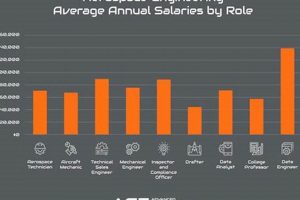
The subsequent sections will delve into the specific curriculum components, career prospects, and potential areas of specialization that this degree path encompasses, providing a detailed exploration of the opportunities available to those pursuing this field of study. Further discussion will highlight some of the career prospects that await graduates, including job opportunities and expected salary ranges.
Prospective and current students pursuing a course of study centered on aircraft and spacecraft design should consider the following guidance to maximize their academic and professional opportunities.
Tip 1: Cultivate a Strong Foundation in Mathematics and Physics. A mastery of calculus, differential equations, linear algebra, and fundamental physics principles is paramount. These disciplines form the bedrock upon which more advanced aerospace engineering concepts are built.
Tip 2: Seek Out Research Opportunities. Active participation in research projects, either within the university or at external organizations, provides invaluable hands-on experience and exposure to cutting-edge technologies. This can lead to publications and conference presentations, enhancing one’s resume.
Tip 3: Develop Proficiency in CAD and Simulation Software. Familiarity with industry-standard software packages such as SolidWorks, CATIA, ANSYS, and MATLAB is essential. These tools are used extensively in design, analysis, and simulation tasks.
Tip 4: Join Relevant Professional Organizations. Membership in organizations such as the American Institute of Aeronautics and Astronautics (AIAA) provides networking opportunities, access to technical resources, and professional development programs.
Tip 5: Pursue Internships in the Aerospace Industry. Internships offer practical experience and insights into the day-to-day operations of aerospace companies. They also provide a valuable opportunity to apply theoretical knowledge to real-world problems.
Tip 6: Focus on a Specialization. While a general foundation is crucial, specializing in a particular area, such as aerodynamics, propulsion, or structures, can increase one’s expertise and make them more competitive in the job market.
Tip 7: Enhance Communication Skills. Aerospace engineers must effectively communicate technical information to colleagues, clients, and stakeholders. Developing strong written and oral communication skills is, therefore, essential.
Adherence to these recommendations will significantly improve academic performance, career prospects, and overall success in the demanding yet rewarding field of aerospace engineering.
The subsequent sections will further explore the diverse career paths and ongoing advancements within this vital engineering discipline.
1. Aerodynamics
Aerodynamics, the study of air in motion, is a cornerstone discipline within the framework of an aerospace engineering baccalaureate. Its principles govern the performance and stability of aircraft and spacecraft, influencing design decisions from initial concept to final production. Understanding aerodynamic forces and phenomena is paramount for engineers seeking to optimize vehicle efficiency and ensure safe operation within the Earth’s atmosphere and beyond.
- Lift Generation and Airfoil Design
Lift, the force that opposes gravity, is fundamentally dependent on the shape of the airfoil, the cross-sectional profile of a wing. The curriculum within an aerospace engineering program provides a rigorous study of airfoil theory, boundary layer behavior, and computational fluid dynamics (CFD) techniques used to predict lift characteristics. Practical applications range from designing high-lift devices for enhanced takeoff and landing performance to optimizing airfoil shapes for supersonic flight.
- Drag Reduction and Boundary Layer Control
Drag, the resistance encountered by an object moving through air, directly impacts fuel efficiency and maximum speed. Aerospace engineering coursework focuses on understanding various forms of drag (pressure drag, friction drag, induced drag) and implementing strategies for their minimization. Boundary layer control techniques, such as suction or blowing, are studied to reduce friction drag and improve aerodynamic performance. Knowledge of these methods is critical for designing aircraft with reduced fuel consumption and improved range.
- Stability and Control Derivatives
An aircraft’s stability and controllability are directly related to its aerodynamic characteristics. Aerospace engineering students learn to calculate stability derivatives, which quantify the aircraft’s response to disturbances in pitch, roll, and yaw. Understanding these derivatives enables the design of control systems that ensure stable flight and allow pilots to maneuver the aircraft safely and effectively. For example, proper aerodynamic design combined with effective control surfaces ensures a stable and controllable aircraft even in turbulent conditions.
- Supersonic and Hypersonic Aerodynamics
The behavior of air at supersonic and hypersonic speeds differs significantly from that at subsonic speeds. Aerospace engineering curricula include studies of shock waves, expansion fans, and other phenomena associated with high-speed flight. This knowledge is essential for designing aircraft and spacecraft capable of operating at speeds exceeding the speed of sound. Applications include the development of high-speed commercial aircraft, re-entry vehicles, and hypersonic missiles.
These facets of aerodynamics, among others, form a crucial foundation for aerospace engineers. The knowledge gained enables the design, analysis, and optimization of aircraft and spacecraft, ensuring their safe, efficient, and effective operation. Advancements in aerodynamic understanding directly translate to improvements in aircraft performance, fuel economy, and overall mission capabilities. Therefore, a strong understanding of Aerodynamics is essential to the graduates of aerospace engineering.
2. Propulsion Systems
Propulsion systems are integral to the function and design of both aircraft and spacecraft. A thorough understanding of these systems is a critical component of the academic curriculum for aerospace engineering undergraduates. The principles governing thrust generation, fuel efficiency, and engine performance are essential for designing effective and reliable aerospace vehicles.
- Fundamentals of Rocket Propulsion
Rocket propulsion involves the creation of thrust through the expulsion of mass, typically in the form of hot gases. A key principle in rocket propulsion is Newton’s Third Law: for every action, there is an equal and opposite reaction. This principle manifests as high-speed gas expelled from the engine nozzle, producing thrust. Students pursuing a baccalaureate aerospace engineering degree examine various rocket engine types, including solid-propellant, liquid-propellant, and hybrid rockets. Analysis of rocket performance parameters, such as specific impulse and thrust-to-weight ratio, is also central to the curriculum. Understanding these fundamentals allows engineers to design efficient and powerful rocket engines used in space launch vehicles and ballistic missiles.
- Jet Engine Thermodynamics and Design
Jet engines, commonly used in aircraft, rely on thermodynamic cycles to convert fuel energy into kinetic energy. These cycles, such as the Brayton cycle, involve compressing air, adding heat through combustion, and expanding the hot gas through a turbine. Aerospace engineering students study the design and performance characteristics of various jet engine types, including turbojets, turbofans, and turboprops. Emphasis is placed on optimizing engine components, such as compressors, combustors, and turbines, to maximize thrust and fuel efficiency. The knowledge from this provides engineers with the skills to enhance aircraft efficiency.
- Advanced Propulsion Concepts
Beyond conventional rocket and jet engines, aerospace engineering programs often introduce advanced propulsion concepts that offer the potential for enhanced performance or novel applications. These concepts may include ion propulsion, which uses electric fields to accelerate charged particles, and nuclear propulsion, which harnesses the energy of nuclear reactions. Although not as widely used as conventional systems, these advanced concepts represent the future of space travel and exploration. Aerospace engineers who understand these technologies are positioned to lead the development of innovative propulsion systems for future missions.
- Combustion and Fuels
Combustion processes are central to both rocket and jet propulsion. The efficient and stable combustion of fuel is critical for maximizing thrust and minimizing emissions. Aerospace engineering students study the chemistry and physics of combustion, including topics such as flame propagation, ignition, and emissions control. They also investigate the properties of various fuels, including kerosene, hydrogen, and methane, and their suitability for different propulsion applications. A solid background in combustion and fuels is essential for developing cleaner and more efficient engines that reduce the environmental impact of air and space travel.
In conclusion, the study of propulsion systems is a core component of education focusing on aircraft and spacecraft design, equipping engineers with the skills to design, analyze, and optimize propulsion systems for a wide range of applications. The ability to design reliable and effective propulsion systems is crucial for advancing aerospace technology and enabling future exploration of space.
3. Materials Science

Materials science constitutes a critical domain within the academic framework of aircraft and spacecraft engineering. The selection and application of appropriate materials are fundamental to ensuring structural integrity, performance efficiency, and overall safety in aerospace vehicles. An understanding of material properties, processing techniques, and failure mechanisms is, therefore, essential for aerospace engineers.
- Lightweight Alloys and Composites
The aerospace industry demands materials with high strength-to-weight ratios to minimize fuel consumption and maximize payload capacity. Aluminum alloys, titanium alloys, and fiber-reinforced composites (such as carbon fiber epoxy) are commonly employed. These materials offer significant weight savings compared to traditional steel, but their application requires careful consideration of factors such as corrosion resistance, fatigue strength, and cost. For example, the Boeing 787 Dreamliner utilizes a significant amount of composite materials in its fuselage and wings, leading to improved fuel efficiency and reduced maintenance costs. A foundation in materials science enables engineers to select and utilize these advanced materials effectively.
- High-Temperature Materials
Components in jet engines and spacecraft experience extremely high temperatures. Nickel-based superalloys and ceramic matrix composites (CMCs) are often used in these applications due to their ability to retain strength and resist oxidation at elevated temperatures. For instance, turbine blades in jet engines, which operate in environments exceeding the melting point of many metals, rely on advanced cooling techniques and high-temperature materials to maintain their structural integrity. Understanding the behavior of materials at extreme temperatures is crucial for designing reliable and efficient aerospace propulsion systems.
- Corrosion and Environmental Degradation
Aerospace vehicles are exposed to harsh environmental conditions, including salt spray, humidity, and ultraviolet radiation, which can lead to corrosion and degradation of materials. Protective coatings, such as paints and anodized layers, are often applied to prevent corrosion. Regular inspection and maintenance are also essential to identify and address any signs of material degradation. For example, the aging of aircraft structures due to corrosion can lead to structural failures if not properly managed. A knowledge of materials science enables engineers to select appropriate corrosion-resistant materials and implement effective maintenance strategies.
- Material Processing and Manufacturing
The manufacturing processes used to fabricate aerospace components can significantly affect their properties and performance. Techniques such as casting, forging, welding, and additive manufacturing are employed to create complex shapes and achieve desired material characteristics. For example, additive manufacturing (3D printing) allows for the creation of lightweight and intricate designs that would be impossible to produce using traditional methods. Aerospace engineers must understand the principles of material processing to ensure that components meet stringent quality and performance requirements.
In summary, a thorough grounding in materials science is indispensable for aerospace engineers. From selecting lightweight composites to designing high-temperature components and mitigating corrosion, the knowledge of material properties and processing techniques is fundamental to creating safe, efficient, and reliable aerospace vehicles. The continued development of novel materials and manufacturing processes is driving innovation in the aerospace industry, enabling the design of aircraft and spacecraft with enhanced capabilities and reduced environmental impact.
4. Structural Analysis

Structural analysis forms a critical and inseparable component of a baccalaureate engineering program focused on aircraft and spacecraft. The principles of structural analysis provide the methodologies for predicting the behavior of aerospace structures under various loading conditions. These analyses are essential for ensuring the safety, reliability, and longevity of aircraft and spacecraft. A deficiency in structural integrity can have catastrophic consequences; therefore, expertise in this area is paramount. The design of wings, fuselages, and other structural elements necessitates a robust understanding of stress, strain, and material properties. For example, finite element analysis (FEA) software, which is a standard tool in the aerospace industry, allows engineers to simulate the behavior of complex structures under load, identify potential weak points, and optimize designs for maximum strength and minimum weight. The application of structural analysis is evident in every stage of aircraft development, from initial design iterations to final certification testing.
The practical applications of structural analysis extend beyond the initial design phase. During the operational life of an aircraft, structural health monitoring (SHM) systems utilize sensors and analytical techniques to detect damage or degradation in real time. This allows for proactive maintenance and prevents potentially catastrophic failures. For example, SHM systems can detect cracks in aircraft skins caused by fatigue loading, enabling timely repairs before the cracks propagate to a critical size. Furthermore, structural analysis plays a vital role in accident investigations. By reconstructing the forces and stresses acting on an aircraft during a crash, investigators can determine the cause of the failure and recommend design changes to prevent similar incidents in the future. This iterative process of design, analysis, testing, and refinement is central to the advancement of aerospace engineering.
In conclusion, structural analysis is not merely a subject within aerospace engineering, it is a fundamental pillar upon which the entire discipline rests. The ability to accurately predict structural behavior under load is essential for ensuring the safety and performance of aircraft and spacecraft. While the complexity of aerospace structures presents ongoing challenges, advancements in computational methods, sensor technologies, and material science continue to enhance the accuracy and effectiveness of structural analysis techniques. This continuous improvement is crucial for pushing the boundaries of aerospace technology and enabling the design of more efficient, reliable, and safer vehicles for both atmospheric and space environments.
5. Flight Mechanics

Flight mechanics, a core discipline in aerospace engineering curricula, provides the theoretical foundation for understanding and predicting the motion of aircraft and spacecraft. Its inclusion within a baccalaureate program provides students with essential knowledge of aerodynamics, propulsion, and control systems. This knowledge is applied to analyze vehicle stability, maneuverability, and trajectory. The absence of a strong grounding in flight mechanics would significantly impair an engineer’s ability to design and optimize flight vehicles, as it directly impacts performance and safety.
Consider, for example, the design of an autopilot system. An engineer must apply principles of flight mechanics to model the aircraft’s response to control inputs, predict its trajectory under varying atmospheric conditions, and design feedback loops that ensure stable and accurate flight. Similarly, the development of flight simulators relies heavily on accurate models of aircraft dynamics, which are derived from flight mechanics principles. These simulations are vital for training pilots and testing new aircraft designs before physical prototypes are built. Flight mechanics is also crucial in analyzing aircraft accidents. By reconstructing the flight path and aerodynamic forces acting on the aircraft, investigators can determine the cause of the accident and identify potential design flaws or operational errors. Understanding the behavior of stall, spin, and flutter directly falls under flight mechanics knowledge.
In conclusion, flight mechanics serves as a critical bridge between theoretical knowledge and practical applications in aerospace engineering. Graduates possessing a comprehensive understanding of flight mechanics are well-equipped to contribute to the design, analysis, and operation of advanced aerospace vehicles. The future of aerospace innovation depends on engineers who can effectively apply the principles of flight mechanics to solve complex challenges and push the boundaries of flight.
6. Control Systems
Control systems are an indispensable element within the aerospace engineering curriculum. Their design and implementation dictate the stability, maneuverability, and overall performance of aircraft and spacecraft. A comprehensive understanding of control theory, sensor technology, and actuator design is, therefore, a fundamental requirement for graduates entering the field.
- Automatic Flight Control Systems (AFCS)
AFCS, often referred to as autopilot, relieve pilot workload and enhance flight precision. These systems utilize sensors to monitor aircraft attitude, altitude, and velocity, automatically adjusting control surfaces to maintain a desired flight path. For instance, modern commercial aircraft rely heavily on AFCS for long-duration flights, enabling precise navigation and fuel-efficient cruise. Within aerospace engineering programs, the design and analysis of AFCS form a significant component of coursework, emphasizing stability analysis, feedback loop design, and robustness to disturbances.
- Guidance, Navigation, and Control (GNC) for Spacecraft
Spacecraft GNC systems enable precise orbital maneuvers, attitude control, and targeted landing on celestial bodies. These systems incorporate inertial measurement units (IMUs), star trackers, and reaction wheels to determine spacecraft position and orientation. Algorithms are then implemented to calculate and execute the necessary control actions. Missions to Mars, for example, require sophisticated GNC systems to ensure accurate trajectory correction and safe entry, descent, and landing. Students in aerospace engineering programs delve into advanced control techniques, such as Kalman filtering and optimal control, to design high-performance GNC systems.
- Fly-by-Wire Systems
Fly-by-wire (FBW) systems replace traditional mechanical linkages between pilot controls and aircraft control surfaces with electronic interfaces. This allows for enhanced flight control capabilities, such as gust load alleviation and envelope protection. The Airbus A320, for example, was one of the first commercial aircraft to utilize FBW technology extensively. Aerospace engineering curricula provide students with the knowledge to design and analyze FBW systems, emphasizing the importance of redundancy, fault tolerance, and safety-critical software development.
- Control Systems for Unmanned Aerial Vehicles (UAVs)
UAVs, or drones, rely heavily on control systems for autonomous navigation, obstacle avoidance, and payload management. These systems typically incorporate GPS, accelerometers, and cameras to perceive the environment and make control decisions. Applications range from aerial photography to package delivery and military surveillance. Aerospace engineering students study control algorithms specific to UAVs, such as PID control, model predictive control, and vision-based control, enabling them to design and implement robust and reliable autonomous flight systems.
The multifaceted applications of control systems in aerospace engineering underscore their critical role in the design and operation of modern aircraft and spacecraft. From stabilizing commercial airliners to guiding spacecraft across interplanetary distances, these systems are essential for ensuring safety, efficiency, and mission success. A solid foundation in control theory and its practical implementation is, therefore, an indispensable asset for aerospace engineers.
Frequently Asked Questions
This section addresses common inquiries and misconceptions surrounding undergraduate studies focused on the design and development of air and space vehicles. The information is intended to provide clarity and guidance to prospective students.
Question 1: What fundamental skills are crucial for success in a curriculum focused on aircraft and spacecraft design?
A strong foundation in mathematics (calculus, differential equations, linear algebra) and physics (classical mechanics, thermodynamics, electromagnetism) is essential. Proficiency in computer programming and problem-solving is also highly beneficial.
Question 2: What career paths are typically available to graduates with such a degree?
Graduates may pursue careers in aircraft design, spacecraft development, propulsion systems, avionics, research and development, and project management within the aerospace industry. Opportunities also exist in government agencies, such as NASA and national defense organizations.
Question 3: How does this undergraduate education differ from other engineering disciplines?
This course of study provides specialized knowledge in aerodynamics, propulsion, aerospace materials, and orbital mechanics, which are not typically covered in detail in other engineering programs. The curriculum is tailored to the specific challenges and requirements of the aerospace sector.
Question 4: Is advanced study (Master’s or Doctoral degree) typically required for career advancement?
While an undergraduate degree provides entry-level opportunities, advanced degrees often lead to more specialized roles, leadership positions, and involvement in research and development. The necessity of advanced study depends on individual career goals and aspirations.
Question 5: What are the typical salary expectations for entry-level positions after earning this degree?
Salary expectations vary based on factors such as location, employer, and specific job role. However, entry-level salaries are generally competitive with other engineering disciplines, reflecting the specialized skills and knowledge required.
Question 6: What is the workload like in such a degree program, and what strategies exist to manage the challenges?
The workload is demanding, requiring significant time commitment for coursework, projects, and research. Effective time management, strong study habits, and utilization of university resources (tutoring, advising) are crucial for success. Collaboration with peers and seeking guidance from professors are also valuable strategies.
These FAQs offer a succinct overview of key considerations related to undertaking the study of aircraft and spacecraft. It is suggested to conduct further research and seek counsel from academics and professionals in the field for specific direction.
Subsequent sections will address advanced topics in aerospace engineering.
Conclusion
This exploration of the curriculum has illuminated the rigorous academic journey inherent in acquiring proficiency. From foundational principles in aerodynamics and propulsion to specialized knowledge in materials science, structural analysis, flight mechanics, and control systems, the multifaceted education equips individuals with the technical expertise necessary to address the complex challenges of the aerospace industry. This degree serves as a vital gateway to contributing to the design, development, and advancement of air and space vehicles.
The continued pursuit of excellence within the field depends on the commitment of future engineers to mastering these core competencies. As aerospace technology continues to evolve, a solid foundation in fundamental principles will be crucial for driving innovation and ensuring the safety and sustainability of future air and space transportation systems. The responsibility rests with each graduate to uphold the standards of the profession and contribute to the ongoing advancement of aerospace knowledge.