Individuals in this profession apply scientific and technological principles to the design, development, testing, and production of aircraft, spacecraft, satellites, and missiles. For example, one might be involved in calculating aerodynamic forces on a new wing design or analyzing the performance of a rocket engine.
These professionals are vital to advancements in air travel, space exploration, and national defense. Their work leads to safer, more efficient aircraft, innovative satellite technologies, and a deeper understanding of the universe. Historically, their contributions have been pivotal in shaping both military and civilian aviation, and continue to drive innovation in related industries.
The following sections will delve deeper into the specific tasks, responsibilities, skill sets, and educational pathways relevant to this demanding and rewarding career path. We will also examine the current trends and future outlook for those engaged in this critical field.
Essential Guidance for Aspiring Professionals
The following recommendations are intended to provide insights into excelling within this challenging and dynamic field. Careful consideration and application of these principles can significantly enhance one’s career trajectory.
Tip 1: Cultivate a Strong Foundation in Mathematics and Physics: Success hinges upon a robust understanding of calculus, differential equations, linear algebra, and classical mechanics. A thorough grasp of these subjects enables the accurate modeling and analysis of complex engineering problems. For example, proficiency in computational fluid dynamics relies heavily on a solid mathematical background.
Tip 2: Develop Proficiency in Relevant Software: Familiarity with industry-standard software packages such as CATIA, ANSYS, MATLAB, and Simulink is essential. These tools are used for design, simulation, and analysis. Exposure to these platforms provides a competitive advantage.
Tip 3: Seek Out Internships and Co-op Opportunities: Practical experience gained through internships and cooperative education programs is invaluable. Such opportunities provide exposure to real-world engineering challenges and allow for the application of theoretical knowledge in a practical setting. Working on a satellite propulsion system, for example, offers hands-on experience.
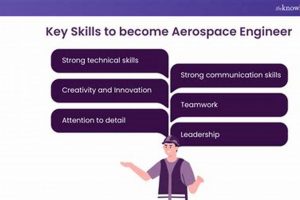
Tip 4: Prioritize Strong Communication Skills: Effective communication, both written and verbal, is crucial for collaborating with colleagues, presenting technical findings, and conveying complex information to stakeholders. Clear and concise reporting is essential for project success.
Tip 5: Embrace Continuous Learning: The field is constantly evolving. Staying abreast of the latest technological advancements and engineering techniques is paramount. This can be achieved through participation in professional development courses, conferences, and industry publications.
Tip 6: Specialize in a Specific Area: Concentrating expertise in a particular domain, such as aerodynamics, propulsion, structures, or avionics, allows for deeper understanding and specialized skill development. Focus leads to greater professional recognition and career advancement.
Tip 7: Network with Professionals: Building relationships with peers and senior engineers provides opportunities for mentorship, knowledge sharing, and career advancement. Attending industry events and joining professional organizations such as AIAA can facilitate networking opportunities.
Adherence to these principles can significantly enhance one’s prospects within this demanding profession. A commitment to excellence, continuous learning, and strong communication skills are key to a successful and rewarding career.
The subsequent sections will provide further insights into the evolving landscape of the field, including emerging technologies and future career opportunities.
1. Design Optimization

Design optimization is a fundamental component of the duties carried out by professionals in this field. It directly influences performance, efficiency, and safety of aircraft and spacecraft and is integral to the engineering process.
- Iterative Modeling and Simulation
Design optimization relies on iterative modeling and simulation processes. Engineers use computer-aided design (CAD) software and computational fluid dynamics (CFD) to create and analyze designs. For example, optimizing the shape of an aircraft wing involves simulating airflow over various designs and iteratively modifying the geometry to minimize drag and maximize lift. This ensures the final product meets performance targets while adhering to structural and aerodynamic constraints.
- Constraint-Based Optimization Algorithms
Optimization often involves the application of algorithms that consider multiple constraints. These constraints can include weight limitations, material properties, cost factors, and safety regulations. For instance, designing a satellite structure necessitates minimizing weight while ensuring it can withstand the stresses of launch and operation in space. Algorithms balance these competing requirements to identify the most efficient and effective design solution.
- Multidisciplinary Design Optimization (MDO)
Modern aircraft and spacecraft designs involve complex interactions between various subsystems. Multidisciplinary Design Optimization (MDO) is a methodology that considers these interactions to achieve optimal overall system performance. For example, MDO can be used to simultaneously optimize the aerodynamic shape, structural design, and control system of an aircraft, leading to improved fuel efficiency, stability, and maneuverability. The MDO process necessitates collaboration across different engineering disciplines.
- Performance Trade-Off Analysis
Optimized designs often require making trade-offs between different performance characteristics. Increasing fuel efficiency may come at the expense of payload capacity, or improving structural integrity might increase weight. Engineers perform trade-off analyses to determine the optimal balance between these competing factors, considering the specific mission requirements and performance objectives. Such analyses are critical in the design and development of both commercial and military aircraft.
In summary, design optimization is a continuous and multifaceted process integral to engineering. It encompasses iterative modeling, constraint-based algorithms, multidisciplinary approaches, and performance trade-off analyses. These techniques enable engineers to create efficient, safe, and high-performing aircraft and spacecraft. Without design optimization, achieving the current standards of safety and efficiency in aerospace engineering would be unattainable.
2. System Integration

System integration is a critical function within the aerospace sector, directly impacting the operational effectiveness and reliability of aircraft and spacecraft. Aerospace engineers are fundamentally responsible for ensuring that various subsystems, components, and software elements work seamlessly together. Failure in system integration can lead to catastrophic outcomes, emphasizing the need for precision and expertise in this area. For example, the successful launch and operation of a satellite hinge on the integration of power systems, communication equipment, navigation sensors, and control mechanisms. These must function in perfect synchronicity to achieve mission objectives. Consequently, system integration profoundly influences the role of these engineers.
The activities involved in system integration for aerospace applications are extensive and require multidisciplinary knowledge. Engineers must address issues related to mechanical, electrical, and software interfaces. This necessitates a deep understanding of each individual subsystem and its interactions with the broader system architecture. Consider the integration of an autopilot system into a commercial aircraft. This involves not only physically connecting the autopilot to the flight control surfaces but also ensuring compatibility with the aircraft’s navigation systems, sensors, and displays. Testing and validation are essential to confirm that the integrated system performs as intended under diverse flight conditions, and that the systems communicate successfully to ensure smooth operation. This also includes testing and validation, critical to aerospace manufacturing.
Effective system integration is indispensable for advancing the capabilities of aerospace technologies. It enables the development of more complex and sophisticated systems that can meet increasingly demanding mission requirements. The ability to seamlessly integrate diverse components translates directly into improved performance, enhanced reliability, and increased safety. Therefore, understanding the principles and practices of system integration is paramount for individuals in this profession. Continuous advancements in integration technologies, such as model-based systems engineering and digital twins, are further reshaping the landscape, requiring aerospace engineers to continually update their skills and knowledge to remain at the forefront of this critical area.
3. Performance Analysis
Performance analysis constitutes an indispensable component of the duties performed by aerospace engineers. It provides quantifiable data concerning the operational effectiveness and safety characteristics of aerospace systems. Without rigorous performance evaluation, design flaws might remain undetected, potentially leading to catastrophic failures. For instance, assessing the lift and drag coefficients of a newly designed aircraft wing involves wind tunnel testing and computational fluid dynamics simulations. The data derived from these analyses allows engineers to identify areas for improvement, leading to enhanced aerodynamic performance and fuel efficiency. This process is not merely academic; it is crucial for ensuring the safe and efficient operation of aircraft.
The scope of performance analysis extends beyond aerodynamic considerations to encompass propulsion systems, structural integrity, and control systems. Evaluating the thrust-to-weight ratio of a rocket engine, for example, is crucial for determining its payload capacity and overall mission feasibility. Similarly, finite element analysis is employed to assess the structural response of aircraft components under various loading conditions, ensuring they can withstand the stresses encountered during flight. Performance analysis also informs the design of control systems, enabling engineers to optimize stability and maneuverability characteristics. A malfunction in a flight control system can create unsafe situations for pilots and passengers. The consequences of inadequate performance are therefore dire, underlining the practical significance of comprehensive analysis.
In summary, performance analysis is an iterative process interwoven throughout the lifecycle of aerospace systems. It serves as a critical feedback loop, guiding design decisions, validating performance claims, and ensuring operational safety. The ability to accurately model, simulate, and interpret performance data is a fundamental skill for any aerospace engineer. The challenges lie in managing the complexity of modern aerospace systems and the uncertainties associated with real-world operating conditions. This rigorous analytical approach, which also involves consideration of ethical factors, is an ongoing process that ultimately enhances the capabilities and reliability of aerospace technology.
4. Safety Compliance
Safety compliance forms an integral and non-negotiable aspect of the duties performed by individuals in the field. The connection between these engineers and adherence to stringent safety regulations is causative: their designs, analyses, and implementations directly impact the safety of flight and space systems. Aerospace engineers must ensure their work meets or exceeds the standards established by regulatory bodies such as the Federal Aviation Administration (FAA) and the European Aviation Safety Agency (EASA). A real-life example includes the design of aircraft structures, which must withstand extreme loads and environmental conditions. Aerospace engineers apply their knowledge of materials science and structural mechanics to design components that meet rigorous safety criteria, as demonstrated by the robust testing and certification process required for new aircraft models.
Furthermore, the importance of safety compliance extends beyond initial design and manufacturing. Ongoing maintenance, repairs, and modifications to aircraft and spacecraft must also adhere to safety protocols. Aerospace engineers are involved in developing procedures for inspections, non-destructive testing, and component replacements. For instance, they may create detailed manuals for technicians to follow during routine maintenance checks or develop innovative methods for detecting structural fatigue in aging aircraft. The practical significance is that strict safety compliance minimizes the risk of accidents, protecting passengers, crew, and equipment, and preserving the public’s trust in air travel.
In conclusion, safety compliance is not merely a procedural formality, but rather a core tenet of the aerospace engineering profession. The skills and knowledge of these engineers are essential for ensuring that aircraft and spacecraft are designed, built, and maintained to the highest safety standards. While continuous innovation drives advancements in the field, it must always be tempered by a steadfast commitment to safety. Challenges arise in balancing performance enhancements with safety requirements, but the ethical imperative to prioritize safety remains paramount. Therefore, aerospace engineers bear a significant responsibility in upholding the safety of air and space travel.
5. Materials Selection

Materials selection is a pivotal responsibility for an engineer in the aerospace sector, influencing performance, safety, and cost-effectiveness of aircraft and spacecraft. Choices made directly impact structural integrity, weight, thermal management, and long-term reliability. The process requires a deep understanding of material properties and their behavior under extreme conditions.
- Strength-to-Weight Ratio Optimization
Aerospace structures demand high strength with minimal weight. Engineers evaluate materials like aluminum alloys, titanium alloys, composites (carbon fiber reinforced polymers), and advanced ceramics for their ability to withstand significant stress while minimizing overall mass. The selection hinges on optimizing this ratio to maximize payload capacity and fuel efficiency. For instance, the shift from aluminum to carbon fiber composites in modern aircraft wings reflects the pursuit of improved strength-to-weight characteristics.
- Environmental Resistance
Aerospace vehicles operate in harsh environments characterized by extreme temperatures, pressures, and radiation. Materials must resist degradation due to corrosion, oxidation, and UV exposure. Engineers consider factors such as coating systems, material stability, and long-term durability when selecting materials for external surfaces and critical components. The selection of specialized alloys for engine components, which endure high temperatures and corrosive gases, exemplifies this consideration.
- Thermal Management Considerations
Heat generated by engines, aerodynamic friction, and solar radiation can significantly affect material properties and structural integrity. Engineers must select materials with appropriate thermal conductivity, expansion coefficients, and heat resistance. Thermal protection systems (TPS) employing ceramic tiles or ablative materials are crucial for spacecraft re-entering the atmosphere, demonstrating the importance of thermal management in materials selection.
- Life Cycle Cost Analysis
While performance and safety are paramount, cost considerations also play a role in materials selection. Engineers evaluate the entire life cycle cost of a material, including procurement, manufacturing, maintenance, and disposal. Factors such as material availability, processing costs, and repair requirements influence the overall economic feasibility of a design. The selection of more affordable, yet still robust, materials for non-critical components can significantly reduce production and maintenance costs.
The selection of appropriate materials is not a static process. Engineers continually evaluate and integrate new materials, processes, and analytical techniques to enhance aerospace systems. These decisions, integral to their work, are critical for achieving the performance, reliability, and safety standards demanded by the aerospace industry.
6. Testing Protocols

Adherence to rigorous testing protocols is an indispensable element. This is directly linked to the function of individuals engaged in aerospace engineering. These protocols are implemented to validate designs, verify performance claims, identify potential weaknesses, and ensure compliance with stringent safety regulations. The relationship is causal: inadequate or flawed testing can result in catastrophic failures, whereas comprehensive and meticulously executed testing enhances the reliability and safety of aerospace systems. For instance, before an aircraft enters commercial service, it undergoes extensive flight testing to evaluate its performance under various conditions, including extreme altitudes, temperatures, and speeds. This ensures that it performs as designed and meets safety standards. The efficacy of this testing relies upon the skills and oversight provided by the professionals within the area.
The responsibilities extend beyond simply conducting tests. They are involved in designing test procedures, developing specialized test equipment, analyzing test data, and interpreting results. They may utilize a range of testing methodologies, including wind tunnel testing, structural testing, non-destructive testing, and system integration testing. As an example, during the development of a new satellite, engineers conduct vibration testing to simulate the stresses encountered during launch. They analyze the data to identify any potential structural weaknesses and implement design modifications to enhance the satellite’s robustness. Moreover, testing is an iterative process that continues throughout the lifecycle of aerospace systems, from initial design to ongoing maintenance and upgrades. This demands continuous skills evaluation for maximum effectivity.
In conclusion, the establishment and execution of robust testing protocols is a core responsibility. These engineers are tasked with ensuring the safety and reliability of flight and space systems. While technological advancements may introduce new testing methodologies and challenges, the fundamental principle of validating designs through rigorous testing remains a critical component of the profession. They must continually adapt their skills and knowledge to meet evolving testing requirements, contributing to the advancement and safety of air and space travel. This continuous cycle of design, test, analysis, and refinement underscores the central importance of testing protocols.
Frequently Asked Questions
The following questions and answers address common inquiries regarding the responsibilities, required skills, and career paths associated with this particular field.
Question 1: What are the primary day-to-day tasks?
Daily activities vary depending on specialization and current projects. These tasks commonly involve design, analysis, testing, and integration of aerospace systems. Collaboration with multidisciplinary teams is also a frequent requirement.
Question 2: What educational background is typically required?
A bachelor’s degree in engineering or a related field is generally the minimum requirement. Advanced positions often necessitate a master’s or doctoral degree, particularly for research or specialized design roles.
Question 3: Which software and tools are essential?
Proficiency in CAD software, computational fluid dynamics (CFD) tools, finite element analysis (FEA) software, and programming languages is typically expected. Specific tools may vary depending on the specialization and industry.
Question 4: What are the common areas of specialization?
Specialization areas include aerodynamics, propulsion, structures, avionics, and control systems. Individuals often focus on a specific area based on their interests and career goals.
Question 5: How significant is the need for continuous learning?
Continuous learning is critical due to the rapid pace of technological advancements in the field. Professionals must stay abreast of new materials, technologies, and design methodologies through professional development courses, conferences, and publications.
Question 6: What career progression opportunities are available?
Career progression can lead to senior engineering roles, project management positions, technical leadership roles, or research and development positions. Advancement often depends on experience, expertise, and leadership skills.
Understanding the core responsibilities, required education, and continuous learning demands associated with this profession is essential for aspiring and current practitioners alike.
The subsequent sections will examine the future trends and challenges facing individuals in this demanding yet rewarding field.
Conclusion
The preceding discussion has illuminated the multifaceted nature of “aerospace engineer working”. Key aspects of the role include design optimization, system integration, performance analysis, safety compliance, materials selection, and adherence to stringent testing protocols. The field demands a robust educational background, proficiency in specialized software, and a commitment to continuous learning.
The profession is vital to advancements in air and space travel, national defense, and scientific exploration. As technology evolves, professionals must embrace new challenges and maintain a dedication to excellence. The continued innovation and rigorous standards upheld by those engaged in this career are essential for ensuring the future of aerospace systems.