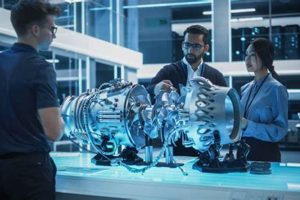
This specialized engineering field focuses on the design, development, and testing of systems that generate thrust to propel aircraft, spacecraft, and missiles. Practitioners in this area apply principles of thermodynamics, fluid mechanics, and combustion to create efficient and reliable propulsion systems. For example, they might work on developing a new jet engine for commercial airliners or designing rocket engines for space exploration.
The importance of this area cannot be overstated, as advancements directly impact the performance, range, and safety of flight vehicles. Historically, progress in propulsion technology has been a driving force behind advancements in aviation and space travel. Improvements in engine efficiency lead to reduced fuel consumption, lower operating costs, and a smaller environmental footprint. Furthermore, enhanced thrust-to-weight ratios enable the development of more capable and versatile vehicles.
The following sections will delve into specific aspects of this vital discipline, including different types of propulsion systems, emerging technologies, and the challenges faced by those working to push the boundaries of flight.
Guidance for Aspiring Professionals
The subsequent points offer targeted advice to individuals seeking to enter or advance within this demanding engineering sector. These suggestions are based on fundamental principles and observed practices.
Tip 1: Solidify Foundational Knowledge: A comprehensive understanding of thermodynamics, fluid mechanics, heat transfer, and combustion is indispensable. These areas form the bedrock of propulsion system design and analysis. Examples include mastering the Navier-Stokes equations for fluid flow simulation and applying thermodynamic cycles to engine performance analysis.
Tip 2: Embrace Computational Tools: Proficiency in Computer-Aided Design (CAD) software, Computational Fluid Dynamics (CFD) software, and programming languages like MATLAB or Python is crucial. These tools enable the modeling, simulation, and optimization of complex propulsion systems. Familiarity with industry-standard software packages is highly recommended.
Tip 3: Pursue Relevant Research and Internships: Practical experience gained through research projects or internships in aerospace companies or research institutions provides invaluable insights. Participation in these activities allows for the application of theoretical knowledge to real-world problems and the development of essential skills.
Tip 4: Develop Strong Analytical and Problem-Solving Skills: The ability to analyze complex engineering problems, identify critical parameters, and develop effective solutions is paramount. This requires a logical and systematic approach, coupled with a keen attention to detail. Example: troubleshooting performance deviations in a rocket engine test.
Tip 5: Maintain Awareness of Emerging Technologies: Continuous learning is essential to stay abreast of advancements in areas such as hypersonic propulsion, electric propulsion, and advanced materials. Actively follow relevant journals, conferences, and industry publications to remain informed.
Tip 6: Cultivate Effective Communication Skills: The ability to clearly and concisely communicate technical information, both verbally and in writing, is vital for collaboration and project success. Practice presenting technical findings and writing comprehensive reports.
These guidelines emphasize the importance of a strong theoretical foundation, practical experience, and continuous learning. Adherence to these principles will significantly enhance the prospects of success in this challenging field.
The concluding section will summarize the key attributes and skills required to excel in this engineering area.
1. Design

Design is a cornerstone of activities related to aerospace propulsion. An aerospace propulsion engineer’s capacity to conceive, model, and refine propulsion systems directly impacts the performance, reliability, and safety of flight vehicles. The design process encompasses a broad spectrum of considerations, from component selection to system integration.
- Component Selection and Integration
This facet pertains to the careful selection of individual components, such as turbines, compressors, nozzles, and combustion chambers, based on performance characteristics, material properties, and manufacturing constraints. Integrating these components into a cohesive propulsion system requires a deep understanding of their interdependencies and potential interactions. The selection of a specific turbine alloy, for example, directly affects the maximum operating temperature and efficiency of a jet engine.
- Thermodynamic Cycle Optimization
Aerospace propulsion systems rely on thermodynamic cycles to convert fuel energy into thrust. Design efforts often focus on optimizing these cycles to maximize efficiency and minimize fuel consumption. Examples include exploring advanced cycles like the Brayton cycle with intercooling or reheat, or implementing variable geometry nozzles to maintain optimal engine performance across a range of flight conditions.
- Aerodynamic Considerations
The aerodynamic design of inlets, nozzles, and other flow passages significantly influences propulsion system performance. Minimizing drag and ensuring smooth airflow are critical for maximizing thrust and efficiency. Computational Fluid Dynamics (CFD) simulations are often employed to analyze and optimize the aerodynamic characteristics of these components.
- Structural Integrity and Material Selection
Propulsion systems operate under extreme conditions of temperature, pressure, and mechanical stress. Ensuring the structural integrity of components is paramount. The selection of appropriate materials, such as high-temperature alloys or composite materials, is crucial for withstanding these conditions and preventing failure. Finite element analysis (FEA) is often used to assess the structural integrity of critical components.
The design process is inherently iterative, involving continuous refinement based on analysis and testing. An aerospace propulsion engineer must possess a strong understanding of fundamental principles, coupled with proficiency in computational tools, to effectively address the multifaceted challenges of propulsion system design. The success of any aerospace endeavor hinges on the quality and innovation inherent in propulsion system design.
2. Analysis

Analysis constitutes an indispensable function within the purview of an aerospace propulsion engineer. This process involves rigorous evaluation and assessment of propulsion system performance, behavior, and safety characteristics. Its application ranges from initial design phases to post-flight assessments, influencing critical decision-making throughout the system lifecycle.
- Performance Prediction and Modeling
This facet involves the use of computational models and analytical techniques to predict propulsion system performance under various operating conditions. Examples include simulating engine thrust, fuel consumption, and exhaust gas temperatures across a range of altitudes and speeds. Accurate performance prediction is crucial for optimizing engine design and ensuring mission success. For example, a propulsion engineer might use CFD to model the airflow through a jet engine’s compressor stage, predicting its performance at different operating conditions.
- Structural Analysis and Integrity Assessment
Propulsion systems are subjected to significant mechanical and thermal stresses. Structural analysis, often using Finite Element Analysis (FEA), is essential for assessing the structural integrity of components and ensuring their ability to withstand these stresses. This analysis helps prevent catastrophic failures and extends component lifespan. An aerospace propulsion engineer might use FEA to determine the stress distribution within a turbine blade operating at high temperatures and rotational speeds.
- Combustion Analysis and Stability
The combustion process within a propulsion system is highly complex and can be prone to instabilities. Combustion analysis involves studying the chemical reactions, heat release, and flow dynamics within the combustion chamber to ensure stable and efficient combustion. This often involves using advanced diagnostic techniques, such as laser-induced fluorescence, to characterize the combustion process. For example, analysis can determine the likelihood of combustion oscillations, preventing potential engine damage or failure.
- Failure Mode and Effects Analysis (FMEA)
FMEA is a systematic approach for identifying potential failure modes within a propulsion system and assessing their potential effects on system performance and safety. This analysis helps prioritize mitigation efforts and improve system reliability. For instance, an FMEA might identify the potential failure of a fuel pump and assess the consequences, such as engine shutdown or loss of control.
These varied analytical approaches are essential tools in the aerospace propulsion engineer’s arsenal. They contribute significantly to the development of safe, reliable, and efficient propulsion systems. Through rigorous analysis, potential problems can be identified and addressed early in the design process, ultimately leading to improved flight vehicle performance and mission success.
3. Testing

Testing represents a critical phase in aerospace propulsion engineering, serving as the validation process for designs and analyses. It transitions theoretical models into empirical data, revealing actual system performance and identifying potential flaws before operational deployment.
- Component-Level Testing
This involves individually evaluating components such as turbines, combustion chambers, and fuel injectors. Tests subject these components to simulated operational stresses, measuring parameters like temperature, pressure, and flow rates. The results validate design specifications and material choices. An example includes testing a newly designed turbine blade under simulated high-temperature, high-stress conditions to assess its durability and performance characteristics, thus refining its design before integration into a larger system.
- System-Level Testing
This facet integrates tested components into a complete propulsion system, such as a jet engine or rocket motor. System-level tests assess overall performance, stability, and control under various operating conditions. This includes measuring thrust, fuel consumption, and exhaust emissions. An example is the hot-fire testing of a rocket engine on a test stand, simulating the launch environment and evaluating its performance across a range of throttle settings. Deviations from predicted performance necessitate design modifications.
- Environmental Testing
Aerospace propulsion systems must withstand extreme environmental conditions, including high and low temperatures, vibration, and vacuum. Environmental testing simulates these conditions to assess the system’s resilience and identify potential vulnerabilities. An example is subjecting a satellite propulsion system to vacuum chamber testing to simulate the space environment and ensure its reliable operation in orbit. Failures detected during environmental testing require design revisions to enhance robustness.
- Non-Destructive Testing (NDT)
NDT methods, such as ultrasonic inspection, radiography, and eddy current testing, are used to detect internal flaws or defects in propulsion system components without causing damage. These techniques are critical for ensuring structural integrity and preventing catastrophic failures during operation. For instance, ultrasonic inspection can identify subsurface cracks in a turbine disc, enabling its replacement before a potentially disastrous engine failure.
The rigorous testing procedures employed by aerospace propulsion engineers are essential for ensuring the safety, reliability, and performance of flight vehicles. The data gathered informs design improvements, validating performance predictions and mitigating potential risks. The iterative cycle of design, analysis, and testing ensures the continuous advancement of propulsion technology.
4. Innovation

Innovation is central to the field. Its pursuit drives advancements in efficiency, performance, and sustainability, enabling new possibilities in aviation and space exploration. Professionals in this field are continuously challenged to develop novel solutions to overcome existing limitations and meet future demands.
- Advanced Materials Development
This facet focuses on the creation and implementation of new materials capable of withstanding extreme temperatures, pressures, and stresses encountered in propulsion systems. Examples include ceramic matrix composites for turbine blades and lightweight alloys for engine casings. The successful integration of these materials enables higher operating temperatures and improved power-to-weight ratios, enhancing engine performance and efficiency. A notable example is the development of single-crystal turbine blades that significantly increase engine operating temperatures, boosting efficiency.
- Novel Propulsion Concepts
This involves exploring and developing entirely new methods of generating thrust, moving beyond conventional combustion-based systems. Examples include hypersonic air-breathing engines (scramjets), electric propulsion systems (ion thrusters), and advanced rocket propulsion concepts like rotating detonation engines. These technologies promise significant improvements in speed, range, and fuel efficiency, opening up new frontiers in space exploration and air travel. The development of ion thrusters, for instance, allows for extremely efficient long-duration space missions.
- Additive Manufacturing Applications
This pertains to the use of 3D printing techniques to fabricate complex propulsion system components with greater design freedom and reduced manufacturing costs. Additive manufacturing allows for the creation of intricate geometries and customized designs that are impossible to achieve with traditional manufacturing methods. Examples include 3D-printed fuel injectors with optimized spray patterns and lightweight engine components with integrated cooling channels. GE Aviation’s use of additive manufacturing to produce fuel nozzles for the LEAP engine demonstrates the practical application of this technology.
- Artificial Intelligence Integration
This area explores the application of AI and machine learning algorithms to optimize propulsion system design, control, and diagnostics. AI can be used to analyze vast amounts of data from engine sensors to predict potential failures, optimize engine performance in real-time, and automate the design process. Examples include using AI to optimize fuel injection strategies for reduced emissions and developing predictive maintenance systems that alert operators to potential engine problems before they occur. The application of AI to engine control systems can lead to significant improvements in fuel efficiency and reduced maintenance costs.
These innovative pursuits are paramount to pushing the boundaries of what is achievable in flight and space exploration. Through these advancements, professionals actively contribute to the progress of aerospace technology, driving the development of more efficient, reliable, and sustainable propulsion systems. The relentless pursuit of novelty ensures that propulsion technology continues to evolve, enabling future breakthroughs and shaping the future of aerospace.
5. Collaboration
Effective collaboration is a critical component in the complex and multifaceted work undertaken by those in the field. The design, development, and implementation of aerospace propulsion systems require a diverse range of expertise, necessitating seamless interaction among specialists.
- Interdisciplinary Teamwork
Aerospace propulsion projects inherently involve engineers from various disciplines, including mechanical, electrical, materials, and software engineering. A design may require a mechanical engineer to determine structural integrity, while an electrical engineer designs the control systems, and a materials engineer selects appropriate alloys for high-temperature environments. Effective communication and coordination are vital to ensure all components integrate seamlessly. For example, the development of a new jet engine requires constant interaction between aerodynamicists, combustion specialists, and control system engineers to optimize performance and stability. This collaboration ensures that each aspect of the design complements the others, maximizing efficiency and reliability.
- Industry-Academia Partnerships
Aerospace companies frequently partner with universities and research institutions to leverage cutting-edge research and development. These partnerships facilitate the transfer of knowledge and technology from academic laboratories to practical applications. For example, a company might collaborate with a university to develop new combustion techniques or advanced materials for propulsion systems. This collaboration provides access to specialized expertise and facilities that may not be available within the company, accelerating the pace of innovation and ensuring that the latest research findings are incorporated into practical designs.
- Supplier Coordination
The manufacture of aerospace propulsion systems relies on a complex network of suppliers providing specialized components and materials. Effective coordination with these suppliers is essential to ensure timely delivery, adherence to specifications, and quality control. A propulsion engineer must work closely with suppliers to resolve technical issues, ensure components meet performance requirements, and manage the supply chain. For instance, a project might require a specialized turbine blade from a specific manufacturer, and the engineer must collaborate with the supplier to ensure the blade meets stringent performance and quality standards. This collaboration minimizes delays and ensures the system functions as designed.
- International Collaboration
Many large-scale aerospace projects involve international collaboration, bringing together expertise and resources from different countries. These collaborations can range from joint research programs to the development of entire propulsion systems. International partnerships can provide access to unique technologies, diverse perspectives, and broader markets. The development of the International Space Station, for example, involved collaboration between multiple countries and required seamless coordination between engineers from different cultural backgrounds. This international collaboration fosters innovation and promotes the sharing of knowledge, leading to advancements that would not be possible otherwise.
The diverse forms of collaborative interaction are integral to the successful design, development, and implementation of aerospace propulsion systems. The ability to work effectively in interdisciplinary teams, forge partnerships with academic institutions, coordinate with suppliers, and engage in international collaborations are essential attributes. The effectiveness of these efforts directly impacts the innovation, performance, and safety of aerospace propulsion technologies.
6. Safety

The concept of safety is paramount within the practice of aerospace propulsion engineering. The design, development, and operation of propulsion systems inherently involve significant risks due to high energies, extreme temperatures, and complex mechanical interactions. Consequently, a commitment to safety is not merely a regulatory requirement but a fundamental ethical obligation for those in the field.
- Redundancy and Fail-Safe Mechanisms
Incorporating redundancy into propulsion system designs is a common strategy to mitigate the risk of single-point failures. This involves providing backup systems or components that can take over in the event of a primary system malfunction. Fail-safe mechanisms are designed to ensure that the system reverts to a safe state in the event of a failure, such as automatically shutting down the engine in response to a detected anomaly. The space shuttle main engines, for example, incorporated redundant sensors and control systems to ensure safe operation during launch and ascent. These measures help to prevent catastrophic events and protect human lives.
- Thorough Risk Assessment and Mitigation
Aerospace propulsion engineers are responsible for conducting comprehensive risk assessments to identify potential hazards associated with propulsion system operation. This involves analyzing potential failure modes, assessing the likelihood of occurrence, and evaluating the potential consequences. Once risks are identified, mitigation strategies are developed and implemented to minimize the likelihood and severity of potential accidents. For example, a risk assessment might identify the potential for a turbine blade to fail due to fatigue. Mitigation strategies could include using more robust materials, implementing more frequent inspections, or reducing engine operating temperatures. This proactive approach to risk management helps to prevent accidents and improve system safety.
- Stringent Testing and Validation Procedures
Rigorous testing and validation procedures are essential for ensuring the safety of aerospace propulsion systems. These procedures involve subjecting the system to a wide range of simulated operating conditions to identify potential weaknesses and ensure that it meets performance and safety requirements. Testing may include component-level tests, system-level tests, and environmental tests. The results of these tests are carefully analyzed to identify potential problems and inform design improvements. For instance, rocket engines undergo extensive hot-fire testing to verify their performance and stability under extreme conditions. These tests help to detect and correct design flaws before the engine is used in flight, minimizing the risk of failure.
- Adherence to Regulatory Standards and Best Practices
The aerospace industry is subject to strict regulatory standards and best practices designed to ensure safety. Aerospace propulsion engineers are responsible for adhering to these standards and incorporating them into their designs and operational procedures. Regulatory agencies, such as the Federal Aviation Administration (FAA), establish safety standards and oversee compliance. Adherence to these standards helps to minimize the risk of accidents and ensure the safety of flight. For example, regulations mandate specific design features and testing requirements for aircraft engines to ensure they meet minimum safety standards. Compliance with these regulations is essential for obtaining certification and operating the engine commercially.
These considerations highlight the crucial role professionals play in upholding the highest safety standards in aerospace engineering. Through proactive risk management, rigorous testing, and adherence to regulatory guidelines, these engineers contribute to protecting human lives and ensuring the reliability of flight vehicles. The unwavering commitment to safety remains a fundamental tenet of the profession.
7. Optimization

Optimization forms a cornerstone of the responsibilities assumed by an aerospace propulsion engineer. The inherent goal is to enhance system performance within given constraints. This encompasses maximizing thrust, minimizing fuel consumption, reducing weight, and ensuring structural integrity, all while adhering to stringent safety regulations and budgetary limitations. The pursuit of optimal solutions necessitates a deep understanding of thermodynamics, fluid mechanics, materials science, and control systems. For example, optimizing the shape of a turbine blade requires balancing aerodynamic efficiency, structural strength, and manufacturing feasibility. Any improvement, however incremental, in a performance metric can translate to significant benefits, such as increased payload capacity, extended flight range, or reduced operating costs.
The tools and techniques employed in this endeavor are varied and sophisticated. Computational Fluid Dynamics (CFD) simulations enable engineers to model and analyze complex flow phenomena within propulsion systems, facilitating the identification of areas for improvement. Finite Element Analysis (FEA) allows for the optimization of structural designs, minimizing weight while maintaining structural integrity under extreme loads and temperatures. Furthermore, optimization algorithms, such as genetic algorithms and gradient-based methods, can be used to automatically search for optimal solutions within a defined design space. A practical example involves using optimization algorithms to tune the control parameters of a jet engine to maximize thrust and minimize fuel consumption across a range of operating conditions. The continuous refinement process, driven by analytical tools and computational power, is essential for achieving optimal designs.
In conclusion, optimization is not merely a desirable attribute, but a fundamental requirement for an aerospace propulsion engineer. The ability to analyze system performance, identify areas for improvement, and implement effective optimization strategies is crucial for developing advanced propulsion systems that meet the demanding requirements of modern aerospace applications. The challenges associated with this process, such as balancing competing design objectives and navigating complex regulatory constraints, demand a high degree of expertise and ingenuity. The ongoing pursuit of optimized designs will continue to drive innovation and shape the future of aerospace propulsion technology.
Frequently Asked Questions
The following questions address common inquiries concerning the field. The answers aim to provide clarity and insight into this specialized engineering discipline.
Question 1: What educational background is generally required to pursue this career path?
A bachelor’s degree in aerospace engineering, mechanical engineering, or a closely related field is typically the minimum requirement. Advanced positions often necessitate a master’s degree or doctorate with a specialization in propulsion, fluid mechanics, or combustion.
Question 2: What specific software or tools are commonly utilized?
Practitioners in this area frequently employ Computer-Aided Design (CAD) software, Computational Fluid Dynamics (CFD) software, Finite Element Analysis (FEA) software, and programming languages such as MATLAB and Python. Familiarity with industry-standard simulation and modeling tools is also beneficial.
Question 3: What are the primary job responsibilities associated with this role?
Responsibilities typically include the design, analysis, testing, and development of propulsion systems for aircraft, spacecraft, and missiles. Further duties may include conducting research, writing technical reports, and collaborating with other engineers and scientists.
Question 4: What are the typical industries or sectors that employ these professionals?
Employment opportunities are commonly found in the aerospace industry, defense contractors, government research laboratories, and universities. Specific employers may include aircraft manufacturers, rocket companies, and engine manufacturers.
Question 5: What are some of the biggest challenges faced in the field?
Significant challenges often include balancing performance requirements with safety considerations, managing the complexity of propulsion systems, and adapting to rapidly evolving technologies. Furthermore, meeting stringent environmental regulations and budgetary constraints can present considerable obstacles.
Question 6: What are some emerging trends or technologies in the field?
Emerging trends include the development of hypersonic propulsion systems, electric propulsion systems, advanced materials, and the integration of artificial intelligence into propulsion system design and control. Research into sustainable aviation fuels and alternative propulsion concepts is also gaining momentum.
These responses offer a concise overview of key aspects of the profession. Further exploration is recommended to gain a more comprehensive understanding.
The concluding remarks will summarize the salient points discussed in this article.
Conclusion
This article has comprehensively explored the multifaceted role. It has elucidated the critical skills, responsibilities, and challenges associated with this demanding profession. Key areas, including design, analysis, testing, innovation, collaboration, safety, and optimization, have been examined to provide a holistic understanding of the field’s scope and complexity. The importance of a strong educational foundation, proficiency in computational tools, and continuous learning has also been emphasized.
The ongoing advancement of aerospace technology relies heavily on the dedication and expertise of those working in this vital engineering area. Continued innovation and rigorous adherence to safety standards are essential for ensuring the future success of both aviation and space exploration. Further study and practical application are encouraged to fully appreciate the depth and significance of this crucial role.