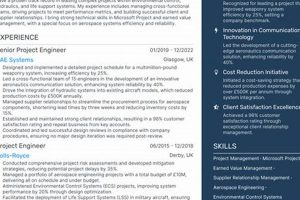
A document submitted alongside a resume when applying for a position in the field of flight and space vehicle design, construction, and testing is critical. This companion piece highlights relevant skills, experience, and enthusiasm for a specific role within an aerospace organization. For example, an applicant seeking a structural engineer position at a company specializing in composite aircraft wings would tailor this document to emphasize their expertise in finite element analysis and materials science.
This professional correspondence is more than just a formality. It provides an opportunity to articulate career goals, demonstrate a genuine interest in the employer, and showcase accomplishments that align with the company’s needs. Historically, it has served as a crucial screening tool, allowing hiring managers to assess not only technical competence but also communication abilities and cultural fit. The ability to present oneself concisely and persuasively can significantly increase the chances of securing an interview.
The following sections will explore key elements to include, common mistakes to avoid, and strategies for creating a compelling narrative that differentiates a candidate in a competitive job market.
Crafting a Compelling Aerospace Engineer Application Document
The following points offer guidance on constructing an effective document to accompany a resume when seeking positions in the aerospace sector.
Tip 1: Tailor Content to the Specific Role. Generic application materials are easily dismissed. Research the company and the specific job description to identify the key skills and experience required. Highlight instances where these qualifications were demonstrated successfully. For instance, if the role emphasizes CFD analysis, detail a project where substantial contributions were made using relevant software packages.
Tip 2: Quantify Achievements Whenever Possible. Instead of simply stating that a project was successfully completed, provide concrete metrics. Did a design modification result in a 15% weight reduction? Was a simulation model validated with experimental data to within 5% accuracy? Numbers provide tangible evidence of contributions.
Tip 3: Demonstrate Understanding of Aerospace Principles. Conveying a fundamental grasp of aerodynamics, propulsion, structural mechanics, or other relevant areas is essential. Refer to specific concepts or technologies relevant to the company’s work. For example, when applying to a rocket engine company, demonstrate familiarity with different propellant types and combustion cycles.
Tip 4: Highlight Relevant Software and Tools. Proficiency with industry-standard software is a significant asset. List specific programs such as CATIA, ANSYS, MATLAB, or Python, and provide examples of how these tools were utilized to solve engineering problems.
Tip 5: Showcase Teamwork and Communication Skills. Aerospace projects are inherently collaborative. Emphasize the ability to work effectively within a team environment and communicate technical information clearly and concisely. Describe instances where collaborative efforts led to successful outcomes.
Tip 6: Address the Company’s Mission and Values. Articulate why the companys work resonates with personal career goals. Demonstrate an understanding of its mission and values, and explain how skills and aspirations align with the organization’s objectives.
Tip 7: Maintain Professional Tone and Formatting. Adhere to formal business writing conventions. Use clear and concise language, avoid jargon, and proofread carefully for errors in grammar and spelling. The document should be well-organized, visually appealing, and easy to read.
In summary, this document functions as a powerful tool to showcase technical abilities, professional attitude, and cultural fit. A well-crafted document significantly improves the likelihood of securing an interview and advancing in the aerospace engineering field.
The following section will address common pitfalls to avoid in the drafting process.
1. Conciseness

In the context of an application document accompanying a resume for an aerospace engineering position, conciseness directly impacts the likelihood of capturing a hiring manager’s attention. A lengthy, unfocused document risks being overlooked, whereas a succinct, targeted presentation of qualifications and achievements is far more likely to make a positive impression. The limited time available for reviewing applications necessitates a direct and impactful approach. For example, stating “Reduced aircraft drag by 8% through winglet redesign” delivers a clear, concise message of achievement compared to a verbose description of the same project.
The ability to communicate technical information efficiently is itself a valuable skill in the aerospace industry. Engineering projects often involve strict deadlines and complex collaborations, requiring clear and concise communication across teams. Therefore, demonstrating conciseness in the application document serves as evidence of this essential skill. A study by a major aerospace manufacturer found that concisely written internal reports resulted in a 15% reduction in project completion time, highlighting the practical importance of efficient communication within the field.
Ultimately, conciseness in such application material is not merely about brevity; it’s about demonstrating respect for the reader’s time, effectively conveying key qualifications, and showcasing the ability to communicate technical information clearly and efficiently. Overcoming the challenge of distilling complex experience into a concise format is a critical step in successfully navigating the competitive aerospace job market.
2. Tailored Content

Tailored content is paramount in a document accompanying a resume for an aerospace engineering position. Generic applications are often disregarded due to their failure to address the specific needs and expectations of the prospective employer.
- Company-Specific Research
Thorough research into the target company’s projects, values, and recent activities is essential. The application document should explicitly demonstrate an understanding of the company’s focus areas. For example, if the company is developing new electric propulsion systems, the application should highlight any experience with electric motors, battery technology, or power electronics.
- Job Description Alignment
Directly addressing the specific requirements outlined in the job description is crucial. Each listed qualification should be acknowledged, and the applicant’s relevant skills and experience should be presented in a manner that demonstrates a clear match. If the description emphasizes experience with computational fluid dynamics (CFD), the application should detail specific CFD projects, software used, and results achieved.
- Skills Emphasis
The document should prioritize the skills and experience that are most relevant to the specific role and the company’s work. An applicant with extensive experience in both aerodynamics and structural analysis should emphasize the area most pertinent to the target position. This focus demonstrates a strategic understanding of the employer’s needs and avoids overwhelming the reader with irrelevant information.
- Project Highlighting
Rather than providing a general overview of past projects, the application should focus on projects that directly align with the responsibilities of the target position. These projects should be described in detail, highlighting the specific contributions made, the technical challenges overcome, and the quantifiable results achieved. For instance, if the role involves designing composite structures, the application should detail experience with composite materials, manufacturing processes, and structural testing.
Effective tailoring transforms a generic application into a targeted communication that demonstrates a clear understanding of the company’s needs, a strong alignment with the role’s responsibilities, and a genuine interest in contributing to the organization’s success. The ability to present qualifications in a contextually relevant manner significantly increases the probability of securing an interview in the competitive aerospace engineering field.
3. Quantifiable Results

The incorporation of verifiable outcomes strengthens the persuasive power of an application document accompanying a resume for positions within the aerospace engineering sector. Presenting achievements through numerical data offers concrete evidence of capabilities and impact, rather than relying solely on subjective descriptions.
- Enhanced Project Credibility
Providing numerical metrics substantiates claims of project success. For instance, instead of stating “Improved engine efficiency,” quantifying the improvement as “Increased engine efficiency by 12%” delivers a more convincing message. This tangible evidence strengthens the credibility of the applicant’s contributions and demonstrates a clear understanding of project goals and outcomes. Data establishes facts that can be measured instead of just words and opinions.
- Direct Contribution Assessment
Quantifiable results facilitate the evaluation of the applicant’s direct impact on project outcomes. If the applicant states “Reduced aircraft weight by 50 kilograms through design optimization,” the hiring manager can directly assess the significance of this contribution to overall aircraft performance. These specific outcomes showcase the applicant’s ability to translate engineering skills into measurable improvements and provide the hiring manager with information to evaluate the candidate.
- Competency Demonstration
Presenting quantifiable achievements serves as an objective demonstration of technical competency. An applicant who states “Developed a CFD model that predicted experimental results with 95% accuracy” showcases expertise in computational fluid dynamics and model validation. These objective measures serve as better measures of technical competency instead of just words and generalities. The data proves that the candidate knows what they are talking about.
- Comparative Advantage
Quantifiable data facilitates comparison between candidates. Applicants who provide specific metrics for their achievements stand out from those who rely on vague descriptions. For example, “Managed a project budget of $5 million and delivered the project 2 weeks ahead of schedule” presents a clear competitive advantage over a statement such as “Managed projects effectively.”
The strategic use of quantifiable results transforms an application document from a general summary of experience into a compelling demonstration of tangible contributions and technical competence. These metrics provide hiring managers with the concrete evidence needed to assess the applicant’s potential value and make informed hiring decisions. Using this strategy will set a candidate apart from the rest.
4. Technical Acumen
The aerospace engineering field demands a high degree of specialized knowledge and practical skill. Therefore, a document accompanying a resume for such a position must effectively convey the applicant’s technical competence. This document provides an opportunity to showcase not only academic qualifications but also the ability to apply theoretical knowledge to real-world engineering challenges. A lack of demonstrated proficiency in relevant technical areas severely diminishes an applicant’s prospects. For instance, an aspiring aerodynamics engineer must clearly articulate expertise in computational fluid dynamics, wind tunnel testing, and aircraft performance analysis. If an applicant claims to have extensive background knowledge, they should showcase specific background examples that support their claim and provide evidence of technical know-how.
Technical acumen, as demonstrated in an application document, is critical for establishing credibility with potential employers. Statements of proficiency should be substantiated with specific examples of projects completed, problems solved, and results achieved. The applicant should be able to articulate the underlying engineering principles behind these achievements, demonstrating a depth of understanding beyond mere familiarity with software tools or procedures. A practical example would be describing the process of designing a composite aircraft wing, detailing the selection of materials, the structural analysis techniques employed, and the trade-offs considered to meet performance requirements. Hiring managers have to see technical acumen in order to trust that the applicant knows what they’re doing.
In summary, effectively conveying technical acumen in a document accompanying a resume for an aerospace engineering position is not merely about listing skills but about demonstrating a deep understanding of engineering principles and the ability to apply them to solve complex problems. Challenges in this area include accurately assessing one’s own technical strengths and communicating them in a clear and concise manner. This aspect is crucial for success in the highly competitive aerospace job market. In order to ensure that a company hires a competent engineer, an applicant must demonstrate technical know-how.
5. Industry Keywords

Strategic incorporation of industry-specific keywords within application documents submitted for aerospace engineering roles significantly enhances visibility and resonance with potential employers. These keywords act as signifiers, communicating technical proficiency and familiarity with current industry practices.
- Skill Validation
The inclusion of precise terms related to specific skills and software demonstrates expertise. Examples include: “Finite Element Analysis (FEA),” “Computational Fluid Dynamics (CFD),” “CATIA,” “MATLAB,” and “Python.” These terms validate technical capabilities and demonstrate relevant experience.
- Project Recognition
Mentioning relevant project types signals industry experience. For example: “Satellite Propulsion Systems,” “UAV Design,” “Composite Aircraft Structures,” and “Hypersonic Vehicle Aerodynamics.” Such terms immediately communicate project involvement and domain knowledge to those reading the document. Using project titles creates a connection between the company reading it and the applicant.
- Requirements Alignment
Mirroring keywords from the job description directly addresses employer needs. For instance, if a job posting emphasizes “Systems Engineering,” the application document should explicitly reference experience with systems engineering principles, tools, and processes. Doing so ensures alignment in understanding and the company knows what the applicant is capable of.
- Search Optimization
Keywords facilitate applicant tracking systems (ATS) in identifying relevant candidates. The system scans submissions for specific keywords, filtering applicants based on their qualifications. Absence of these keywords may result in the application being overlooked. Optimizing search ensures that the applicant is looked at and can be considered for the position.
These keywords, when strategically integrated, transform an application document from a general overview into a targeted communication that resonates with industry professionals and automated screening systems. Successful employment of this strategy strengthens the applicant’s qualifications and increases the likelihood of securing an interview within the competitive aerospace engineering job market. Using a specific and targeted list of keywords increases the value and potential of the applicant.
6. Professional Tone
A formal and respectful demeanor within application correspondence is a critical element for individuals pursuing positions in the aerospace sector. This communication style conveys competence, diligence, and a commitment to industry standards, all of which are essential attributes for aerospace engineers.
- Respectful Language and Etiquette
Refraining from slang, colloquialisms, or overly casual language is essential. The communication should adhere to standard business writing conventions, demonstrating respect for the recipient and the organization. For example, address the hiring manager by their formal title (e.g., “Dear Dr. Smith”) rather than using a first name, unless explicitly invited to do so. Adhering to standard business practices shows the level of respect that the applicant has towards the company.
- Clarity and Precision in Communication
Ambiguous or vague statements should be avoided in favor of clear and concise language. Technical information should be presented accurately and precisely, demonstrating a command of the subject matter. For instance, when describing a project, specify the technical challenges, the methodologies employed, and the quantifiable results achieved, using terminology appropriate for an aerospace engineering audience. Clear and concise communication signals competence and provides relevant information about what the candidate is capable of.
- Focus on Achievements and Contributions
The communication should primarily focus on showcasing relevant skills, experience, and accomplishments. Personal anecdotes or irrelevant details should be omitted. Emphasis should be placed on contributions to previous projects, quantifying achievements whenever possible to demonstrate the impact made. A serious focus on the job conveys to the company that the applicant is serious about working for the company.
- Absence of Grammatical Errors and Typos
Meticulous proofreading is imperative to ensure that the document is free of grammatical errors, typos, and inconsistencies. A document riddled with errors reflects poorly on the applicant’s attention to detail and professionalism, potentially undermining their credibility. Errors and typos demonstrate that the applicant is not serious about working for the company and decreases their chance of being hired.
Maintaining a professional tone in application materials serves as a demonstration of the applicant’s suitability for a career in the aerospace industry. This communication style communicates competence, respect, and a commitment to industry standards, thereby increasing the likelihood of securing an interview and advancing in the selection process.
Frequently Asked Questions
The following section addresses common inquiries regarding the preparation and content of application documents for positions in the field of aerospace engineering. These responses aim to provide clarity and guidance based on industry best practices.
Question 1: Is a document accompanying a resume always necessary for applications to aerospace engineering positions?
While not universally mandated, submitting a document alongside a resume is strongly recommended. It provides an opportunity to elaborate on qualifications, demonstrate interest in the specific role and company, and showcase communication skills aspects often difficult to fully convey in a resume alone. Its absence can be perceived as a lack of enthusiasm or effort.
Question 2: What length is considered appropriate for such a document?
Ideally, it should not exceed one page. Hiring managers often have limited time to review applications, and conciseness is valued. Focus on the most relevant skills and experience, and prioritize quantifiable achievements over lengthy descriptions. An easy to read one-page document shows the company that you value their time and you are able to write efficiently and professionally.
Question 3: How should technical skills be presented?
Technical skills should be presented with specificity and supported by examples. Instead of simply listing software proficiency, describe specific projects where these tools were used to solve engineering problems. Quantify the results achieved through the application of these skills whenever possible. Having examples and data to back up your claims demonstrates competence in the specific skill.
Question 4: Is it acceptable to use a template for such a document?
Using a template as a starting point can be acceptable, provided that the content is significantly customized to match the specific job description and company. Generic, unaltered templates are easily recognizable and can convey a lack of effort. Tailoring the content demonstrates that the applicant has specific interest in the position.
Question 5: Should the document explicitly address gaps in experience?
Addressing gaps in experience requires a strategic approach. A brief, positive explanation can be provided, focusing on skills or knowledge gained during that time. Avoid dwelling on negative aspects or making excuses. Frame these gaps as opportunities for growth or skill development instead of a period of dormancy.
Question 6: How important is it to proofread the document carefully?
Meticulous proofreading is paramount. Grammatical errors, typos, and inconsistencies reflect poorly on the applicant’s attention to detail and professionalism. These errors can undermine credibility and negatively impact the chances of securing an interview. Taking the time to proofread sends a message to the company that you care about the company and your performance.
In summary, the application document serves as a critical opportunity to showcase qualifications, demonstrate enthusiasm, and communicate technical competence to potential employers in the aerospace engineering field. Addressing these frequently asked questions is important to understand what your value is and how you can set yourself apart from your competition.
The following section will discuss common mistakes to avoid during this process.
Conclusion
The preceding exploration of the cover letter for aerospace engineer has underscored its crucial role in the job application process. This document serves as more than a mere formality; it is a strategic instrument for conveying technical proficiency, professional demeanor, and a genuine interest in contributing to the aerospace sector. Key elements such as tailored content, quantifiable results, technical acumen, strategic keyword use, and a consistently professional tone have been identified as essential for crafting a compelling and effective communication.
A well-crafted cover letter for aerospace engineer offers a significant advantage in a competitive job market. Its meticulous preparation reflects the seriousness with which an applicant approaches their career, thereby increasing the likelihood of securing an interview and ultimately contributing to the advancement of aerospace engineering. The future demands highly skilled and articulate engineers; the ability to present oneself effectively is, therefore, a critical professional competency.
![Best Aerospace Engineering Fundamentals Publisher [Guide] | Innovating the Future of Flight with Reliable Aviation Solutions](https://mixaerospace.com/wp-content/uploads/2026/05/th-229-300x200.jpg "Best Aerospace Engineering Fundamentals Publisher [Guide] Innovating the Future of Flight with Reliable Aviation Solutions")