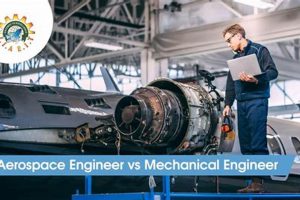
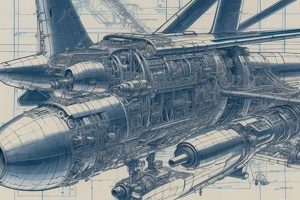
The disciplines of aeronautical engineering and aerospace engineering are often used interchangeably, but distinctions exist. One focuses primarily on aircraft that operate within Earth’s atmosphere. The other encompasses the design, development, and testing of vehicles and systems operating both within and beyond the atmosphere. Examples of aeronautical engineering work include designing more efficient wings for commercial airliners or developing advanced flight control systems. Aerospace engineering, on the other hand, might involve designing spacecraft, satellites, or interplanetary probes.
Understanding the nuances between these fields is important for individuals pursuing careers in the aerospace sector. It enables a more precise targeting of educational paths and career specializations. Historically, aeronautical engineering emerged first, preceding the advent of spaceflight. As technology advanced and the exploration of space became a reality, the broader field of aerospace engineering evolved to encompass the challenges and opportunities presented by this new frontier.
The core engineering principles are similar, but the specific applications and challenges differ. This article will explore the curriculum differences, typical career paths, and the specific skills associated with each specialization, providing a clearer understanding of the scope and focus of both aeronautical and aerospace engineering.
Clarifying Aeronautical and Aerospace Engineering
Navigating the disciplines of aeronautical and aerospace engineering requires careful consideration. This section provides guidance for prospective students and professionals.
Tip 1: Define Your Interests: Before selecting a specific program, evaluate your passion. A stronger interest in atmospheric flight suggests aeronautical engineering, while an interest in space exploration aligns with aerospace engineering.
Tip 2: Review Curricular Differences: Compare the course content of programs labeled ‘aeronautical’ versus ‘aerospace.’ Note the emphasis on atmospheric dynamics, aircraft design, and flight control in aeronautical curricula, compared to the broader focus on space systems, propulsion, and orbital mechanics in aerospace programs.
Tip 3: Consider Career Goals: Research potential career paths associated with each discipline. Aeronautical engineers frequently work on aircraft design, testing, and maintenance. Aerospace engineers may work on spacecraft, satellite systems, or launch vehicles.
Tip 4: Analyze Skill Requirements: Identify the technical skills valued in each field. Both require strong mathematical and analytical abilities, but aeronautical engineering may emphasize aerodynamics and structural analysis, while aerospace engineering may demand expertise in propulsion systems and materials science.
Tip 5: Explore Specializations: Recognize that both disciplines offer specializations. Within aeronautical engineering, one can specialize in areas such as avionics or propulsion. Aerospace engineering offers specializations such as astrodynamics or spacecraft design.
Tip 6: Evaluate Program Resources: Assess the resources available within each program. Look for laboratories, wind tunnels, and computational facilities that support hands-on learning and research in your area of interest.
Tip 7: Network with Professionals: Connect with engineers working in both aeronautical and aerospace fields. Attending industry events and seeking informational interviews can provide valuable insights into the day-to-day realities of each profession.
Understanding the distinct features and career opportunities related to each engineering field is crucial for academic and professional success. Informed decision-making enables a more tailored educational path and career trajectory.
The subsequent sections will delve deeper into the core differences and similarities, offering a more comprehensive overview.
1. Atmospheric flight

Atmospheric flight represents a core element differentiating aeronautical and aerospace engineering. While both disciplines share engineering foundations, the primary concern of aeronautical engineering remains within Earth’s atmosphere. Its applications include the design, development, and operation of aircraft designed for atmospheric conditions.
- Aerodynamics and Lift Generation
Atmospheric flight relies heavily on aerodynamic principles to generate lift and control movement through the air. Aeronautical engineers focus on optimizing wing designs, control surfaces, and propulsion systems to achieve efficient and stable flight within the atmosphere. Examples include the design of high-lift wings for short takeoff and landing (STOL) aircraft and the development of efficient turbofan engines.
- Structural Integrity and Material Science
Ensuring the structural integrity of aircraft during atmospheric flight is paramount. Aeronautical engineers select and test materials capable of withstanding the stresses and strains imposed by aerodynamic forces, turbulence, and varying atmospheric conditions. This includes the use of lightweight composites and advanced alloys designed to minimize weight and maximize strength.
- Flight Control Systems and Navigation
Maintaining stable and controlled flight requires sophisticated flight control systems. Aeronautical engineers develop and integrate systems that enable pilots or autonomous systems to manage altitude, airspeed, and direction. Examples include fly-by-wire systems, autopilot systems, and advanced navigation technologies such as GPS and inertial navigation systems.
- Atmospheric Considerations and Environmental Impact
Atmospheric conditions, such as temperature, pressure, and wind, significantly impact aircraft performance. Aeronautical engineers consider these factors when designing aircraft and developing operational procedures. Furthermore, the environmental impact of atmospheric flight, including noise pollution and emissions, is an increasingly important consideration, driving research into more sustainable aviation technologies.
The design and operation of vehicles for atmospheric flight constitute a central focus of aeronautical engineering, distinguishing it from aerospace engineering, which encompasses a broader scope including spaceflight. While certain aspects of atmospheric flight, such as re-entry, also concern aerospace engineers, the optimization of vehicles specifically for sustained atmospheric operation remains a primary domain of aeronautical expertise.
2. Spacecraft design
Spacecraft design represents a critical element differentiating aerospace engineering from aeronautical engineering. While aeronautical engineering concentrates on vehicles operating within Earth’s atmosphere, spacecraft design extends to vehicles functioning in the vacuum of space. This distinction affects fundamental engineering considerations such as propulsion, environmental control, and structural integrity. Cause-and-effect relationships are evident; the absence of atmospheric pressure necessitates specialized pressure vessel design for habitable spacecraft. For instance, the International Space Station (ISS) required extensive engineering to maintain a life-supporting internal environment, a challenge not typically encountered in aeronautical projects. This importance as a component underscores the broader scope of aerospace engineering.
Practical significance is demonstrated through various examples. The design of the James Webb Space Telescope required innovative solutions for thermal management, given its exposure to extreme temperature gradients in space. Deployable sunshields and specialized radiative cooling systems are critical components not typically found in aircraft design. Similarly, spacecraft propulsion systems rely on different principles than those used in aeronautics. Ion propulsion and chemical rockets are standard spacecraft technologies, whereas air-breathing engines dominate aeronautical applications. These distinctions shape the skill sets and knowledge base required for engineers in each field.
In summary, spacecraft design differentiates aerospace engineering from its aeronautical counterpart by necessitating specialized knowledge and solutions tailored to the unique challenges of operating in space. The technological demands of spacecraft, as exemplified by the ISS and James Webb Space Telescope, highlight the practical significance of this distinction. Addressing challenges in areas like thermal management and propulsion within spacecraft design further reinforces the understanding that while aeronautical and aerospace engineering share foundational principles, their applications and specialized knowledge domains differ substantially.
3. Overlapping foundations

While aeronautical and aerospace engineering address distinct operational environments, a significant degree of overlap exists in their fundamental engineering foundations. This common ground often leads to the misconception that they are synonymous, despite their diverging specializations. Understanding these shared foundations is crucial for delineating the true scope of each discipline.
- Fluid Mechanics and Aerodynamics
Both aeronautical and aerospace engineering rely extensively on fluid mechanics and aerodynamics. The principles governing airflow over an aircraft wing are also applicable to understanding the behavior of gases around a spacecraft during atmospheric re-entry. Both fields require a deep understanding of concepts such as lift, drag, turbulence, and boundary layer effects. Computational Fluid Dynamics (CFD) software, used to model airflow around aircraft wings, is equally applicable in simulating hypersonic flow around space vehicles. The shared need to predict and control fluid behavior represents a significant overlap.
- Structural Analysis and Materials Science
Ensuring structural integrity is paramount in both aeronautical and aerospace applications. Both fields require knowledge of stress analysis, material properties, and failure modes. Finite Element Analysis (FEA) is employed to assess the structural response of both aircraft and spacecraft to various loads. While the specific materials used may differfor example, spacecraft require radiation-resistant materialsthe underlying principles of structural design and analysis remain consistent. The ability to design lightweight, high-strength structures is crucial in both domains.
- Control Systems Engineering
Control systems are essential for maintaining stability and achieving desired performance in both aircraft and spacecraft. Concepts such as feedback control, stability analysis, and sensor integration are fundamental to both disciplines. While aircraft control systems often focus on atmospheric maneuvers, and spacecraft control systems deal with orbital mechanics and attitude control, the underlying principles of control theory are shared. For example, PID controllers are used extensively in both aircraft autopilots and spacecraft attitude control systems.
- Thermodynamics and Heat Transfer
Thermodynamics and heat transfer play crucial roles in both aeronautical and aerospace engineering. Understanding the principles of heat engines, fluid dynamics, and heat transfer mechanisms is essential for designing efficient propulsion systems, managing thermal loads, and ensuring the reliability of equipment. Whether it’s designing an efficient aircraft engine or managing the thermal environment of a spacecraft, the same fundamental principles apply. Heat exchangers, insulation techniques, and thermal modeling are common tools used in both domains.
In conclusion, while aeronautical and aerospace engineering diverge in their specific applications and environmental contexts, their shared foundations in fluid mechanics, structural analysis, control systems, and thermodynamics are undeniable. These overlapping principles contribute to the common misconception of their interchangeability. A deeper understanding of their distinct specializations reveals the unique challenges and focuses within each field, highlighting that while they share a foundation, their applications and ultimate goals are significantly different.
4. Specialized applications
Specialized applications serve as a key differentiator between aeronautical engineering and aerospace engineering, clarifying that the two, while related, are not interchangeable. The distinct environments and operational requirements dictate unique engineering approaches and skill sets.
- Aircraft Design vs. Spacecraft Design
Aeronautical engineering focuses on optimizing aircraft for atmospheric flight. This includes wing design, propulsion system integration, and control surface development, specifically tailored for aerodynamic efficiency and maneuverability within the atmosphere. In contrast, spacecraft design, a core area of aerospace engineering, prioritizes survival and functionality in the vacuum of space. This necessitates expertise in radiation shielding, thermal control in the absence of convection, and propulsion systems suited for orbital maneuvers, a domain where atmospheric considerations are secondary.
- Atmospheric vs. Orbital Mechanics
Aeronautical engineers are primarily concerned with atmospheric mechanics, including airflow, lift, drag, and stability within the air. Their analyses focus on optimizing flight performance within the Earth’s atmosphere. Aerospace engineers, however, apply orbital mechanics principles. This involves calculating trajectories, orbital maneuvers, and spacecraft attitude control in the absence of atmospheric drag. The complexities of celestial mechanics and gravitational interactions are central to their work, which is a distinctly different focus from atmospheric flight.
- Materials Science: Atmospheric vs. Space Environment
Material selection differs significantly based on the intended environment. Aeronautical engineering materials must withstand atmospheric pressures, temperature variations, and aerodynamic stresses, with a strong emphasis on lightweight, high-strength alloys and composites. Aerospace engineering requires materials that can endure the harsh space environment, including extreme temperature variations, vacuum conditions, and exposure to radiation. Radiation-hardened materials and specialized coatings are necessary for spacecraft components, requirements less critical in aeronautical applications.
- Propulsion Systems: Air-Breathing vs. Rocket Propulsion
Aeronautical propulsion systems typically involve air-breathing engines, such as turbojets, turbofans, and propellers, which rely on atmospheric air for combustion. Optimizing these systems involves improving fuel efficiency, reducing emissions, and enhancing thrust output. Aerospace engineering necessitates the use of rocket propulsion systems, which carry their own oxidizer and can operate in the vacuum of space. Rocket engine design requires expertise in combustion stability, nozzle design for optimal thrust, and propellant management in a zero-gravity environment, presenting distinctly different engineering challenges from air-breathing engines.
These specialized applications underline the distinction between aeronautical and aerospace engineering. While both fields share foundational engineering principles, their distinct focus areas and the unique challenges posed by their respective operational environments necessitate specialized knowledge and skill sets. Therefore, while related, these engineering fields are not interchangeable due to these specialized applications.
5. Career divergence

Career divergence serves as a practical indicator that aeronautical engineering and aerospace engineering, while related, are not functionally identical. The career paths available to graduates of each discipline reveal distinct specializations and industry demands. Aeronautical engineers predominantly find employment in the design, testing, and maintenance of aircraft. Aerospace engineers, on the other hand, engage in a broader range of activities, including spacecraft design, satellite development, and launch vehicle engineering. The cause of this divergence lies in the specialized knowledge and skills acquired during academic training. Curricular differences, such as a greater emphasis on orbital mechanics in aerospace programs, directly influence career opportunities.
The practical significance of this divergence is evident in the job market. A search for “aeronautical engineer” yields positions focused on improving aircraft efficiency, developing advanced flight control systems, or ensuring the safety and reliability of commercial airliners. Conversely, a search for “aerospace engineer” reveals opportunities in satellite communication, space exploration, and defense systems. For example, an aeronautical engineer might work on designing a more fuel-efficient wing for a Boeing 787, while an aerospace engineer could be involved in developing the propulsion system for a SpaceX Falcon 9 rocket. These distinct roles underscore the specialized nature of each field. Further, career progression opportunities often differ. Aeronautical engineers might advance into roles managing aircraft maintenance operations or leading aircraft design teams, while aerospace engineers may specialize in areas like mission planning for interplanetary probes or managing satellite constellations.
In summary, career divergence highlights that while aeronautical and aerospace engineering share fundamental principles, the career paths they lead to are distinct. This divergence stems from specialized academic training and the unique demands of the industries they serve. Understanding these differences is essential for students seeking to make informed career choices and for employers seeking engineers with the specific skills required for their projects. This distinction is a key argument against the notion that “aeronautical engineering and aerospace engineering are the same,” revealing the practical implications of their respective specializations.
6. Evolving synergy

Evolving synergy between aeronautical and aerospace engineering complicates the question of whether the two disciplines are identical. Advances in technology and the exploration of new frontiers necessitate a blurring of traditional boundaries, influencing the skills and knowledge required of engineers in both fields.
- Hypersonic Flight Technology
Hypersonic flight, involving speeds exceeding Mach 5, demands expertise in both atmospheric and spaceflight dynamics. The design of hypersonic vehicles requires managing extreme aerodynamic heating, a problem relevant to both atmospheric re-entry (aerospace) and high-speed atmospheric flight (aeronautical). This convergence necessitates a unified approach, drawing from both aeronautical and aerospace principles. For instance, scramjet engines, designed for hypersonic propulsion, require sophisticated understanding of fluid dynamics and combustion, traditionally taught in both fields.
- Advanced Materials and Structures
The development of advanced materials and structures applicable to both aircraft and spacecraft blurs the lines between the two disciplines. Lightweight composites, initially developed for aerospace applications, are now widely used in aircraft design to improve fuel efficiency. Similarly, self-healing materials, originally intended for spacecraft subjected to micrometeoroid impacts, are finding applications in aircraft structures to enhance durability and safety. This cross-pollination of materials technology underscores the evolving synergy.
- Autonomous Systems and Control
Autonomous systems and control algorithms are increasingly relevant in both aeronautical and aerospace engineering. Unmanned aerial vehicles (UAVs), initially developed for military reconnaissance, are now used in civilian applications such as aerial surveying and package delivery. These systems require sophisticated control algorithms that can handle both atmospheric disturbances and complex mission objectives, drawing from both aeronautical and aerospace control theory. Spacecraft autonomy, essential for long-duration missions, also informs the development of more sophisticated aircraft autopilot systems.
- Reusable Launch Vehicle Technology
The development of reusable launch vehicles, such as those pioneered by SpaceX, exemplifies the synergy between aeronautical and aerospace engineering. These vehicles require sophisticated aerodynamic control during atmospheric re-entry, drawing upon principles of aircraft design. Landing a rocket booster requires precise control and stability, similar to landing an aircraft. The integration of both rocket propulsion (aerospace) and aerodynamic control surfaces (aeronautical) highlights the convergence of these disciplines.
These examples of evolving synergy demonstrate that while distinct specializations remain, the boundaries between aeronautical and aerospace engineering are becoming increasingly blurred. Technological advancements necessitate a broader understanding of both atmospheric and spaceflight principles, requiring engineers to possess a more interdisciplinary skill set. This convergence does not necessarily imply that the two fields are identical, but it does suggest that a more holistic approach to engineering education and practice is becoming increasingly important.
Frequently Asked Questions
This section addresses common inquiries regarding the distinctions between aeronautical and aerospace engineering, offering concise and factual responses.
Question 1: What is the fundamental difference between aeronautical and aerospace engineering?
The core distinction lies in the operational environment. Aeronautical engineering focuses on the design and development of aircraft operating within Earth’s atmosphere. Aerospace engineering encompasses a broader scope, including both atmospheric flight and spaceflight, such as spacecraft and satellites.
Question 2: Do aeronautical and aerospace engineers study the same subjects in college?
While both disciplines share foundational coursework in mathematics, physics, and engineering principles, the specialized courses differ. Aeronautical engineering curricula typically emphasize aerodynamics, aircraft design, and flight control systems. Aerospace engineering curricula often include orbital mechanics, spacecraft propulsion, and space environment studies.
Question 3: Can an aeronautical engineer work on spacecraft, and vice versa?
Transitioning between the two fields is possible, but often requires additional training or experience. An aeronautical engineer may need to acquire knowledge of orbital mechanics and spacecraft systems to effectively contribute to spacecraft design. Similarly, an aerospace engineer transitioning to aeronautical projects would benefit from expertise in atmospheric flight dynamics.
Question 4: Is one field considered “better” or more prestigious than the other?
Neither field holds inherent superiority. Both are challenging and rewarding disciplines. The perceived prestige often depends on individual interests and career aspirations. Those passionate about atmospheric flight may find aeronautical engineering more appealing, while those interested in space exploration may gravitate towards aerospace engineering.
Question 5: Are the job prospects similar for aeronautical and aerospace engineers?
Job markets vary based on location and industry trends. Aeronautical engineers find opportunities in aircraft manufacturing, airlines, and regulatory agencies. Aerospace engineers find employment in space agencies, satellite companies, and defense contractors. Economic factors and government spending on space exploration can influence demand in each field.
Question 6: How has the increasing commercialization of space travel impacted the aerospace engineering field?
The commercialization of space travel has significantly expanded opportunities within aerospace engineering. Private companies are now heavily involved in developing spacecraft, launch vehicles, and satellite constellations, creating a growing demand for skilled aerospace engineers in the private sector.
The key takeaway is that while aeronautical and aerospace engineering share common engineering foundations, their specific applications and career paths differ substantially. Understanding these distinctions is essential for informed academic and professional decision-making.
The following section provides resources for those interested in pursuing a career in either aeronautical or aerospace engineering.
Distinguishing Aeronautical and Aerospace Engineering
The preceding exploration clarifies that aeronautical engineering and aerospace engineering, while sharing fundamental principles, are not synonymous. The core difference lies in the operational environment, with aeronautical engineering focusing on atmospheric flight and aerospace engineering encompassing both atmospheric and space environments. Specialized applications, diverging career paths, and the evolving synergy between the disciplines further reinforce this distinction.
Therefore, it is crucial to recognize that while overlaps exist, each field demands specific expertise tailored to its unique challenges. Individuals seeking careers in these domains should carefully consider their interests and career aspirations to pursue the path that aligns best with their goals. A thorough understanding of the nuances between aeronautical and aerospace engineering enables informed decision-making and contributes to the advancement of both fields.