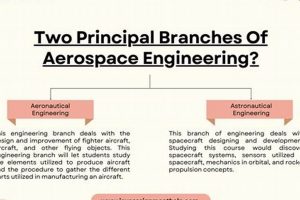
Mechanical engineering and aerospace engineering are distinct fields of engineering, although they share fundamental principles. The former focuses on the design, analysis, and manufacturing of mechanical systems, encompassing a broad range of applications from engines and power generation to robotics and manufacturing equipment. The latter concentrates on the design, development, testing, and production of aircraft, spacecraft, and related systems. For example, a mechanical engineer might design a car engine, while an aerospace engineer might design the wings of an airplane.
Understanding the differences between these two disciplines is important for students considering career paths and for employers seeking qualified engineers. Mechanical engineering offers versatility across diverse industries, while aerospace engineering provides specialized expertise within the aviation and space sectors. Historically, aerospace engineering emerged as a specialized branch of mechanical engineering, driven by advancements in flight and space exploration. The increasing complexity of aerospace systems demanded a dedicated field of study.
The following sections will delve into the core curricula, typical career opportunities, required skill sets, and potential areas of overlap for mechanical and aerospace engineers, highlighting the similarities and differences in these two vital engineering disciplines.
Guidance on Differentiating Mechanical and Aerospace Engineering
The following provides information to help distinguish between mechanical and aerospace engineering, ensuring clarity for academic and professional pursuits.
Tip 1: Focus on Core Principles: Mechanical engineering emphasizes fundamental principles applicable across diverse systems, including thermodynamics, fluid mechanics, and materials science. Aerospace engineering applies these principles specifically to aircraft and spacecraft. Examining the application of these core principles within each discipline can reveal distinctions.
Tip 2: Consider Industry Focus: Mechanical engineers find opportunities in automotive, manufacturing, energy, and robotics industries. Aerospace engineers typically work in aviation, space exploration, defense, and satellite technology sectors. Industry sector preference strongly indicates suitability for one discipline over the other.
Tip 3: Evaluate Curriculum Content: University curricula for each discipline reveal the depth of specialized knowledge. Aerospace engineering curricula incorporate aerodynamics, propulsion, orbital mechanics, and aerospace structures. Mechanical engineering programs cover a broader range of topics, including design, manufacturing, and control systems.
Tip 4: Assess Design Focus: Mechanical engineering design activities involve components such as engines, machines, and tools. Aerospace engineering design focuses on aircraft wings, rocket engines, and satellite components. Understanding specific design considerations within each discipline is crucial.
Tip 5: Analyze Career Trajectories: Mechanical engineering graduates often pursue roles in product development, manufacturing process optimization, and system design. Aerospace engineering graduates find careers in aircraft design, spacecraft propulsion systems, and flight control engineering. Examining career paths highlights different skill sets and expertise.
Tip 6: Understand Areas of Overlap: There are areas where the disciplines converge. For example, a mechanical engineer may work on aircraft engine components. However, an aerospace engineer typically designs the complete engine system and integrates it into the aircraft. Recognizing these overlaps provides a nuanced understanding.
Distinguishing between mechanical and aerospace engineering requires careful consideration of core principles, industry focus, curriculum content, design activities, and career trajectories. The analysis facilitates informed decision-making regarding academic and professional goals.
The ensuing discourse elaborates on practical implications related to the distinction between mechanical and aerospace engineering.
1. Core Principles

Core principles serve as the foundational knowledge base upon which both mechanical and aerospace engineering disciplines are built. These principles, while shared to a degree, are applied in distinctly different contexts, leading to divergent skill sets and specializations. Understanding how these principles are tailored to each field is essential for differentiating the two disciplines.
- Thermodynamics
Thermodynamics, the study of energy transfer and its effects on matter, is fundamental to both fields. Mechanical engineers apply thermodynamics to design efficient engines, power generation systems, and HVAC systems. Aerospace engineers utilize it in the design of propulsion systems such as jet engines and rockets, optimizing fuel efficiency and performance under extreme conditions. The applications differ in scale and operational environment.
- Fluid Mechanics
Fluid mechanics, the study of fluid behavior, is crucial for understanding how liquids and gases interact with solid objects. Mechanical engineers use fluid mechanics to design pumps, pipelines, and hydraulic systems. Aerospace engineers apply these principles to aerodynamics, analyzing airflow over aircraft wings to optimize lift and minimize drag, and in the design of rocket nozzles. The emphasis in aerospace is on high-speed compressible flow.
- Materials Science
Materials science, the study of the properties and applications of materials, informs the selection and utilization of appropriate materials in engineering designs. Mechanical engineers choose materials for their strength, durability, and resistance to wear in various mechanical components. Aerospace engineers require materials with high strength-to-weight ratios and resistance to extreme temperatures for aircraft and spacecraft structures. The specific requirements for extreme environments distinguish aerospace applications.
- Control Systems
Control systems engineering focuses on designing systems that regulate and control the behavior of dynamic systems. Mechanical engineers apply control systems to robotics, automated manufacturing processes, and engine management systems. Aerospace engineers use control systems for flight control systems, guidance systems for spacecraft, and autopilot systems. The level of precision and reliability required in aerospace control systems is particularly stringent.
The application of core principles, like thermodynamics, fluid mechanics, materials science, and control systems, illustrates the fundamental differences between mechanical and aerospace engineering. While both fields draw upon the same base of knowledge, the context, specific applications, and performance requirements diverge significantly, contributing to the unique identity of each discipline.
2. Industry Application

Industry application is a key differentiating factor between mechanical and aerospace engineering, demonstrating that the fields are not the same despite sharing fundamental principles. The industries that predominantly employ mechanical engineers differ significantly from those employing aerospace engineers. Mechanical engineers find opportunities across a broad spectrum of sectors, including automotive, manufacturing, energy, robotics, and consumer product development. This versatility stems from their generalized training in mechanics, thermodynamics, fluid mechanics, and materials science, allowing them to adapt to diverse engineering challenges. For instance, a mechanical engineer may design engines for automobiles, develop automated production lines for manufacturing plants, or create energy-efficient HVAC systems for buildings.
Conversely, aerospace engineers are primarily concentrated in aviation, space exploration, defense, and related satellite industries. Their specialized knowledge in aerodynamics, propulsion, aerospace structures, and orbital mechanics makes them uniquely qualified for designing, developing, and testing aircraft, spacecraft, missiles, and satellites. Examples include designing the aerodynamic profiles of aircraft wings to minimize drag, developing propulsion systems for rockets to achieve orbital velocity, or designing satellite communication systems for global connectivity. The specific demands of these industries require expertise not typically found within the general mechanical engineering domain.
In summary, industry application serves as a significant determinant in distinguishing between mechanical and aerospace engineering. The diversified nature of mechanical engineering applications contrasts sharply with the focused and specialized applications characteristic of aerospace engineering, illustrating that they are distinct engineering disciplines each catering to a unique set of industrial needs and technological challenges. This difference highlights the importance of aligning educational and career goals with the specific industry where an engineer wishes to contribute.
3. Curriculum Specificity

Curriculum specificity plays a pivotal role in distinguishing mechanical and aerospace engineering, revealing that the fields are not the same. The distinct coursework and training associated with each discipline equip graduates with different sets of skills and knowledge, tailored to meet the specific challenges within their respective industries.
- Aerodynamics and Propulsion
Aerospace engineering curricula extensively cover aerodynamics, the study of air motion and its effects on objects, and propulsion, the science of generating thrust to move vehicles through the air or space. These subjects are central to the design of aircraft wings, control surfaces, and propulsion systems like jet engines and rockets. Mechanical engineering curricula touch upon these topics but do not delve into the specialized knowledge required for aerospace applications. A mechanical engineering student may study basic fluid dynamics, while an aerospace student studies compressible flow, boundary layers, and advanced propulsion cycles.
- Aerospace Structures
Aerospace structures focuses on the design and analysis of lightweight yet strong structures capable of withstanding the extreme loads and environmental conditions encountered by aircraft and spacecraft. Aerospace curricula include courses on composite materials, finite element analysis tailored for aerospace applications, and structural dynamics with emphasis on vibration and flutter. Mechanical engineering curricula often cover structural analysis but typically lack the specific focus on aerospace materials, loading conditions, and design requirements. A mechanical engineering student might analyze a bridge structure, while an aerospace student analyzes a wing spar.
- Orbital Mechanics and Spacecraft Design
Orbital mechanics and spacecraft design are unique to aerospace engineering curricula. These subjects cover the principles of satellite motion, trajectory planning, spacecraft subsystems, and mission design. Students learn to calculate orbital parameters, design attitude control systems, and manage spacecraft power and thermal budgets. These topics are absent from mechanical engineering curricula. A mechanical engineering student might study robotics, while an aerospace student designs a satellite’s attitude control system.
- Control Systems for Flight
Both disciplines include control systems. However, aerospace engineering focuses on flight control systems which are a sub-discipline. This involves designing and implementing feedback control systems to stabilize and guide aircraft and spacecraft. This includes developing autopilot systems, navigation systems, and guidance systems for missiles and rockets. Students learn to design control laws, analyze system stability, and implement real-time control algorithms. While mechanical engineers might study control systems for manufacturing processes, aerospace engineers focus on the specific challenges of controlling vehicles in flight.
Curriculum specificity clearly differentiates mechanical and aerospace engineering. The focused coursework in aerospace engineering equips graduates with specialized knowledge and skills necessary for success in the aviation, space exploration, and defense industries. This targeted training is distinct from the broader, more generalized education provided in mechanical engineering, confirming that the fields are not interchangeable and require specific academic preparation.
4. Design Focus

The design focus within engineering disciplines serves as a defining characteristic, particularly when distinguishing between mechanical and aerospace engineering. Though both fields employ fundamental engineering principles, the application of these principles in design processes differs significantly, highlighting that the fields are not the same. The variance in design focus arises from the distinct challenges and requirements inherent in their respective industries.
- Mechanical Systems Design
Mechanical systems design encompasses the creation of components and systems involving motion, energy transfer, and force application. This field focuses on efficiency, reliability, and cost-effectiveness across diverse applications. For example, designing an internal combustion engine involves optimizing thermodynamic cycles, material selection for high-stress components, and manufacturing processes for mass production. Mechanical engineers engaged in systems design consider factors such as power generation, transmission efficiency, and minimizing environmental impact, reflecting a broad application scope beyond specialized aerospace constraints. The focus is not on flight, rather generalized mechanical function.
- Aerospace Vehicle Design
Aerospace vehicle design concentrates on creating aircraft, spacecraft, and related technologies optimized for flight within or beyond Earth’s atmosphere. This involves considering aerodynamic performance, structural integrity under extreme conditions, and propulsion systems capable of generating sufficient thrust for lift or orbital maneuvers. The design of an aircraft wing, for instance, requires a deep understanding of aerodynamics to maximize lift-to-drag ratio, ensuring stability and control across a wide range of speeds and altitudes. Material selection prioritizes high strength-to-weight ratios to minimize structural mass. Aerospace vehicle design is constrained by rigorous safety standards and performance requirements specific to flight environments, distinguishing it from general mechanical systems.
- Thermal Management Design
Thermal management design addresses the critical need to control heat generation and dissipation in engineering systems. In mechanical engineering, this might involve designing cooling systems for engines or heat exchangers for industrial processes. Aerospace applications, however, face unique challenges due to extreme temperature variations in space or high-speed flight. Designing a thermal protection system for a spacecraft re-entering Earth’s atmosphere requires specialized knowledge of heat transfer mechanisms, advanced materials, and complex modeling techniques to prevent catastrophic failure. Thermal management in aerospace engineering is often more demanding due to the extreme and variable environments.
- Control Systems Design
Control systems design involves creating feedback mechanisms to regulate the behavior of dynamic systems. Mechanical engineering applications include controlling robotic arms or optimizing manufacturing processes. In aerospace engineering, control systems are essential for maintaining stability and maneuverability of aircraft and spacecraft. Designing a flight control system requires accounting for complex aerodynamic interactions, sensor noise, and actuator limitations to ensure precise and reliable vehicle control. Aerospace control systems often operate under stringent performance requirements and must be highly robust to external disturbances, such as wind gusts or atmospheric turbulence.
The variations in design focus between mechanical and aerospace engineering underscore the fundamental differences between these disciplines. While mechanical engineers address diverse engineering challenges across numerous industries, aerospace engineers specialize in the unique requirements of flight and space environments. This specialization requires a depth of knowledge in aerodynamics, aerospace structures, and propulsion systems not typically found in mechanical engineering curricula, further solidifying the distinction that the fields, while related, are not the same.
5. Required Skills

The required skills for mechanical and aerospace engineers significantly contribute to understanding whether the fields are the same. While both disciplines share foundational competencies, specialized skills are necessary to address the distinct challenges and demands within each engineering domain.
- Analytical and Problem-Solving Abilities
Both mechanical and aerospace engineers require strong analytical and problem-solving abilities to diagnose complex technical issues, evaluate design options, and optimize system performance. However, the nature of the problems differs. Mechanical engineers might analyze the efficiency of a manufacturing process or troubleshoot a mechanical failure in an automotive engine. Aerospace engineers, on the other hand, could analyze flight data to identify aerodynamic inefficiencies or develop solutions for structural failures in aircraft components. The contextual application of these skills differentiates the two disciplines.
- Technical Proficiency in Design Software
Proficiency in computer-aided design (CAD) and simulation software is essential for both fields. However, the specific software and its applications vary. Mechanical engineers frequently use CAD software like SolidWorks or AutoCAD for designing mechanical components and systems. Aerospace engineers commonly employ software such as CATIA or ANSYS for designing and simulating aircraft structures, aerodynamic flows, and spacecraft thermal environments. While both sets of engineers design, the complexity and physics involved are vastly different.
- Knowledge of Materials Science and Manufacturing Processes
A deep understanding of materials science and manufacturing processes is critical for selecting appropriate materials and fabricating components that meet performance and durability requirements. Mechanical engineers need to be knowledgeable about a wide range of materials, including metals, polymers, and composites, and manufacturing techniques such as casting, machining, and welding. Aerospace engineers require specialized knowledge of high-performance materials like titanium alloys, carbon fiber composites, and advanced manufacturing processes used in aerospace applications, such as additive manufacturing for complex geometries. These materials are generally high cost and require a different skill set.
- Systems Thinking and Integration Skills
Systems thinking and integration skills are crucial for understanding how individual components and systems interact within a larger context. Mechanical engineers need to integrate various mechanical, electrical, and control systems in products ranging from automobiles to industrial machinery. Aerospace engineers must integrate complex subsystems, including propulsion, avionics, communications, and life support, into aircraft or spacecraft. The increased complexity of the integrated systems is why they cannot be considered the same.
The distinct skill sets demanded by mechanical and aerospace engineering underscore the specialized nature of each field. While foundational skills such as analytical thinking and software proficiency are shared, the specific knowledge domains and practical applications differ significantly. The need for specialized expertise in areas like aerospace materials, flight dynamics, and spacecraft systems in aerospace engineering, versus broader knowledge of manufacturing and machine design in mechanical engineering, reinforces that these are separate and distinct engineering disciplines.
6. Areas Overlap

The concept of overlapping areas between mechanical and aerospace engineering provides nuanced insight into the question of whether they are the same field. While distinct, these disciplines share common ground, necessitating a careful examination of where their principles and applications intersect.
- Computational Fluid Dynamics (CFD)
CFD, a tool for simulating fluid flow, is utilized extensively in both mechanical and aerospace engineering. Mechanical engineers employ CFD to optimize the design of pumps, valves, and heat exchangers. Aerospace engineers use CFD to analyze airflow around aircraft wings, through jet engines, and within rocket nozzles. Although both fields use CFD, the specific models, boundary conditions, and validation techniques differ according to the application’s distinct requirements. For example, aerospace CFD often involves high-speed compressible flow simulations absent in typical mechanical engineering applications.
- Materials Science and Engineering
Both mechanical and aerospace engineering rely on materials science for selecting suitable materials based on properties like strength, weight, and thermal resistance. Mechanical engineers consider a broad range of materials for various applications, including automotive components and manufacturing equipment. Aerospace engineers focus on high-performance materials such as titanium alloys, composites, and superalloys, which are critical for withstanding extreme temperatures and stresses in aircraft and spacecraft. While the fundamental principles remain the same, the selection criteria and specific materials of interest diverge.
- Control Systems
Control systems engineering is essential in both mechanical and aerospace disciplines, dealing with the design and implementation of systems to regulate and control dynamic processes. Mechanical engineers apply control systems in robotics, automated manufacturing lines, and HVAC systems. Aerospace engineers use control systems for aircraft flight control, satellite attitude control, and missile guidance systems. The level of precision and reliability required in aerospace applications is often higher due to the critical nature of flight safety and mission success. While a mechanical engineer may design a feedback loop for a motor, an aerospace engineer might design a redundant flight control system.
- Design and Manufacturing
Both fields involve design and manufacturing processes, from conceptualization to production. Mechanical engineers design a variety of mechanical components and systems, often focusing on cost-effectiveness and manufacturability at scale. Aerospace engineers design components for aircraft and spacecraft, emphasizing performance, weight reduction, and adherence to stringent aerospace standards. Manufacturing processes in aerospace often involve specialized techniques, such as additive manufacturing for complex geometries and precision machining for tight tolerances. Although both fields utilize design and manufacturing, the emphasis and techniques differ significantly.
The overlapping areas between mechanical and aerospace engineering illustrate shared foundational knowledge and skills. However, the application of these principles in specific contexts, the focus on particular materials, and the stringent performance requirements in aerospace engineering highlight the distinct nature of each discipline. These overlaps do not negate the fundamental differences but rather provide a basis for potential collaboration and cross-disciplinary innovation.
Frequently Asked Questions
This section addresses common queries regarding the distinctions between mechanical and aerospace engineering, providing clear and concise answers based on factual information.
Question 1: Do mechanical and aerospace engineers study the same fundamental subjects?
Both mechanical and aerospace engineering curricula include foundational subjects such as thermodynamics, fluid mechanics, materials science, and control systems. However, aerospace engineering programs delve deeper into specialized topics like aerodynamics, propulsion, orbital mechanics, and aerospace structures, tailoring these fundamental subjects to the specific demands of flight and space environments.
Question 2: Can a mechanical engineer work in the aerospace industry?
While mechanical engineers possess transferable skills applicable to certain roles within the aerospace industry, specialized aerospace engineering knowledge is often required for positions involving aircraft design, propulsion systems, and spacecraft development. Mechanical engineers may find opportunities in aerospace-related manufacturing or component design, but typically require further specialized training or experience.
Question 3: What is the primary difference in the design focus between the two disciplines?
Mechanical engineering design focuses on a broad range of mechanical systems, from engines and manufacturing equipment to consumer products and robotics. Aerospace engineering design centers specifically on aircraft, spacecraft, and related systems optimized for flight within or beyond Earth’s atmosphere. This specialization necessitates a deep understanding of aerodynamics, aerospace structures, and propulsion systems.
Question 4: Are the career paths interchangeable between mechanical and aerospace engineering?
Career paths are not entirely interchangeable. Mechanical engineers find opportunities in diverse industries, while aerospace engineers primarily work in aviation, space exploration, and defense sectors. While a transition may be possible with further education or specialized experience, the core skill sets and industry knowledge are typically distinct.
Question 5: Does one field require more advanced mathematical skills than the other?
Both mechanical and aerospace engineering require strong mathematical skills. However, aerospace engineering often involves more complex mathematical modeling due to the intricacies of fluid dynamics, orbital mechanics, and structural analysis under extreme conditions. The mathematical rigor may be more pronounced in specialized aerospace applications.
Question 6: How does the required software proficiency differ between the two fields?
While both mechanical and aerospace engineers use CAD and simulation software, the specific applications and software packages often differ. Aerospace engineers frequently utilize software such as CATIA and ANSYS for simulating complex aerodynamic flows and structural behavior, whereas mechanical engineers may rely on software like SolidWorks and AutoCAD for designing mechanical components and systems. The software requirements are driven by the specific design and analysis needs of each discipline.
In summary, while mechanical and aerospace engineering share foundational principles, their specialized curricula, industry applications, design foci, required skills, and typical career paths distinguish them as distinct engineering disciplines.
The subsequent section will provide concluding remarks, reiterating the key differences and emphasizing the importance of understanding these distinctions for academic and professional pursuits.
Defining Engineering Disciplines
This exploration of whether mechanical and aerospace engineering are the same concludes that they are distinct fields. While sharing foundational principles in physics, mathematics, and engineering science, the application of these principles diverges significantly. Aerospace engineering specializes in the design, analysis, and manufacturing of aircraft, spacecraft, and related systems, focusing on aerodynamics, propulsion, and aerospace structures. Mechanical engineering encompasses a broader range of mechanical systems, from engines and power generation to manufacturing equipment and robotics. This specialization necessitates different curricula, skills, and career paths.
Understanding these distinctions is critical for students charting their academic trajectory and for professionals seeking to optimize their career advancement. The nuanced understanding of each field’s strengths will enable informed decisions, promoting excellence and innovation within the respective engineering domains. Continued advancements in technology will likely further differentiate these fields, underscoring the importance of informed specialization.