The field encompasses the design, development, testing, and production of aircraft and spacecraft. Professionals in this discipline apply principles from physics, mathematics, and engineering to create machines that operate within and beyond the Earth’s atmosphere. Their work includes optimizing aerodynamic performance, ensuring structural integrity, developing propulsion systems, and integrating complex electronic controls. For example, they might design a more fuel-efficient airplane wing or develop the guidance system for a satellite.
This endeavor is vital to advancements in transportation, communication, national security, and scientific exploration. Throughout history, innovations in this domain have revolutionized travel and allowed for unprecedented observation of our planet and the universe. This field also drives economic growth, creating opportunities in manufacturing, research, and development while simultaneously enhancing the quality of life through improved technologies.
The remainder of this document will elaborate on the specific areas of focus within the engineering specialty, examine the educational requirements for pursuing a career in this domain, and outline potential career paths available to graduates.
Guidance on Aerospace Engineering Endeavors
The following recommendations are designed to provide insight into the practical aspects associated with this type of engineering. Successful navigation of its complexities requires a firm grasp of both theoretical principles and practical application.
Tip 1: Prioritize a Strong Foundation in Mathematics and Physics: A comprehensive understanding of calculus, differential equations, linear algebra, and physics is crucial. These disciplines form the bedrock upon which all design and analytical work is constructed.
Tip 2: Develop Proficiency in Computer-Aided Design (CAD) and Simulation Software: Modern engineering relies heavily on digital tools. Familiarity with software packages such as SolidWorks, CATIA, ANSYS, and MATLAB is essential for design, analysis, and simulation purposes.
Tip 3: Cultivate a Systems-Thinking Approach: Any airborne or spaceborne vehicle is a complex system of interconnected components. Successful engineering requires the ability to consider the interaction between subsystems and the overall impact of design decisions.
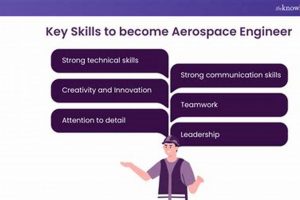
Tip 4: Emphasize Communication Skills: The ability to articulate technical concepts clearly and concisely is paramount. Effective communication is essential for collaborating with multidisciplinary teams, presenting design reviews, and documenting findings.
Tip 5: Seek Practical Experience Through Internships and Research Opportunities: Hands-on experience is invaluable. Internships and research positions provide opportunities to apply theoretical knowledge to real-world problems and gain practical skills.
Tip 6: Stay Abreast of Emerging Technologies: The field is constantly evolving. Continuously monitor advancements in areas such as additive manufacturing, advanced materials, and autonomous systems to remain competitive.
Tip 7: Focus on a Specific Area of Specialization: Due to the breadth of the field, concentrating on a particular area of interest, such as aerodynamics, propulsion, or control systems, can lead to deeper expertise and greater career opportunities.
By adhering to these principles, individuals can enhance their prospects for success and contribute meaningfully to the field. These guidelines provide a framework for developing the skills and knowledge necessary to excel in this challenging and rewarding career path.
The ensuing sections will delve deeper into the educational requirements and career prospects.
1. Aircraft Design

Aircraft design forms a cornerstone of the overall effort within the field. It represents the practical application of theoretical knowledge to create functional, safe, and efficient vehicles for atmospheric flight, constituting a significant aspect.
- Aerodynamic Performance
The shape and form of an aircraft directly impact its aerodynamic efficiency. Engineers analyze airflow patterns, design airfoils, and optimize control surfaces to minimize drag and maximize lift. This directly relates to fuel efficiency, flight stability, and overall performance characteristics, impacting everything from commercial aviation to military aircraft.
- Structural Integrity
Ensuring the aircraft can withstand the stresses of flight is paramount. Engineers perform stress analyses, select appropriate materials, and design structural components to resist forces generated during flight maneuvers, turbulence, and landing. Failure to adequately address structural integrity can have catastrophic consequences.
- Propulsion Systems
The selection and integration of propulsion systems are crucial to aircraft performance. Engineers consider factors such as thrust-to-weight ratio, fuel consumption, and noise levels when choosing and integrating engines. The propulsion system directly influences the aircraft’s range, speed, and payload capacity. Examples include gas turbine engines, turboprops, and electric propulsion systems.
- Control Systems
Modern aircraft rely on sophisticated control systems to maintain stability and allow pilots to maneuver the aircraft. These systems involve sensors, actuators, and computers that work together to adjust control surfaces and manage engine performance. Fly-by-wire systems are a common example, enhancing safety and maneuverability.
These facets highlight the intricate relationship. The design process requires a holistic approach, considering aerodynamic performance, structural integrity, propulsion systems, and control systems in conjunction. Each aspect directly influences the overall effectiveness and safety of the vehicle, demonstrating the breadth and depth of the engineering effort required.
2. Spacecraft development

Spacecraft development is a critical component of the broader realm. It involves the application of engineering principles to design, construct, test, and operate vehicles intended for use in the space environment. The significance of spacecraft development stems from its enabling role in scientific discovery, communication, national security, and resource exploration. Without this capacity, advancements in space-based technologies and the benefits they provide would be unattainable. For instance, the design of the James Webb Space Telescope required engineers to overcome significant thermal and mechanical challenges to allow for unprecedented astronomical observations.
The process necessitates a multi-faceted approach. Engineers must consider factors such as orbital mechanics, radiation shielding, power generation, and thermal management. Launch vehicles must be integrated with the spacecraft. Control systems must be developed and deployed for attitude determination and control, as well as autonomous navigation. Furthermore, robust communication systems that can transmit data across vast distances are required. Consider the ongoing efforts to develop spacecraft capable of transporting humans to Mars; these involve tackling intricate problems related to life support, propulsion, and planetary entry, descent, and landing. These examples highlight the complex considerations in designing space-faring vehicles.
In conclusion, spacecraft development is an integral area within the overall aerospace engineering scope, and the continuous innovation in this area directly impacts advancements in technology and space exploration, impacting global communication infrastructure, weather monitoring, and a deeper understanding of the universe and our place within it.
3. System integration

System integration is a critical facet. It represents the process of bringing together individual components or subsystems to function as a cohesive and unified whole. This activity is particularly crucial given the complexity and interdependencies inherent in aerospace vehicles. The ability to effectively integrate systems is paramount to achieving operational objectives and ensuring the reliability and safety of flight operations.
- Component Compatibility
Ensuring compatibility between diverse components is fundamental. This involves addressing physical, electrical, and software interfaces to ensure seamless interaction. For example, integrating a new radar system into an existing aircraft requires careful consideration of power requirements, data communication protocols, and potential electromagnetic interference. Improper component matching can result in system malfunction or even catastrophic failure.
- Interface Management
Effective interface management is essential for coordinating interactions between subsystems. This necessitates clearly defined specifications for data transfer, signal timing, and power distribution. Consider the integration of a flight control system with an autopilot; the autopilot must be able to accurately interpret data from the flight control system and issue commands without creating conflicts. Standardized communication protocols and rigorous testing are crucial.
- Performance Optimization
System integration aims to optimize overall performance by carefully balancing the capabilities of individual components. This may involve trade-offs between weight, power consumption, and functionality. For example, integrating a more powerful engine may improve performance but also increase fuel consumption and structural stress. System-level modeling and simulation are used to predict performance and identify potential bottlenecks.
- Testing and Validation
Rigorous testing and validation are necessary to verify that the integrated system meets performance requirements and safety standards. This includes laboratory testing, flight testing, and simulations. For example, before a new aircraft is certified, it undergoes extensive testing to ensure that all systems function correctly under a variety of flight conditions. Comprehensive testing reduces the risk of in-flight failures and ensures passenger safety.
The intricate nature of integration necessitates a holistic understanding of all constituent components and their interactions. Successful system integration is not simply about connecting parts; it’s about ensuring that all parts work together harmoniously to achieve the desired performance characteristics. The aforementioned concepts are central in successfully building and operating both airborne and spaceborne vehicles.
4. Materials research

Materials research is a critical enabler in advancing the capabilities within the field. The development and application of novel materials directly influences the performance, safety, and efficiency of both aircraft and spacecraft, making it an indispensable element.
- High Strength-to-Weight Ratio Materials
The pursuit of materials with high strength-to-weight ratios is a constant driver in aerospace engineering. Lighter materials translate to reduced fuel consumption, increased payload capacity, and enhanced maneuverability. For example, the widespread adoption of carbon fiber composites in aircraft structures has significantly improved fuel efficiency compared to traditional aluminum alloys. The implications extend to spacecraft, where minimizing weight is crucial for launch costs and mission durations.
- High-Temperature Materials
Components in propulsion systems and spacecraft re-entry shields endure extreme temperatures. Materials research focuses on developing alloys and ceramics capable of withstanding these conditions without degradation. Turbine blades in jet engines, for instance, are manufactured from superalloys designed to maintain their strength and shape at temperatures exceeding the melting point of conventional metals. Likewise, thermal protection systems on spacecraft employ ceramic tiles to dissipate heat generated during atmospheric re-entry.
- Corrosion-Resistant Materials
Aerospace vehicles operate in harsh environments where corrosion can compromise structural integrity. Materials research aims to develop alloys and coatings resistant to corrosion from exposure to salt water, atmospheric pollutants, and other corrosive agents. For instance, aluminum alloys used in aircraft fuselages are often treated with protective coatings to prevent corrosion that could lead to structural failure. The increased lifespan of aerospace components directly translates to reduced maintenance costs and improved safety.
- Radiation-Shielding Materials
Spacecraft operating beyond Earth’s atmosphere are exposed to high levels of radiation, which can damage electronic equipment and pose risks to astronauts. Materials research investigates shielding materials that can effectively block or attenuate harmful radiation. These materials range from specialized polymers to dense metals, and their integration into spacecraft design is essential for ensuring mission success and crew safety during long-duration spaceflights.
These facets illustrate the direct connection. Advances in materials directly translate to improvements in aircraft and spacecraft performance, durability, and safety. Continuous innovation in materials research is essential for pushing the boundaries of what is possible in air and space travel, contributing to more efficient, reliable, and capable aerospace systems.
5. Mission analysis

Mission analysis is a core element of the work within the engineering discipline. It provides a structured framework for defining mission objectives, evaluating potential solutions, and determining the feasibility of proposed aerospace projects. This analytical approach is fundamental to ensuring that engineered systems meet specific performance criteria and contribute effectively to overall mission goals.
- Trajectory Optimization
Trajectory optimization involves determining the most efficient flight path for a vehicle to reach its destination. This process considers factors such as fuel consumption, flight time, and gravitational forces. For example, optimizing the trajectory of a satellite launch can minimize the amount of propellant required to reach the desired orbit, thereby increasing the payload capacity. The selection of an optimal trajectory is a critical decision that dictates the overall mission efficiency and success. It’s a foundational aspect of what dictates capabilities in aerospace engineering.
- Payload Capacity Assessment
Assessing payload capacity involves determining the maximum weight and volume of equipment or cargo that a vehicle can carry while still meeting performance requirements. This assessment takes into account factors such as structural limitations, propulsion system capabilities, and aerodynamic drag. For instance, estimating the payload capacity of a cargo aircraft involves balancing the weight of the cargo with the need to maintain acceptable flight performance. Exceeding payload limits can compromise safety and lead to structural failure. An accurate payload capacity assessment directly impacts the design and operational constraints of aerospace systems.
- Risk Assessment and Mitigation
Risk assessment and mitigation involves identifying potential hazards and developing strategies to minimize their impact. This includes analyzing potential system failures, environmental factors, and human errors. For example, conducting a risk assessment for a manned space mission involves identifying potential hazards such as equipment malfunctions, radiation exposure, and micrometeoroid impacts. Mitigation strategies may include redundant systems, radiation shielding, and emergency procedures. This comprehensive evaluation enables engineers to proactively address potential problems and improve mission safety.
- Cost-Benefit Analysis
Cost-benefit analysis involves evaluating the costs and benefits associated with different mission design options. This assessment takes into account factors such as development costs, operational expenses, and potential revenue. For example, conducting a cost-benefit analysis for a new commercial aircraft involves comparing the costs of developing and manufacturing the aircraft with the potential revenue from passenger fares and cargo transport. This analysis helps decision-makers determine whether a project is economically viable and justifies the investment of resources. A rigorous cost-benefit analysis is integral to the development and deployment decisions.
These facets are central to the activities within the engineering specialization. Trajectory optimization enhances fuel efficiency, payload capacity assessment defines operational limits, risk assessment ensures safety, and cost-benefit analysis drives economic viability. These analyses collectively shape the design, development, and execution, ultimately advancing capabilities in air and space travel.
Frequently Asked Questions Regarding Aerospace Engineering Activities
The following section addresses common inquiries related to the scope and responsibilities of this engineering field. These questions aim to clarify misconceptions and provide a deeper understanding of the various roles and functions within the domain.
Question 1: Does aerospace engineering solely involve designing aircraft and spacecraft?
While aircraft and spacecraft design are core components, the field also encompasses areas such as propulsion systems, materials science, control systems, and mission analysis. It is a multidisciplinary field requiring knowledge of aerodynamics, thermodynamics, structural mechanics, and electronics.
Question 2: Is a background in physics absolutely necessary to pursue a career in aerospace engineering?
Yes, a solid foundation in physics is essential. Principles of mechanics, thermodynamics, electromagnetism, and fluid dynamics are foundational to understanding the behavior of aircraft and spacecraft. Students without a strong physics background may struggle to grasp more advanced concepts.
Question 3: How crucial is computer programming to this branch of engineering?
Computer programming skills are increasingly important. Engineers utilize programming languages such as MATLAB, Python, and C++ for modeling, simulation, data analysis, and control systems development. A strong programming background is beneficial for solving complex problems and automating engineering tasks.
Question 4: Are there opportunities for specialization within the field?
Yes, numerous specialization options exist, including aerodynamics, propulsion, structures, control systems, avionics, and space systems engineering. Specialization allows engineers to develop in-depth knowledge in a specific area of interest and contribute to niche areas of innovation.
Question 5: Is employment limited to government agencies and large aerospace corporations?
While government agencies like NASA and large corporations such as Boeing and Lockheed Martin are major employers, opportunities also exist in smaller aerospace companies, research institutions, and consulting firms. The diverse nature of aerospace activities creates opportunities in various sectors.
Question 6: How does aerospace engineering contribute to fields outside of aviation and space exploration?
Aerospace engineering principles and technologies are often adapted for use in other industries, including automotive, renewable energy, and biomedical engineering. For example, aerodynamic principles are applied to improve vehicle design, and composite materials developed for aerospace applications are used in prosthetics.
In summary, this engineering activity involves a wide range of responsibilities, demanding a solid understanding of fundamental science and math principles. With various avenues for employment and countless specializations, aerospace engineering presents many career possibilities.
The following segment will cover educational requirements and career paths.
Conclusion
This document has detailed the core functions involved with aerospace engineering. The comprehensive efforts of the engineers, covering design, development, testing, and production in both aeronautics and astronautics, are central to technological advancement. Disciplines that impact include: aircraft design, spacecraft development, system integration, materials research, and mission analysis, all contributing significantly to progress in diverse sectors.
Understanding the multifaceted activities is essential for current practitioners and aspiring professionals. The continuous pursuit of innovation within aerospace engineering remains vital for enhancing capabilities in air and space travel and for addressing future global challenges.