The field encompassing the design, development, testing, and production of aircraft and spacecraft offers a diverse array of career paths. These roles involve applying scientific and technological principles to create innovative solutions for air and space travel, defense systems, and related technologies. Examples include designing efficient aircraft wings, developing propulsion systems for rockets, or analyzing the structural integrity of spacecraft components.
Careers in this sector are crucial for advancing technological capabilities in aviation and space exploration, contributing to national security, and driving economic growth through innovation. Historically, advancements in aeronautics and astronautics have been pivotal in shaping modern transportation, communication, and scientific understanding of the universe.
This article will explore various specializations within this vast domain, providing a glimpse into the responsibilities, required skills, and potential career trajectories associated with roles such as aerodynamicist, propulsion engineer, structural engineer, and avionics specialist, among others.
Successfully pursuing opportunities in the aerospace engineering sector requires strategic planning and focused skill development. The following guidelines provide a framework for individuals seeking to enter or advance within this competitive field.
Tip 1: Specialization is Key: Focus on developing expertise in a specific area, such as aerodynamics, propulsion, structures, or avionics. Deep knowledge in a chosen area enhances marketability and allows for contributions to specialized projects.
Tip 2: Cultivate Strong Analytical Skills: Proficiency in mathematical modeling, data analysis, and problem-solving is paramount. These skills are fundamental for addressing complex engineering challenges and optimizing system performance.
Tip 3: Master Relevant Software and Tools: Familiarity with industry-standard software for CAD, simulation, and analysis is essential. Proficiency in tools like MATLAB, ANSYS, or similar programs increases efficiency and effectiveness in design and analysis tasks.
Tip 4: Gain Practical Experience: Internships and research opportunities provide invaluable hands-on experience. Participating in real-world projects allows for the application of theoretical knowledge and the development of practical skills.
Tip 5: Network Strategically: Attend industry conferences, join professional organizations (e.g., AIAA), and connect with professionals in the field. Networking expands knowledge, provides access to opportunities, and facilitates mentorship.
Tip 6: Pursue Advanced Education: A Master’s degree or Ph.D. can significantly enhance career prospects, particularly for roles involving research and development or specialized engineering. Advanced degrees often lead to higher-level positions and increased responsibilities.
Tip 7: Emphasize Communication Skills: The ability to clearly communicate technical concepts, both verbally and in writing, is crucial for effective collaboration and project management. Develop skills in technical writing, presentations, and team communication.
By prioritizing specialization, cultivating analytical skills, mastering relevant software, gaining practical experience, networking strategically, pursuing advanced education, and emphasizing communication, individuals can significantly improve their prospects in this demanding yet rewarding field.
The following sections will delve into specific roles and responsibilities associated with different aerospace engineering disciplines, providing a deeper understanding of the required skills and potential career paths available.
1. Aerodynamics Expertise

Aerodynamics expertise forms a cornerstone of numerous roles within aerospace engineering. This specialization focuses on the study of air and its motion, particularly as it interacts with solid objects. The design and performance of aircraft, spacecraft, and even ground vehicles are fundamentally dependent on understanding and manipulating aerodynamic principles. Consequently, a deep knowledge of aerodynamics is crucial for various positions, influencing factors such as lift, drag, stability, and control.
Specific career paths that heavily rely on this expertise include aerodynamicists, who are directly involved in designing airfoils, wings, and entire aircraft configurations to optimize flight characteristics. Performance engineers utilize aerodynamic data to predict and enhance aircraft efficiency, range, and speed. Flight test engineers analyze flight data to validate aerodynamic models and identify areas for improvement. For instance, the design of a new aircraft wing requires extensive computational fluid dynamics (CFD) simulations and wind tunnel testing to refine its aerodynamic profile, minimizing drag and maximizing lift. Similarly, spacecraft designers leverage aerodynamic knowledge to manage atmospheric entry and ensure stable flight within the upper atmosphere.
The practical significance of aerodynamics expertise lies in its direct impact on aircraft and spacecraft safety, performance, and fuel efficiency. Challenges in this field often involve balancing competing design requirements, such as minimizing drag while maintaining sufficient lift at various speeds and altitudes. Understanding the role of aerodynamics is essential for individuals seeking careers related to aircraft design, testing, and analysis, as it forms the basis for informed decision-making and innovation in the aerospace industry.
2. Propulsion Systems Design

Propulsion systems design is a critical element within the spectrum of aerospace engineering careers. This specialization concentrates on creating and enhancing systems that generate thrust, enabling aircraft and spacecraft to move through the atmosphere or space. A robust comprehension of thermodynamics, fluid mechanics, and combustion is indispensable for professionals in this domain.
- Rocket Engine Design
Rocket engine design involves creating engines for spacecraft and missiles, which necessitate maximizing thrust and efficiency. Roles in this area entail selecting propellants, designing combustion chambers, and managing heat transfer. For example, engineers working on a satellite launch vehicle must ensure the engine can deliver the required thrust for liftoff and orbital insertion. This facet directly correlates with positions such as rocket propulsion engineer and combustion specialist.
- Gas Turbine Engine Design
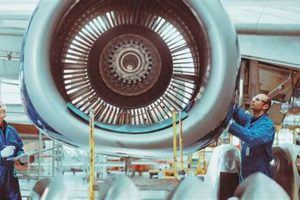
Gas turbine engine design focuses on developing engines for aircraft, prioritizing fuel efficiency, reliability, and power output. Tasks include compressor and turbine blade design, fuel injection system development, and noise reduction strategies. Commercial aircraft engines are a prime example, requiring continuous optimization for improved performance and reduced emissions. This facet is relevant to roles such as turbine engine designer and performance analyst.
- Alternative Propulsion Systems
Alternative propulsion systems explore innovative technologies like electric propulsion, ion drives, and ramjets. These systems aim to improve efficiency, reduce environmental impact, or enable novel mission profiles. For instance, ion drives are used in deep-space missions to provide continuous, low-thrust propulsion over extended periods. This specialization connects to roles such as advanced propulsion engineer and plasma physicist.
- Combustion and Fuel Systems
Combustion and fuel systems focuses on the efficient and stable burning of fuel. The design of fuel injectors, flame holders and combustion chambers are critical to the design of a propulsion system. The types of roles associated with this is a combustion engineer.
These facets of propulsion systems design are central to the spectrum of aerospace engineering roles. From enhancing fuel efficiency in commercial aviation to enabling deep-space exploration, propulsion engineers play a pivotal role. The ongoing evolution of propulsion technologies ensures continued demand for specialized expertise in this critical field.
3. Structural Integrity Analysis

Structural integrity analysis is paramount within the domain of aerospace engineering, ensuring the safety and reliability of aircraft and spacecraft. This specialized area involves assessing the ability of aerospace structures to withstand various loads and environmental conditions encountered during flight and operation. A thorough understanding of materials science, mechanics, and finite element analysis is critical for professionals engaged in this domain.
- Stress Analysis
Stress analysis focuses on determining the distribution of internal stresses within a structure subjected to external loads. This process involves calculating stress concentrations at critical points, such as joints and cutouts, to prevent premature failure. For example, stress analysis is used to evaluate the wing-to-fuselage connection of an aircraft, ensuring it can withstand the aerodynamic forces experienced during flight. This directly informs the role of a stress engineer.
- Fatigue Analysis
Fatigue analysis assesses the cumulative damage caused by repeated loading cycles, which can lead to crack initiation and propagation over time. This analysis is crucial for predicting the lifespan of components and establishing maintenance schedules. A common example is the fatigue analysis of turbine blades in jet engines, which are subjected to high-frequency vibrations and thermal stresses. This process is the domain of a fatigue analysis engineer.
- Fracture Mechanics
Fracture mechanics deals with the behavior of materials containing cracks or flaws, predicting the critical crack size that would lead to catastrophic failure. This analysis is essential for evaluating the safety of structures with pre-existing defects and developing inspection protocols. For instance, fracture mechanics is used to assess the integrity of pressure vessels on spacecraft, ensuring they can safely contain pressurized gases. Such tasks are preformed by fracture mechanics engineers.
- Finite Element Analysis (FEA)
Finite Element Analysis is a numerical method used to predict how a structure will react to forces, vibration, heat, fluid flow, and other physical effects. FEA involves dividing a complex structure into small elements, then solving for the behavior of each element. For example, FEA is used to analyze the structural integrity of a spacecraft during launch, simulating the intense vibrations and stresses it experiences. The tasks are performed by FEA Analysts.
These facets of structural integrity analysis directly correlate with various roles in aerospace engineering, including structural analysts, stress engineers, materials scientists, and design engineers. By ensuring the structural integrity of aerospace vehicles, these professionals contribute to the safety, reliability, and longevity of aircraft and spacecraft, thereby advancing the capabilities of air and space travel.
4. Avionics Integration

Avionics integration constitutes a critical domain within aerospace engineering, focusing on the design, development, and implementation of electronic systems that control and manage aircraft and spacecraft operations. These systems encompass navigation, communication, flight control, radar, and electronic warfare capabilities. Careers in this sector demand a strong foundation in electrical engineering, computer science, and control systems, underlining the multidisciplinary nature of these positions. Real-world examples include the integration of flight management systems that guide aircraft along pre-programmed routes, ensuring efficient navigation and fuel consumption. The effective integration of these systems is paramount for maintaining aircraft safety, optimizing performance, and enabling advanced capabilities.
Further practical applications include the development of integrated sensor systems that provide pilots with comprehensive situational awareness, enhancing safety during adverse weather conditions or in congested airspace. Additionally, avionics engineers are involved in the design and testing of autonomous flight control systems, which are increasingly prevalent in unmanned aerial vehicles (UAVs) and are being explored for future commercial aircraft. This integration necessitates careful consideration of system compatibility, data processing speed, and cybersecurity to prevent vulnerabilities. For example, the integration of anti-jamming communication systems enhances the resilience of military aircraft against electronic warfare threats, maintaining secure communication channels.
In summary, avionics integration is a vital aspect of numerous aerospace engineering positions, directly impacting the functionality, safety, and overall performance of aircraft and spacecraft. Challenges in this field include the increasing complexity of electronic systems, the need for robust cybersecurity measures, and the demand for efficient integration across diverse platforms. Understanding the intricacies of avionics integration is essential for individuals seeking careers in the design, development, and testing of modern aerospace vehicles.
5. Research and Development
Research and Development (R&D) forms the bedrock of advancement within the aerospace engineering sector. The pursuit of novel technologies, improved materials, and enhanced system designs is fundamentally driven by dedicated research efforts. Numerous positions within the field are directly involved in R&D, pushing the boundaries of aerospace capabilities. A direct consequence of successful R&D is the creation of more efficient, safer, and higher-performing aircraft and spacecraft. For instance, the development of composite materials, a result of extensive materials science research, has led to lighter and stronger aircraft structures, improving fuel efficiency and payload capacity. Understanding the importance of R&D is therefore crucial for anyone seeking to comprehend the diverse range of positions within aerospace engineering.
The practical applications of R&D in aerospace are vast. From the development of advanced propulsion systems that enable faster and more efficient space travel to the design of autonomous flight control systems that enhance safety and reduce pilot workload, R&D efforts directly translate into tangible improvements in aerospace technology. The ongoing research into hypersonic flight is another example, aiming to revolutionize air travel and access to space. Positions like research engineer, scientist, and principal investigator are all instrumental in driving these advancements, conducting experiments, analyzing data, and developing new theories and models. These roles often require advanced degrees and specialized knowledge, reflecting the complex nature of aerospace R&D.
In summary, R&D is an integral component of many positions within aerospace engineering, playing a critical role in pushing the boundaries of what is possible. The challenges associated with R&D, such as managing risk, securing funding, and navigating regulatory hurdles, are significant, but the potential rewards are immense. By fostering innovation and driving technological progress, R&D ensures that aerospace engineering remains at the forefront of scientific and engineering endeavors, continually shaping the future of air and space travel.
Frequently Asked Questions
The following section addresses common inquiries regarding positions within the aerospace engineering sector, providing clarity on roles, responsibilities, and career progression.
Question 1: What fundamental skills are essential for success in positions associated with aerospace engineering?
A strong foundation in mathematics, physics, and computer science is paramount. Proficiency in CAD software, simulation tools, and data analysis techniques is also crucial. Furthermore, effective communication and teamwork skills are essential for collaboration on complex projects.
Question 2: How does specialization impact career opportunities in aerospace engineering?
Specializing in a specific area, such as aerodynamics, propulsion, or structural analysis, can significantly enhance career prospects. Deep expertise in a chosen area allows for focused contributions and increased marketability in a competitive job market.
Question 3: What are the typical educational requirements for positions within aerospace engineering?
A bachelor’s degree in aerospace engineering or a related field (e.g., mechanical engineering, electrical engineering) is generally required for entry-level positions. Advanced degrees (master’s or doctorate) are often necessary for research-oriented roles and leadership positions.
Question 4: How important is practical experience for securing a position in aerospace engineering?
Practical experience gained through internships, co-op programs, or research projects is highly valued by employers. Hands-on experience demonstrates the ability to apply theoretical knowledge to real-world problems and contributes to a more competitive resume.
Question 5: What are the common career progression paths within aerospace engineering?
Entry-level positions often involve assisting senior engineers with design, analysis, and testing tasks. With experience and expertise, individuals can progress to roles such as project manager, lead engineer, or technical specialist. Management positions may also be pursued with further experience and leadership development.
Question 6: What are the potential long-term career outlooks for those in various roles within aerospace engineering?
The long-term career outlook for professionals in aerospace engineering is generally positive, driven by ongoing demand for advancements in aviation, space exploration, and defense technologies. However, economic conditions and government funding policies can impact specific sectors and specializations.
This FAQ section provides valuable insight into the necessary skills, educational paths, and career trajectories for individuals seeking opportunities in this innovative field. Continued learning and adaptation to emerging technologies are crucial for sustained success.
The subsequent sections will provide additional valuable and helpful information about aerospace engineering careers.
Conclusion
This examination of various positions within the aerospace engineering sector underscores the breadth and depth of opportunities available. From aerodynamics and propulsion to structural analysis and avionics integration, each specialization contributes uniquely to the design, development, and operation of aircraft and spacecraft. A commitment to research and development ensures continuous innovation and advancement within this dynamic field.
The competencies and considerations outlined serve as a foundational framework for individuals contemplating or actively pursuing careers in this domain. Continued advancements in aerospace technology present both challenges and significant opportunities for those prepared to contribute to the future of air and space travel. Further exploration into specialized areas is encouraged for those seeking to maximize their impact on the industry.