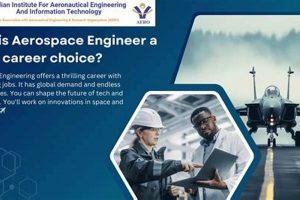
The field concerned with the design, development, testing, and production of aircraft and spacecraft offers a wide range of professional opportunities. These positions span various disciplines, from engineering and science to business and technology, all contributing to the advancement of air and space travel. For example, individuals can find careers designing aircraft wings, developing propulsion systems, or managing the logistics of a satellite launch.
The sector is critical to national defense, global communication, and scientific discovery. Advancements driven by professionals in this area have led to faster and more efficient air travel, enhanced satellite communication capabilities, and a deeper understanding of the universe. Historically, the pursuit of flight and space exploration has fueled innovation and spurred technological breakthroughs that benefit society as a whole.
The following sections will explore the different career paths available, outlining the required skills, typical responsibilities, and potential for growth within this dynamic and impactful industry.
Successful entry and advancement in the aviation and space sector necessitate strategic planning and targeted development. The following recommendations provide guidance for individuals seeking to establish and grow their careers.
Tip 1: Acquire a Strong Technical Foundation: A solid grounding in mathematics, physics, and engineering principles is crucial. Formal education, such as a bachelor’s or master’s degree in aerospace engineering, mechanical engineering, or a related field, provides the necessary theoretical knowledge and practical skills.
Tip 2: Develop Specialized Expertise: The sector encompasses diverse specializations, including aerodynamics, propulsion, structures, and avionics. Focusing on a specific area allows for in-depth knowledge acquisition and increased marketability. For instance, concentrating on composite materials design can make an individual highly sought after.
Tip 3: Pursue Internships and Co-op Opportunities: Gaining practical experience through internships or cooperative education programs is invaluable. These experiences provide exposure to real-world challenges and allow for the application of theoretical knowledge in a professional setting. They also facilitate networking with industry professionals.
Tip 4: Cultivate Essential Soft Skills: Technical proficiency alone is insufficient. Effective communication, teamwork, problem-solving, and leadership skills are essential for success. Participating in group projects and seeking opportunities to lead teams can help develop these critical attributes.
Tip 5: Maintain Continuous Learning: The aviation and space domain is constantly evolving. Staying abreast of the latest advancements through conferences, workshops, and professional publications is crucial. Obtaining certifications and pursuing advanced degrees can further enhance expertise and career prospects.
Tip 6: Network Strategically: Building a professional network within the industry can open doors to opportunities and provide valuable insights. Attending industry events, joining professional organizations, and connecting with individuals on platforms like LinkedIn can facilitate network development.
Tip 7: Tailor Your Resume and Cover Letter: When applying for positions, it’s imperative to customize these documents to align with the specific role requirements and employer needs. Highlight relevant skills, experiences, and achievements, demonstrating a clear understanding of how one can contribute to the organization.
Adhering to these recommendations can significantly enhance an individual’s prospects of securing and excelling in various roles across the aerospace industry. A combination of strong technical skills, practical experience, and professional development is the key to a successful long-term career.
The subsequent sections will delve deeper into specific roles, qualifications, and pathways for career advancement in the aviation and space sector.
1. Engineering Design

Engineering design forms the bedrock of aviation and space sector careers. It’s where theoretical concepts transform into tangible aircraft and spacecraft, driving innovation and enabling the advancement of flight and space exploration.
- Aerodynamics Specialist
This role centers on studying how air moves around aircraft. Aerodynamics Specialists design airfoils, control surfaces, and entire aircraft shapes to minimize drag, maximize lift, and ensure stable flight. For example, they might use computational fluid dynamics to simulate airflow over a new wing design, optimizing it for fuel efficiency and maneuverability. Such contributions are essential for the design of both commercial airliners and high-performance military aircraft.
- Structural Engineer
Structural Engineers ensure aircraft and spacecraft can withstand extreme stresses and strains. They analyze load-bearing components, select appropriate materials, and design robust structures that meet stringent safety requirements. Consider the design of a spacecraft heat shield, which must endure extreme temperatures during atmospheric reentry. This requires careful selection of heat-resistant materials and a structural design that can withstand immense pressure.
- Propulsion Systems Engineer
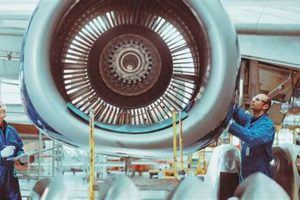
These engineers focus on designing and developing the engines that power aircraft and spacecraft. They work on improving engine efficiency, reducing emissions, and increasing thrust. The development of more efficient jet engines for commercial aviation, or the design of rocket engines for interplanetary travel, falls under their purview. These advancements directly impact the feasibility of air travel and space exploration.
- Avionics Engineer
Avionics Engineers design and integrate the electronic systems used in aircraft and spacecraft, including navigation, communication, and flight control systems. This encompasses everything from designing the autopilot system on a commercial airliner to developing the communication systems for a satellite. Their work ensures safe and reliable operation of complex flight systems.
These specialized engineering roles illustrate the breadth of opportunities available. Each contributes to the broader objective of designing and building safer, more efficient, and more capable aircraft and spacecraft. The skills and knowledge developed within these roles are highly valued across the aerospace sector, providing diverse and rewarding career paths for aspiring engineers.
2. Research and Development

Research and Development (R&D) is intrinsically linked to roles within the aviation and space sector, forming the engine that propels innovation and technological advancement. The pursuit of improved aircraft performance, enhanced space exploration capabilities, and groundbreaking scientific discoveries relies heavily on R&D initiatives. Consequently, career paths within this domain are instrumental in defining the future of aerospace. The practical significance of R&D jobs lies in their direct contribution to solving complex engineering problems, developing cutting-edge technologies, and maintaining a competitive edge in a rapidly evolving global landscape. For instance, the development of new composite materials for aircraft construction stems from extensive R&D, leading to lighter, more fuel-efficient, and durable aircraft. Similarly, advancements in propulsion systems, such as the development of hypersonic engines, are a direct result of dedicated R&D efforts aimed at achieving faster and more efficient air and space travel.
Practical applications of R&D manifest in numerous forms across the industry. The creation of more efficient solar panels for spacecraft, the development of advanced sensors for Earth observation satellites, and the design of autonomous flight control systems are all examples of R&D outcomes translated into real-world solutions. Understanding the intricacies of R&D helps anticipate challenges, and foster inventive approaches. The role of R&D is not merely limited to technological advancements; it extends to improving the safety, reliability, and sustainability of air and space systems. In this area, for example, the study of new methods for reducing aircraft noise and emissions through R&D has far-reaching consequences, contributing to a cleaner environment and improved quality of life.
In conclusion, the symbiotic relationship between R&D and the aviation and space sector is undeniable. R&D drives the progress of the industry, leading to safer, more efficient, and more capable aircraft and spacecraft. The sector is challenged by increasing complexities and constraints, such as limited resources and concerns for environmental sustainability. Thus, continued investment in R&D, alongside the development of skilled professionals in this domain, is imperative. It is a key element for securing the future of air and space travel.
3. Manufacturing
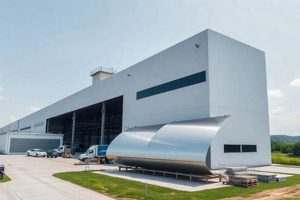
The manufacturing sector forms a critical nexus within the broader spectrum of careers related to the aviation and space industry. It serves as the tangible realization of engineering designs and research innovations, converting theoretical models into operational aircraft and spacecraft. Manufacturing, within this context, is not merely an assembly process, but a highly specialized and technically demanding endeavor. Its importance is underscored by the fact that the safety, performance, and reliability of aviation and space systems are directly dependent on the precision and quality of manufacturing processes. A failure in manufacturing, such as a flawed weld in an aircraft fuselage or an incorrectly assembled circuit board in a satellite, can have catastrophic consequences. The significance of manufacturing is further amplified by stringent regulatory standards and safety protocols that govern the sector, necessitating highly skilled personnel and meticulous adherence to quality control procedures.
Manufacturing within this context encompasses a diverse range of activities, including machining, fabrication, assembly, testing, and quality control. Examples of specific manufacturing roles include aircraft structure assemblers, who construct the airframe of an aircraft, avionics technicians, who install and maintain electronic systems, and quality control inspectors, who ensure that manufactured components meet specified standards. The manufacturing process involves the use of advanced technologies, such as computer-aided manufacturing (CAM) systems, robotic assembly lines, and non-destructive testing methods. These technologies enhance precision, efficiency, and quality, while also demanding specialized skills from manufacturing personnel. The rise of additive manufacturing, also known as 3D printing, is revolutionizing the sector. It enables the creation of complex, lightweight components with unprecedented precision, thereby unlocking new possibilities for aircraft and spacecraft design. For example, additive manufacturing is used to produce custom-designed engine parts with enhanced performance characteristics, which were previously impossible to fabricate using conventional methods.
In summary, the manufacturing aspect is indispensable for converting engineering designs into operational aircraft and spacecraft. The sector has a high requirement on precision and quality, with consequences of failure reaching across the whole industry. The manufacturing processes require a wide range of advanced technologies, and it is crucial for ensuring the safety, performance, and reliability of aviation and space systems. Personnel working in this area have an essential part in these operations. Additive manufacturing is revolutionizing sector, which provides opportunities for the creation of sophisticated components. As the aviation and space sectors continue to evolve, the manufacturing aspect must keep pace with ongoing advancements by developing its technical capabilities, and embracing new technologies.
4. Flight Operations

Flight Operations represents a core functional area within the aviation and space sectors. It encompasses the activities related to the safe and efficient execution of air and space travel, ranging from pre-flight planning to post-flight analysis. The jobs within flight operations necessitate specialized training, strict adherence to safety protocols, and a comprehensive understanding of aviation and space regulations. The efficiency and safety of these operations directly influence all aspects of this sector, therefore, they are vital for the success of air and space missions.
- Piloting
Piloting involves controlling aircraft and spacecraft to transport passengers, cargo, or conduct specialized missions. Pilots must possess extensive knowledge of aircraft systems, navigation techniques, meteorology, and air traffic control procedures. Commercial airline pilots, for instance, undergo rigorous training and certification processes to ensure the safe transport of hundreds of passengers. Similarly, test pilots evaluate the performance of new aircraft designs, pushing the boundaries of flight capabilities. Roles such as these are fundamental to ensuring the safety and reliability of air transport.
- Air Traffic Control
Air traffic controllers manage the flow of air traffic within controlled airspace, preventing collisions and ensuring the orderly movement of aircraft. They utilize radar systems, communication technologies, and standardized procedures to guide aircraft from takeoff to landing. The safe and efficient operation of airports and air routes relies heavily on their expertise. Therefore, this role is vital for facilitating the rapid growth of aviation and the expansion of airspace.
- Mission Control
Mission control personnel oversee space missions, monitoring spacecraft systems, communicating with astronauts, and executing mission plans. They manage all aspects of a space mission, from launch to landing, ensuring the safety of the crew and the successful completion of mission objectives. The role of mission control personnel exemplifies the dedication and expertise required to operate in the extreme environment of space.
- Flight Dispatch
Flight dispatchers plan and coordinate flight operations, considering factors such as weather conditions, aircraft performance, and air traffic congestion. They collaborate with pilots to determine optimal routes and fuel requirements, ensuring safe and efficient flight operations. These roles are instrumental in ensuring the reliability and efficiency of air transport.
These facets of flight operations demonstrate the diverse range of professional opportunities available, each playing a critical role in ensuring the safe and efficient conduct of air and space travel. The personnel involved contribute to the expansion and improvement of air and space exploration, playing a significant role in the evolution of the sector.
5. Project Management
Project Management constitutes a vital discipline within the aviation and space sector. It ensures that complex initiatives, from the development of new aircraft to the deployment of satellites, are completed efficiently, within budget, and to the required specifications. Consequently, project management roles are integral to the successful execution of aviation and space endeavors, impacting virtually every facet of the industry.
- Planning and Scheduling
Effective planning and scheduling are fundamental to managing aviation and space projects. Project managers must define project scope, create detailed schedules, allocate resources, and identify potential risks. For example, developing a new commercial aircraft requires years of meticulous planning, coordinating numerous engineering teams, manufacturing facilities, and regulatory agencies. Inefficient planning can lead to delays, cost overruns, and compromised performance. Skilled project managers are essential for keeping projects on track and within budget.
- Risk Management
Aviation and space projects are inherently risky due to the complex technologies involved, stringent safety requirements, and demanding operational environments. Project managers must proactively identify, assess, and mitigate potential risks. Consider the launch of a satellite, where risks range from technical malfunctions to adverse weather conditions. Effective risk management involves developing contingency plans, implementing redundant systems, and conducting rigorous testing to minimize the likelihood of failure. Professionals adept in risk management are critical in minimizing unexpected setbacks and ensuring project success.
- Team Leadership and Communication
Aviation and space projects typically involve large, multidisciplinary teams of engineers, scientists, technicians, and business professionals. Project managers must effectively lead and coordinate these teams, fostering collaboration, resolving conflicts, and ensuring clear communication. Developing a new spacecraft, for instance, requires the coordinated efforts of propulsion engineers, structural engineers, avionics specialists, and mission planners. Effective leadership and communication are crucial for ensuring that all team members are aligned towards common goals and that potential issues are addressed promptly.
- Budget and Resource Management
Aviation and space projects often involve substantial investments of capital and resources. Project managers are responsible for developing and managing project budgets, tracking expenditures, and optimizing resource allocation. Manufacturing a new aircraft engine, for example, requires careful management of material costs, labor expenses, and equipment utilization. Efficient budget and resource management are essential for delivering projects within financial constraints and maximizing return on investment.
These facets of project management underscore the critical role project managers play in the aviation and space sectors. They ensure that complex initiatives are executed efficiently, safely, and within budget, contributing to technological advancement, scientific discovery, and the overall growth of the industry. Expertise in project management is highly valued, offering diverse and rewarding career paths for professionals seeking to lead and manage innovative aviation and space projects.
6. Quality Assurance
Quality Assurance (QA) functions as a critical process within the aviation and space sector, directly influencing the reliability, safety, and performance of aircraft, spacecraft, and related systems. Positions in QA are interwoven into diverse operational areas, from design and manufacturing to maintenance and flight operations. The core objective of QA is to prevent defects and ensure adherence to stringent regulatory and industry standards. These rigorous standards are in place due to the extreme consequences that can arise from even minor failures. For example, QA engineers meticulously inspect aircraft components during manufacturing to detect flaws that could compromise structural integrity. Similarly, QA specialists evaluate software code used in flight control systems to identify potential vulnerabilities that could lead to catastrophic malfunctions. The practical significance of QA lies in its direct impact on safeguarding human lives and ensuring mission success. A robust QA program prevents costly rework, reduces the risk of accidents, and enhances customer confidence in the products and services offered by the sector.
The application of QA principles in aviation and space encompasses a wide range of activities. Non-destructive testing methods, such as ultrasonic and radiographic inspection, are employed to detect hidden defects in materials without causing damage. Statistical process control techniques are used to monitor manufacturing processes and identify deviations from established standards. Root cause analysis is conducted to investigate failures and implement corrective actions. Audit programs are implemented to assess compliance with quality management systems, such as ISO 9001 and AS9100. Data analysis is performed to identify trends and patterns that may indicate potential quality issues. The data is then analyzed to implement proactive strategies. The effectiveness of QA relies heavily on the competence and vigilance of QA personnel. These roles require strong technical skills, attention to detail, and a commitment to continuous improvement. QA professionals must possess a thorough understanding of aviation and space regulations, engineering principles, and quality management methodologies.
In summary, QA holds paramount importance within the aviation and space sector, safeguarding quality and reliability. The challenges in QA, such as adapting to new technologies and maintaining a culture of quality, can be addressed through workforce training. QA remains integral to ensuring the continued advancement and safety of aviation and space operations.
Frequently Asked Questions Regarding Careers in Aviation and Space
The following questions address common inquiries and misconceptions about pursuing a professional path within the aviation and space sectors.
Question 1: What educational qualifications are typically required to secure employment within the aerospace sector?
Educational requirements vary based on the specific role. Engineering and scientific positions generally necessitate a bachelor’s or master’s degree in a relevant field, such as aerospace engineering, mechanical engineering, or physics. Technical roles may require an associate’s degree or vocational training. Management and administrative positions may require a bachelor’s degree in business administration or a related field.
Question 2: Are there specific skills that are highly valued by employers in the aviation and space industry?
Employers value a combination of technical and soft skills. Technical skills may include proficiency in computer-aided design (CAD) software, knowledge of aerospace materials, and understanding of aerodynamics. Soft skills such as communication, teamwork, problem-solving, and leadership are also highly valued.
Question 3: What are some of the most common entry-level positions for individuals entering the aerospace sector?
Common entry-level positions include junior engineers, manufacturing technicians, quality control inspectors, and research assistants. These roles provide opportunities to gain practical experience and develop specialized skills.
Question 4: Are internships and co-op programs beneficial for aspiring aerospace professionals?
Internships and co-op programs are highly beneficial. They provide valuable hands-on experience, allowing individuals to apply their knowledge in a professional setting. They also facilitate networking with industry professionals and enhance employment prospects.
Question 5: What are the long-term career advancement opportunities within the aviation and space sector?
Career advancement opportunities vary depending on the chosen career path. Engineers can progress to senior engineering roles, project management positions, or technical leadership roles. Skilled technicians can advance to supervisory or management positions. Opportunities for advancement are generally tied to performance, experience, and continued professional development.
Question 6: Are there opportunities for individuals with non-technical backgrounds to work in the aerospace industry?
Yes, numerous opportunities exist for individuals with non-technical backgrounds. These may include roles in business development, marketing, finance, human resources, and legal affairs. While technical expertise may not be required, a general understanding of the aerospace sector can be beneficial.
Securing a position in the aviation and space industry requires strategic planning, targeted skill development, and a commitment to continuous learning. Understanding the requirements and expectations can lead to a fulfilling and rewarding career.
The following sections will further elaborate on the trends shaping the future of the aviation and space sectors.
Summary of Aviation and Space Roles
This exploration of the roles involved in the aviation and space sector has revealed the breadth and depth of career opportunities available. From engineering design and research to manufacturing, flight operations, project management, and quality assurance, the sector demands a diverse range of skills and expertise. Each area plays a crucial role in advancing air and space travel, contributing to technological innovation, scientific discovery, and national security.
The roles involved in the aviation and space sector offer a chance to contribute to human progress, and offer challenging problems that spur intellectual curiosity. The pursuit of air and space travel continues to drive innovation. The future of the industry depends on individuals ready to dedicate their talents to pushing the boundaries of what is possible. The opportunities described here represent a call to individuals ready to shape the future of flight and space exploration.