The necessary academic path to enter the field of aerospace engineering involves a focused curriculum centered on mathematics, physics, and engineering principles. This includes subjects such as calculus, differential equations, linear algebra, classical mechanics, thermodynamics, fluid dynamics, aerodynamics, materials science, and control systems. A strong foundation in these areas is essential for understanding the complexities of aircraft and spacecraft design, construction, and operation.
Mastering this educational pathway is vital for innovation and progress within the aerospace industry. A solid grasp of these subjects enables engineers to design more efficient aircraft, develop advanced propulsion systems, and contribute to space exploration initiatives. Historically, advancements in these areas have led to groundbreaking achievements in aviation and space travel, improving global connectivity and expanding scientific understanding.
The following sections will delve deeper into the specific academic disciplines, practical experiences, and essential skills that form the core of an aerospace engineering education, providing a detailed roadmap for aspiring professionals in this field.
Guidance for Aspiring Aerospace Engineers
The following recommendations aim to provide clarity and direction to individuals seeking a career in aerospace engineering. Adhering to these suggestions can enhance academic performance and facilitate professional development.
Tip 1: Strengthen Foundational Mathematics: A deep understanding of calculus, differential equations, and linear algebra is paramount. Dedicate significant time to mastering these concepts through rigorous study and practice. For example, regularly solving complex differential equations will build a critical skill for analyzing dynamic systems.
Tip 2: Emphasize Physics Proficiency: Classical mechanics, thermodynamics, and electromagnetism form the bedrock of aerospace engineering principles. Prioritize comprehension of these physical laws and their applications. Understanding the principles of aerodynamics, derived from physics, is crucial for aircraft design.
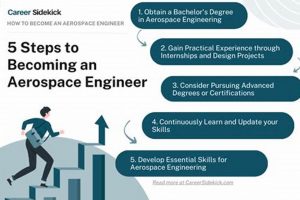
Tip 3: Engage in Hands-On Projects: Participate in projects that allow for practical application of theoretical knowledge. Building model rockets, designing wind tunnel experiments, or contributing to student aerospace teams provide invaluable experience. Such activities translate theoretical knowledge into tangible skills.
Tip 4: Cultivate Strong Programming Skills: Proficiency in programming languages such as Python, MATLAB, or C++ is essential for data analysis, simulation, and control systems design. Develop coding skills by working on projects that require numerical computation and data visualization.
Tip 5: Seek Relevant Internships: Secure internships with aerospace companies or research institutions to gain industry exposure and practical experience. Internships provide opportunities to apply learned concepts in real-world scenarios and build professional networks.
Tip 6: Focus on Materials Science: Understanding the properties and behavior of materials used in aerospace applications is critical. Study materials science and engineering courses to gain knowledge of metals, composites, and other materials used in aircraft and spacecraft construction.
These guidelines emphasize the importance of a robust academic foundation, practical experience, and continuous skill development. By diligently following these recommendations, aspiring aerospace engineers can enhance their prospects for success in this demanding yet rewarding field.
The concluding section will summarize the core elements of aerospace engineering education and reiterate the importance of lifelong learning in this rapidly evolving field.
1. Mathematics

Mathematics forms the bedrock upon which all aerospace engineering principles are built. It is not merely a supporting subject but an essential language for describing and analyzing the complex phenomena encountered in flight and space travel. A robust understanding of advanced mathematical concepts is critical for success in this field.
- Calculus
Calculus provides the tools for analyzing rates of change and accumulation, fundamental for understanding fluid dynamics, heat transfer, and orbital mechanics. For example, derivatives are used to calculate lift and drag forces acting on an aircraft wing, while integrals are used to determine the total mass of fuel consumed during a flight. Mastery of calculus is paramount for modeling and predicting the behavior of aerospace systems.
- Differential Equations
Differential equations are used to model dynamic systems, such as the motion of an aircraft through the atmosphere or the trajectory of a spacecraft. These equations describe the relationships between variables and their rates of change, allowing engineers to predict the behavior of complex systems over time. Solving differential equations is crucial for designing stable control systems and predicting the performance of aerospace vehicles.
- Linear Algebra
Linear algebra provides the mathematical framework for representing and manipulating systems of linear equations, which are ubiquitous in aerospace engineering. It is used for structural analysis, control system design, and image processing. For example, finite element analysis, a technique used to analyze the stresses and strains in aircraft structures, relies heavily on linear algebra to solve large systems of equations. Understanding linear algebra is essential for analyzing and optimizing the performance of aerospace systems.
- Numerical Methods
Numerical methods provide techniques for approximating solutions to mathematical problems that cannot be solved analytically. These methods are essential for simulating complex systems and analyzing large datasets. For instance, computational fluid dynamics (CFD) uses numerical methods to solve the Navier-Stokes equations, which describe the flow of fluids around aircraft and spacecraft. Proficiency in numerical methods is crucial for performing simulations and validating designs.
These mathematical disciplines are integral to the study of aerospace engineering. They enable engineers to model, analyze, and optimize the performance of aircraft and spacecraft. Proficiency in these areas is not only essential for academic success but also for contributing to innovation and advancements in the aerospace industry. The practical application of these mathematical principles directly influences the safety, efficiency, and effectiveness of aerospace vehicles and systems.
2. Physics

Physics provides the fundamental laws and principles that govern the behavior of matter and energy, essential for the design, analysis, and operation of aerospace vehicles. Its understanding is not a supplementary skill, but an indispensable core component of aerospace engineering education.
- Classical Mechanics
Classical mechanics explains the motion of objects under the influence of forces, providing the foundation for understanding aircraft flight dynamics and spacecraft orbital mechanics. For example, Newton’s laws of motion are used to calculate the forces acting on an aircraft during flight, enabling engineers to predict its trajectory and stability. A strong grasp of classical mechanics is crucial for designing stable and controllable aerospace vehicles.
- Thermodynamics
Thermodynamics governs the relationships between heat, work, and energy, vital for understanding the performance of engines and propulsion systems. For instance, the principles of thermodynamics are applied in the design of jet engines and rocket motors to maximize efficiency and thrust. Understanding thermodynamic cycles and heat transfer processes is essential for optimizing the performance of aerospace propulsion systems.
- Fluid Dynamics
Fluid dynamics describes the behavior of fluids, including air and gases, and is essential for understanding aerodynamics and the forces acting on aircraft and spacecraft. The principles of fluid dynamics are used to design efficient wing shapes and analyze the flow of air around aircraft. Computational Fluid Dynamics (CFD) simulations, based on fluid dynamics, allow engineers to predict aerodynamic performance and optimize designs.
- Electromagnetism
Electromagnetism explains the behavior of electric and magnetic fields, crucial for the design of avionics systems, communication systems, and electric propulsion. Electromagnetic principles underpin the operation of radar systems, navigation systems, and electric motors used in aerospace applications. A thorough understanding of electromagnetism is necessary for designing reliable and efficient electrical systems in aerospace vehicles.
These facets of physics are not isolated disciplines, but interconnected aspects of aerospace engineering. The application of these physical principles enables the creation of innovative aerospace technologies, contributing to advancements in air travel, space exploration, and satellite communication. The proficiency of an aerospace engineer is directly proportional to their depth of understanding and practical application of these fundamental physical laws.
3. Aerodynamics

Aerodynamics, the study of air and other gaseous fluid motion, is an indispensable element within the curriculum required to become an aerospace engineer. The comprehension of aerodynamic principles directly dictates an engineer’s capacity to design aircraft and spacecraft that efficiently navigate atmospheric and space environments. A deficiency in aerodynamic knowledge invariably results in suboptimal designs, leading to increased fuel consumption, reduced performance, and potential safety hazards. Real-world examples underscore this connection; the development of supercritical airfoils, enabled by advanced aerodynamic understanding, significantly reduced drag and improved fuel efficiency in commercial airliners. Furthermore, the design of hypersonic vehicles, like the X-43A, relied heavily on complex aerodynamic models to manage extreme heating and maintain stability at high speeds.
The practical application of aerodynamics extends beyond aircraft and spacecraft design. It is also crucial in the development of wind turbines for renewable energy, the design of high-performance racing cars, and even in architectural engineering to mitigate wind loads on buildings and bridges. Specific areas of focus within aerodynamics for aspiring aerospace engineers include boundary layer theory, compressible flow, airfoil design, and computational fluid dynamics (CFD). Proficiency in these areas allows engineers to analyze and predict the aerodynamic behavior of various designs, enabling them to optimize performance and ensure structural integrity. The ability to utilize CFD software, for instance, is now a standard expectation for aerospace engineers, allowing for detailed simulations of airflow around complex geometries.
In summary, aerodynamics constitutes a foundational pillar in aerospace engineering education. Without a comprehensive understanding of its principles and applications, engineers cannot effectively contribute to the design and development of safe, efficient, and high-performing aerospace vehicles and systems. While the study of aerodynamics presents inherent challenges, such as the complexity of turbulent flow and the computational demands of accurate simulations, overcoming these hurdles is essential for advancing the field and pushing the boundaries of what is possible in air and space travel.
4. Propulsion
Propulsion is a core discipline within aerospace engineering, directly influencing the capabilities and limitations of aircraft and spacecraft. A thorough comprehension of propulsion systems is thus essential for individuals pursuing careers in this field.
- Thermodynamics and Combustion
The foundation of propulsion study rests on understanding thermodynamics and combustion processes. These principles govern the energy release from fuel and oxidizer mixtures, crucial for generating thrust in jet engines and rockets. For example, the Brayton cycle describes the thermodynamic processes in gas turbine engines, while understanding chemical kinetics is essential for optimizing combustion efficiency and minimizing pollutant emissions. Study in this area requires a strong background in physical chemistry and heat transfer.
- Gas Turbine Engines
Gas turbine engines are the workhorse of modern aviation. Understanding their design, operation, and performance characteristics is vital for aerospace engineers. This includes studying compressors, turbines, combustion chambers, and nozzles. Knowledge of compressor stall, turbine blade cooling techniques, and nozzle design for optimal thrust are all critical areas. The development of more efficient and environmentally friendly gas turbine engines is a continuing area of research and development.
- Rocket Propulsion
Rocket propulsion enables space access and long-range missile capabilities. The study of rocket propulsion encompasses liquid-propellant rockets, solid-propellant rockets, and hybrid rockets. Understanding the principles of rocket nozzle design, propellant feed systems, and combustion instability is crucial. Advancements in rocket propulsion, such as electric propulsion and advanced propellant combinations, are key to future space exploration endeavors.
- Electric Propulsion
Electric propulsion offers high efficiency for long-duration space missions, using electric fields to accelerate ions or plasma to generate thrust. Types of electric propulsion include ion thrusters, Hall-effect thrusters, and pulsed plasma thrusters. This area requires knowledge of plasma physics, electromagnetism, and power electronics. Electric propulsion is particularly relevant for satellite station keeping, interplanetary travel, and deep-space exploration.
Mastery of propulsion principles and technologies is integral to the education of an aerospace engineer. The ability to design, analyze, and optimize propulsion systems is essential for contributing to advancements in aviation and space exploration. The continued pursuit of more efficient, reliable, and environmentally friendly propulsion systems will remain a key focus for aerospace engineers in the years to come.
5. Structures
The study of aerospace structures represents a cornerstone of an aerospace engineering education. Its importance stems from the necessity to design and analyze airframes and spacecraft capable of withstanding extreme loads, temperatures, and environmental conditions. The structural integrity of these vehicles is paramount for safety and mission success. A firm grounding in structural mechanics is thus indispensable for aspiring aerospace engineers.
- Stress Analysis
Stress analysis involves determining the internal forces and stresses within structural components subjected to external loads. Techniques include analytical methods, such as beam theory and plate theory, as well as numerical methods like finite element analysis (FEA). A practical example is the analysis of aircraft wings under aerodynamic loads to ensure they do not exceed allowable stress limits, preventing structural failure. The ability to accurately predict stress distributions is crucial for designing lightweight yet robust structures.
- Materials Science
Materials science provides the understanding of the properties and behavior of materials used in aerospace structures. This includes metals, composites, and ceramics. Engineers must consider factors such as strength, stiffness, density, fatigue resistance, and corrosion resistance. For example, the selection of aluminum alloys for aircraft fuselages involves balancing strength with weight, while carbon fiber composites are used in high-performance applications requiring high strength-to-weight ratios. An understanding of material behavior under various environmental conditions, such as extreme temperatures and radiation, is also critical.
- Structural Dynamics
Structural dynamics focuses on the response of structures to dynamic loads, such as vibrations, shocks, and impacts. This includes analyzing the natural frequencies and mode shapes of structures to avoid resonance, which can lead to catastrophic failure. For example, the design of aircraft landing gear must account for the impact forces during landing, while the design of spacecraft structures must consider the vibrations induced during launch. Understanding structural dynamics is crucial for ensuring the stability and reliability of aerospace vehicles under dynamic conditions.
- Finite Element Analysis (FEA)
FEA is a powerful numerical technique used to analyze complex structural problems. It involves dividing a structure into a mesh of small elements and solving the equations of equilibrium for each element. FEA can be used to determine stress distributions, deflections, and vibration modes. For example, FEA is used extensively in the design of aircraft wings, fuselages, and engine components to optimize their structural performance. Proficiency in FEA software is an essential skill for aerospace engineers.
These structural engineering disciplines are integral to a comprehensive aerospace engineering curriculum. Through these studies, prospective aerospace engineers gain the skills necessary to design, analyze, and ensure the structural integrity of the vehicles that operate in the demanding environments of the air and space. The effective application of these principles directly impacts the safety, performance, and longevity of aerospace systems.
6. Control Systems

The effective operation of aerospace vehicles hinges critically on control systems, making their study an indispensable component of aerospace engineering education. Without robust control systems, aircraft and spacecraft become unstable and unmanageable, leading to potential catastrophic failures. The connection is causal: the performance of aerospace vehicles is directly and significantly affected by the design and implementation of their control systems. This necessitates a thorough understanding of control theory, feedback mechanisms, and system dynamics for aspiring aerospace engineers.
Real-world examples illustrate the practical significance of control systems. The autopilot system in commercial airliners maintains stable flight, reducing pilot workload and improving fuel efficiency. Fly-by-wire systems in modern fighter jets enhance maneuverability and responsiveness, allowing pilots to execute complex maneuvers. In spacecraft, attitude control systems ensure proper orientation for communication, navigation, and scientific observations. A failure in any of these control systems can have severe consequences, underscoring the need for rigorous analysis, testing, and redundancy in control system design. The development of advanced control algorithms, such as adaptive control and model predictive control, is crucial for dealing with uncertainties and disturbances in the aerospace environment.
The integration of control systems into aerospace vehicles presents numerous challenges. Designing controllers that can cope with nonlinearities, time delays, and uncertainties is a complex task. Furthermore, control systems must be robust to sensor noise, actuator limitations, and external disturbances. Addressing these challenges requires a multidisciplinary approach, combining knowledge of control theory, signal processing, and system identification. The continued advancement of control system technologies is essential for enabling the development of safer, more efficient, and more capable aerospace vehicles, solidifying control systems as a fundamental aspect of aerospace engineering studies.
Frequently Asked Questions
The following addresses common inquiries regarding the necessary academic qualifications for a career in aerospace engineering.
Question 1: Is a bachelor’s degree sufficient for entering the aerospace engineering field?
While a bachelor’s degree in aerospace engineering provides a foundational understanding of the discipline, advanced positions often require a master’s degree or a doctorate. Specialized knowledge and research experience gained through graduate studies can significantly enhance career prospects and opportunities for advancement.
Question 2: How important are mathematics courses beyond calculus?
Advanced mathematics courses, such as differential equations, linear algebra, and numerical analysis, are integral to aerospace engineering. These courses provide the mathematical tools necessary to model, analyze, and simulate complex aerospace systems. Proficiency in these areas is essential for solving challenging engineering problems.
Question 3: What role do physics courses play in aerospace engineering education?
Physics courses, including classical mechanics, thermodynamics, and fluid dynamics, are fundamental to understanding the physical principles that govern the behavior of aerospace vehicles. A thorough understanding of these principles is essential for designing efficient, safe, and reliable aerospace systems.
Question 4: Is programming knowledge necessary for aerospace engineers?
Proficiency in programming languages such as Python, MATLAB, or C++ is increasingly important for aerospace engineers. Programming skills are essential for data analysis, simulation, and control system design. Engineers should strive to develop strong programming skills to enhance their problem-solving abilities.
Question 5: What types of internships are most beneficial for aspiring aerospace engineers?
Internships with aerospace companies, government agencies, or research institutions provide invaluable practical experience and industry exposure. Internships allow students to apply their theoretical knowledge to real-world problems and develop essential professional skills. Securing relevant internships is a critical step in preparing for a successful career in aerospace engineering.
Question 6: How crucial is a strong foundation in materials science?
Understanding the properties and behavior of materials used in aerospace applications is critical. Courses in materials science and engineering provide knowledge of metals, composites, and other materials used in aircraft and spacecraft construction. Material selection is a key aspect of structural design and performance.
These FAQs highlight the importance of a robust academic foundation in mathematics, physics, and engineering principles for a successful career in aerospace engineering. Continuous learning and professional development are also essential in this rapidly evolving field.
The subsequent section will offer concluding remarks, summarizing the key elements of aerospace engineering education.
What to Study to Become an Aerospace Engineer
This exploration has detailed the extensive academic preparations necessary for a career in aerospace engineering. Core disciplines such as mathematics, physics, aerodynamics, propulsion, structures, and control systems have been highlighted as fundamental building blocks. Mastery of these areas, coupled with practical experience through projects and internships, provides the essential skillset for designing, analyzing, and innovating within the aerospace industry.
The pursuit of aerospace engineering demands a commitment to rigorous study and continuous learning. The fields ongoing evolution necessitates a proactive approach to acquiring new knowledge and skills. A sustained dedication to academic excellence and professional development will ultimately determine an individuals success in contributing to the future of air and space travel.