



The curricula designed for individuals pursuing a career in flight vehicle and spacecraft development mandate a specific set of academic subjects. These subjects ensure a foundational understanding of the principles governing the behavior of objects within and beyond the Earth’s atmosphere. For instance, a typical bachelor’s program will necessitate successful completion of courses in fluid mechanics, thermodynamics, structural analysis, and control systems.
A well-defined academic path is paramount for aspiring professionals. These educational benchmarks equip students with the analytical and problem-solving skills vital for addressing the complex challenges inherent in the field. Historically, emphasis on these areas has directly contributed to advancements in aircraft design, propulsion systems, and space exploration capabilities.
Further examination of specific subject matter, project-based learning, and specialized electives within this academic domain will provide a more complete picture of the preparation required for a successful career in this dynamic and demanding area of engineering.
The following recommendations offer strategic insights for students engaged in, or preparing for, studies related to flight vehicle and spacecraft development. These points emphasize proactive engagement and focused learning for optimal academic achievement.
Tip 1: Master Foundational Mathematics and Physics: A strong grasp of calculus, differential equations, linear algebra, and Newtonian mechanics is essential. Rigorous study of these subjects will provide the necessary tools for understanding advanced concepts.
Tip 2: Prioritize Understanding of Core Engineering Sciences: Fluid mechanics, thermodynamics, heat transfer, and materials science form the backbone of aerospace engineering. Devote considerable time to comprehending the underlying principles and interrelationships between these disciplines.
Tip 3: Develop Proficiency in Computational Tools: Familiarity with software such as MATLAB, ANSYS, or similar simulation packages is crucial. Practice using these tools to model and analyze engineering problems.
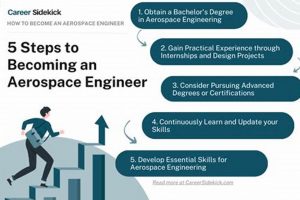
Tip 4: Seek Practical Experience Through Internships: Internships within the aerospace industry provide invaluable real-world experience. Apply for internships at companies involved in aircraft design, spacecraft development, or related fields.
Tip 5: Engage in Project-Based Learning: Participate in design projects, competitions, or research opportunities that allow for application of theoretical knowledge. These experiences enhance problem-solving skills and foster innovation. Examples include student satellite projects or drone design challenges.
Tip 6: Cultivate Strong Communication Skills: Effective communication is vital for conveying technical information to both technical and non-technical audiences. Practice writing technical reports, presenting research findings, and collaborating within teams.
Tip 7: Explore Specialized Electives: Select elective courses that align with specific interests within the field. Options might include astrodynamics, propulsion systems, or composite materials. This focused study can deepen expertise in a particular area.
Consistent application of these guidelines will aid students in successfully meeting the academic demands of this rigorous engineering discipline, setting the stage for a productive career.
A strong academic foundation, coupled with practical experience, prepares individuals to contribute meaningfully to future advancements in flight vehicle and spacecraft technology.
1. Mathematics

Mathematics serves as the bedrock upon which all engineering disciplines are built. In the context of aerospace engineering curricula, mathematical proficiency is not merely an advantage; it is an indispensable prerequisite for comprehending and manipulating the complex physical phenomena encountered in flight and space.
- Calculus and Differential Equations
These mathematical tools are essential for modeling and analyzing the motion of aircraft and spacecraft. They allow engineers to predict trajectories, optimize flight paths, and understand the dynamic behavior of systems under varying conditions. For example, differential equations are used to describe the aerodynamic forces acting on an aircraft wing, enabling the precise design of airfoils.
- Linear Algebra
Linear algebra is critical for representing and manipulating systems of equations that arise in structural analysis and control systems. It enables the calculation of stresses and strains within an aircraft structure under load, and the design of stable and responsive control algorithms. Understanding matrix operations is also vital for simulating the behavior of complex systems.
- Probability and Statistics
Statistical methods are necessary for analyzing experimental data, assessing risk, and predicting the reliability of aerospace systems. Engineers use statistics to determine the probability of failure in critical components and to design systems that are robust against uncertainty. Statistical analysis is also essential for interpreting flight test data and validating simulation models.
- Numerical Methods
Many problems in aerospace engineering are too complex to solve analytically. Numerical methods provide a means to approximate solutions using computational techniques. These methods are used extensively in computational fluid dynamics (CFD) simulations, finite element analysis (FEA), and optimization algorithms. Proficiency in numerical methods is essential for performing advanced engineering analysis.
The mathematical concepts outlined above are integral parts of mandatory subject matter. A strong foundation guarantees that students can solve complex engineering problems. Understanding math enables them to contribute to innovative solutions in this dynamic area of engineering. Success depends on mathematical skill.
2. Physics
Physics forms the fundamental basis for understanding the universe and is, therefore, indispensable to the field of aerospace engineering. It provides the underlying principles that govern the behavior of aircraft, spacecraft, and related technologies. Specific physics subject matter is a non-negotiable component of academic preparations. The following facets illustrate the core areas of physics that shape educational benchmarks.
- Newtonian Mechanics
This classical branch of physics dictates the motion of objects under the influence of forces. Its application is essential for analyzing the flight dynamics of aircraft, calculating trajectories of projectiles, and understanding the behavior of control systems. For example, Newton’s laws are used to design stable aircraft capable of maneuvering effectively in the atmosphere. Newtonian mechanics also provides a first-order approximation for orbital mechanics calculations.
- Thermodynamics
Thermodynamics deals with the relationships between heat, work, and energy. It is critical for understanding the operation of engines and propulsion systems. For instance, the design of a jet engine relies heavily on thermodynamic principles to optimize efficiency and maximize thrust. Analysis of heat transfer in hypersonic vehicles, where atmospheric friction generates significant heat, also depends on solid thermodynamic understanding.
- Fluid Mechanics
The behavior of fluids, both liquids and gases, is crucial for understanding aerodynamics. Fluid mechanics concepts underpin the design of airfoils, wings, and control surfaces. Boundary layer theory, a core component of fluid mechanics, governs the drag experienced by aircraft and impacts overall fuel efficiency. The principles also apply to understanding rocket engine performance and the behavior of plasmas in electric propulsion systems.
- Electromagnetism
While perhaps less immediately apparent than mechanics or thermodynamics, electromagnetism plays a significant role in aerospace engineering, particularly in areas such as communications, radar systems, and electric propulsion. The design of antennas for satellite communication systems relies on electromagnetic theory. Furthermore, developing advanced propulsion concepts like ion drives requires a strong understanding of electromagnetic fields.
These areas of physics are not isolated topics; rather, they are interconnected and form a unified framework for understanding the physical world within which flight vehicles and spacecraft operate. Successful completion of courses covering these topics is compulsory for aspiring aerospace engineers. This physics foundation supports higher-level engineering coursework and professional practice in the aerospace industry.
3. Core Engineering
Core engineering subject matter constitutes a fundamental pillar of knowledge within prescribed educational pathways for prospective aerospace engineers. It encompasses the essential principles and analytical methods applicable across diverse engineering disciplines, providing a robust foundation for specialized study within aerospace contexts. Competency in these core areas is crucial for successful navigation of advanced topics and real-world engineering challenges.
- Structural Analysis
This discipline investigates the behavior of structures under various loads and environmental conditions. Aerospace applications demand lightweight yet robust designs capable of withstanding extreme stresses. Understanding structural analysis allows engineers to predict stress distributions, prevent failures, and optimize the weight-to-strength ratio of aircraft and spacecraft components. For example, finite element analysis, a core component of structural studies, is used to model the stress on an aircraft wing during flight, informing design decisions and material selection.
- Thermodynamics and Heat Transfer
The study of energy transfer and its effects on physical systems is essential for designing efficient propulsion systems and managing thermal environments. Aerospace engineers apply thermodynamic principles to analyze engine cycles, optimize combustion processes, and design heat shields for re-entry vehicles. Understanding heat transfer mechanisms is critical for preventing overheating in electronic components and maintaining habitable conditions within spacecraft.
- Fluid Mechanics
Analyzing the behavior of fluids (liquids and gases) is fundamental to understanding aerodynamics and propulsion. Core fluid mechanics studies equip aerospace engineers with the knowledge to predict airflow patterns around aircraft, optimize wing designs to reduce drag, and design efficient nozzles for rocket engines. Computational Fluid Dynamics (CFD), a numerical approach to solving fluid mechanics problems, is a vital tool for analyzing complex flow phenomena in aerospace applications.
- Control Systems
The design and implementation of automated systems to maintain stability and performance are crucial in aerospace engineering. Control systems principles are applied to stabilize aircraft during flight, guide spacecraft along precise trajectories, and automate various functions within aerospace vehicles. Understanding feedback control, stability analysis, and sensor technology is essential for developing robust and reliable control systems capable of operating in demanding environments.
The competencies gained through rigorous study of core engineering areas empower aerospace engineers to tackle complex design and analysis tasks. Integration of these fundamental principles is essential for understanding the challenges in aerospace and innovating for the next generation of flight vehicle and spacecraft technologies. The convergence of core subject matter and specialized aerospace topics constitutes a key educational path to prepare students for careers in the aerospace sector.
4. Specialized Courses

Within the broader framework of aerospace engineering education, specialized courses provide focused training in specific sub-disciplines essential for addressing the complexities of modern aerospace technology. These courses represent a critical component of overall curriculum design, enabling students to develop in-depth expertise in areas of particular interest or relevance to their career aspirations. This focused training is directly linked to meeting the demands of the wider aerospace industry.
- Astrodynamics
This specialized area centers on the study of spacecraft trajectories and orbital mechanics. It provides engineers with the tools necessary to design missions to other planets, predict satellite positions, and analyze the effects of gravitational forces on space vehicles. Real-world examples include calculating the precise trajectory for a Mars rover landing or predicting the long-term orbital stability of a communication satellite. Competency in astrodynamics is necessary for satisfying the requirements of space mission design and operation roles.
- Propulsion Systems
Focused study in propulsion encompasses the design and analysis of various engine types, including jet engines, rocket engines, and electric propulsion systems. Students learn the thermodynamic principles underlying engine operation, combustion processes, and nozzle design. This specialized knowledge is essential for developing more efficient and powerful propulsion systems for aircraft and spacecraft. For example, advancements in rocket engine technology are directly linked to achieving deep space exploration goals. Expertise in propulsion is required for many aerospace design positions.
- Aerodynamics and Aeroelasticity
Aerodynamics delves into the study of airflow around objects and its effect on their motion. Aeroelasticity examines the interaction between aerodynamic forces and structural deformations. These fields are critical for designing efficient and stable aircraft wings, optimizing control surfaces, and preventing structural failures due to flutter. The design of modern commercial aircraft relies heavily on aerodynamic principles to minimize drag and maximize fuel efficiency. Aeroelasticity considerations are essential to ensure the structural integrity of high-speed aircraft. Specialized knowledge is required for airframe design and testing.
- Aerospace Vehicle Design
This course integrates knowledge from various sub-disciplines to provide a holistic understanding of the aircraft and spacecraft design process. It encompasses requirements definition, conceptual design, preliminary design, and detailed design phases. Students learn to apply engineering principles, design tools, and project management techniques to develop innovative aerospace vehicle concepts. Such practical experience is invaluable to meeting real-world engineering challenges. This specialized area often serves as a capstone course, synthesizing knowledge from across the aerospace engineering curriculum.
Successful completion of specialized coursework complements the knowledge gained in core engineering subject matter. This integration empowers aerospace engineers to address diverse challenges. Focus allows engineers to make contributions to advancements in flight vehicle and spacecraft technology.
5. Design Projects
Design projects constitute an essential element within the established framework of aerospace engineering curricula. These projects serve as a culminating experience, integrating knowledge acquired across diverse subject matter. Their success validates student comprehension and application of engineering principles, reflecting the efficacy of prescribed academic preparation.
- Application of Theoretical Knowledge
Design projects mandate the practical application of theoretical knowledge gained in core engineering and specialized courses. Students must translate concepts from fluid mechanics, structural analysis, and control systems into tangible designs. For example, designing an unmanned aerial vehicle necessitates the application of aerodynamic principles for wing design, structural analysis for fuselage integrity, and control systems for stable flight. This practical application reinforces understanding and identifies areas requiring further study.
- Problem-Solving and Innovation
These projects cultivate problem-solving skills and encourage innovative thinking. Students are challenged to address real-world engineering problems with often-conflicting constraints, such as performance, cost, and safety. They learn to evaluate trade-offs, propose creative solutions, and justify their design choices with technical rationale. A hypothetical example is optimizing the fuel efficiency of a small satellite propulsion system while minimizing its weight and volume. This process replicates the challenges encountered in professional engineering practice.
- Teamwork and Communication
Design projects typically require collaboration within teams, fostering teamwork and communication skills. Students must effectively communicate technical ideas, coordinate tasks, resolve conflicts, and present their design solutions to stakeholders. For example, a team designing a lunar rover might divide tasks related to locomotion, power generation, and scientific instrument integration. Clear communication and collaborative problem-solving are crucial for project success. Teamwork reflects the practices of engineering companies.
- Integration of Design Tools and Software
These projects necessitate proficiency in industry-standard design tools and software. Students gain hands-on experience with CAD software for creating 3D models, simulation software for analyzing performance, and programming languages for implementing control algorithms. For example, designing a composite aircraft wing might involve using CAD software for geometric modeling, finite element analysis software for stress analysis, and MATLAB for control system simulation. This experience prepares students for immediate contributions to real-world engineering projects.
In summary, design projects are not merely academic exercises; they represent a bridge between theoretical knowledge and practical application. Successfully completing these projects demonstrates mastery of established educational subject matter, preparation for the rigors of professional engineering practice, and readiness to contribute meaningfully to the aerospace industry. The design process is iterative, and these exercises help students learn the process of design, test, and refine.
Frequently Asked Questions
The subsequent queries and responses address common points of concern regarding the academic criteria for pursuing a career in flight vehicle and spacecraft development. The information presented is intended to provide clarity and guidance for prospective engineers.
Question 1: Are there specific Advanced Placement (AP) courses recommended for students planning to study flight vehicle and spacecraft engineering?
Strong performance in AP Calculus, AP Physics, and AP Chemistry is highly advantageous. These courses provide a solid foundation for the rigorous mathematical and scientific subject matter encountered in collegiate aerospace engineering programs. Prior exposure to these topics can facilitate a smoother transition to higher-level coursework.
Question 2: How crucial is a background in computer programming for succeeding in aerospace engineering curricula?
Proficiency in computer programming is increasingly vital. Many aerospace engineering courses involve numerical simulations, data analysis, and control system implementation. Familiarity with programming languages such as MATLAB, Python, or C++ is highly beneficial for completing assignments and conducting research.
Question 3: What level of mathematical proficiency is expected upon entering a bachelor’s degree program in aerospace engineering?
A solid understanding of algebra, trigonometry, and pre-calculus is generally expected. Furthermore, familiarity with basic calculus concepts, such as limits and derivatives, can provide a competitive advantage. A strong foundation in these mathematical areas is essential for tackling the more advanced mathematical subjects encountered during aerospace studies.
Question 4: Are laboratory courses an essential component of aerospace engineering curricula?
Yes, laboratory courses are an integral part of aerospace engineering education. These courses provide hands-on experience in applying theoretical concepts, conducting experiments, and analyzing data. Laboratory work reinforces understanding of fundamental principles and develops practical skills necessary for engineering practice.
Question 5: Is participation in undergraduate research opportunities advisable for aspiring aerospace engineers?
Engaging in undergraduate research is highly recommended. It provides opportunities to work alongside faculty members on cutting-edge research projects, develop advanced technical skills, and contribute to the advancement of knowledge in the field. Research experience can also enhance career prospects and prepare students for graduate studies.
Question 6: How important are communication skills in aerospace engineering?
Effective communication skills are crucial. Aerospace engineers must be able to clearly convey technical information to diverse audiences, including colleagues, clients, and the public. Strong written and oral communication skills are essential for preparing technical reports, presenting research findings, and collaborating within teams.
A thorough understanding of these common inquiries can assist prospective engineers in preparing for the demands of academic study and professional engagement within this challenging field. Meeting educational criteria is a fundamental step.
Proceeding to the next section will further clarify essential information related to career pathways.
Aerospace Engineering Course Requirements
This exploration has highlighted the fundamental components of the academic preparation necessary for a successful career in aerospace engineering. Mastery of mathematics and physics, coupled with rigorous study of core engineering principles and specialized aerospace subjects, forms the bedrock upon which future innovation and technological advancement are built. Participation in design projects further solidifies theoretical understanding and develops crucial practical skills.
A comprehensive and focused approach to meeting these educational benchmarks is not merely a prerequisite for entry into the field, but an investment in the future of flight vehicle and spacecraft technology. The rigor inherent in “aerospace engineering course requirements” reflects the demanding nature of the profession and prepares individuals to address the complex challenges of exploring and utilizing the aerospace domain. A commitment to excellence in these areas is paramount for those seeking to contribute meaningfully to this vital field.

![Best Work Environment for Aerospace Engineers [2024] | Innovating the Future of Flight with Reliable Aviation Solutions](https://mixaerospace.com/wp-content/uploads/2026/04/th-277-300x200.jpg "Best Work Environment for Aerospace Engineers [2024] Innovating the Future of Flight with Reliable Aviation Solutions")