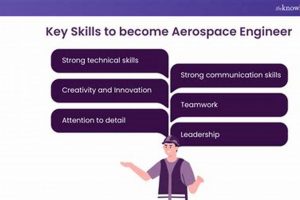
The central question pertains to the suitability of pursuing a course of study focused on the design, development, and testing of aircraft and spacecraft. This field integrates principles of physics, mathematics, and engineering to address challenges in atmospheric and space environments. Evaluating personal aptitude and career goals is essential before committing to this demanding academic path.
Aeronautical and astronautical engineering provide opportunities to contribute to advancements in air travel, satellite technology, space exploration, and national defense. Historically, this field has been at the forefront of technological innovation, driving progress in materials science, propulsion systems, and control systems. The benefits extend to economic growth, scientific discovery, and improved global communication.
The subsequent sections will delve into the academic requirements, career prospects, necessary skills, and potential challenges associated with this field of study. These considerations are crucial for informed decision-making regarding the investment of time and resources.
Guidance for Prospective Aerospace Engineering Students
Careful consideration is paramount when contemplating a path in aerospace engineering. The following guidance offers crucial factors to weigh before committing to this rigorous and demanding field.
Tip 1: Evaluate Mathematical and Scientific Aptitude: A solid foundation in mathematics, physics, and chemistry is essential. This field relies heavily on calculus, differential equations, linear algebra, and advanced physics concepts. Students should assess their performance and enjoyment of these subjects.
Tip 2: Research Academic Programs: Investigate the curriculum, faculty expertise, research opportunities, and accreditation of various aerospace engineering programs. Consider specializations offered and whether they align with individual interests, such as propulsion, structures, or aerodynamics.
Tip 3: Develop Strong Problem-Solving Skills: Aerospace engineering requires the ability to analyze complex problems, develop innovative solutions, and test their effectiveness. Cultivating critical thinking and analytical skills is crucial for success.
Tip 4: Explore Related Fields: Consider engaging in activities related to aerospace, such as building model rockets, participating in robotics clubs, or pursuing internships at aerospace companies. This provides practical experience and confirms interest in the field.
Tip 5: Understand the Career Landscape: Research the various career paths available to aerospace engineers, including roles in design, research, testing, and management. Investigate potential employers, such as aerospace companies, government agencies, and research institutions.
Tip 6: Assess Time Commitment and Work Ethic: Aerospace engineering programs are demanding and require significant dedication. Students must be prepared to invest substantial time and effort in coursework, projects, and research. A strong work ethic and commitment to learning are essential.
Tip 7: Network with Professionals: Attend industry events, connect with aerospace engineers on professional networking platforms, and seek mentorship opportunities. This provides valuable insights into the field and helps build professional connections.
These insights emphasize the need for careful self-assessment and thorough research to determine if this field aligns with individual skills, interests, and career aspirations. A considered approach increases the likelihood of success and fulfillment in this technically challenging and rewarding field.
The subsequent analysis will cover potential career opportunities and the long-term implications of committing to aerospace engineering.
1. Aptitude
Aptitude plays a pivotal role in determining the suitability of pursuing aerospace engineering. Innate abilities and acquired skills significantly influence academic performance and professional success within this demanding field. A thorough evaluation of one’s strengths and weaknesses is crucial before embarking on this path.
- Mathematical Proficiency
Aerospace engineering relies heavily on mathematical principles, including calculus, differential equations, and linear algebra. A strong aptitude for mathematics enables students to comprehend complex concepts, solve intricate problems, and develop accurate models of physical phenomena. Deficiencies in mathematical skills can hinder progress and limit the ability to excel in advanced coursework.
- Scientific Reasoning
A solid understanding of physics, chemistry, and other scientific disciplines is essential for aerospace engineers. An aptitude for scientific reasoning allows students to analyze experimental data, formulate hypotheses, and draw logical conclusions. This skill is crucial for designing and testing aerospace systems, ensuring their safety and performance.
- Spatial Visualization
Aerospace engineering often involves working with complex three-dimensional objects and systems. An aptitude for spatial visualization enables students to mentally manipulate these objects, understand their relationships, and create accurate representations. This skill is particularly important for designing aircraft and spacecraft components, as well as for visualizing flight paths and trajectories.
- Problem-Solving Abilities
Aerospace engineering presents numerous challenges that require creative and effective problem-solving skills. An aptitude for problem-solving allows students to identify critical issues, develop innovative solutions, and evaluate their effectiveness. This skill is essential for addressing design flaws, troubleshooting technical problems, and optimizing system performance.
The combination of mathematical proficiency, scientific reasoning, spatial visualization, and problem-solving abilities forms the cornerstone of aptitude for aerospace engineering. Assessing these areas provides critical insight into the potential for success in this field and informs the decision of whether to pursue it as a course of study.
2. Curriculum

The academic curriculum constitutes a critical component in the determination of the suitability of aerospace engineering as a course of study. The specific content, structure, and rigor of the curriculum directly impact a student’s ability to acquire the necessary knowledge and skills for a successful career in the field. A poorly designed or insufficiently challenging curriculum may leave graduates ill-prepared for the demands of the profession. Conversely, a well-structured and comprehensive curriculum can provide a solid foundation for future success. For example, a curriculum that neglects hands-on experience in wind tunnels or computational fluid dynamics (CFD) software would be detrimental to a graduate’s ability to perform aerodynamic analyses effectively.
Furthermore, the curriculum’s emphasis on specific areas within aerospace engineering, such as propulsion, structures, or control systems, will influence the types of career opportunities available to graduates. A curriculum focused heavily on astronautics may prepare students for roles in the space industry, while a curriculum emphasizing aeronautics may be more suitable for those seeking careers in aircraft design and manufacturing. Moreover, the inclusion of interdisciplinary coursework, such as systems engineering or project management, can enhance graduates’ ability to work effectively in collaborative environments and manage complex aerospace projects. The practical significance of a rigorous curriculum lies in its ability to equip students with the tools and knowledge necessary to address real-world challenges in the aerospace industry, from designing more efficient aircraft to developing innovative space exploration technologies.
In summary, the curriculum represents a foundational element when considering aerospace engineering. Its rigor, content, and structure directly impact a student’s preparedness for the profession. Evaluating the curriculum’s alignment with personal interests and career aspirations is essential. The selection of an appropriate curriculum serves as a pivotal step in shaping a future aerospace engineer’s capabilities and opportunities. Recognizing the challenges inherent in the demanding curriculum, and its link to the broader theme of career choice, is therefore crucial in deciding if aerospace engineering is the right path.
3. Opportunities
The existence of meaningful opportunities constitutes a significant determinant when evaluating the prospect of pursuing aerospace engineering. A direct correlation exists: the abundance and quality of available opportunities critically influence the long-term viability and desirability of this career path. Limited opportunities may lead to underemployment, job dissatisfaction, and a diminished return on the investment of time and resources in education. Conversely, a robust job market and diverse career options can provide a sense of security, promote professional growth, and justify the challenges inherent in this demanding field. For instance, if government funding for space exploration decreases significantly, opportunities in related fields may diminish, impacting the attractiveness of astronautical engineering as a specialty.
The presence of opportunities extends beyond mere job availability. It encompasses the potential for research and development, innovation, and contribution to societal advancement. Aerospace engineers may find opportunities to design more fuel-efficient aircraft, develop sustainable propulsion systems, or contribute to the exploration of other planets. These opportunities can provide a sense of purpose and allow engineers to apply their skills to solve real-world problems. Consider the development of advanced materials for aircraft construction: this not only creates opportunities for materials scientists and engineers but also enhances the performance and safety of air travel.
In summary, the evaluation of available opportunities is an integral part of the decision-making process. A thorough assessment of the current and projected job market, the potential for innovation, and the possibilities for making a meaningful contribution to society are crucial factors. A lack of opportunities diminishes the value proposition of aerospace engineering, while a wealth of possibilities can make it a rewarding and fulfilling career path. Prospective students should research employment trends, government policies, and technological advancements to gauge the long-term outlook for aerospace engineers and inform their decision regarding whether or not to pursue this field of study.
4. Challenges

The decision to pursue aerospace engineering necessitates a clear understanding of the inherent challenges. These obstacles, ranging from academic rigor to competitive job markets, significantly influence the experience and career prospects of individuals considering this field. The correlation between facing and overcoming these challenges and the ultimate success of an aerospace engineer is substantial.
Academic challenges begin with demanding coursework in mathematics, physics, and specialized engineering subjects. Successful navigation requires a strong foundation, consistent effort, and effective study habits. For example, the study of fluid dynamics involves complex equations and simulations, demanding a high level of mathematical proficiency. Competition for internships and research opportunities further intensifies the academic pressure. Obtaining valuable practical experience often requires exceptional academic performance and proactive networking. This necessitates more than just theoretical knowledge; it demands practical application and problem-solving skills. Furthermore, the industry itself presents ongoing technological challenges. Engineers are consistently tasked with developing innovative solutions to complex problems, such as improving fuel efficiency, reducing emissions, and ensuring the safety and reliability of aircraft and spacecraft. These challenges demand continuous learning and adaptation to new technologies and methodologies. The practical significance of recognizing these challenges lies in allowing prospective students to prepare adequately, develop resilience, and cultivate the necessary skills for success in this competitive and demanding field. Without acknowledging the obstacles, students may face disappointment and struggle to meet the industry’s expectations.
In conclusion, prospective aerospace engineers must realistically assess the challenges involved. These range from rigorous academic demands to a highly competitive professional landscape. A proactive approach, characterized by academic preparedness, strong problem-solving skills, and a commitment to lifelong learning, is essential for overcoming these obstacles and achieving a fulfilling career in aerospace engineering. A clear understanding of the difficulties linked to the choice of a career will result in a more satisfactory outcome.
5. Career

The prospective career path serves as a primary driver in determining whether to pursue aerospace engineering. The alignment between individual career aspirations and the potential roles available to aerospace engineers directly influences the suitability of this field as a course of study. A mismatch between desired career outcomes and the realities of the profession can lead to dissatisfaction and underutilization of skills. For example, an individual primarily interested in theoretical physics may find the applied nature of aerospace engineering less appealing, while someone drawn to practical problem-solving and technological innovation may thrive in this field. The practical significance lies in ensuring that the educational investment translates into a fulfilling and productive career.
Aerospace engineering offers a diverse range of career options, encompassing design, research and development, testing, and management roles within various sectors, including aerospace companies, government agencies, and research institutions. Specific roles might include designing aircraft structures, developing propulsion systems, analyzing flight data, or managing satellite projects. Each of these roles demands a unique skill set and offers varying levels of responsibility and compensation. The availability of these career paths is contingent upon factors such as economic conditions, government policies, and technological advancements. For instance, increased investment in space exploration could create new opportunities for aerospace engineers specializing in astronautics, whereas a decline in the commercial aviation industry might limit opportunities in aeronautical engineering. Real-world examples include the growing demand for engineers specializing in unmanned aerial vehicles (UAVs) and the increasing need for expertise in sustainable aviation technologies.
In summary, a comprehensive understanding of the potential career paths, their demands, and their long-term prospects is essential when considering aerospace engineering. The decision to pursue this field should be based on a realistic assessment of individual interests, skills, and career goals, as well as a thorough evaluation of the current and future career landscape. A well-informed decision maximizes the likelihood of a successful and fulfilling career in aerospace engineering. This understanding also addresses the challenges inherent in a dynamic industry and informs the student about the potential rewards of this field.
6. Commitment
The decision to embark on a course of study in aerospace engineering necessitates a substantial and sustained commitment, influencing the potential for success and long-term career satisfaction. The rigor of the curriculum, the demands of the profession, and the ever-evolving nature of the field require a level of dedication that extends beyond mere academic interest. Lack of commitment is a significant cause for attrition among aerospace engineering students and can hinder professional advancement. For example, the completion of complex design projects often requires extensive hours beyond the standard academic schedule, necessitating a willingness to sacrifice personal time.
Commitment manifests in several key areas: consistent academic effort, proactive engagement in extracurricular activities such as research or engineering clubs, and a dedication to lifelong learning. Real-world examples illustrate this point: engineers working on satellite deployment missions often face unpredictable schedules and must be prepared to dedicate extended periods to ensuring mission success. Similarly, engineers involved in the design of new aircraft components must commit to rigorous testing and iterative design processes, often involving long hours and meticulous attention to detail. The practical significance of this understanding is that prospective aerospace engineering students must realistically assess their capacity for sustained effort and their willingness to prioritize their academic and professional development. Individuals who are not prepared to dedicate the necessary time and effort may find themselves struggling to keep pace with the demands of the field.
In summary, commitment is a crucial component of pursuing aerospace engineering successfully. It requires sustained effort, proactive engagement, and a willingness to adapt to the evolving demands of the profession. Prospective students must carefully evaluate their capacity for commitment to maximize their chances of success in this challenging and rewarding field. The lack of a concrete commitment will often contribute to the individual re-evaluating their choice.
Frequently Asked Questions
The following section addresses common inquiries and misconceptions regarding the pursuit of aerospace engineering as a field of study. These responses aim to provide clarity and guidance for prospective students.
Question 1: What level of mathematical proficiency is truly necessary for success in aerospace engineering?
Aerospace engineering necessitates a strong foundation in advanced mathematical concepts, including calculus, differential equations, linear algebra, and statistics. A comprehensive understanding of these principles is essential for modeling and analyzing complex physical systems. Deficiencies in these areas will hinder progress.
Question 2: How competitive is the job market for aerospace engineers, and what strategies can enhance employment prospects?
The job market for aerospace engineers can be competitive, depending on economic conditions and government funding for aerospace projects. Enhancing employment prospects involves pursuing internships, gaining practical experience, developing strong problem-solving skills, and networking with industry professionals. Specializing in high-demand areas, such as unmanned aerial vehicles or sustainable aviation, can also improve job opportunities.
Question 3: What are some common misconceptions about the day-to-day work of an aerospace engineer?
Common misconceptions include the belief that the work primarily involves designing rockets or flying aircraft. While these activities may be part of the job, the daily work of an aerospace engineer often involves complex calculations, data analysis, simulations, and report writing. Collaboration with other engineers and technicians is also essential.
Question 4: How important are communication and teamwork skills in aerospace engineering?
Communication and teamwork skills are critical for success in aerospace engineering. Projects often involve collaboration among engineers from various disciplines, as well as with technicians, manufacturers, and clients. Effective communication is essential for conveying technical information, coordinating tasks, and resolving conflicts.
Question 5: What are the long-term career prospects for aerospace engineers, and how can they adapt to changes in the industry?
Long-term career prospects for aerospace engineers are generally favorable, but adaptability is essential. The industry is constantly evolving, driven by technological advancements and changing economic conditions. Continuous learning, professional development, and a willingness to embrace new technologies are crucial for maintaining career relevance.
Question 6: Is a graduate degree necessary to advance in aerospace engineering, or is a bachelor’s degree sufficient?
While a bachelor’s degree can provide entry-level opportunities, a graduate degree is often required for advanced research positions, leadership roles, and specialized areas of expertise. A master’s or doctoral degree can enhance career prospects and increase earning potential. The necessity of a graduate degree depends on individual career goals and the specific requirements of the desired position.
This FAQ section addresses key concerns and clarifies common misunderstandings regarding aerospace engineering as a field of study. The provided information should aid prospective students in making informed decisions about their academic and career paths.
The next section will provide a summary of resources, websites, and organizations that can offer valuable information about aerospace engineering.
Conclusion
The preceding analysis has addressed the complex question of whether one ought to study aerospace engineering. Considerations encompassed aptitudes, curriculum, opportunities, challenges, career paths, and the commitment required for success in this demanding field. A thorough evaluation of individual strengths, interests, and career aspirations, coupled with a realistic understanding of the academic and professional landscape, is essential for informed decision-making.
The ultimate determination rests on a careful synthesis of these factors. Prospective students are encouraged to conduct further research, seek mentorship from professionals, and engage in practical experiences to solidify their understanding of the field. A deliberate and well-informed choice will maximize the likelihood of a fulfilling and impactful career in aerospace engineering, contributing to advancements in aviation, space exploration, and technological innovation for generations to come.