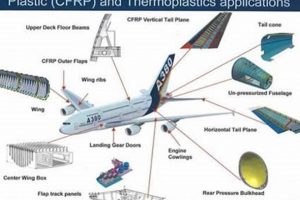
The integration of advanced materials, characterized by a matrix reinforced with fibers, has become increasingly prevalent in the construction of aircraft and spacecraft. These materials offer a unique combination of properties, including high strength-to-weight ratio and corrosion resistance, which are critical for optimizing performance in demanding operational environments. For example, components like wing structures, fuselage sections, and interior panels increasingly rely on these engineered substances.
The adoption of these materials provides significant advantages in terms of fuel efficiency, payload capacity, and overall structural integrity. Historically, the aerospace sector has been at the forefront of materials science innovation, driving the development and refinement of these sophisticated solutions. The resulting improvements in aircraft performance and lifespan contribute to both economic and environmental benefits, furthering the progress of air travel and space exploration.
The subsequent sections will delve into specific applications within aircraft design, manufacturing processes, and the ongoing research and development efforts focused on enhancing the performance and durability of these materials in the aerospace sector. These explorations will examine the material selection criteria, the engineering challenges, and the future trends shaping the integration of these materials in aviation and space applications.
Considerations for Implementing Composites
Effective utilization necessitates a comprehensive understanding of material properties, manufacturing techniques, and lifecycle implications. The following points outline essential considerations for professionals engaged in integrating these materials within aerospace applications.
Tip 1: Material Selection: Choosing appropriate composite materials requires careful evaluation of operational requirements. Factors include expected loads, temperature ranges, environmental exposure, and desired lifespan. Selecting materials with optimized strength, stiffness, and resistance to degradation is paramount.
Tip 2: Manufacturing Process Control: Rigorous control over manufacturing processes is crucial to ensuring consistent quality and performance. Processes such as layup, curing, and bonding must be meticulously monitored and validated to minimize defects and maintain structural integrity.
Tip 3: Non-Destructive Inspection (NDI): Implementing robust NDI techniques is vital for detecting internal flaws or damage within composite structures. Regular inspections using methods like ultrasonic testing or radiography can identify potential issues before they compromise structural integrity.
Tip 4: Damage Tolerance Analysis: Assessing damage tolerance is essential for predicting the behavior of composite structures under various loading scenarios. Understanding how damage propagates and affects performance helps establish maintenance schedules and repair strategies.
Tip 5: Environmental Considerations: Environmental factors such as moisture, UV radiation, and chemical exposure can significantly impact the long-term performance of composites. Implementing protective coatings and selecting materials with inherent environmental resistance are critical for extending service life.
Tip 6: Repair Procedures: Establishing well-defined repair procedures is essential for maintaining the structural integrity of composites throughout their service life. These procedures should address various damage scenarios and employ appropriate repair materials and techniques.
Tip 7: Life Cycle Cost Analysis: A thorough lifecycle cost analysis should consider not only the initial cost of materials and manufacturing but also the long-term maintenance, repair, and disposal costs. Evaluating the overall economic impact helps justify the use of composites and optimize resource allocation.
By carefully considering these aspects, aerospace professionals can effectively leverage the advantages of composites, enhancing aircraft performance, reducing weight, and improving overall operational efficiency.
The subsequent sections will explore specific case studies and future trends relating to the further advancement and successful use of these materials in aerospace applications.
1. Weight Reduction

In the aerospace industry, weight reduction stands as a pivotal objective, significantly impacting aircraft performance, fuel efficiency, and operational costs. The strategic implementation of composites directly addresses this imperative, offering substantial weight savings compared to traditional metallic materials.
- Increased Payload Capacity
A lighter aircraft structure, achieved through composite materials, allows for an increased payload capacity. This translates to a greater volume of cargo or a larger number of passengers without compromising fuel consumption or flight range. For example, commercial airlines utilizing composite-intensive aircraft like the Boeing 787 Dreamliner can carry more passengers per flight, directly impacting revenue generation.
- Enhanced Fuel Efficiency
Reduced weight directly correlates to improved fuel efficiency. Lighter aircraft require less energy to maintain flight, resulting in decreased fuel consumption and associated emissions. This has led to widespread adoption of composites in wing and fuselage structures, as evidenced by Airbus A350, where significant percentage of weight is reduced because of Composites, and thus decreasing operational expenses and environmental impact.
- Extended Flight Range
The weight savings afforded by composites enable aircraft to achieve longer flight ranges. This capability is particularly crucial for long-haul flights and military applications, where extended operational reach is paramount. Aircraft employing composite materials can traverse greater distances without requiring refueling, enhancing operational flexibility and mission effectiveness.
- Improved Maneuverability and Performance
Lower weight improves aircraft maneuverability and overall performance characteristics. This is particularly important in military aircraft and high-performance jets, where agility and responsiveness are critical. Composite materials enable the design of lighter, more agile aircraft capable of executing complex maneuvers with greater precision.
The multifaceted benefits of weight reduction, realized through composite utilization, underscore their indispensable role in modern aerospace engineering. From enhancing fuel efficiency and extending flight range to improving payload capacity and maneuverability, composites contribute significantly to the performance and economic viability of aircraft across various sectors.
2. Structural Integrity

The adoption of composite materials in the aerospace industry is intrinsically linked to the pursuit of enhanced structural integrity. Aircraft components are subjected to substantial stresses during flight, demanding materials capable of withstanding these forces without deformation or failure. Composites, engineered with high strength-to-weight ratios, contribute significantly to achieving this objective. The directional strength properties of composites, achieved through fiber alignment, allow engineers to tailor the material’s resistance to specific load paths, optimizing structural performance. A prime example is the use of carbon fiber reinforced polymers in wing structures, where the material’s strength is aligned with the primary bending and shear forces experienced during flight. This targeted reinforcement ensures the wing can withstand high aerodynamic loads while minimizing weight, directly enhancing structural integrity and aircraft performance.
Furthermore, the resistance of composites to fatigue and corrosion contributes to long-term structural integrity. Unlike metallic materials, composites are less susceptible to fatigue cracking, a common cause of structural failure in aircraft. Their inherent resistance to corrosion also reduces the need for extensive maintenance and repair, extending the lifespan of structural components. The Boeing 787 Dreamliner exemplifies this benefit, utilizing a composite fuselage that exhibits significantly improved corrosion resistance compared to traditional aluminum structures. This reduces maintenance downtime and enhances the aircraft’s overall operational availability. Moreover, composite materials can be designed with integrated damage tolerance features. This allows the material to withstand some level of damage without catastrophic failure, increasing the safety margin for aircraft operations.
In conclusion, the use of composites in aerospace is not merely a matter of weight reduction or performance enhancement, but fundamentally a strategy for achieving superior structural integrity. The targeted reinforcement, resistance to fatigue and corrosion, and inherent damage tolerance of these materials contribute to safer, more durable, and more efficient aircraft. While challenges remain in terms of manufacturing costs and repair techniques, the ongoing research and development efforts are focused on overcoming these limitations and further unlocking the potential of composites to enhance the structural integrity of future aerospace vehicles.
3. Aerodynamic Efficiency

The integration of composite materials significantly influences aerodynamic efficiency in aerospace applications. The capacity to mold composites into complex, contoured shapes enables the creation of aircraft surfaces with reduced drag. This capability is crucial for optimizing airflow and minimizing turbulence, leading to enhanced fuel economy and increased aircraft performance. Traditional metallic structures often require multiple parts joined together, creating surface imperfections and increasing drag. Composites allow for the creation of seamless, aerodynamically optimized surfaces, reducing friction and enhancing lift.
Real-world examples illustrate this connection. The blended wing body (BWB) concept, often explored in advanced aircraft designs, relies heavily on composite materials to achieve its highly aerodynamic shape. Composites enable the smooth transition between the wing and fuselage, minimizing drag and maximizing lift. The Boeing 787 Dreamliner, with its composite wings and fuselage, demonstrates the practical benefits of this approach. The smooth, contoured surfaces of the 787 contribute to its improved fuel efficiency and extended range compared to aircraft with traditional aluminum structures. Furthermore, composite materials are used to create complex aerodynamic features such as winglets and vortex generators, which further enhance aerodynamic performance by reducing induced drag.
In summary, composite materials play a vital role in achieving aerodynamic efficiency in aerospace design. Their ability to be molded into complex shapes allows for the creation of aerodynamically optimized surfaces with reduced drag, leading to improved fuel economy, increased range, and enhanced aircraft performance. While challenges remain in terms of manufacturing costs and repair techniques, the continued development and refinement of composite materials will undoubtedly lead to further advancements in aerodynamic efficiency for future aerospace vehicles.
4. Corrosion Resistance

Corrosion poses a significant threat to the structural integrity and operational lifespan of aircraft. The integration of composite materials directly addresses this challenge, offering superior resistance to corrosive environments compared to traditional metallic alloys. This inherent resistance reduces maintenance requirements, enhances safety, and extends the service life of aerospace vehicles.
- Elimination of Galvanic Corrosion
Dissimilar metals in contact, particularly in the presence of an electrolyte, can lead to galvanic corrosion, a common issue in aircraft construction. Composites, being non-metallic, eliminate the potential for galvanic corrosion when used in conjunction with metallic components. This is particularly important in areas where aluminum alloys are used alongside other metals, such as in fasteners or structural supports.
- Resistance to Atmospheric Corrosion
Aircraft are constantly exposed to corrosive atmospheric elements such as moisture, salt spray, and industrial pollutants. Composites demonstrate superior resistance to these corrosive agents compared to many metallic alloys. For example, carbon fiber reinforced polymers (CFRP) exhibit excellent resistance to saltwater corrosion, making them ideal for use in marine environments or in aircraft operating near coastal regions.
- Reduced Maintenance and Inspection Requirements
The inherent corrosion resistance of composites translates to reduced maintenance and inspection requirements. Aircraft constructed with a significant proportion of composite materials require less frequent inspections for corrosion damage, leading to lower operating costs and increased aircraft availability. This is a significant advantage for airlines and military operators seeking to minimize downtime and maximize aircraft utilization.
- Extended Service Life
By resisting corrosion, composites contribute to the extended service life of aircraft. Components made from composite materials retain their structural integrity for a longer period, reducing the need for costly repairs or replacements. This extended service life translates to lower lifecycle costs and a greater return on investment for aircraft operators.
The superior corrosion resistance of composites is a critical factor driving their increased adoption in the aerospace industry. By mitigating the risks associated with corrosion, these materials enhance safety, reduce maintenance costs, and extend the service life of aircraft, contributing to more efficient and sustainable air travel.
5. Manufacturing Costs

The economic viability of employing composite materials in the aerospace industry is significantly influenced by manufacturing costs. While composites offer numerous performance advantages, the initial investment in manufacturing processes can be substantial, presenting a critical factor in material selection and overall project feasibility.
- Raw Material Expenses
The cost of raw composite materials, such as carbon fibers, resins, and core materials, contributes significantly to the overall manufacturing expense. High-performance fibers and specialized resins command premium prices, impacting the economic competitiveness of composite structures compared to traditional aluminum or steel. Fluctuations in raw material availability and market demand can further influence cost volatility.
- Specialized Equipment and Tooling
The manufacture of composite components often necessitates specialized equipment and tooling, including autoclaves, filament winding machines, and automated fiber placement systems. These investments represent a substantial capital outlay, particularly for smaller aerospace manufacturers. The complexity of composite part geometries can also drive up tooling costs, requiring intricate mold designs and precision fabrication.
- Labor-Intensive Processes
Many composite manufacturing processes, such as manual layup and inspection, are inherently labor-intensive. Skilled technicians are required to precisely position and orient composite plies, ensuring proper fiber alignment and resin impregnation. The time required for these manual processes can significantly impact production rates and overall labor costs. Automation strategies, such as automated fiber placement (AFP) and automated tape laying (ATL), are employed to reduce labor costs and improve manufacturing efficiency.
- Quality Control and Inspection
Maintaining stringent quality control throughout the composite manufacturing process is essential to ensure structural integrity and performance reliability. Non-destructive inspection (NDI) techniques, such as ultrasonic testing and X-ray radiography, are employed to detect internal flaws or defects. These inspections can be time-consuming and costly, but are crucial for preventing structural failures and ensuring the safety of aerospace vehicles.
The manufacturing costs associated with composite materials represent a significant consideration for aerospace engineers and manufacturers. Efforts to reduce these costs through process optimization, automation, and the development of more affordable raw materials are essential to expanding the use of composites in future aerospace applications. The long-term benefits of composite materials, such as weight reduction and improved fuel efficiency, must be carefully weighed against the initial manufacturing investment to determine the overall economic viability of composite structures.
Frequently Asked Questions
This section addresses common inquiries concerning the utilization of composite materials within the aerospace industry. The objective is to provide clear and concise information regarding the properties, applications, and challenges associated with these advanced materials.
Question 1: What specific properties of composites make them desirable for aerospace applications?
Composites offer a unique combination of high strength-to-weight ratio, stiffness, corrosion resistance, and fatigue resistance. These properties are essential for reducing aircraft weight, enhancing structural integrity, and improving fuel efficiency.
Question 2: In what specific aircraft components are composite materials commonly used?
Composites are employed in a wide range of aircraft components, including fuselage sections, wing structures, control surfaces, interior panels, and engine nacelles. The specific materials and manufacturing processes vary depending on the component’s function and performance requirements.
Question 3: How do composites contribute to improved fuel efficiency in modern aircraft?
The primary contribution to fuel efficiency stems from weight reduction. Lighter aircraft require less energy to maintain flight, resulting in decreased fuel consumption and lower emissions. Additionally, composites allow for the creation of aerodynamically optimized shapes that reduce drag.
Question 4: What are the primary challenges associated with the use of composites in aircraft construction?
Key challenges include high material costs, complex manufacturing processes, and the need for specialized repair techniques. Furthermore, concerns related to impact damage and long-term environmental degradation require careful consideration.
Question 5: How is the structural integrity of composite components ensured during aircraft manufacturing and operation?
Stringent quality control measures are implemented throughout the manufacturing process, including non-destructive inspection (NDI) techniques to detect internal flaws. Regular inspections and maintenance procedures are also crucial for monitoring the condition of composite components during aircraft operation.
Question 6: What future trends are expected in the use of composites within the aerospace industry?
Future trends include the development of more affordable and sustainable composite materials, advancements in automated manufacturing processes, and the increased use of composites in primary structural components. Nanomaterials and self-healing composites are also areas of active research.
The integration of composite materials in aerospace represents a continuous evolution, driven by the need for enhanced performance, improved efficiency, and reduced environmental impact. Addressing the challenges associated with these materials will pave the way for further advancements in aircraft design and operation.
The subsequent section will delve into case studies illustrating successful implementations of composites in aerospace applications.
Conclusion
The preceding analysis has demonstrated the multifaceted influence of advanced materials integration within the aerospace sector. The ability to tailor material properties to specific performance requirements, coupled with inherent advantages in weight reduction and corrosion resistance, positions these materials as essential components in modern aircraft and spacecraft design. The advancements in manufacturing techniques and the ongoing research into novel composite systems promise continued improvements in performance, durability, and cost-effectiveness.
Continued investigation and refinement of composite technologies are critical for sustaining progress in aviation and space exploration. As performance demands increase and environmental regulations tighten, the integration of these materials will become even more vital to achieving ambitious goals. The future of aerospace engineering is inextricably linked to the ongoing innovation and responsible deployment of these advanced material solutions.