The pursuit of a career in aerospace engineering necessitates a strong foundation in mathematics and the physical sciences. A prospective aerospace engineer should cultivate proficiency in subjects such as calculus, differential equations, linear algebra, physics (particularly mechanics, thermodynamics, and electromagnetism), and chemistry. These disciplines provide the theoretical framework essential for understanding aerodynamic principles, propulsion systems, structural mechanics, and control systems, all of which are fundamental aspects of aerospace vehicle design and analysis.
Success in aerospace engineering offers the opportunity to contribute to advancements in air travel, space exploration, and national defense. The field has a rich history, marked by groundbreaking innovations that have shaped human transportation and our understanding of the universe. Contributing to this legacy requires a dedication to continuous learning and innovation, adapting to evolving technologies and challenges.
The following sections will detail the specific educational requirements, necessary skills, career paths, and other vital considerations for individuals aspiring to this challenging and rewarding profession. It will cover the academic preparation, technical skills, and personal attributes necessary to succeed in this field.
Essential Guidance for Aspiring Aerospace Engineers
This section offers actionable advice for individuals considering a career in aerospace engineering. It emphasizes preparation, skill development, and strategic planning to maximize the chances of success in this demanding field.
Tip 1: Solidify the Mathematics Foundation: A strong understanding of calculus, differential equations, and linear algebra is paramount. Regularly practice problem-solving to develop both speed and accuracy.
Tip 2: Emphasize Physics Proficiency: Concentrate on mechanics, thermodynamics, and electromagnetism. These concepts directly underpin many aerospace engineering principles; a deep understanding is critical.
Tip 3: Pursue Relevant Extracurricular Activities: Join or create clubs focused on rocketry, model aircraft, or robotics. These provide hands-on experience and demonstrate a genuine interest in the field.
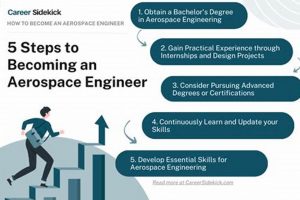
Tip 4: Seek Internships and Research Opportunities: Gaining practical experience is invaluable. Look for internships with aerospace companies or research positions in university laboratories.
Tip 5: Develop Strong Computer Skills: Proficiency in programming languages (such as Python or MATLAB) and CAD software (such as SolidWorks or AutoCAD) is essential for design and analysis tasks.
Tip 6: Hone Communication Skills: Aerospace engineers must effectively communicate complex ideas to colleagues and clients. Practice technical writing and public speaking.
Tip 7: Consider a Master’s Degree: While a bachelor’s degree can provide entry-level opportunities, a master’s degree often opens doors to more specialized and advanced roles.
By diligently following these guidelines, aspiring aerospace engineers can significantly enhance their prospects for a successful and rewarding career.
The following sections will delve deeper into the specific specializations and career pathways available within the aerospace engineering discipline.
1. Mathematics Proficiency

Mathematics proficiency is not merely a desirable attribute, but a fundamental prerequisite for anyone aspiring to a career in aerospace engineering. This discipline relies heavily on mathematical models and calculations to design, analyze, and optimize aerospace vehicles and systems. A strong grasp of mathematical principles enables aerospace engineers to predict performance, ensure safety, and innovate in this demanding field.
- Calculus and Differential Equations
Calculus provides the tools to analyze rates of change and accumulation, essential for understanding fluid dynamics, heat transfer, and control systems. Differential equations are crucial for modeling the behavior of dynamic systems, such as aircraft flight and rocket trajectories. For example, calculating the optimal angle of attack for an aircraft wing to minimize drag and maximize lift relies on calculus-based aerodynamic models.
- Linear Algebra
Linear algebra is fundamental for representing and manipulating systems of equations, analyzing structural stability, and performing computer-aided design (CAD). Finite element analysis, used to simulate the stress and strain on aircraft components, heavily relies on linear algebra techniques to solve large systems of equations. Moreover, control systems for spacecraft attitude control depend on matrix operations and eigenvalue analysis to ensure stability and responsiveness.
- Statistics and Probability
Statistics and probability are indispensable for analyzing experimental data, assessing risk, and ensuring reliability in aerospace systems. Uncertainty quantification, a critical aspect of aerospace engineering, relies on probabilistic methods to account for variations in material properties, manufacturing tolerances, and environmental conditions. For example, determining the probability of engine failure during a long-duration space mission requires statistical analysis of historical performance data.
- Numerical Methods
Numerical methods provide algorithms for approximating solutions to mathematical problems that cannot be solved analytically. These techniques are essential for simulating complex phenomena, such as turbulent flow around aircraft and heat transfer in rocket engines. Computational fluid dynamics (CFD) software relies heavily on numerical methods to discretize the governing equations and solve them iteratively. Furthermore, optimization algorithms, used to design fuel-efficient aircraft and high-performance rockets, often employ numerical techniques to find optimal solutions.
In summary, a deep and comprehensive understanding of mathematics is not just advantageous; it is absolutely essential for any individual seeking to contribute meaningfully to the field of aerospace engineering. Proficiency in calculus, linear algebra, statistics, and numerical methods provides the analytical foundation needed to tackle the complex challenges inherent in designing, building, and operating aerospace systems. These mathematical tools empower aerospace engineers to innovate, optimize, and ensure the safety and reliability of the technologies that shape our world and explore the vast expanse of space.
2. Physics Understanding

A thorough comprehension of physics principles forms a critical cornerstone for individuals pursuing a career in aerospace engineering. It provides the fundamental understanding of the physical phenomena governing the behavior of aircraft, spacecraft, and related systems, enabling effective design, analysis, and problem-solving.
- Classical Mechanics
Classical mechanics provides the foundation for understanding the motion of objects and forces acting upon them, essential for analyzing aircraft flight dynamics and spacecraft orbital mechanics. For example, Newton’s laws of motion are fundamental to calculating the trajectory of a projectile or the forces acting on an aircraft during flight. Understanding these principles enables engineers to predict the behavior of aerospace vehicles under various conditions and design control systems to ensure stability and maneuverability.
- Thermodynamics
Thermodynamics governs the principles of energy transfer and conversion, critical for designing efficient and effective propulsion systems. Understanding thermodynamic cycles, such as the Brayton cycle used in gas turbine engines, allows engineers to optimize engine performance and minimize fuel consumption. Additionally, thermodynamics principles are crucial for managing heat transfer in spacecraft, ensuring that sensitive electronic components operate within acceptable temperature ranges.
- Fluid Dynamics
Fluid dynamics is the study of fluid motion and its interaction with solid objects, vital for designing aerodynamic surfaces and understanding the behavior of air and other fluids around aircraft and spacecraft. Bernoulli’s principle, a fundamental concept in fluid dynamics, explains how airflow over an aircraft wing generates lift. Computational Fluid Dynamics (CFD) software, based on fluid dynamics principles, is used extensively to simulate and analyze the airflow around complex aerospace structures, optimizing their aerodynamic performance.
- Electromagnetism
Electromagnetism deals with the interaction of electric and magnetic fields, essential for designing electrical systems, sensors, and communication systems in aerospace vehicles. Understanding electromagnetic interference (EMI) is crucial for ensuring the reliable operation of electronic equipment in aircraft and spacecraft. Furthermore, electromagnetic principles are applied in the development of radar systems for aircraft navigation and remote sensing technologies for Earth observation satellites.
These facets of physics, interwoven and applied, are not isolated academic concepts but practical tools that aerospace engineers use daily. From designing efficient propulsion systems to ensuring the structural integrity of spacecraft, a robust understanding of physics is indispensable for addressing the multifaceted challenges inherent in the field and contributing to advancements in aerospace technology.
3. Engineering Fundamentals

Engineering fundamentals form the bedrock of aerospace engineering competence. These core principles, encompassing statics, dynamics, materials science, and thermodynamics, provide the analytical framework necessary for the design and evaluation of aerospace systems. A deficiency in these fundamental areas directly impedes an engineer’s ability to address the complex challenges inherent in the field. For instance, understanding the principles of statics is crucial for analyzing the structural integrity of an aircraft wing, while a grasp of dynamics is essential for designing stable control systems for a spacecraft. The application of materials science principles dictates the selection of appropriate alloys for high-stress components, considering factors like strength-to-weight ratio and resistance to corrosion.
The connection between engineering fundamentals and practical aerospace applications is direct and demonstrable. Consider the design of a rocket engine. Thermodynamic principles govern the efficiency of the combustion process and the performance of the nozzle. Fluid mechanics dictates the flow of propellant and exhaust gases, while heat transfer considerations ensure the engine’s structural integrity under extreme temperatures. Furthermore, control systems engineering ensures stable operation of the engine throughout its burn cycle. Neglecting any of these fundamental aspects during the design phase can lead to catastrophic failure, underscoring the critical importance of a solid grounding in engineering principles.
In summary, a comprehensive understanding of engineering fundamentals is not merely a desirable attribute, but an absolute necessity for anyone aspiring to a successful career in aerospace engineering. These principles provide the analytical toolkit required to address the complex challenges inherent in the design, analysis, and operation of aerospace systems. A thorough grounding in statics, dynamics, materials science, and thermodynamics empowers engineers to innovate, optimize, and ensure the safety and reliability of aerospace technologies. The absence of this foundational knowledge represents a significant impediment to professional success and the ability to contribute meaningfully to the field.
4. Software Skills

Proficiency in relevant software applications is no longer a supplemental skill, but an essential component of competence within the aerospace engineering profession. The design, analysis, simulation, and operation of aerospace systems rely heavily on sophisticated software tools. Without mastery of these tools, aspiring engineers face a significant impediment to professional success.
- CAD/CAM Software (e.g., SolidWorks, CATIA)
Computer-Aided Design (CAD) and Computer-Aided Manufacturing (CAM) software are critical for creating and refining detailed 3D models of aircraft components, spacecraft structures, and propulsion systems. These tools enable engineers to visualize designs, perform interference checks, and generate manufacturing instructions. For example, the design of a new aircraft wing requires the use of CAD software to define its geometry, analyze its aerodynamic properties, and generate the tooling paths for its fabrication. Furthermore, CAD software facilitates collaboration among engineers, enabling them to share and modify designs efficiently.
- Simulation and Analysis Software (e.g., ANSYS, MATLAB)
Simulation and analysis software packages allow aerospace engineers to model and analyze the behavior of complex systems under various operating conditions. Finite element analysis (FEA) software, such as ANSYS, is used to simulate stress, strain, and thermal behavior in structural components. MATLAB provides a powerful environment for developing and executing simulations of flight dynamics, control systems, and propulsion systems. For instance, simulating the thermal stress on a turbine blade in a jet engine requires the use of FEA software to predict its performance and ensure its structural integrity. Similarly, simulating the trajectory of a spacecraft requires MATLAB to model the gravitational forces and control system response.
- Programming Languages (e.g., Python, C++)
Knowledge of programming languages is essential for developing custom software tools, automating tasks, and analyzing large datasets. Python is widely used for data analysis, scripting, and developing custom simulations. C++ is often used for developing high-performance applications, such as flight control systems and real-time data processing. For example, developing a flight control algorithm for an unmanned aerial vehicle (UAV) requires proficiency in programming to implement the control logic and interface with sensors and actuators.
- Data Analysis and Visualization Software (e.g., Tableau, Power BI)
Aerospace engineers often work with large datasets from flight tests, simulations, and manufacturing processes. Data analysis and visualization software enables them to extract meaningful insights, identify trends, and communicate findings effectively. These tools facilitate the identification of performance bottlenecks, the optimization of designs, and the early detection of potential problems. For instance, analyzing flight test data to assess the performance of a new aircraft requires the use of data analysis software to identify deviations from predicted behavior and optimize control system parameters.
The integration of these software skills into the aerospace engineering workflow is pervasive. From initial design concepts to final flight testing, software tools empower engineers to innovate, optimize, and ensure the safety and reliability of aerospace systems. Therefore, the acquisition and continuous development of these skills are paramount for aspiring aerospace engineers.
5. Problem-Solving Aptitude

Problem-solving aptitude is inextricably linked to the competencies required for success in aerospace engineering. The discipline inherently involves addressing multifaceted challenges related to design, analysis, and operation of complex systems. Aerospace engineers are routinely tasked with identifying, analyzing, and resolving technical obstacles where readily available solutions may not exist. This aptitude is not merely a supplementary skill; it is a core component of the intellectual toolkit necessary for navigating the complexities of this field. The ability to deconstruct intricate problems into manageable components, evaluate potential solutions, and implement effective strategies is essential for achieving project objectives and advancing aerospace technology.
The practical significance of problem-solving aptitude is evident in various real-world applications within aerospace engineering. For example, consider the challenge of designing a heat shield for a spacecraft re-entering the Earth’s atmosphere. This requires a comprehensive understanding of thermodynamics, fluid dynamics, and materials science. An engineer must identify the critical parameters affecting heat transfer, analyze the performance of different materials under extreme conditions, and develop a design that can withstand the intense thermal stresses. This process demands a systematic approach to problem-solving, involving iterative design, simulation, and testing. Similarly, troubleshooting anomalies in flight control systems requires a meticulous examination of sensor data, actuator performance, and software code to pinpoint the root cause of the problem. The capability to reason logically, apply engineering principles, and adapt to unforeseen circumstances is paramount in these situations.
In conclusion, problem-solving aptitude is not merely a desirable attribute for aspiring aerospace engineers; it is a fundamental necessity. Its presence directly influences an engineer’s capacity to navigate the complex challenges inherent in the field, innovate effectively, and contribute meaningfully to technological advancements. Cultivating this aptitude through rigorous academic training, hands-on experience, and continuous learning is crucial for ensuring professional success and upholding the standards of excellence in aerospace engineering. A deficiency in problem-solving skills represents a significant impediment to effective engineering practice, underscoring the critical importance of this aptitude within the constellation of skills required to thrive in this demanding field.
6. Analytical Thinking
Analytical thinking constitutes a fundamental skill for individuals pursuing a career in aerospace engineering. The discipline demands the ability to dissect complex problems, identify critical variables, and synthesize information to formulate effective solutions. A deficiency in analytical thinking directly impacts an engineer’s capacity to address the intricate challenges inherent in the design, analysis, and operation of aerospace systems.
- Systems Analysis
Systems analysis necessitates the ability to evaluate the interdependencies among various components within an aerospace system. For example, designing an aircraft wing requires consideration of aerodynamic forces, structural integrity, control surface effectiveness, and manufacturing constraints. A systems analysis approach enables engineers to optimize the wing design by considering the trade-offs between these competing factors. This approach enhances performance and ensures safety.
- Data Interpretation
Data interpretation involves extracting meaningful insights from experimental data, simulation results, and operational records. Aerospace engineers routinely analyze flight test data to validate aircraft performance, identify anomalies, and optimize control system parameters. Proficiency in data analysis techniques enables engineers to detect trends, identify correlations, and make informed decisions based on empirical evidence. This skill is crucial for continuous improvement and risk mitigation.
- Root Cause Analysis
Root cause analysis entails the systematic investigation of failures or malfunctions to identify the underlying causes. This process requires engineers to gather information, conduct tests, and analyze data to determine the factors that contributed to the problem. For instance, investigating an engine failure during flight requires a thorough examination of engine components, fuel system performance, and control system behavior to identify the root cause and implement corrective actions. Effective root cause analysis prevents recurrence and enhances system reliability.
- Logical Reasoning
Logical reasoning involves the application of deductive and inductive reasoning to solve engineering problems. Aerospace engineers must be able to construct logical arguments, identify fallacies, and draw valid conclusions based on available evidence. This skill is essential for evaluating design alternatives, justifying technical decisions, and communicating findings effectively. A strong foundation in logical reasoning enhances the quality and reliability of engineering solutions.
The facets of analytical thinking detailed above are not isolated skills, but rather interconnected components of a broader analytical framework. Aerospace engineers rely on this framework to address the multifaceted challenges inherent in the field, ensuring the safety, performance, and reliability of aerospace systems. The absence of strong analytical skills represents a significant impediment to professional success and the ability to contribute meaningfully to the advancement of aerospace technology.
Frequently Asked Questions
This section addresses common queries regarding the requirements and expectations associated with pursuing a career in aerospace engineering. The information presented aims to provide clarity and guidance to prospective engineers.
Question 1: Is a graduate degree essential for advancement in aerospace engineering?
While entry-level positions may be attainable with a bachelor’s degree, a master’s degree or doctorate often provides access to more specialized roles, research opportunities, and leadership positions within the industry.
Question 2: How important are internships in securing a full-time position after graduation?
Internships and co-operative education experiences are highly valued by employers in the aerospace sector. They provide practical experience, networking opportunities, and a competitive advantage during the job search.
Question 3: What are the key differences between aeronautical and astronautical engineering?
Aeronautical engineering focuses on the design and development of aircraft operating within Earth’s atmosphere, while astronautical engineering deals with spacecraft and systems designed for operation in space.
Question 4: What specific software skills are most sought after by aerospace employers?
Proficiency in CAD/CAM software (e.g., SolidWorks, CATIA), simulation and analysis tools (e.g., ANSYS, MATLAB), and programming languages (e.g., Python, C++) are highly valued by employers.
Question 5: How crucial is a strong foundation in mathematics and physics?
A solid understanding of mathematics and physics is paramount for success in aerospace engineering. These disciplines provide the theoretical framework necessary for understanding aerodynamic principles, structural mechanics, and propulsion systems.
Question 6: What personal attributes contribute to success in this field?
Strong problem-solving skills, analytical thinking, attention to detail, and the ability to work effectively in multidisciplinary teams are essential attributes for success in aerospace engineering.
In summary, a combination of rigorous academic preparation, practical experience, and essential skills significantly enhances the prospects of a successful aerospace engineering career.
The following section will further explore the diverse career paths available within the aerospace engineering discipline.
Conclusion
This exposition has detailed the foundational knowledge, technical skills, and personal attributes vital to aspiring aerospace engineers. Mastery of mathematics and physics, coupled with proficiency in engineering fundamentals and specialized software, forms the bedrock of competence. Furthermore, a cultivated aptitude for problem-solving and analytical thinking is indispensable for addressing the complex challenges inherent in this demanding field.
The pursuit of aerospace engineering demands unwavering commitment and continuous learning. Success requires not only academic rigor but also the proactive development of practical skills and a dedication to innovation. The future of aerospace technology hinges on the contributions of well-prepared and highly skilled engineers; therefore, aspiring individuals must embrace the challenges and diligently acquire the necessary tools to shape the future of flight and space exploration.