



These professionals are primarily concerned with the design, development, testing, and production of aircraft, spacecraft, and related systems and equipment. Their responsibilities often involve applying engineering principles and techniques to create safe, efficient, and cost-effective solutions for air and space travel. For instance, they might design a new type of wing for an airplane to improve fuel efficiency or develop a navigation system for a satellite.
The work performed by these specialists is critical to advancements in transportation, communication, national defense, and scientific exploration. Historically, their contributions have driven innovation in materials science, propulsion systems, and computer technology. Their efforts contribute significantly to economic growth, national security, and the expansion of human knowledge. They are essential to maintaining a nation’s competitive edge in the global aerospace industry.
The following sections will explore the specific disciplines within the field, the typical projects these experts undertake, the required education and skills, and the career outlook for this profession. Additionally, we will examine the impact of emerging technologies on their work and the ethical considerations that guide their practice.
Guidance for Aspiring Aerospace Professionals
The following advice addresses key areas individuals interested in pursuing such a career should consider. These suggestions focus on academic preparation, skill development, and professional engagement.
Tip 1: Emphasize a Strong Foundation in Mathematics and Science: A thorough understanding of calculus, differential equations, linear algebra, physics, and chemistry is essential. These disciplines provide the foundational knowledge necessary for solving complex engineering problems. A focus on advanced coursework in these areas is highly recommended.
Tip 2: Develop Proficiency in Computer-Aided Design (CAD) and Simulation Software: Familiarity with industry-standard software such as CATIA, SolidWorks, and ANSYS is crucial. The ability to create detailed designs, perform simulations, and analyze data is a core skill. Hands-on experience with these tools through coursework or internships is invaluable.
Tip 3: Seek Internships and Research Opportunities: Practical experience is highly valued by employers. Internships at aerospace companies, government agencies, or research institutions provide exposure to real-world engineering challenges and allow individuals to apply their knowledge. Research experience demonstrates the ability to conduct independent analysis and contribute to innovation.
Tip 4: Cultivate Effective Communication Skills: The ability to clearly communicate technical information, both orally and in writing, is essential for collaboration and project management. Practice presenting technical concepts to diverse audiences and developing concise, well-structured reports. Effective communication fosters teamwork and facilitates the exchange of ideas.
Tip 5: Understand Aerospace Regulations and Standards: Familiarity with industry regulations and standards, such as those established by the FAA (Federal Aviation Administration) and NASA, is important for ensuring safety and compliance. Staying abreast of current regulations and technological advancements in the field is crucial for professional competence.
Tip 6: Join Professional Organizations: Organizations such as the American Institute of Aeronautics and Astronautics (AIAA) provide opportunities for networking, professional development, and staying informed about the latest industry trends. Membership demonstrates a commitment to the field and provides access to valuable resources.
Tip 7: Develop Problem-Solving and Critical Thinking Skills: The profession demands the ability to analyze complex problems, identify potential solutions, and evaluate their effectiveness. Cultivating critical thinking skills through rigorous coursework, research projects, and practical experience is essential for success.
Adhering to these recommendations can significantly enhance an individual’s prospects in the competitive field of aerospace engineering. Preparation, skill development, and proactive engagement are crucial elements for a successful career.
The concluding section will offer a summary of the key areas discussed and provide additional resources for further exploration.
1. Aircraft Design

Aircraft design is an integral component of the profession. It encompasses the conceptualization, development, and refinement of airframes, propulsion systems, control mechanisms, and avionics. These engineers apply principles of aerodynamics, structural mechanics, materials science, and thermodynamics to ensure aircraft meet stringent performance, safety, and regulatory standards. Consequently, aircraft design directly reflects the core competencies and responsibilities associated with the professionals in this field.
The design process begins with defining mission requirements, such as range, payload capacity, and speed. Engineers then generate preliminary designs, evaluate their feasibility using computational fluid dynamics and finite element analysis, and refine them based on performance simulations. Real-world examples include the development of blended wing body aircraft to reduce drag and improve fuel efficiency, or the creation of unmanned aerial vehicles (UAVs) for surveillance and reconnaissance. The practical significance lies in the continuous improvement of air travel safety, efficiency, and capability.
Challenges in aircraft design include balancing competing requirements for performance, weight, and cost, while also mitigating risks associated with structural failure and environmental impact. Understanding the connection between aircraft design and the profession is crucial for appreciating the multifaceted nature of this field and its impact on technological advancement. Further research into specific design methodologies and emerging technologies provides deeper insights into the continuous evolution of aircraft engineering.
2. Spacecraft Development

Spacecraft development represents a significant focus of professionals working in the aerospace field. It encompasses the design, construction, testing, and deployment of vehicles intended for operation in outer space. This intricate process relies heavily on the expertise and skills associated with aerospace engineering.
- Orbital Mechanics and Trajectory Design
Aerospace engineers apply principles of celestial mechanics to determine optimal trajectories for spacecraft missions. This involves calculating orbital parameters, designing transfer orbits, and accounting for gravitational forces of celestial bodies. For instance, engineers design trajectories for interplanetary missions like the Mars rovers, ensuring they reach their destinations with minimal fuel consumption. This aspect directly reflects the profession’s analytical and problem-solving capabilities.
- Spacecraft Subsystems Design
Spacecraft are comprised of numerous interdependent subsystems, including power generation, thermal control, communication, navigation, and life support (for crewed missions). These specialists are responsible for designing and integrating these systems to ensure proper functionality in the harsh space environment. The design of a reliable communication system for a deep-space probe exemplifies this facet, showcasing the integration of electrical, mechanical, and software engineering principles.
- Materials Selection and Structural Analysis
The extreme conditions of space, including vacuum, radiation, and temperature fluctuations, necessitate the use of specialized materials and robust structural designs. Engineers carefully select materials with high strength-to-weight ratios and resistance to radiation damage. They also perform structural analysis to ensure the spacecraft can withstand the stresses of launch and operation. For example, the selection of carbon-fiber composites for spacecraft structures illustrates the application of advanced materials science to enhance performance and minimize weight.
- Testing and Validation
Rigorous testing and validation are essential to ensure spacecraft reliability. Engineers conduct a series of tests, including thermal vacuum tests, vibration tests, and electromagnetic compatibility tests, to simulate the space environment and verify the spacecraft’s functionality. The testing of a satellite in a thermal vacuum chamber to simulate the extreme temperatures of space demonstrates the crucial role of this phase in ensuring mission success.
These facets of spacecraft development demonstrate the broad range of skills and knowledge that specialists in aerospace engineering must possess. The ability to design, analyze, and test complex systems is critical for successful space missions, underscoring the importance of their role in advancing space exploration and technology.
3. Systems Integration

Systems integration is a fundamental aspect of the profession. Aerospace engineers are frequently tasked with combining disparate components and subsystems into a cohesive, functional whole. This process demands a comprehensive understanding of the individual elements and their interactions, as well as the ability to manage complexity and ensure compatibility. Improper integration can lead to system failures, performance degradation, and safety hazards, underscoring the critical role these engineers play in mitigating such risks. For example, integrating a new radar system into an existing aircraft platform requires careful consideration of power requirements, data interfaces, electromagnetic compatibility, and structural modifications.
The significance of systems integration is apparent in various aerospace applications. The development of a satellite communication network necessitates integrating communication payloads, power systems, attitude control systems, and tracking mechanisms. Success hinges on the ability of the engineers to ensure these components function seamlessly and reliably in the harsh environment of space. Additionally, the increasing reliance on autonomous systems in aerospace necessitates integrating sensors, processors, and actuators to enable self-navigation and decision-making. This requires them to navigate complex algorithms and ensure fault tolerance, further highlighting the importance of their expertise in this area.
In conclusion, systems integration represents a core competency for aerospace engineers. Their proficiency in this domain directly impacts the performance, reliability, and safety of aerospace systems. The challenges associated with integrating increasingly complex and interconnected systems will continue to drive the need for skilled professionals capable of managing these intricate engineering endeavors.
4. Testing & Analysis
Testing and analysis are inseparable from the functions associated with aerospace engineering. These processes serve to validate designs, identify potential flaws, and ensure that systems meet required performance specifications. Aerospace engineers employ a wide range of testing methodologies, including wind tunnel experiments, structural load tests, and simulated space environments. The data derived from these tests are then subjected to rigorous analysis to assess performance characteristics and identify areas for improvement. Without thorough testing and analysis, the risks associated with aerospace systems would be unacceptably high, emphasizing its pivotal role.
The practical applications of testing and analysis extend across the entire lifecycle of aerospace systems. For instance, during the design phase of an aircraft wing, wind tunnel testing is used to measure lift and drag forces, allowing engineers to optimize the wing’s shape for maximum efficiency. Similarly, finite element analysis is employed to predict the structural behavior of spacecraft components under extreme loads. Real-world examples include the extensive testing conducted on the Space Shuttle tiles to ensure their thermal protection capabilities, or the ongoing analysis of satellite telemetry data to monitor system health and performance in orbit.
In summation, testing and analysis are integral to the success of aerospace engineering endeavors. The rigorous application of these processes provides the necessary assurance that systems are safe, reliable, and capable of meeting their intended objectives. Although challenges remain in simulating increasingly complex environments and predicting system behavior with greater accuracy, the ongoing development of advanced testing techniques and analytical tools is essential for pushing the boundaries of aerospace technology.
5. Materials Research
Materials research constitutes a critical function inextricably linked to the work performed by aerospace engineers. The selection and development of appropriate materials directly impact the performance, safety, and longevity of aircraft and spacecraft. Aerospace engineers rely on advancements in materials science to overcome limitations imposed by extreme environments, stringent weight requirements, and demanding operational conditions. Therefore, understanding the properties and behavior of materials is fundamental to their role in designing and building advanced aerospace systems. Real-world examples include the development of high-temperature alloys for jet engine turbines, lightweight composites for aircraft fuselages, and radiation-resistant materials for spacecraft shielding. The practical significance of this understanding translates directly into improved fuel efficiency, enhanced structural integrity, and expanded operational capabilities.
Further analysis reveals that materials research contributes to specific applications within aerospace engineering. The design of hypersonic vehicles necessitates the use of materials capable of withstanding extreme heat fluxes. Engineers must, therefore, collaborate with materials scientists to develop thermal protection systems that can survive prolonged exposure to high temperatures. Similarly, the development of advanced propulsion systems requires materials that can withstand high pressures and corrosive environments. The research and implementation of ceramic matrix composites in rocket nozzles provides a pertinent illustration of this close connection. These materials offer significant advantages in terms of high-temperature performance and weight reduction, leading to increased engine efficiency and thrust.
In summary, materials research is an indispensable component of aerospace engineering. The ongoing pursuit of novel materials and improved understanding of existing ones directly supports the advancement of aerospace technology. While challenges persist in developing materials with tailored properties and ensuring their long-term reliability, the continued collaboration between engineers and scientists will undoubtedly drive innovation and enable the development of future aerospace systems. The understanding is crucial for continuous innovation and further breakthroughs.
6. Mission Planning
Mission planning forms a core activity inextricably linked to the responsibilities discharged by aerospace engineers. It encompasses the detailed process of defining mission objectives, identifying constraints, selecting appropriate spacecraft or aircraft, designing trajectories, and developing operational procedures. Effective mission planning is paramount to mission success, directly impacting the attainment of scientific goals, resource allocation, and risk mitigation. It determines the operational parameters within which engineers must design and optimize systems, influencing key decisions regarding propulsion, navigation, communication, and payload deployment. For example, in the context of a Mars rover mission, mission planning involves determining the landing site, designing the rover’s traverse paths, scheduling scientific observations, and managing power resources to maximize scientific return within the rover’s operational lifespan. The practical significance of rigorous mission planning is underscored by its capacity to transform ambitious concepts into achievable realities.
The connection between mission planning and the activities performed by aerospace engineers extends beyond the initial design phase. Throughout the mission lifecycle, engineers are actively involved in monitoring performance, analyzing data, and adapting plans in response to unforeseen events or changing conditions. This requires a deep understanding of the system capabilities, environmental factors, and potential contingencies. Engineers might analyze telemetry data to assess the health of a satellite’s power system and adjust its operational schedule to conserve energy. Similarly, they could modify flight plans for commercial aircraft to optimize fuel efficiency or avoid adverse weather conditions. Therefore, mission planning is not merely a preliminary exercise but an ongoing process that demands adaptability and expertise.
In summary, mission planning is an essential function within the broader scope of aerospace engineering. Its influence extends from initial design decisions to real-time operational adjustments. While challenges persist in accurately predicting environmental conditions and managing complex mission parameters, the integration of advanced modeling techniques and data analytics offers opportunities to enhance mission planning capabilities and further improve the performance and reliability of aerospace systems. The effectiveness of mission planning remains a crucial determinant of success in aerospace endeavors, thereby solidifying the role of aerospace engineers in this domain.
Frequently Asked Questions
This section addresses common inquiries regarding the roles, responsibilities, and expertise associated with the work of aerospace engineers.
Question 1: What is the primary focus of work for aerospace engineers?
These engineering professionals concentrate on the design, development, testing, and production of aircraft and spacecraft. Their work encompasses a wide range of systems, including propulsion, aerodynamics, structural integrity, and control systems.
Question 2: Do aerospace engineers only work on airplanes and rockets?
While aircraft and spacecraft are central to the field, these specialists also contribute to the design and development of satellites, missiles, and other advanced technologies related to air and space travel. Furthermore, their expertise is applicable in areas such as wind energy and advanced materials.
Question 3: What are the fundamental skills required to succeed as an aerospace engineer?
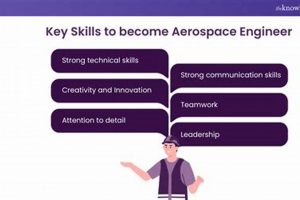
A strong foundation in mathematics, physics, and computer science is essential. Proficiency in computer-aided design (CAD) software, computational fluid dynamics (CFD), and finite element analysis (FEA) is also crucial. Problem-solving skills and the ability to work effectively in teams are equally important.
Question 4: How does the work of aerospace engineers impact society?
The work performed by these professionals contributes to advancements in transportation, communication, national defense, scientific exploration, and space exploration. These advancements enhance global connectivity, promote economic growth, and contribute to a better understanding of the universe.
Question 5: What are some common challenges faced by aerospace engineers?
Challenges include designing systems that can withstand extreme environments, meeting stringent performance requirements, managing complex integration issues, and mitigating safety risks. Ethical considerations also play a vital role in ensuring responsible development and deployment of aerospace technologies.
Question 6: What is the career outlook for aerospace engineers?
The demand for aerospace engineers is projected to grow as the aerospace industry continues to evolve. Opportunities exist in various sectors, including commercial aviation, space exploration, defense, and research and development. Continuous learning and adaptation to emerging technologies are essential for career advancement.
In summary, the work associated with aerospace engineering is multifaceted and critical to technological progress. Individuals interested in pursuing a career in this field should possess a strong aptitude for science, technology, engineering, and mathematics (STEM) and a desire to contribute to the advancement of air and space travel.
Further sections will delve into specific career paths, educational requirements, and emerging trends shaping the profession of aerospace engineering.
Conclusion
This exploration has clarified what specialists in aerospace engineering do, emphasizing their role in the design, development, testing, and production of aircraft, spacecraft, and related systems. Their proficiency in areas such as aircraft design, spacecraft development, systems integration, testing and analysis, materials research, and mission planning collectively contribute to the advancement of air and space technology.
The future of aerospace engineering is contingent upon continuous innovation and adaptation to emerging technologies. Further research and development efforts are essential to addressing global challenges and expanding the boundaries of human knowledge in air and space. Their expertise remains integral to ensuring continued progress and safety within this dynamic and crucial field.
![Top Aerospace Engineering Staffing Agencies | [Your Company] | Innovating the Future of Flight with Reliable Aviation Solutions](https://mixaerospace.com/wp-content/uploads/2026/04/th-293-300x200.jpg "Top Aerospace Engineering Staffing Agencies | [Your Company] Innovating the Future of Flight with Reliable Aviation Solutions")