Institutions offering specialized courses of study focused on the design, development, and testing of aircraft and spacecraft, and the principles underlying their operation, prepare students for careers in this dynamic field. These academic settings provide foundational knowledge and practical experience relevant to the aerospace industry. For example, a university with a robust curriculum in this area might offer courses in aerodynamics, propulsion systems, and space vehicle design, along with hands-on laboratory experiences.
Pursuing higher education in this discipline is crucial for individuals seeking to contribute to advancements in air and space travel, defense technologies, and related scientific endeavors. Access to qualified faculty, specialized facilities, and opportunities for research allows students to develop the necessary skills and knowledge. Historically, the growth of this area of study has been directly linked to advancements in aviation and space exploration, driven by both government and private sector initiatives.
The subsequent sections will examine factors to consider when evaluating potential institutions, typical curriculum components, career paths available to graduates, and the ongoing evolution of academic training in response to industry demands. These aspects provide a comprehensive overview for prospective students and professionals seeking to understand the landscape of higher education focused on flight and space.
Guidance for Selecting Programs in Aerospace Engineering
The selection of an appropriate institution for aerospace engineering studies requires careful consideration of multiple factors. This section provides guidance to prospective students navigating the application process.
Tip 1: Accreditation Verification: Ensure the program holds accreditation from ABET (Accreditation Board for Engineering and Technology). Accreditation signifies that the program meets established quality standards and is recognized by industry employers. Lack of accreditation may limit career prospects.
Tip 2: Faculty Expertise and Research: Research the faculty’s credentials, publications, and areas of specialization. Faculty actively engaged in cutting-edge research often provide students with enhanced learning opportunities and exposure to emerging technologies. Reviewing faculty profiles on department websites provides insights.
Tip 3: Available Resources and Facilities: Evaluate the availability of essential resources, such as wind tunnels, computational fluid dynamics (CFD) software, and advanced materials laboratories. Access to these resources allows for practical application of theoretical concepts and hands-on learning experiences.
Tip 4: Internship and Co-op Opportunities: Prioritize institutions that facilitate internships and cooperative education (co-op) programs with aerospace companies or government agencies. Practical experience gained through these opportunities significantly enhances employability upon graduation. Check career services websites for industry partnerships.
Tip 5: Curriculum Breadth and Depth: Analyze the curriculum to ensure it covers fundamental aerospace engineering principles, as well as specialized areas of interest, such as propulsion, aerodynamics, or spacecraft design. A balanced curriculum provides a strong foundation for diverse career paths. Course catalogs provide detailed information.
Tip 6: Location and Industry Connections: Consider the geographical location of the institution and its proximity to aerospace industry hubs. Schools located near major aerospace companies often provide increased opportunities for networking, internships, and post-graduation employment.
Tip 7: Financial Aid and Scholarships: Investigate available financial aid options, scholarships, and grants specific to aerospace engineering students. The cost of tuition and living expenses can be significant, and securing financial assistance is essential for many students.
Selecting a program requires a thorough evaluation of the available options. Considerations related to accreditation, faculty experience, resources, and career opportunities should inform the decision-making process.
Subsequent discussions will delve into specific aspects of aerospace engineering curricula and potential career trajectories for graduates.
1. Accreditation Standards
Accreditation standards serve as a critical benchmark for evaluating the quality and rigor of aerospace engineering programs. These standards, primarily established by organizations such as ABET (Accreditation Board for Engineering and Technology), provide a framework for ensuring that educational institutions meet defined criteria for curriculum content, faculty expertise, and resource availability.
- Curriculum Adequacy
Accreditation mandates that aerospace engineering curricula cover fundamental subjects such as aerodynamics, thermodynamics, structural analysis, propulsion, and control systems. The curriculum must also provide opportunities for students to engage in design projects and laboratory experiences. Programs lacking sufficient breadth and depth in these areas risk failing to meet accreditation requirements, thereby diminishing the value of the degree.
- Faculty Qualifications
Accredited programs must demonstrate that their faculty possess the necessary qualifications, including advanced degrees and relevant industry experience, to effectively teach and mentor students. Faculty should also be actively engaged in research and scholarly activities to remain current with advancements in the field. A lack of qualified faculty can negatively impact the quality of instruction and the program’s ability to attract and retain students.
- Resource Availability
Accreditation standards necessitate that institutions provide adequate resources to support aerospace engineering education, including well-equipped laboratories, computational facilities, and access to relevant software and equipment. Programs lacking sufficient resources may struggle to provide students with the hands-on experience and technical skills required for success in the aerospace industry.
- Continuous Improvement
Accredited programs are expected to engage in a process of continuous improvement, regularly assessing their performance and implementing changes to enhance the quality of education. This process involves soliciting feedback from students, faculty, and industry stakeholders, and using this feedback to inform curriculum revisions, faculty development activities, and resource allocation decisions. The absence of a robust continuous improvement process can lead to stagnation and a decline in program quality.
Meeting accreditation standards is paramount for colleges with aerospace engineering programs, as it signals to prospective students, employers, and the public that the program has met rigorous quality standards. Graduates of accredited programs are often viewed more favorably by employers and may be eligible for professional licensure. Furthermore, accreditation helps ensure that aerospace engineering programs are preparing students to meet the evolving needs of the aerospace industry.
2. Faculty Research

Faculty research forms a cornerstone of strong aerospace engineering programs. The presence of actively researching faculty members directly influences the quality and depth of education offered. When faculty are engaged in cutting-edge research, they infuse their coursework with current advancements, challenging students to think critically and innovatively. For example, a professor researching new materials for hypersonic vehicles may incorporate these emerging technologies into their materials science curriculum, providing students with exposure to state-of-the-art developments.
The significance of faculty research extends beyond the classroom. Research opportunities often provide students with invaluable hands-on experience. Students may participate in experiments, data analysis, and the development of new technologies under the guidance of experienced researchers. These experiences not only enhance their technical skills but also foster critical thinking, problem-solving abilities, and a deeper understanding of the scientific method. Furthermore, involvement in research projects can lead to publications in academic journals and presentations at conferences, which significantly strengthens their rsums and enhances their prospects for future employment or graduate studies. Consider the case of a university where faculty research focuses on sustainable aviation fuels. Students participating in this research gain expertise in areas of growing importance in the aerospace industry, such as renewable energy and environmental sustainability.
In summary, the level of faculty research is a critical factor when evaluating institutions with aerospace engineering programs. Strong faculty research contributes to a dynamic curriculum, provides students with valuable research experience, and positions graduates for success in a rapidly evolving field. Institutions that prioritize and support faculty research are likely to offer a more enriching and relevant educational experience, ensuring graduates are well-prepared to contribute to the advancement of aerospace technology.
3. Curriculum Depth

Curriculum depth within aerospace engineering programs represents the level of detail and specialization offered in the coursework. It is a critical determinant of a program’s ability to prepare graduates for advanced engineering roles and research opportunities. The depth of the curriculum directly influences a graduate’s capacity to address complex challenges in the aerospace sector.
- Core Engineering Principles
A robust aerospace engineering curriculum extends beyond introductory concepts to provide in-depth coverage of core engineering principles. This includes advanced topics in fluid dynamics, propulsion systems, structural mechanics, and control theory. A program demonstrating curriculum depth might offer specialized courses in areas such as computational fluid dynamics for compressible flows or advanced composite materials for aerospace structures. The absence of in-depth coverage of core principles limits a graduate’s capacity to analyze and design complex aerospace systems.
- Specialized Electives and Concentrations
Institutions with programs demonstrating curriculum depth offer a diverse range of specialized electives and concentrations. These options allow students to tailor their education to specific areas of interest within aerospace engineering, such as space systems engineering, aircraft design, or autonomous systems. The availability of such electives provides students with the opportunity to develop specialized knowledge and skills, making them more competitive for specific career paths or advanced research opportunities. A limited selection of electives may restrict a student’s ability to pursue their specific interests within the field.
- Advanced Mathematics and Computational Methods
Curriculum depth necessitates a strong emphasis on advanced mathematics and computational methods. This includes coursework in differential equations, linear algebra, numerical analysis, and computational modeling techniques. Aerospace engineers require a strong mathematical foundation to analyze complex systems and develop accurate models. The curriculum should integrate computational tools and techniques to enable students to solve realistic engineering problems. Deficiencies in mathematical training limit a graduate’s capacity to perform advanced analyses and simulations.
- Design and Research Opportunities
A deep curriculum integrates significant design and research opportunities throughout the program. This includes capstone design projects, independent research projects, and participation in undergraduate research programs. These opportunities allow students to apply their knowledge and skills to real-world problems and contribute to the advancement of aerospace technology. Programs with limited design and research opportunities may not adequately prepare students for the challenges of engineering practice or advanced research.
The depth of the curriculum is a key differentiator among colleges offering programs in aerospace engineering. Institutions committed to providing comprehensive and rigorous training emphasize advanced coursework, specialized electives, mathematical proficiency, and hands-on design and research experiences. These elements, collectively, contribute to producing graduates who are well-prepared to excel in the diverse and demanding aerospace industry. Conversely, programs lacking curriculum depth may leave graduates inadequately prepared for the complexities of modern aerospace engineering.
4. Facilities
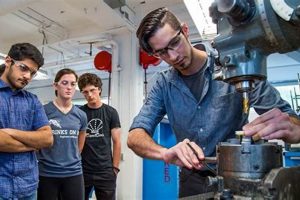
Specialized facilities represent a core component of any institution offering aerospace engineering programs. The availability and quality of these resources directly impact the educational experience and practical preparedness of students. Adequate facilities are not merely a convenience; they constitute an essential element of effective aerospace engineering training. The absence of suitable resources impairs students’ capacity to translate theoretical knowledge into practical skills and limits their exposure to the complexities of the field. For instance, an aerospace engineering program without a wind tunnel restricts students’ ability to conduct experiments on aerodynamic principles, forcing reliance on theoretical models alone. Similarly, the lack of a composites laboratory limits opportunities for hands-on experience with advanced materials crucial in modern aircraft and spacecraft design.
The influence of facilities extends beyond basic experimentation. Advanced facilities, such as flight simulators, propulsion testing facilities, and satellite ground stations, enable students to engage in complex projects that mirror real-world engineering challenges. Institutions with access to high-performance computing clusters can offer courses in computational fluid dynamics and finite element analysis, preparing students for careers involving sophisticated modeling and simulation techniques. Moreover, facilities often serve as focal points for research collaborations between faculty and students, leading to advancements in aerospace technology. A university with a dedicated space systems laboratory, for example, might involve students in the design, construction, and testing of small satellites, providing invaluable experience in space mission development.
In conclusion, the quality and availability of specialized facilities are inextricably linked to the effectiveness of aerospace engineering programs. These resources enhance learning, enable practical application of knowledge, and foster research collaboration. Therefore, prospective students should carefully evaluate the facilities offered by an institution to determine its capacity to provide a comprehensive and relevant aerospace engineering education. The presence of state-of-the-art facilities signals a commitment to providing students with the tools necessary to succeed in the dynamic and demanding aerospace industry.
5. Industry Connections

The strength of industry connections constitutes a critical element in the evaluation of aerospace engineering programs. These connections serve as a conduit between academic learning and real-world application, significantly impacting the quality and relevance of education. Direct ties with aerospace companies, government agencies, and research institutions enhance the practical preparedness of graduates, offering pathways to internships, research collaborations, and employment opportunities. A program lacking robust industry engagement risks isolating students from the evolving demands of the aerospace sector.
The benefits of robust industry connections are multifaceted. Internship programs within aerospace companies provide students with invaluable hands-on experience, allowing them to apply theoretical knowledge to real-world engineering challenges. Cooperative education programs, which alternate periods of academic study with periods of full-time employment, offer extended exposure to the industry and often lead to full-time employment upon graduation. Further, collaborative research projects between faculty and industry partners contribute to the advancement of aerospace technology while providing students with opportunities to work on cutting-edge projects under the guidance of experienced professionals. For example, a university partnered with a major aerospace manufacturer might offer students the chance to participate in the design and testing of new aircraft components, gaining practical skills directly applicable to industry needs. Similarly, collaboration with government agencies, such as NASA or the FAA, can expose students to critical research and development efforts in space exploration and air traffic management.
In conclusion, the degree to which aerospace engineering programs cultivate and maintain strong industry connections is a key indicator of their overall effectiveness. These connections enhance the curriculum, provide students with practical experience, and improve their employment prospects. Therefore, prospective students should carefully evaluate the industry partnerships and engagement opportunities offered by an institution when considering programs in aerospace engineering, recognizing the critical role these connections play in bridging the gap between academia and the professional world.
6. Graduate Outcomes

Graduate outcomes represent a tangible measure of the effectiveness of academic institutions offering aerospace engineering programs. These outcomes, encompassing employment rates, salary levels, and career advancement, provide prospective students and stakeholders with valuable insights into the real-world impact of a particular educational experience. Examination of graduate outcomes allows for a comparative assessment of various programs and their ability to prepare students for successful careers in the aerospace industry.
- Employment in Aerospace-Related Fields
The percentage of graduates employed in aerospace engineering or related fields, such as aviation, defense, or space exploration, constitutes a primary indicator of program success. High employment rates suggest that the curriculum aligns with industry needs and that graduates possess the requisite skills and knowledge. Institutions actively cultivate relationships with aerospace companies to facilitate internship and job placement opportunities, directly impacting graduate employment rates. For example, a program with strong ties to Boeing or NASA might exhibit higher placement rates than one without such connections.
- Entry-Level Salary and Compensation Packages
Entry-level salary and compensation packages serve as quantifiable measures of the economic value of an aerospace engineering degree. Graduates from programs with strong industry recognition and a rigorous curriculum typically command higher starting salaries. Furthermore, benefits such as health insurance, retirement plans, and stock options contribute to the overall compensation package, reflecting the demand for qualified aerospace engineers. Analysis of salary data provides insights into the perceived value of graduates from different institutions.
- Acceptance into Graduate Programs
The percentage of graduates accepted into advanced degree programs, such as master’s or doctoral studies in aerospace engineering or related disciplines, indicates the program’s effectiveness in preparing students for research and academic careers. Institutions with a strong research focus and a challenging curriculum often produce graduates who are well-prepared for graduate-level studies. Acceptance into prestigious graduate programs signifies the quality of undergraduate preparation and the students’ potential for advanced research and development.
- Career Advancement and Leadership Roles
Longitudinal analysis of graduate career trajectories provides insights into the program’s impact on career advancement and leadership development. Graduates who progress to leadership positions within aerospace companies or government agencies demonstrate the value of their education in fostering professional growth and strategic thinking. Assessment of alumni achievements, such as patents, publications, and awards, further highlights the program’s influence on innovation and leadership within the aerospace community.
In summary, graduate outcomes provide a comprehensive assessment of the effectiveness of aerospace engineering programs, encompassing employment rates, salary levels, acceptance into graduate programs, and career advancement. These outcomes serve as valuable metrics for prospective students and stakeholders seeking to evaluate the return on investment in aerospace engineering education, ultimately influencing institutional rankings and program reputation.
Frequently Asked Questions
This section addresses common inquiries regarding institutions offering specialized curricula in aerospace engineering. The information presented aims to clarify key aspects and considerations for prospective students.
Question 1: What constitutes an ABET-accredited aerospace engineering program, and why is it important?
ABET accreditation signifies that a program meets established quality standards for engineering education. It assures prospective students and employers that the curriculum is rigorous, the faculty is qualified, and the program provides adequate resources for students to succeed. Graduates of non-accredited programs may encounter limitations in licensure and employment opportunities.
Question 2: How significant is the location of a college in relation to aerospace industry hubs?
Colleges situated near major aerospace industry centers often provide students with enhanced opportunities for internships, cooperative education programs, and networking with industry professionals. Proximity to industry hubs can also facilitate access to research collaborations and post-graduation employment prospects.
Question 3: What essential resources and facilities should prospective students look for when evaluating aerospace engineering programs?
Key resources and facilities include wind tunnels for aerodynamic testing, computational fluid dynamics (CFD) software for simulations, materials testing laboratories for structural analysis, and propulsion testing facilities for engine research. Access to these resources enables practical application of theoretical concepts and enhances hands-on learning experiences.
Question 4: How can prospective students assess the quality and expertise of the faculty in an aerospace engineering program?
Prospective students should review faculty profiles on department websites, focusing on their academic credentials, research publications, and areas of specialization. Faculty actively engaged in cutting-edge research and scholarly activities often provide students with enhanced learning opportunities and exposure to emerging technologies.
Question 5: What types of career paths are typically available to graduates of aerospace engineering programs?
Graduates may pursue careers in aircraft design, spacecraft development, propulsion systems engineering, aerodynamics, flight controls, avionics, and related fields. Opportunities exist within aerospace companies, government agencies (such as NASA and the Department of Defense), research institutions, and consulting firms.
Question 6: How do aerospace engineering programs adapt to the constantly evolving technological landscape of the aerospace industry?
Programs continually update their curriculum to incorporate new technologies, materials, and computational methods. Engagement with industry advisory boards, faculty participation in research and development, and integration of emerging technologies into coursework are essential for maintaining relevance in this dynamic field.
Selecting an aerospace engineering program requires careful consideration of accreditation, location, resources, faculty expertise, career opportunities, and curriculum relevance. Thorough research and evaluation are crucial for making an informed decision.
The succeeding section will summarize key considerations for prospective students and offer actionable guidance for navigating the college selection process.
Colleges with Aerospace Engineering Programs
This examination of colleges with aerospace engineering programs has highlighted several critical factors for consideration. Accreditation standards, faculty research, curriculum depth, facilities, industry connections, and graduate outcomes collectively define the quality of these academic institutions. Each element contributes to the preparation of students for successful careers in a demanding and evolving field. A balanced approach, integrating rigorous academic training with practical experience, is paramount.
The selection of a suitable institution requires careful deliberation, weighing individual academic goals against the resources and opportunities offered. Continued advancements in aerospace technology necessitate a commitment to lifelong learning and professional development. Prospective students are encouraged to conduct thorough research and engage with current students and faculty to make informed decisions, thereby contributing to the future of aerospace innovation.